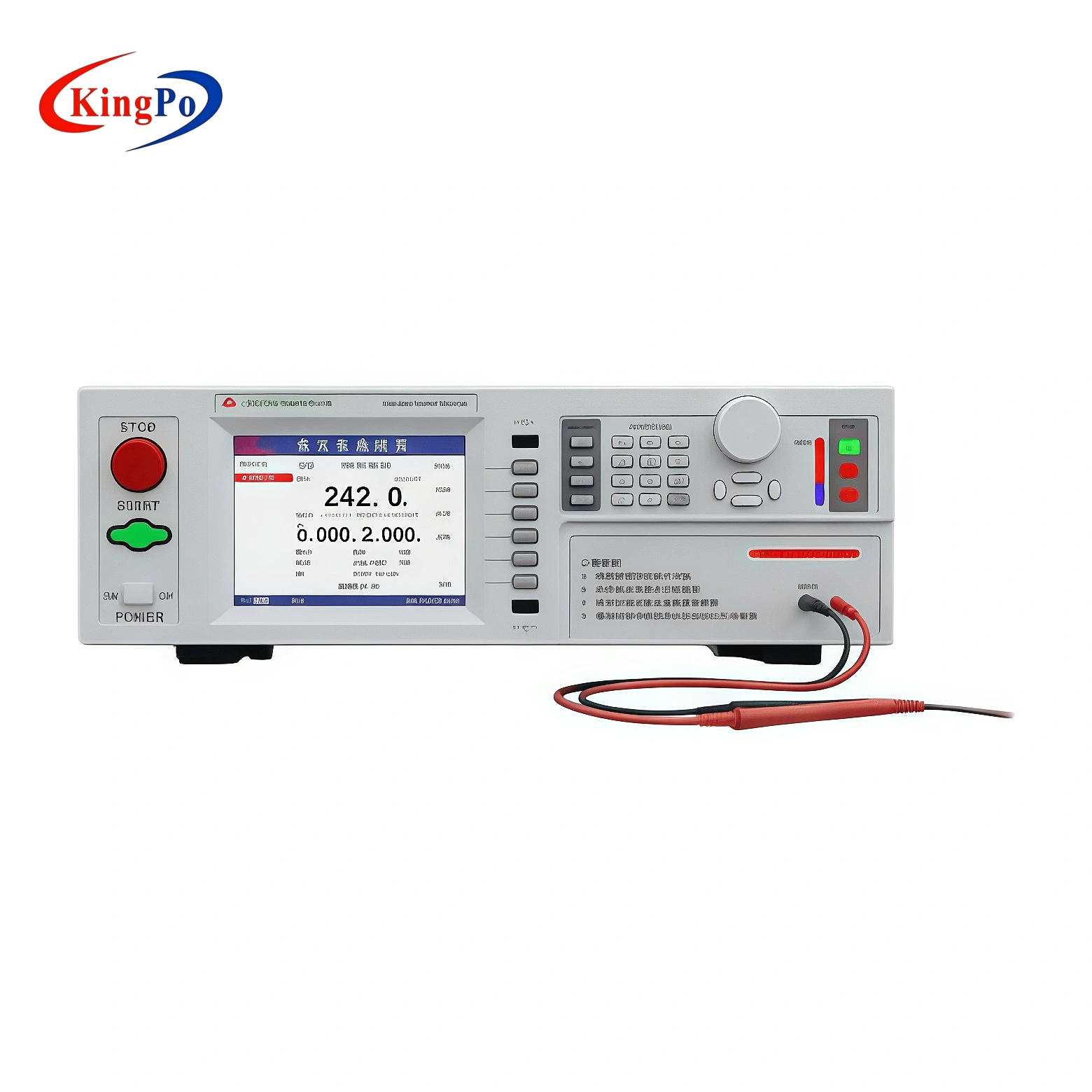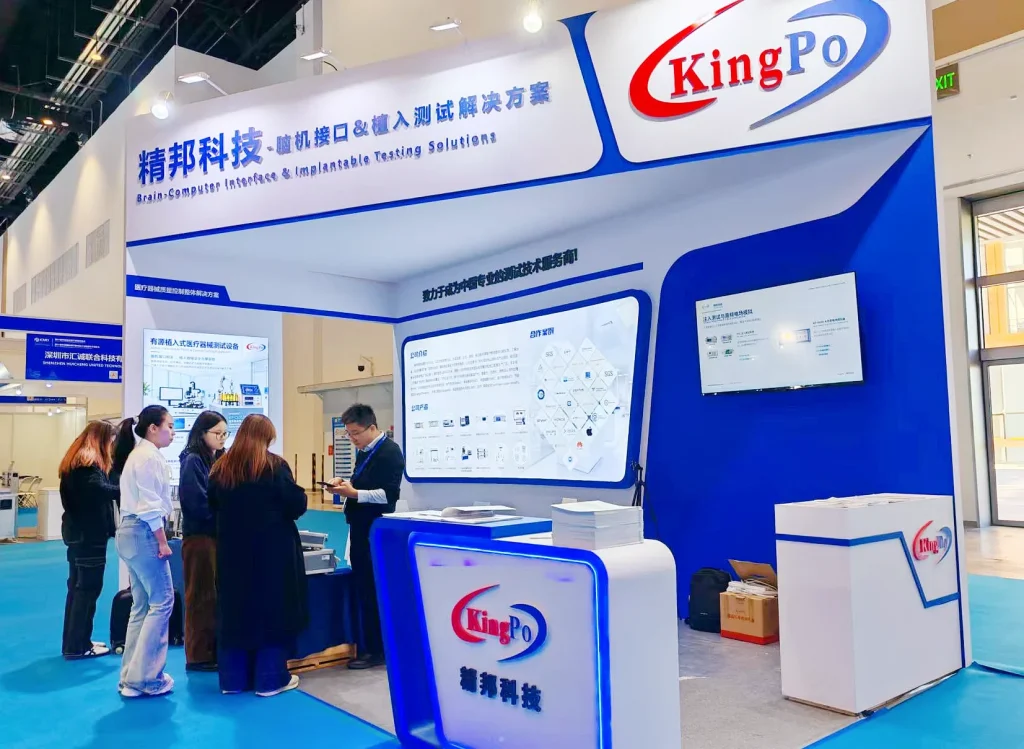
| Beijing, China | October 21–24, 2026
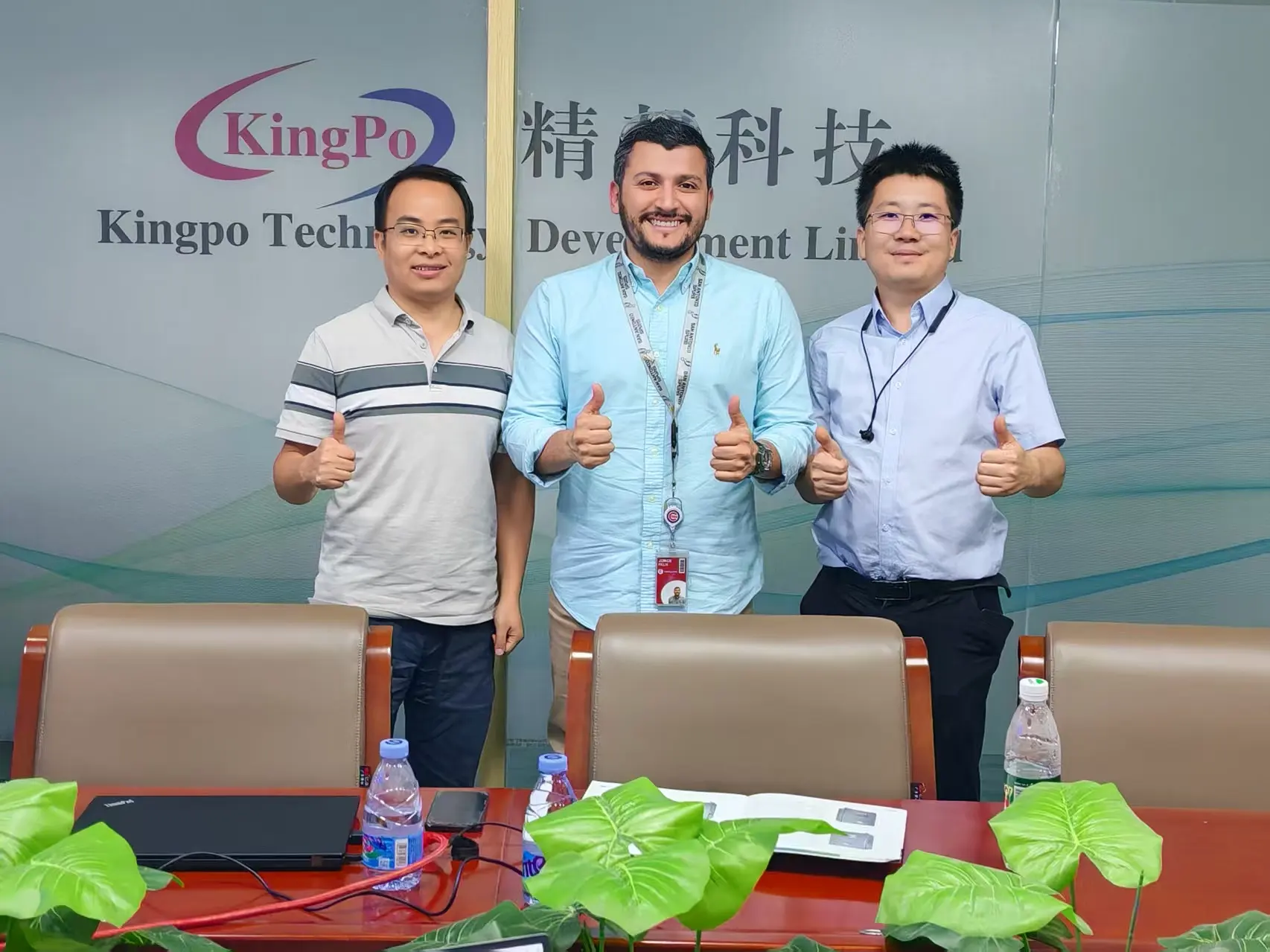
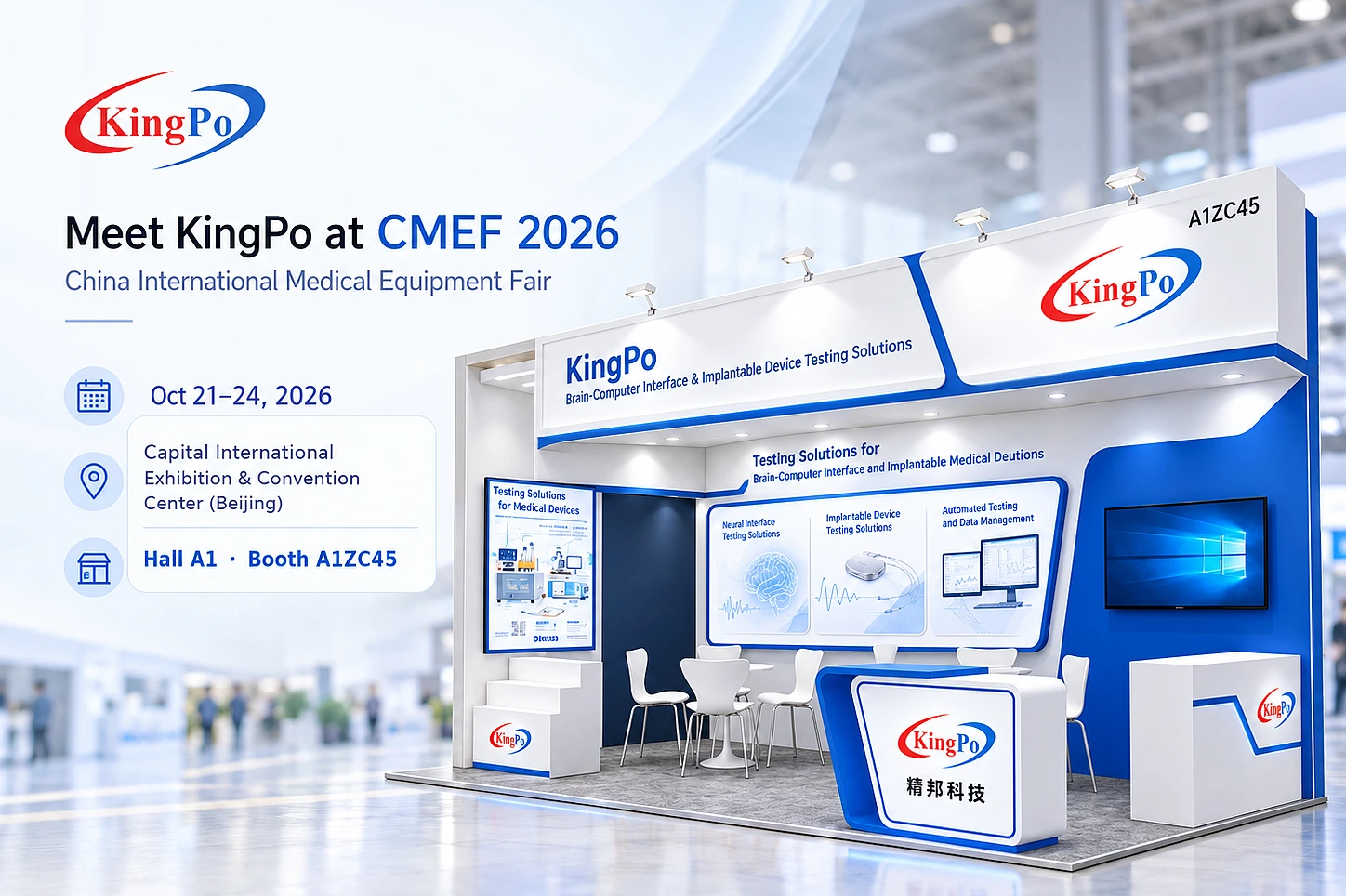
Following our CMEF 2026 pre-show announcement, KINGPO successfully participated in the 94th China International Medical Equipment Fair (CMEF 2026), held in Beijing from October 21 to 24, 2026.
At Booth A1ZC45, KINGPO presented specialized testing equipment and integrated laboratory solutions for active implantable medical devices, brain-computer interfaces (BCIs) and related medical technologies.
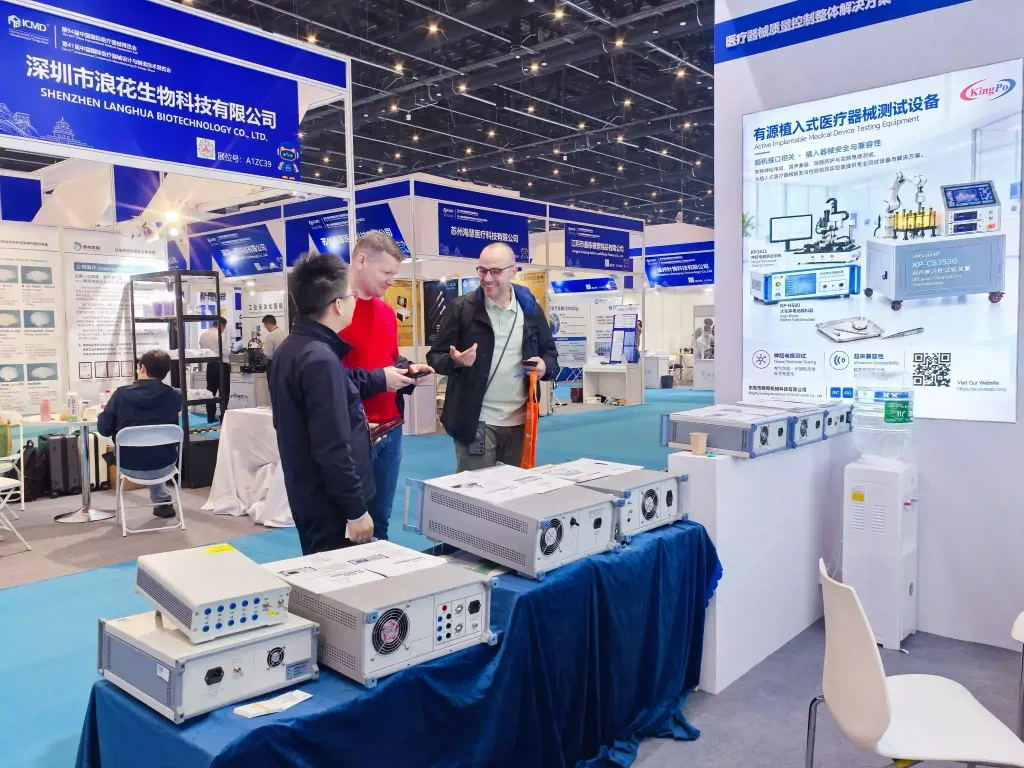
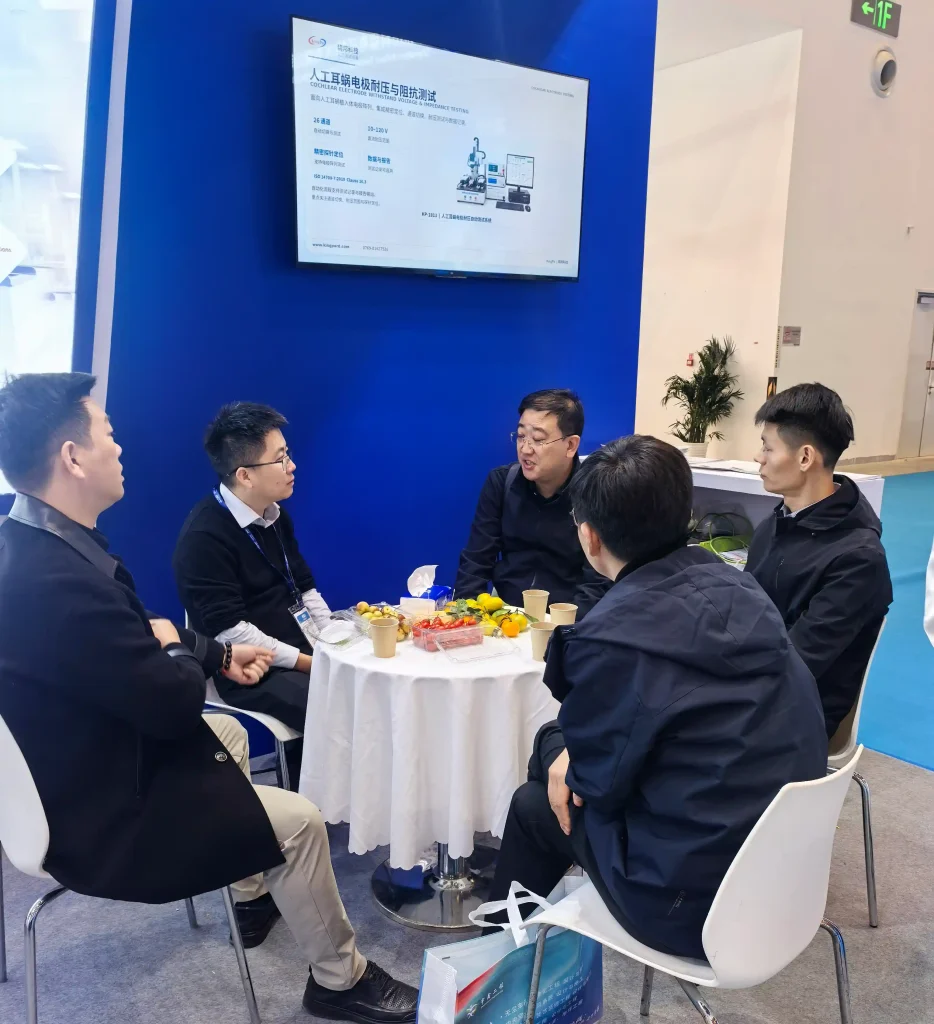
Throughout the exhibition, visitors and industry professionals came to the KINGPO booth to explore our testing equipment, learn about different testing applications and discuss practical requirements with our engineering team. These conversations covered a wide range of subjects, including implantable device safety, electrode testing, electromagnetic compatibility, energy transfer and specialized laboratory configurations.
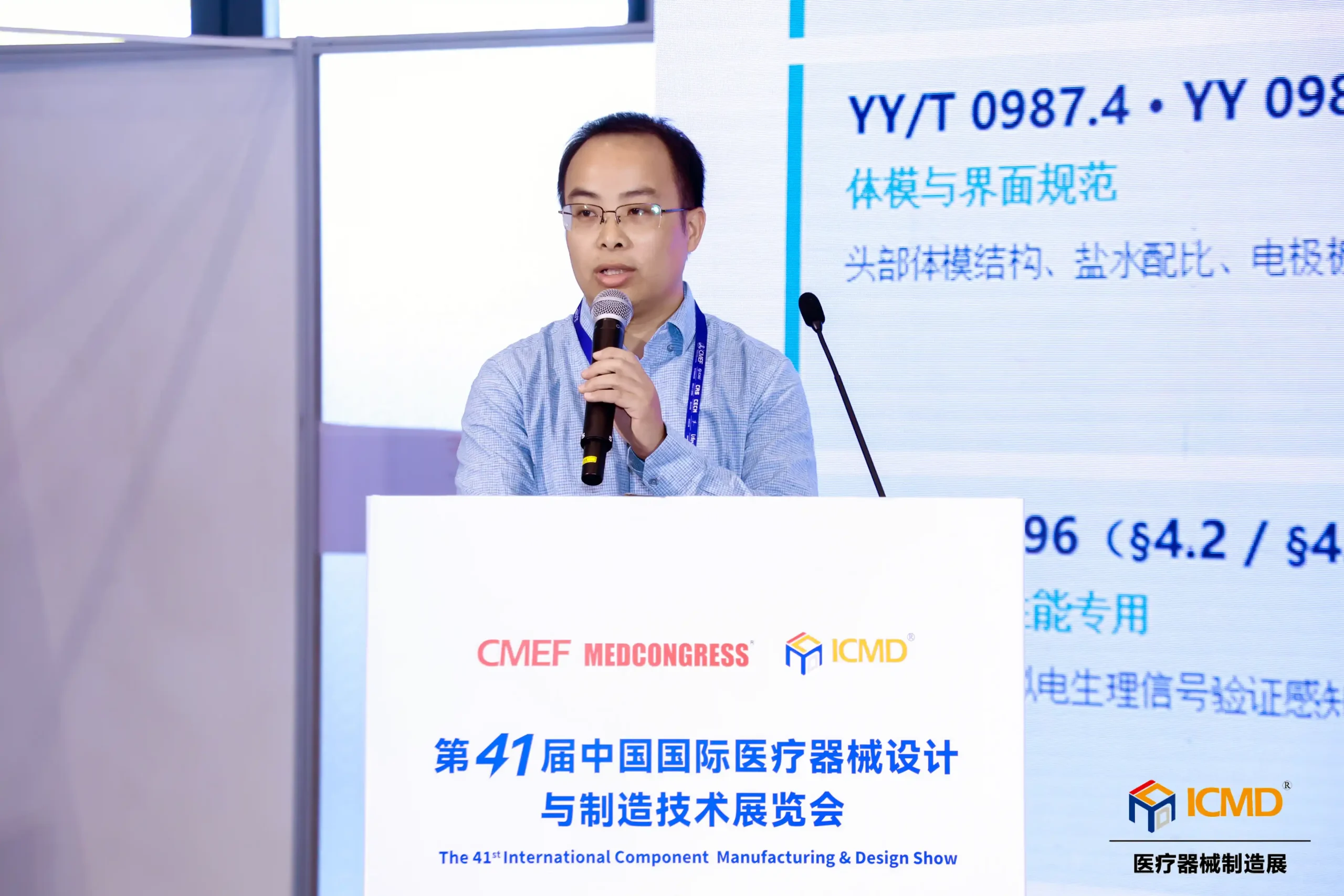
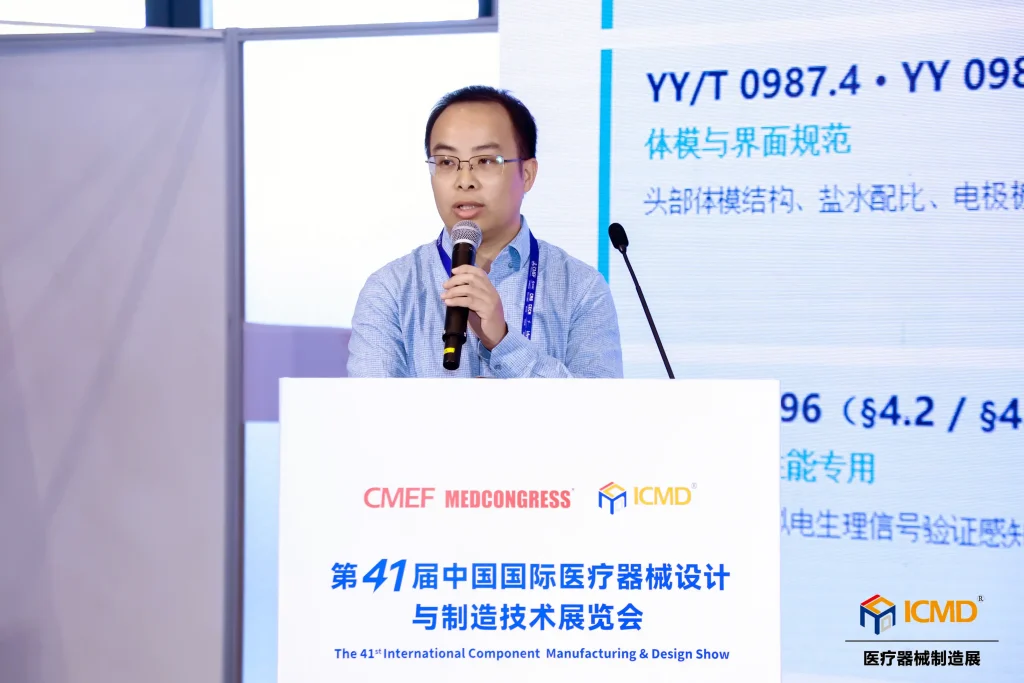
An important highlight of KINGPO’s participation was a technical presentation on Integrated Testing Solutions for Implantable Brain-Computer Interfaces, which explored how international standards can be translated into practical testing procedures, equipment configurations and reproducible measurement results.
The presentation introduced a comprehensive framework covering four major testing domains, 21 categories of specialized equipment and more than ten relevant testing requirements.
- Exhibition Highlights: Implantable Medical Device Testing Solutions
- Technical Presentation: From International Standards to Reproducible Testing
- International Standards Framework
- Four Major Testing Domains and Specialized Equipment
- Integrated Testing Architecture and Laboratory Implementation
- KINGPO’s Engineering and Manufacturing Capabilities
- Looking Ahead
Exhibition Highlights: Implantable Medical Device Testing Solutions
At CMEF 2026, KINGPO focused on the growing testing requirements associated with active implantable medical devices and emerging brain-computer interface technologies.
Our exhibition display introduced equipment and technical solutions for several important testing applications, including:
- Implantable brain-computer interface performance verification.
- Neural electrode electrical and insulation testing.
- Transcutaneous energy transfer measurement.
- Implantable device electromagnetic compatibility testing.
- Defibrillation and ultrasound compatibility evaluation.
- Mechanical reliability and environmental testing.
- MRI-related safety assessment.
Visitors had the opportunity to learn about the testing principles behind these systems, examine the equipment configurations and discuss how different instruments can be combined to address specific laboratory requirements.
For manufacturers and testing laboratories, implantable medical device evaluation involves more than checking individual electrical parameters. The testing arrangement must also consider electrode interfaces, tissue-equivalent models, external energy exposure, mechanical loading and the operating conditions of the implantable system.
KINGPO’s approach is to connect these requirements through specialized instruments, customized fixtures, automated test procedures and coordinated data acquisition.
Technical Presentation: From International Standards to Reproducible Testing
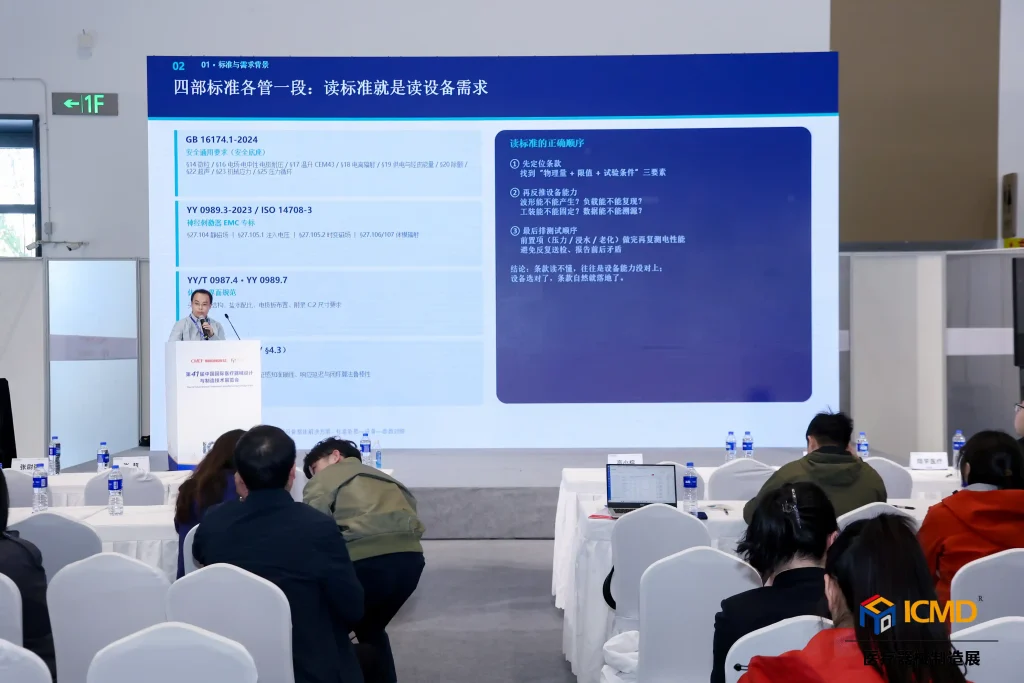
A major technical highlight of the exhibition was KINGPO’s presentation on implantable BCI testing equipment and integrated laboratory solutions.
The presentation examined the relationship between international standards, test requirements, equipment capabilities and practical laboratory implementation.
Rather than treating each requirement as an isolated test, KINGPO introduced a structured approach:
- Identify the standard requirement: Determine the relevant physical quantities, limits and specified test conditions.
- Define the test method: Establish how the required exposure, measurement or performance evaluation should be performed.
- Configure the equipment: Select appropriate instruments, fixtures, loads, phantoms and interfaces.
- Establish data traceability: Record test conditions, measurement results and evaluation records for subsequent review.
Three fundamental engineering questions formed the basis of the testing methodology.
Is the signal reliable?
Standardized virtual electrophysiological signals provide controlled reference inputs for evaluating signal acquisition, sensing accuracy and closed-loop response.
By controlling signal amplitude, frequency and noise characteristics, laboratories can reduce variations between test runs and obtain more comparable measurement results.
Is the delivered energy safe?
Implantable devices may involve battery-powered operation, transcutaneous energy transfer, thermal exposure and electrical interactions with surrounding tissues.
Temperature rise, CEM43 thermal assessment, energy transmission efficiency, particle release and radiation measurements are among the factors that need to be considered when evaluating potential safety risks.
Can the device withstand external interference?
Implantable medical devices may be exposed to external electromagnetic fields, defibrillation, ultrasound and high-frequency electrosurgical equipment during clinical use.
Appropriate test systems, controlled exposure conditions and tissue-equivalent models are required to investigate potential interference and evaluate the resulting device response.
These questions lead to four interconnected testing domains: closed-loop performance, safety and environmental reliability, external energy compatibility, and electromagnetic compatibility.
International Standards Framework for Implantable Medical Device Testing
KINGPO’s testing framework is based primarily on the ISO 14708 series, supplemented by internationally recognized MRI safety and brain-computer interface reference documents.
The following standards provide the main technical references for the applications introduced during the presentation.
ISO 14708-1:2014 – General Requirements for Active Implantable Medical Devices
ISO 14708-1:2014 establishes general requirements for the safety, marking and manufacturer-provided information of active implantable medical devices.
It provides the general safety framework for evaluating implantable devices, including requirements associated with electrical safety, environmental exposure, mechanical integrity, power supply and device performance.
The relevant testing areas covered by the KINGPO presentation include:
- Particle release and material-related safety.
- Electrical field exposure and electrode insulation.
- Temperature rise and thermal injury assessment.
- Ionizing radiation measurement.
- Battery-powered operating conditions.
- Transcutaneous energy transfer.
- Protection against external defibrillation.
- Ultrasound exposure.
- Mechanical stress and pressure cycling.
This standard provides the general reference framework for the safety and reliability testing configurations presented by KINGPO.
ISO 14708-3:2017 – Implantable Neurostimulators
ISO 14708-3:2017 specifies particular requirements for active implantable medical devices intended to electrically stimulate the central or peripheral nervous system.
It is particularly relevant to implantable neural stimulation systems and brain-computer interface devices incorporating implanted neurostimulation functions.
The electromagnetic compatibility requirements addressed in the presentation include:
- Clause 27.104: Static magnetic field exposure.
- Clause 27.105.1: Injected voltage testing.
- Clause 27.105.2: Time-varying magnetic field exposure.
- Clauses 27.106 and 27.107: Phantom-based electromagnetic radiation testing configurations.
These requirements form the basis for configuring static magnetic field systems, injected voltage systems, time-varying magnetic field equipment, tissue-equivalent models and radiation monitoring arrangements.
ISO 14708-7:2019 – Cochlear and Auditory Brainstem Implant Systems
ISO 14708-7:2019 specifies particular requirements for active implantable devices intended to treat hearing impairment through electrical stimulation of the auditory pathways.
It provides an additional reference for cochlear implant and auditory brainstem implant testing applications.
For laboratories working with implantable electrodes and related stimulation systems, this standard is relevant when selecting appropriate electrical measurement methods, electrode configurations and specialized test fixtures.
MRI Safety Assessment for Active Implantable Devices
MRI compatibility requires a dedicated assessment framework because active implantable devices may interact with the static magnetic field, radiofrequency field and gradient magnetic fields of an MR system.
The principal international reference for this application is:
This technical specification addresses the interaction between active implantable medical devices and MRI environments. Its published scope includes testing in 1.5 T cylindrical-bore MRI systems operating at approximately 64 MHz with whole-body coil excitation.
The assessment considers:
- Magnetically induced displacement force and torque.
- Radiofrequency-induced temperature rise.
- Induced voltage and electromagnetic interactions.
- Device operating behaviour under specified MRI conditions.
For passive implants, ASTM F2182-19e2 – Standard Test Method for Measurement of Radio Frequency Induced Heating On or Near Passive Implants During Magnetic Resonance Imaging provides a related international test method.
These two documents address different device categories and should not be treated as interchangeable. ISO/TS 10974 is the relevant reference for active implantable medical devices, while ASTM F2182 addresses RF-induced heating on or near passive implants.
International BCI Terminology and System Architecture
In addition to medical implant standards, two recently published international documents provide useful background for the broader BCI technology field:
- ISO/IEC 8663:2025 – Information Technology: Brain-Computer Interfaces – Vocabulary defines terminology and concepts used in BCI systems, including signal processing, feedback, stimulation and related hardware.
- ISO/IEC 27572:2026 – Information Technology: Brain-Computer Interfaces – Reference Architecture describes the general reference architecture of BCI systems, including their characteristics, functions and implementation categories.
These documents provide terminology and architectural references. They are not substitutes for medical-device safety standards or specialized implantable BCI performance test methods.
For closed-loop sensing and response performance in implantable neurostimulators, no directly equivalent published ISO/IEC test method was identified for the specific procedures presented here. KINGPO therefore presents its standardized signal-generation and performance-evaluation workflow as a specialized engineering solution rather than claiming conformity with an international test method that has not been established.
For further technical reference, visit KINGPO’s International Standards and Testing Equipment Guides.
Four Major Testing Domains and Specialized Equipment
The proposed implantable BCI testing solution connects international standard requirements with specific test functions, specialized instruments and corresponding measurement capabilities.
A. Closed-Loop Performance Testing
Representative Equipment: KP-EEG10 Brain-Computer Interface Closed-Loop Performance Tester
Performance verification is essential for evaluating whether an implantable BCI system can reliably acquire physiological signals, process information and respond through its intended stimulation or feedback mechanism.
The KP-EEG10 is designed around standardized virtual electrophysiological signal generation and closed-loop performance evaluation.
Supported signal types include:
- EEG – Electroencephalography.
- ECG – Electrocardiography.
- EOG – Electrooculography.
- EMG – Electromyography.
- Spike – Neural spike signals.
- LFP – Local field potentials.
- ECoG – Electrocorticography.
The system provides controlled signal inputs for evaluating sensing accuracy, signal stability, signal processing and response behaviour under different test conditions.
| Parameter | Technical Specification |
|---|---|
| Signal amplitude range | 30 μV–10 mV |
| Amplitude resolution | ≤1 μV |
| Amplitude accuracy | ±0.1% FS |
| Noise level | <500 nV |
| Output channels | 8 channels, expandable to 64 |
| Sampling rate | ≥1 MHz |
| Resolution | ≥16 bit |
| Output frequency | DC–150 kHz |
| Waveform types | Sine / Sqrt / Pulse / Noise / Arbitrary |
| Arbitrary waveform length | 20 Mpts |
| External triggering | TTL supported |
The system provides a consistent signal source for engineering evaluation of sensing performance and closed-loop stimulation response.
By applying repeatable input signals and recording the resulting device behaviour, laboratories can investigate signal decoding accuracy, response timing and performance under different physiological signal conditions.
B. Safety and Environmental Reliability Testing
Representative Equipment: KP1811, KP3100, KP-5590 and KP-8103A
Implantable devices are expected to maintain their safety and performance under long-term electrical, thermal, mechanical and environmental stresses.
KINGPO’s proposed testing configuration covers several important aspects of implantable device reliability.
Electrode and Lead Insulation Testing – KP1811
Electrode insulation is a critical safety consideration for implantable neurostimulation systems.
The KP1811 electrode withstand voltage automatic tester is designed to evaluate the insulation performance of electrode leads and related electrical connections under specified test conditions.
The testing process includes fixture positioning, channel selection, voltage application, leakage monitoring and automatic breakdown detection.
| Parameter | Technical Specification |
|---|---|
| Output channels | 32-channel automatic switching |
| Test voltage | 10–120 V, continuously adjustable |
| Insulation resistance range | 1 kΩ–10 TΩ |
| Test method | Individual channel testing |
| Protection | Automatic shutdown upon breakdown or flashover |
| Data interface | USB / RS485 |
| Fixture configuration | Customized cortical, deep-brain and cochlear electrode fixtures |
The system supports individual electrode and channel evaluation, with test records available for subsequent analysis.
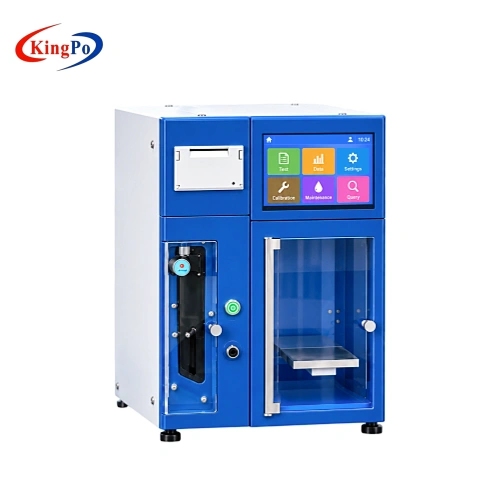
For laboratories evaluating particulate matter released from cochlear implant systems, KINGPO’s KP-MP500D liquid particle counter for ISO 14708-7:2019 Clause 14.2 testing supports quantitative particle analysis under controlled sample preparation and measurement conditions.
Particle Release, Thermal Injury and Radiation Assessment
Implantable medical device safety also involves evaluating potential particle release, temperature rise and radiation exposure.
The proposed testing configuration includes:
- Particle measurement range: 1–500 μm.
- Configurable thresholds: 5 / 10 / 25 μm.
- Concentration range: 0–10,000 particles/mL.
- Repeatability: RSD ≤2%.
- Accuracy: ±5%.
- Minimum sample volume: 0.1 mL.
- Temperature range: -10°C to 55°C.
- Temperature fluctuation: ±2°C.
- 16-channel temperature monitoring.
- Temperature resolution: 0.1°C.
- Real-time CEM43 calculation and curve display.
- Energy range: 48 keV–3 MeV.
- Sensitivity: 8,000 cpm/mR/h.
- Protection rating: IP65.
- Battery operation: up to 24 hours.
These measurement functions support the evaluation of different potential safety risks associated with implantable device operation.
Battery and Transcutaneous Energy Transfer Testing – KP3100
Battery reliability and wireless energy transmission are important considerations for active implantable medical devices.
The proposed battery reliability system supports eight-channel charging and discharging cycles, with programmable operating modes and environmental testing capabilities.
The KP3100 transcutaneous energy transfer testing system is designed to evaluate energy transmission efficiency under different positioning and alignment conditions.
Battery Testing Configuration
| Parameter | Technical Specification |
|---|---|
| Channels | 8 |
| Voltage range | 0.010–5.000 V |
| Current accuracy | ±0.1% |
| Charging modes | Constant voltage / CC-CV / constant power |
| Environmental chamber | ≥60 L |
| Temperature range | -10°C to 55°C |
KP3100 Transcutaneous Energy Transfer System
| Parameter | Technical Specification |
|---|---|
| Positioning configuration | Four degrees of freedom |
| Angular range | 0–90°, accuracy ±1° |
| Displacement range | 0–100 mm |
| Displacement resolution | 0.1 mm |
| Temperature channels | 9 |
| Temperature range | -20°C to 100°C |
| Temperature accuracy | ±0.3°C |
| Water bath stability | ±1°C |
| Software interface | Open API |
The system evaluates the relationship between alignment deviation, energy transfer efficiency and temperature rise.
This is particularly important when investigating the effects of angular misalignment, vertical displacement and horizontal offset on the performance of transcutaneous energy transmission systems.
Mechanical Stress and Pressure Cycling
Mechanical loading is another important consideration for long-term implantable device reliability.
The KP-5590 mechanical stress testing suite is designed for pulling, swinging and impact-related evaluation of implantable components and electrode leads.
Its presented configuration includes:
- Pulling force range: 0.5–10 N.
- Force resolution: ≤0.01 N.
- Force accuracy: ≤0.3%.
- Length measurement accuracy: ≤100 μm.
- Single-side swing angle: 0–45°.
- Swing cycling: ≥100,000 cycles.
- Mechanical cycling frequency: ≥2 Hz.
- Optional 37°C constant-temperature water bath.
The KP-8103A pressure cycling testing system is designed for evaluating the response of implantable devices under specified pressure conditions.
Key Technical Specifications
| Parameter | Technical Specification |
|---|---|
| Maximum pressure | ≥304 kPa |
| Pressure cycles | 40 cycles |
| Pressure change rate | ≥152 kPa/min |
| Pressure holding condition | 150 ±7.5 kPa absolute pressure for ≥1 hour |
| Water chamber capacity | ≥500 mL |
| Recording | Pressure-time curves and cycle records |
These testing configurations help laboratories evaluate the effects of mechanical loading and pressure variation before conducting subsequent electrical and functional verification.
C. External Energy Compatibility Testing
Representative Equipment: KP-1050S / KP-1050T, KP-CS3530, KP-H500 and HL17-500
Implantable devices may encounter different external energy sources during medical procedures.
Defibrillation, ultrasound, electrosurgical exposure and magnetic fields can affect implanted components and their associated electrical systems. Dedicated testing arrangements are therefore required to investigate potential interference and functional changes.
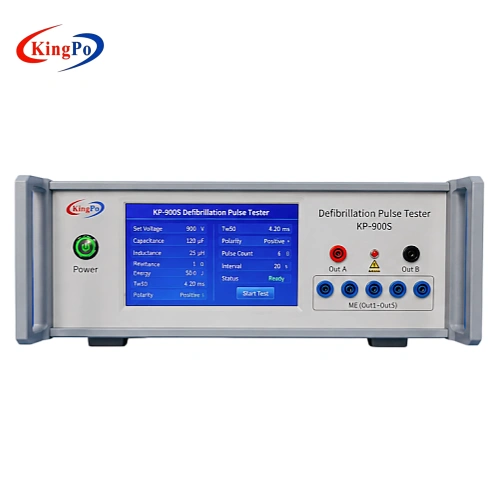
Defibrillation Compatibility Testing – KP-1050S / KP-1050T
For implantable devices with relevant thoracic components, external defibrillation exposure requires particular attention.
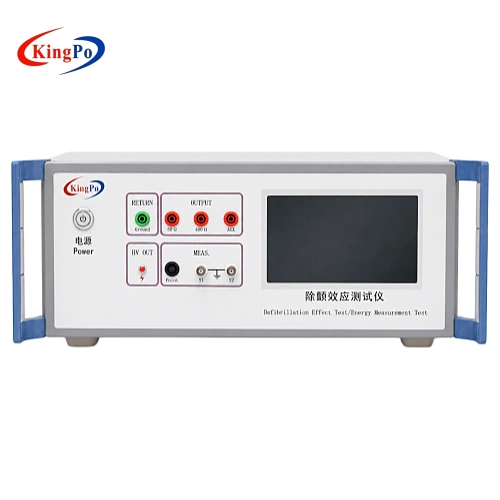
The KP-1050S / KP-1050T systems are designed to reproduce specified defibrillation waveforms and controlled exposure conditions.
The testing configuration includes:
- Damped sinusoidal and biphasic waveforms.
- Controlled voltage output levels.
- Eight-channel automatic load connection.
- Repeated exposure sequences.
- Post-exposure functional verification.
Key Technical Specifications
| Parameter | Technical Specification |
|---|---|
| Waveforms | Damped sinusoidal / biphasic |
| Output levels | 140–147 V / 380–399 V |
| Load configuration | 8 channels × (300 ±15) Ω |
| Repeated testing | More than 200 cycles for each specified test sequence |
| Post-test evaluation | Stimulation parameters, software status and communication |
The objective is to evaluate more than physical survival. The functional condition of the implanted system after exposure must also be considered.
Ultrasound Compatibility Testing – KP-CS3530
The KP-CS3530 ultrasound compatibility testing system is designed for evaluating the response of active implantable medical devices under controlled ultrasound exposure.
The system combines a 3.5 MHz ultrasound source with six-axis automatic tracking to provide repeatable acoustic field scanning.
Key Technical Specifications
| Parameter | Technical Specification |
|---|---|
| Center frequency | (3.5 ±0.175) MHz |
| Duty cycle | 50% / 20%, selectable |
| Acoustic intensity | ISPTA >1,500 mW/cm² |
| Scanning method | Six-axis automatic tracking |
| Positioning accuracy | ≤0.1 mm |
| Travel range | 230 × 230 × 150 mm |
| Data storage | 50,000 records |
| Data export | Excel / PDF |
The testing process combines automatic transducer movement with implantable device temperature and output monitoring.
This arrangement helps laboratories evaluate device behaviour under controlled acoustic exposure and document the corresponding measurement results.
KP-H500 high-frequency surgical exposure test equipment
High-frequency electrosurgical equipment can generate strong electrical fields during surgical procedures.
For implantable neural devices, the evaluation needs to consider both the effects of external high-frequency interference and the potential risks associated with DC leakage.
The KP-H500 high-power electric field simulator and KP3910 electrical neutrality tester provide complementary testing functions.
KP-H500
| Parameter | Technical Specification |
|---|---|
| Output frequency | 500 kHz |
| Open-circuit output | ≥36 V peak-to-peak |
| Test modes | Pulse groups / 30-second continuous / continuous |
| Noise level | ≤65 dB |
| Temperature rise | ≤10°C |
KP3910
| Parameter | Technical Specification |
|---|---|
| Resolution | 6½ digits |
| Measurement | True RMS AC / DC leakage current |
| Time base | ≤40 μs |
| Input impedance | ≥10 GΩ |
| Evaluation | Automatic calculation based on electrode parameters |
The combined configuration supports the investigation of transient interference and DC leakage-related electrical safety conditions.
Static and Time-Varying Magnetic Field Testing – HL17-500
Magnetic field testing is particularly relevant to implantable neurostimulators and devices with magnetic or electromagnetic sensitivity.
The HL17-500 static magnetic field testing system is designed for evaluating device behaviour under controlled magnetic field exposure.
The overall solution also includes a time-varying magnetic field testing configuration.
The presented testing ranges include:
- Static magnetic field evaluation: 1–50 mT.
- Time-varying magnetic field evaluation: 1–150 kHz.
These systems support controlled exposure and monitoring arrangements for evaluating implantable device responses to different magnetic field conditions.
MRI Safety Assessment
MRI-related testing is treated as a dedicated safety assessment rather than simply another magnetic field exposure test.
Under ISO/TS 10974:2018, the evaluation of active implantable medical devices considers their interactions with the MRI environment, including magnetically induced forces, RF heating and electromagnetic interactions.
The relevant test configuration must be selected according to the device design, MRI operating conditions and intended MR Conditional labelling.
D. Electromagnetic Compatibility and Phantom-Based Monitoring
Representative Equipment: IPG Injection Voltage Test System, KP-1512 and KP-CI2700
Electromagnetic compatibility testing of implantable neurostimulators requires a carefully controlled test environment.
The electromagnetic field, electrode interface, tissue-equivalent model and monitoring arrangement must work together to reproduce relevant exposure conditions.
KINGPO’s proposed solution combines injection voltage testing, tissue-equivalent models, phantom-based radiation testing and optical monitoring.
IPG Injection Voltage Testing
The IPG injection voltage testing system is designed around the frequency and modulation conditions associated with the electromagnetic immunity requirements of ISO 14708-3.
Key Technical Specifications
| Parameter | Technical Specification |
|---|---|
| Frequency range | 16.6 Hz–80 MHz |
| Low-frequency modulation | 16.6 Hz–1 kHz, continuous-wave sine |
| Mid-frequency modulation | 1–150 kHz, 2 Hz sinusoidal amplitude modulation |
| High-frequency modulation | 150 kHz–80 MHz, 1 kHz amplitude modulation |
| Test levels | Programmable levels based on applicable test requirements |
Tissue-Equivalent Model Testing
The injection system provides the external electrical disturbance, but the interaction between that disturbance and the electrode-tissue interface also needs to be considered.
A tissue-equivalent model helps reproduce the electrical characteristics of the relevant electrode interface under controlled conditions.
The presented configuration includes:
- Four types of electrode-tissue interface models.
- Eight independent channels.
- SCS electrode parameter configurations.
- Customized cylindrical electrode models for DBS applications.
- Four-layer PCB 50 Ω microstrip transmission-line structures.
- Operating frequency support up to 80 MHz.
- Port-to-port frequency response variation within 10%.
Combining the injection system with the tissue-equivalent model provides a more representative testing arrangement than applying electrical disturbances to an isolated electrode without considering its interface characteristics.
Phantom-Based Radiation Immunity Testing – KP-1512 / KP-CI2700
The phantom-based testing configuration is designed to reproduce relevant electromagnetic exposure conditions for implantable devices and their associated leads.
It combines a torso radiation simulation unit, head and chest phantoms, antenna positioning and multi-channel fiber-optic monitoring.
Torso Radiation Simulation Unit
| Parameter | Technical Specification |
|---|---|
| Saline container | ≥26.5 L |
| Dipole antenna frequency | 385 MHz–3 GHz |
| Antenna positioning | 15.5 cm / 2.5 cm from the IPG surface |
| Device monitoring | Stainless-steel electrode plate arrangement |
KP-1512 Head and Chest Phantom
The phantom configuration supports the positioning of implantable pulse generators and electrode leads in a controlled geometric arrangement.
Presented configuration features include:
- IPG and electrode lead positioning on the same plane.
- Electrode lead length support of ≥50 cm.
- Adjustable positioning from 0–8 cm relative to the phantom side.
- Customized phantom and electrode positioning arrangements.
Multi-Channel Fiber-Optic Monitoring
| Parameter | Technical Specification |
|---|---|
| Channels | ≥4 |
| Resolution | ≥16 bit |
| Monitoring frequency | 0–100 kHz |
| Minimum signal level | <0.2 V |
| Sensor dimensions | <5.5 × 3.5 mm |
| Application | Monitoring during RF exposure and MRI-related testing environments |
Fiber-optic monitoring provides a practical method of observing device behaviour without introducing the same type of electromagnetic disturbance associated with conventional conductive measurement probes.
The overall testing sequence is:
The accuracy of this arrangement depends on several factors, including phantom geometry, saline composition, electrode placement, antenna distance and monitoring configuration.
KINGPO’s KP-CI2700 software supports the automation and coordination of the corresponding testing procedures.
Integrated Testing Architecture and Laboratory Implementation
Beyond individual testing instruments, KINGPO’s presentation introduced a broader approach to laboratory integration.
The proposed architecture connects specimen positioning, test execution and data management into a coordinated workflow.
Sample and Fixture Layer
The first layer provides the necessary positioning and connection arrangements for implantable pulse generators, electrodes, phantoms and other test specimens.
Customized fixtures and interfaces help maintain consistent specimen positioning and repeatable electrical connections.
Test Execution Layer
The execution layer integrates different testing instruments and supports coordinated control through available communication interfaces.
The presented configuration includes:
- 21 categories of specialized testing equipment.
- USB, RS485 and Ethernet communication interfaces.
- Open API support.
- Programmable test sequences.
- More than 200 unattended repeated test cycles for configured automated procedures.
Data Management Layer
The data management layer supports test record storage, traceability and integration with laboratory information management systems.
Presented system capabilities include:
- Approximately 50,000–100,000 records per instrument, depending on configuration.
- Data retrieval by channel, time and specimen identification.
- Automated measurement record collection.
- Excel and PDF report export.
- Reports organized according to individual testing requirements.
This architecture is intended to help laboratories move beyond isolated instrument operation and establish more structured testing workflows.
For medical device manufacturers and testing organizations, an integrated system can simplify test coordination, reduce repetitive manual operations and improve the consistency of test documentation.
6. KINGPO’s Engineering and Manufacturing Capabilities
KINGPO is a specialized manufacturer of product safety, medical device and reliability testing equipment.
Our technical capabilities cover several areas, including:
- Active implantable medical device testing.
- Electrical safety and EMC testing.
- Medical electrical equipment testing.
- Electrosurgical equipment analysis.
- IP waterproof and dust protection testing.
- Environmental simulation and reliability testing.
- Laboratory automation and customized test systems.
With manufacturing operations in Dongguan and an R&D presence in Songshan Lake, KINGPO focuses on developing specialized testing instruments and integrated solutions for manufacturers, certification organizations, research institutions and testing laboratories.
Our engineering approach combines equipment development, fixture design, measurement technology, software integration and customized testing configurations.
For implantable medical device applications, this means that equipment selection and system configuration can be considered together, taking into account the intended device, applicable international standards, test procedures and laboratory requirements.
Beyond implantable medical device testing, KINGPO also provides a broader range of medical device testing equipment for electrical safety, performance verification and specialized laboratory applications.
Looking Ahead: Advancing Implantable Medical Device Testing
CMEF 2026 provided KINGPO with an opportunity to present its implantable BCI testing solutions, introduce specialized equipment and exchange technical perspectives with visitors and industry professionals.
The technical presentation highlighted an important principle: reliable implantable medical device testing depends on the connection between international standards, appropriate test methods, specialized equipment and traceable measurement results.
From closed-loop performance evaluation and electrode insulation to transcutaneous energy transfer, external energy compatibility, MRI safety and electromagnetic immunity, each testing domain addresses a different aspect of device safety and reliability.
KINGPO will continue to develop specialized testing equipment and integrated laboratory solutions for the evolving requirements of implantable medical devices and brain-computer interface technologies.
We sincerely appreciate everyone who visited our booth at CMEF 2026 and took the time to learn about our equipment and discuss testing applications with our team.
We look forward to maintaining these technical connections and working with medical device manufacturers, research institutions and testing laboratories worldwide.