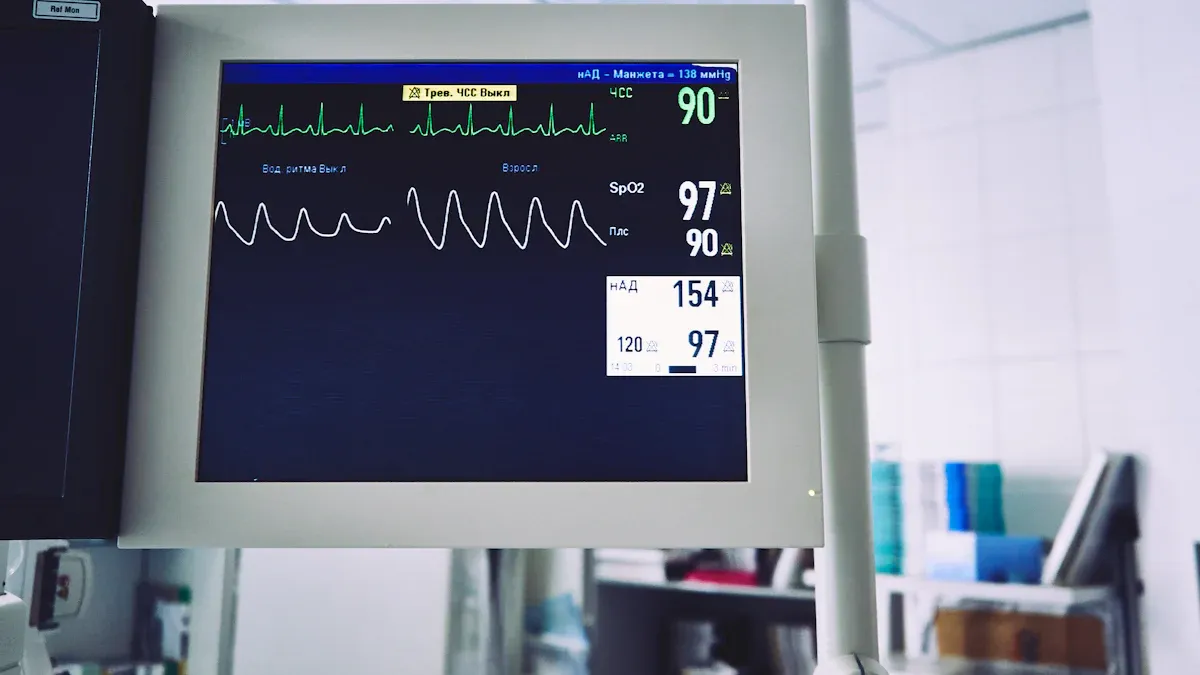
IEC 60601-2-34 and IEC 60601-2-25 are both particular standards in the IEC 60601 series, but they address different medical functions. IEC 60601-2-34 applies to invasive blood pressure monitoring equipment, while IEC 60601-2-25 applies to electrocardiographs that produce ECG reports for diagnostic purposes.
This distinction affects more than the title of the test report. It determines the physiological input being evaluated, the required test signals, essential performance, laboratory setup and supporting test equipment. For a multifunction patient monitor, more than one particular standard may be relevant.
Quick answer
Use IEC 60601-2-34 for an invasive blood pressure measurement function. Use IEC 60601-2-25 when the equipment is intended to produce diagnostic ECG reports. If the device only monitors ECG continuously, IEC 60601-2-27 is generally the more relevant particular standard.
IEC 60601-2-34 vs IEC 60601-2-25 at a Glance
| Comparison Point | IEC 60601-2-34 | IEC 60601-2-25 |
|---|---|---|
| Equipment covered | Invasive blood pressure monitoring equipment | Diagnostic electrocardiographs |
| Current IEC publication | IEC 60601-2-34:2024 | IEC 60601-2-25:2011 |
| Primary input | Pressure signal from an invasive pressure measurement system | Low-level electrical signals acquired through ECG leads and electrodes |
| Main output | Displayed and monitored invasive blood pressure values and waveforms | ECG waveforms and reports intended for diagnostic interpretation |
| Typical test stimulus | Controlled static and dynamic pressure | Defined ECG signals, waveforms and electrical disturbances |
| Typical equipment | Invasive pressure monitors and invasive pressure modules | Resting or diagnostic electrocardiographs |
| Important exclusion | Non-invasive blood pressure monitoring equipment | Equipment used only for ECG monitoring without diagnostic ECG reporting |
| Related standard to check | IEC 80601-2-49 for a multifunction patient monitor | IEC 60601-2-27 for ECG monitoring or IEC 60601-2-47 for applicable ambulatory ECG systems |
The correct standard should be selected from the manufacturer’s intended purpose and clinical claims—not simply from the signals displayed on the screen. A patient monitor may show both pressure and ECG waveforms, but each physiological function still has its own performance requirements.
What Does IEC 60601-2-34 Cover?
IEC 60601-2-34:2024 specifies particular requirements for the basic safety and essential performance of invasive blood pressure monitoring equipment. Its scope includes equipment intended for professional healthcare facilities and the emergency medical service environment.
In an invasive blood pressure measurement chain, pressure from a catheter and fluid-filled system is transmitted to a pressure transducer. The resulting signal is processed by the monitor and presented as a waveform and numerical measurement. Because clinicians may use this information for immediate treatment decisions, an inaccurate, interrupted or misleading indication can create significant risk.
Typical Equipment Within the Scope
- Standalone invasive blood pressure monitors
- Invasive pressure modules used with compatible monitoring systems
- Multifunction patient monitors incorporating invasive pressure channels
- Equipment intended for emergency medical service use when covered by the declared intended environment
What the Standard Does Not Cover
- Non-invasive blood pressure monitoring equipment
- Catheter tubing and catheter needles
- Luer locks, taps and related fluid-path components connected to the transducer dome
- Every requirement applicable to the complete multifunction patient-monitoring system
These exclusions are important during equipment selection. A laboratory may need separate fixtures, reference instruments and standards for the pressure monitor, transducer interface, connector system and complete medical electrical system.
Why the 2024 Edition Matters
IEC 60601-2-34:2024 replaced the 2011 edition. The revision aligns the document with IEC 60601-1 and its amendments, extends its scope to the emergency medical service environment, revises essential-performance provisions and updates requirements including ingress protection and primary operating functions.
An existing test plan based on the 2011 edition should therefore undergo a formal gap assessment before it is used for a new project. Manufacturers should also confirm which edition is accepted by the target market or certification programme rather than assuming that publication of a new IEC edition immediately changes every regulatory requirement.
What Does IEC 60601-2-25 Cover?
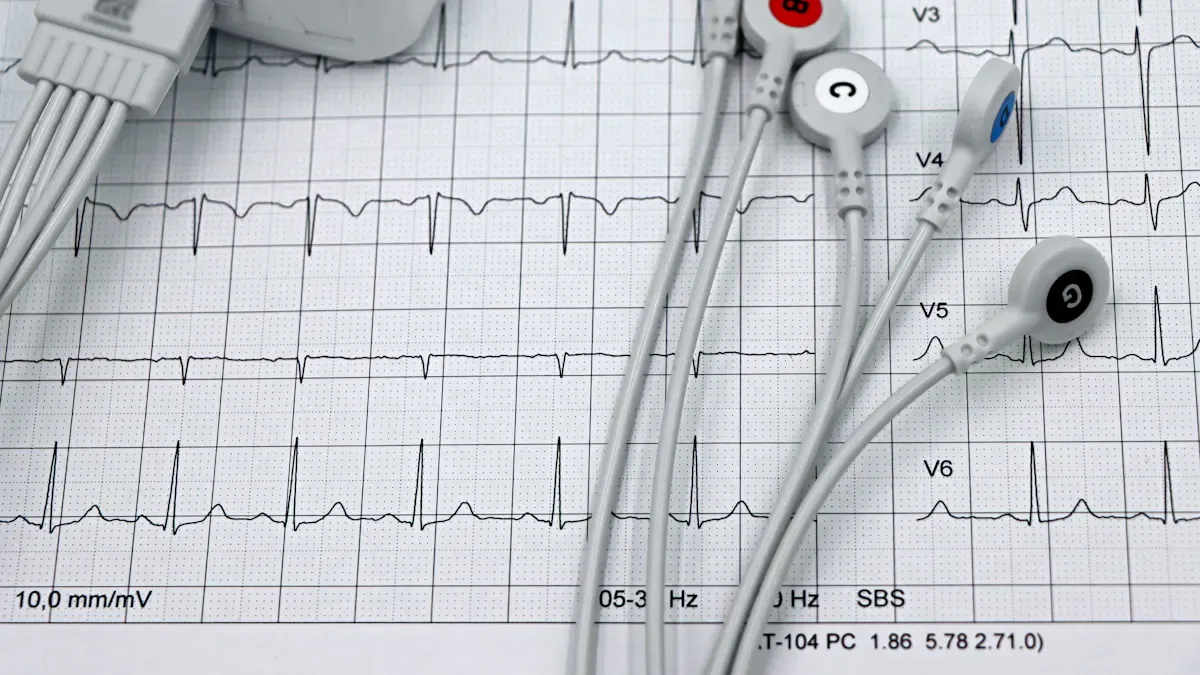
IEC 60601-2-25:2011 applies to electrocardiographs intended, either independently or as part of a medical electrical system, to produce electrocardiogram reports for diagnostic purposes.
The standard evaluates the path from the patient input through signal acquisition, processing and presentation of the final ECG report. The objective is not merely to confirm that a waveform appears on the screen. The equipment must reproduce clinically relevant signal characteristics without unacceptable distortion, loss of information or misleading presentation.
Diagnostic ECG and ECG Monitoring Are Not the Same
One of the most common scope errors is assigning IEC 60601-2-25 to every device that displays an ECG waveform. The deciding factor is whether the equipment is intended to produce ECG reports for diagnostic purposes.
| ECG Function | Standard Normally Considered |
|---|---|
| Production of diagnostic ECG reports | IEC 60601-2-25 |
| Continuous electrocardiographic monitoring | IEC 60601-2-27 |
| Applicable ambulatory or Holter ECG systems | IEC 60601-2-47 |
| Multifunction patient monitoring system | IEC 80601-2-49 together with relevant physiological-function standards |
A multifunction patient monitor can therefore require several coordinated evaluations. IEC 80601-2-49 addresses additional system-level requirements, but it does not replace the particular standards for individual physiological functions such as ECG and invasive pressure.
How the Test Objectives Differ
The most important difference is the physical quantity entering the equipment. IEC 60601-2-34 begins with a pressure input, whereas IEC 60601-2-25 begins with a low-level electrical cardiac signal. This leads to different simulators, reference instruments, test circuits and acceptance criteria.
| Technical Area | Invasive Blood Pressure | Diagnostic ECG |
|---|---|---|
| Input source | Pressure transmitted through an invasive measurement chain | Electrical cardiac signals acquired through ECG leads |
| Reference condition | Controlled pressure generated and measured against a reference instrument | Defined ECG signals and waveforms generated by calibrated electrical equipment |
| Performance concern | Pressure indication, response and continuity of the monitoring function | Amplitude, timing, waveform reproduction, lead behaviour and report quality |
| Typical disturbance | Loss or degradation of the pressure channel and associated indication | Common-mode interference, noise, baseline disturbance and waveform distortion |
| Potential clinical effect | Incorrect or unavailable haemodynamic information | ECG information that may be misinterpreted during diagnosis |
Exact waveforms, limits, test circuits and acceptance criteria must be taken from the applicable edition of the standard and the approved laboratory test plan. Simplified comparison tables should not be used as substitutes for the standard because the required setup can depend on the equipment configuration, intended use and declared performance.
Typical Laboratory Equipment
There is no single universal patient-monitor tester that automatically covers both standards. The laboratory setup should be built around the applicable clause and the DUT interface.
For IEC 60601-2-34 Testing
- Traceable pressure source or pressure controller
- Reference pressure measuring instrument
- Compatible pressure transducer, transducer simulator or interface fixture
- Dynamic pressure or response test arrangement where required
- Alarm verification and data-recording equipment
- Electrical safety and EMC equipment required by the broader test programme
For IEC 60601-2-25 Testing
- Calibrated ECG or patient simulator capable of producing the required signals
- Specified lead networks and patient-electrode interface circuits
- Equipment for waveform, amplitude, duration and timing evaluation
- Common-mode, noise and interference test arrangements
- Recording or image-analysis tools for evaluating the ECG report
- Defibrillation-protection test equipment where required by the applicable test programme
- Electrical safety and EMC equipment suitable for the DUT configuration
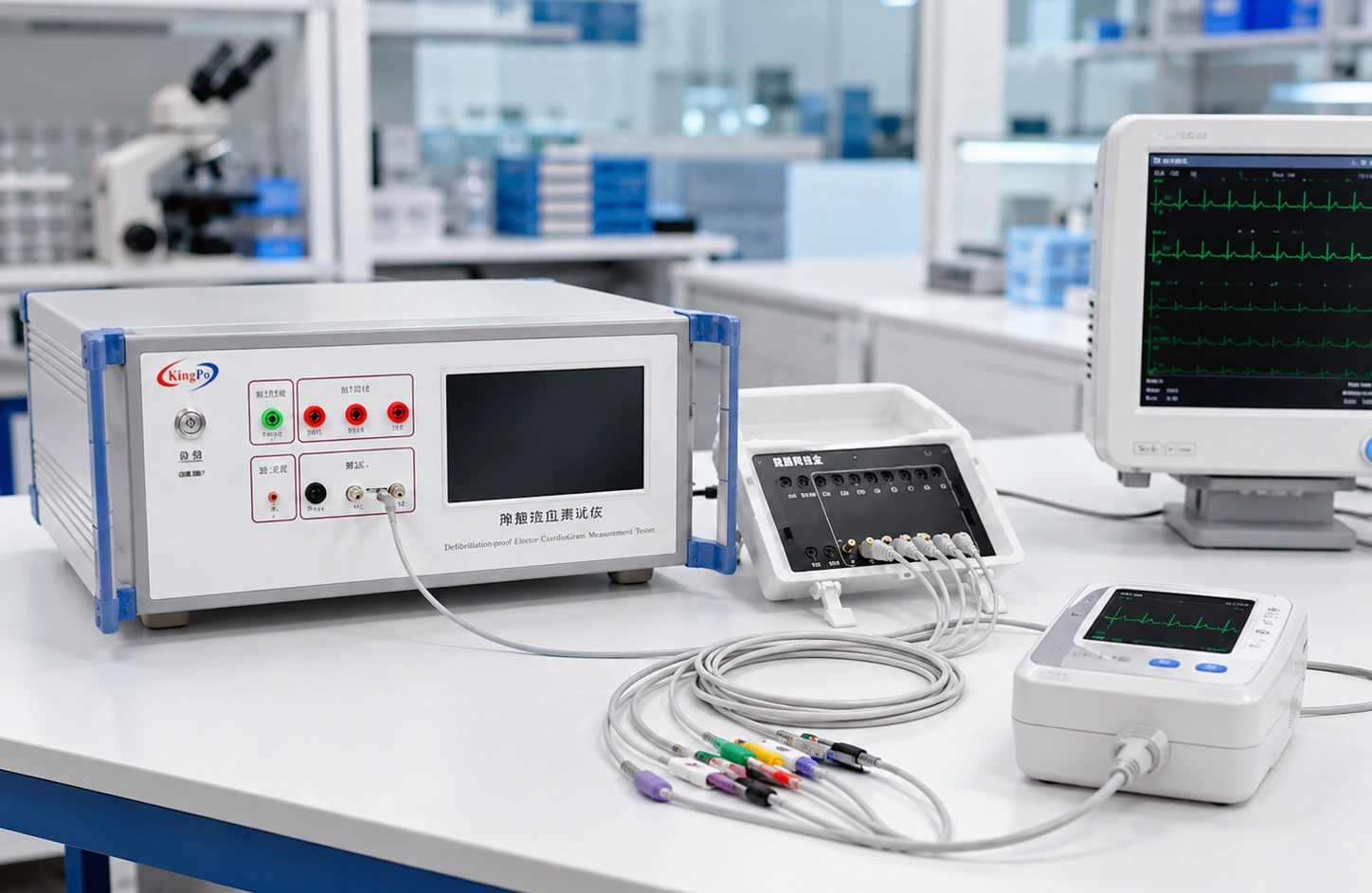
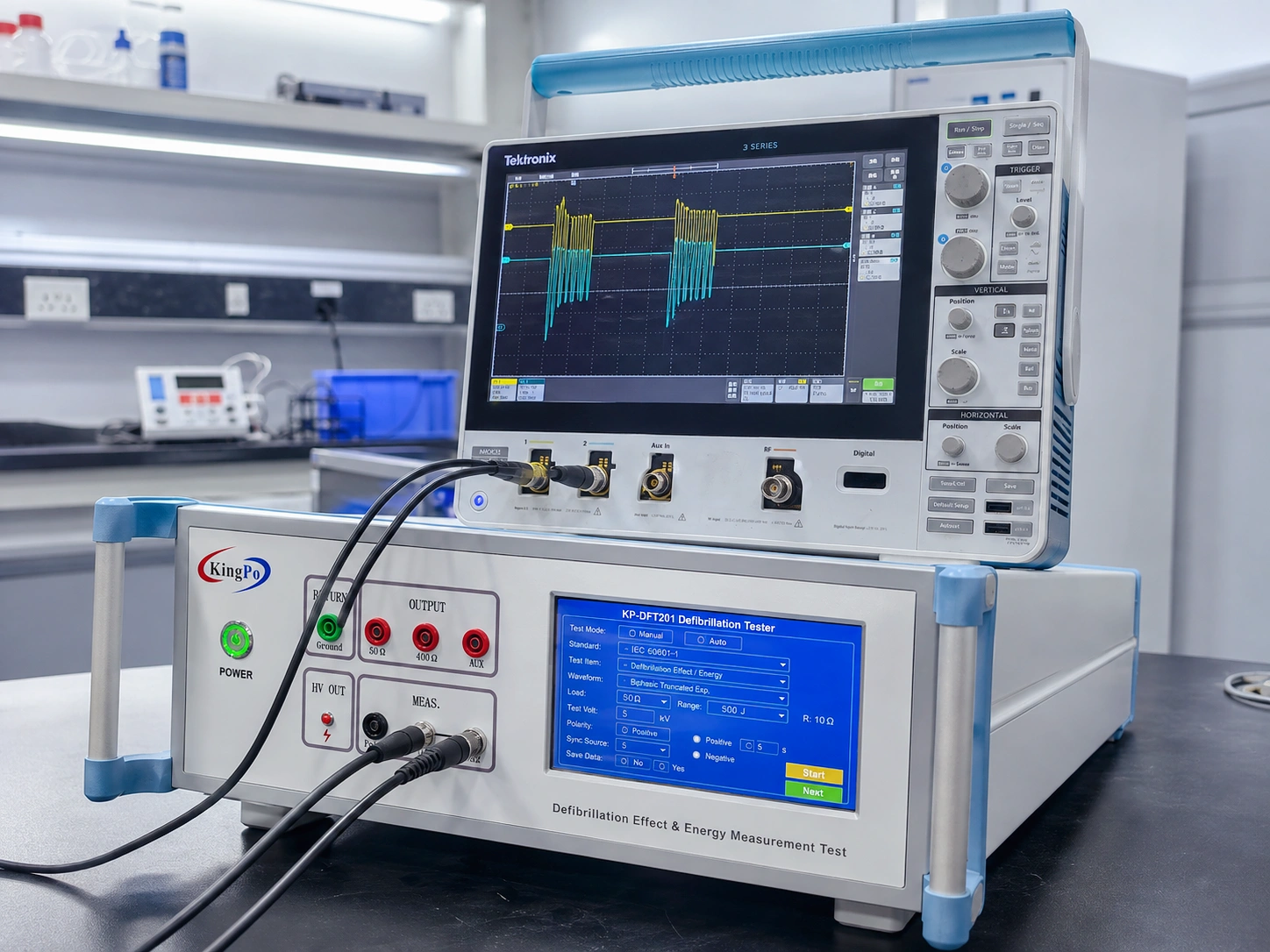
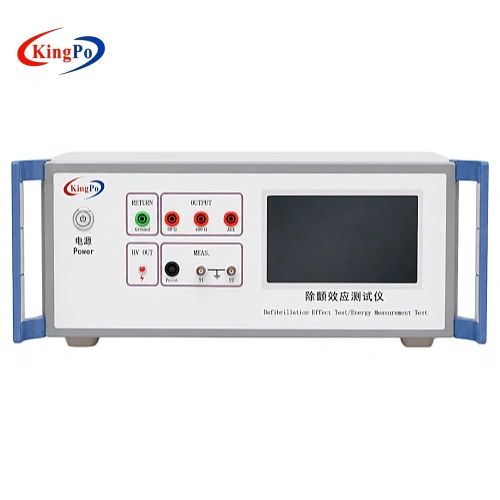
For ECG monitors, electrocardiographs and other compatible patient-connected equipment, the KP3301 Defibrillation-Proof and Energy Reduction Tester supports evaluation of protection against the effects of defibrillation. Its suitability must still be confirmed against the exact standard clause, lead configuration and required test circuit.
Do not confuse an ECG electrode tester with an electrocardiograph test system.
An ECG electrode tester evaluates the electrical performance of disposable electrodes. IEC 60601-2-25 evaluates the electrocardiograph as medical electrical equipment. The products, interfaces and test methods are different.
Requirements Shared Within the IEC 60601 Framework
Both documents are particular standards used together with IEC 60601-1 and applicable collateral standards. Although their physiological performance tests differ, the broader evaluation may cover several common areas:
- Basic safety and essential performance
- Protection against electrical hazards
- Applied-part and patient-circuit requirements
- Leakage current and patient auxiliary current
- Protection against the effects of defibrillation where applicable
- Mechanical and thermal hazards
- Electromagnetic emissions and immunity
- Alarm-system performance where applicable
- Usability-related safety
- Labelling and accompanying documents
- Risk-management and programmable-system evidence
Laboratories building a wider medical electrical safety capability can use the IEC 60601-1 test equipment list as an initial planning reference. It should then be supplemented with the physiological-function equipment required by IEC 60601-2-34, IEC 60601-2-25 or other applicable particular standards.
General Electrical Safety Equipment
Leakage current testing is one part of the wider IEC 60601-1 evaluation. The IEC 60601 Programmable Leakage Current Tester can support applicable leakage-current measurements, subject to confirmation of the measuring network, operating condition, applied-part configuration and required measurement mode.
Alarm Evaluation
Where the DUT includes audible or visual medical alarm functions, the test plan may also require equipment for evaluating alarm patterns, priority indications and visual signals. KingPo’s IEC 60601-1-8 Medical Alarm Signal Analyzer is intended for this type of alarm-signal assessment. It should not be treated as a substitute for pressure or ECG performance simulators.
Does ISO 20653 Apply?
ISO 20653 should not be listed as a general supporting standard for IEC 60601-2-34 or IEC 60601-2-25. ISO 20653 defines degrees of protection for electrical equipment in road vehicles. It is not the default ingress-protection standard for medical electrical equipment.
Ingress-protection requirements should instead be determined from the applicable IEC 60601 documents, the declared enclosure rating and the intended use environment. Vehicle-related requirements may become relevant when medical equipment is installed or transported in a road vehicle, but this is a separate application decision.
How to Determine Which Standard Applies
- Define the intended medical function. Determine whether the equipment measures invasive pressure, produces diagnostic ECG reports, performs continuous ECG monitoring or combines several functions.
- Review the manufacturer’s claims. A diagnostic claim can change the applicable standard even when the hardware resembles a conventional patient monitor.
- Identify the intended environment. Professional healthcare, emergency medical service and home healthcare environments can introduce different collateral requirements.
- Separate individual functions from the complete system. A multifunction monitor can require both system-level and physiological-function standards.
- Confirm the required edition. Check the target market, certification scheme and existing product documentation before finalizing the test plan.
- Map every function to a standard. Include ECG, pressure, alarms, applied parts, communications, accessories and other claimed functions.
- Review exclusions and accessories. Electrodes, catheters, connectors and transducers may be covered by separate standards.
Practical Procurement Considerations
A useful quotation should be based on the actual DUT and required clauses rather than the standard number alone. Before selecting equipment, manufacturers and laboratories should confirm:
- Whether the DUT is a standalone device, module or multifunction patient monitor
- Whether the ECG output is intended for diagnosis or monitoring
- The required standard and edition
- The number of pressure channels or ECG leads
- Pressure transducer, lead-wire and connector interfaces
- Required static, dynamic, waveform and interference tests
- Defibrillation-protection configuration, if applicable
- Alarm functions that must be monitored during testing
- Electrical safety and EMC test scope
- Required calibration documents and measurement traceability
- Manual or automated test sequencing and report generation
This information allows the supplier to assess signal ranges, interfaces, accessories, channel switching and software requirements before quotation. It also reduces the risk of purchasing a general-purpose simulator that cannot reproduce the test conditions required by the applicable clause.
Test Equipment Support from KingPo
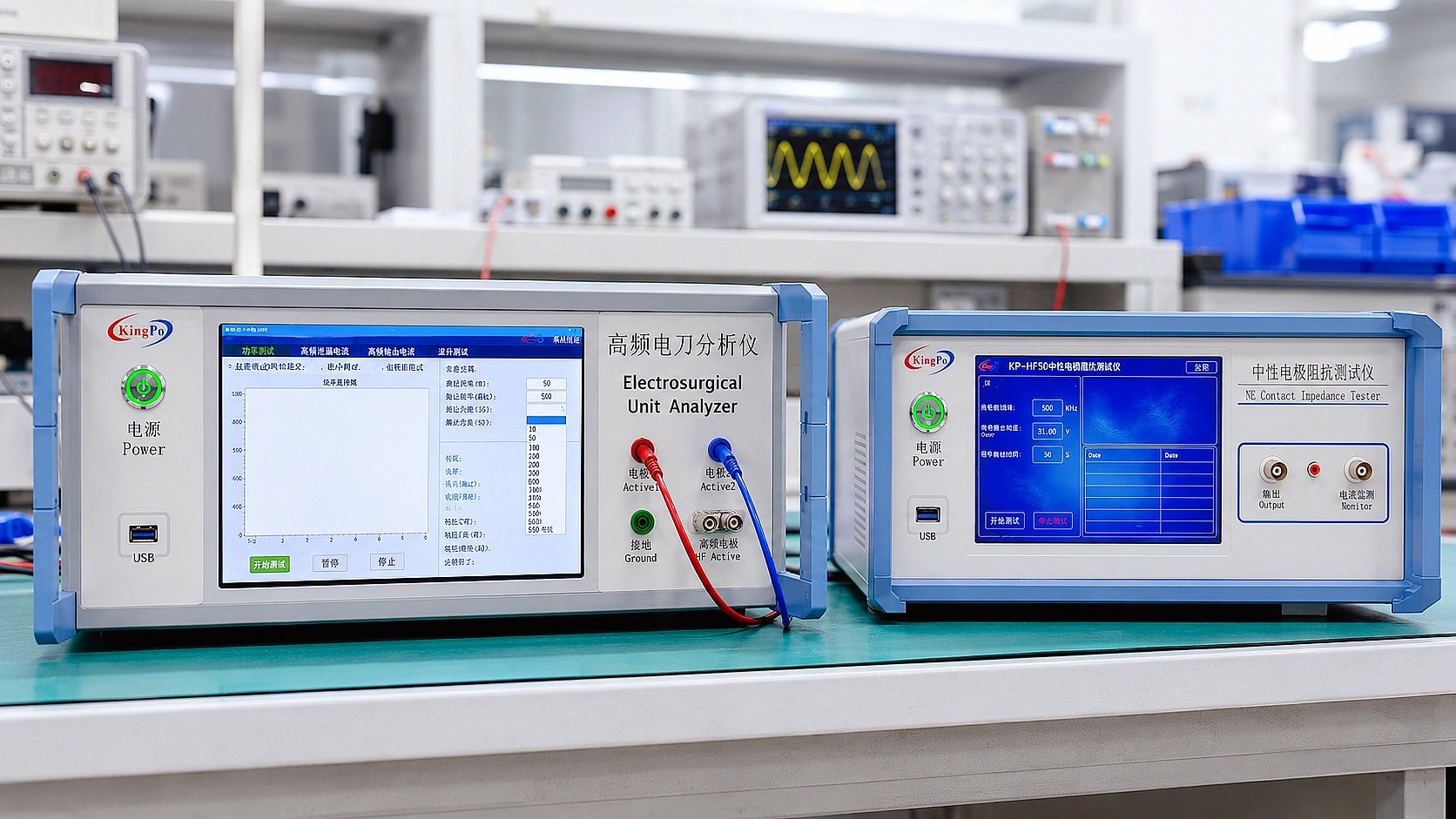
KingPo supplies medical electrical safety instruments, test fixtures and customized systems for manufacturers, independent laboratories and certification organizations. Available solutions cover areas such as leakage current, defibrillation protection, medical alarm signals, electrosurgical equipment, ECG and defibrillation electrodes, medical connectors and mechanical safety.
Because IEC 60601-2-34 and IEC 60601-2-25 require different physiological test inputs, the final equipment proposal should be developed from the applicable clauses and the DUT interface. KingPo should not be assumed to provide a complete pressure or diagnostic ECG simulator unless that configuration has been confirmed in the quotation.
Frequently Asked Questions
What is the main difference between IEC 60601-2-34 and IEC 60601-2-25?
IEC 60601-2-34 applies to invasive blood pressure monitoring equipment. IEC 60601-2-25 applies to electrocardiographs intended to produce diagnostic ECG reports. They use different input quantities, test stimuli and performance criteria.
Does IEC 60601-2-25 apply to every ECG monitor?
No. Equipment intended only for continuous ECG monitoring is generally evaluated under IEC 60601-2-27. IEC 60601-2-25 is relevant when the equipment produces ECG reports for diagnostic purposes.
Which edition of IEC 60601-2-34 should be used?
IEC 60601-2-34:2024 is the current IEC publication. The edition required for a specific project should still be confirmed with the target market, certification body or regulatory programme.
Does IEC 60601-2-34 cover non-invasive blood pressure monitors?
No. Non-invasive blood pressure monitoring equipment is excluded from the scope of IEC 60601-2-34.
Can one patient simulator complete both standards?
Usually not. Invasive pressure testing requires controlled pressure stimuli and reference pressure measurement. Diagnostic ECG testing requires defined electrical waveforms, lead networks and ECG-report evaluation. An integrated system is suitable only when all required methods have been verified.
Does a multifunction patient monitor require both standards?
It may. A monitor with an invasive pressure function and a diagnostic ECG-reporting function can require both particular standards. IEC 80601-2-49 may also apply to the complete multifunction patient monitor.
Is an ECG electrode tester an IEC 60601-2-25 test system?
No. An ECG electrode tester evaluates the electrode itself. IEC 60601-2-25 evaluates the electrocardiograph, including its patient input, signal processing and diagnostic ECG report.
Is ISO 20653 required by these two standards?
No. ISO 20653 is an ingress-protection standard for road-vehicle electrical equipment. It should not be presented as a general requirement of IEC 60601-2-34 or IEC 60601-2-25.
What should be provided when requesting a test-equipment quotation?
Provide the DUT type, intended purpose, required standard edition, channel or lead count, connector interfaces, required clauses, signal or pressure range, defibrillation-protection requirements, automation needs and calibration-document requirements.