Standards and Test Method Support
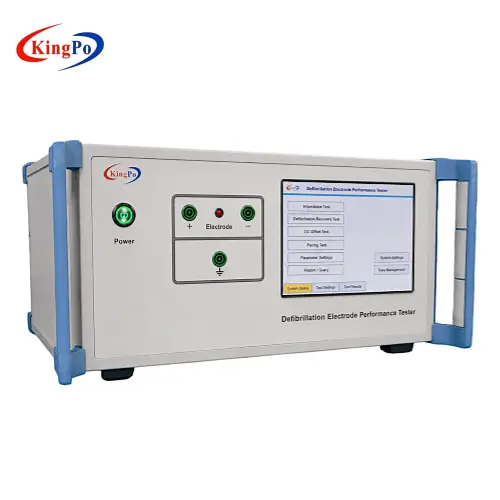
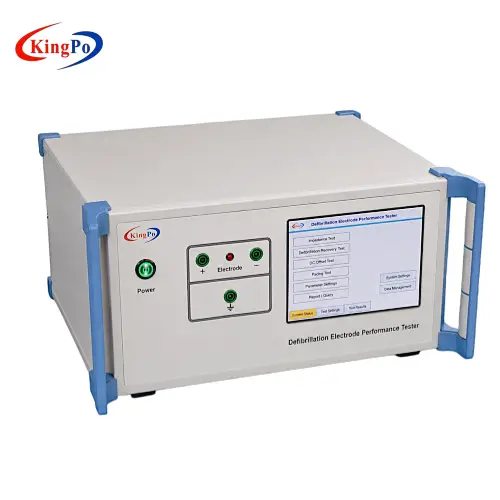
The KP-DFT100E Defibrillation Electrode Performance Tester is designed for Clause 201.108 related testing under GB 9706.204:2022 and IEC 60601-2-4:2018. This test scope focuses on the electrical performance of disposable defibrillation electrodes used as the conductive interface between a defibrillator and the patient.
The instrument supports key performance evaluations including low-level impedance, high-energy defibrillation-related impedance, post-shock recovery behavior, DC offset voltage and pacing signal transmission for multifunction electrodes.
This product should not be confused with a general defibrillator analyzer or an ECG electrode tester. The KP-DFT100E is specifically configured for disposable defibrillation electrode performance testing, especially where high-energy 360J defibrillation recovery and pacing signal-related tests are required.
System Configuration
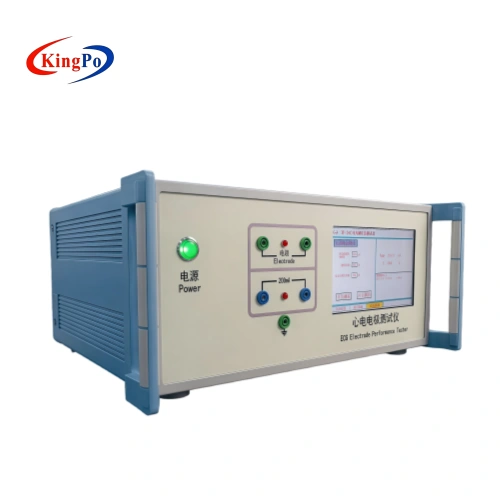
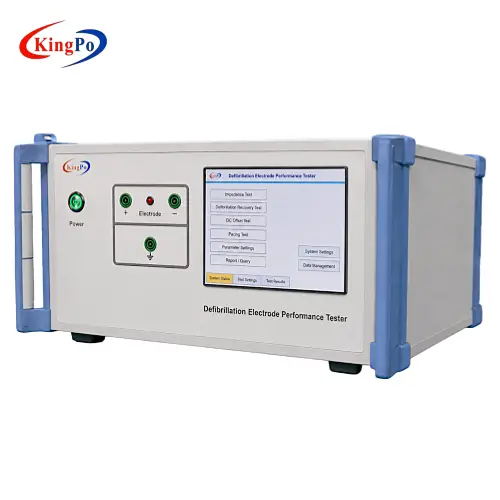
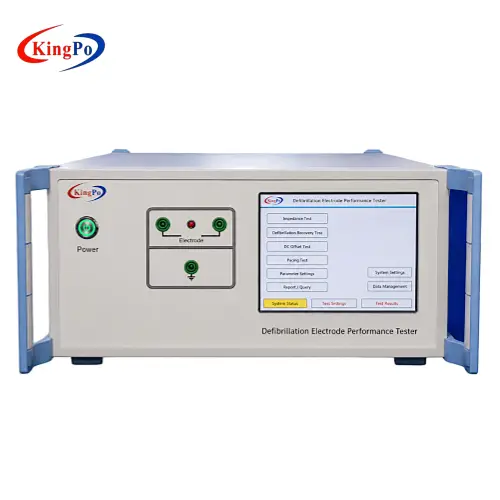
The KP-DFT100E integrates the required test circuits, signal source, measurement circuit, defibrillation-related test source, touchscreen control interface and automatic test program in one benchtop instrument.
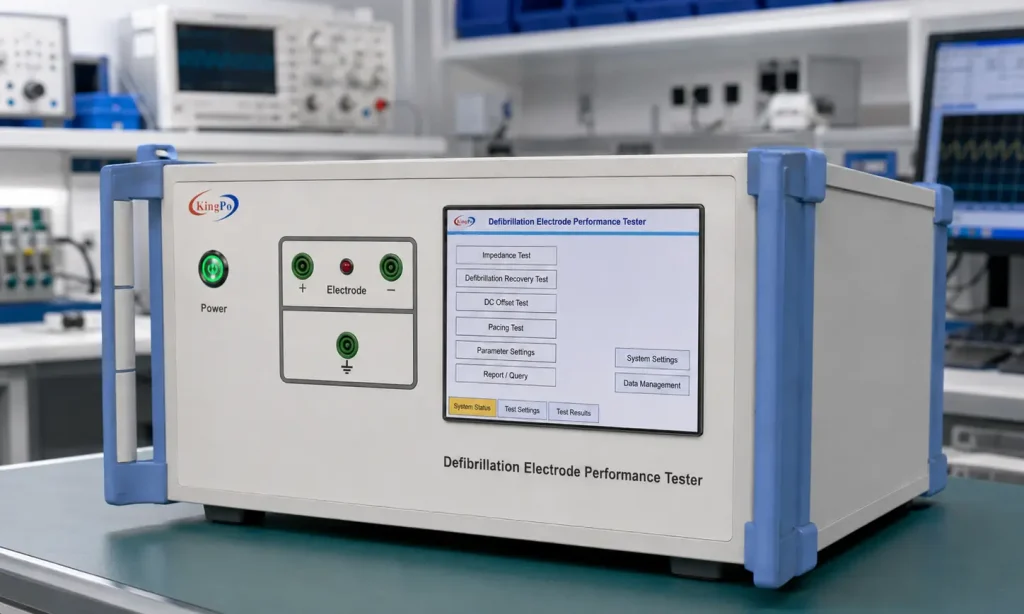
Operators can select the required test item through the 7-inch capacitive touchscreen. Test parameters and results are displayed on the same interface, improving usability and reducing manual operation complexity. The built-in test program supports one-touch automatic testing and can generate test data and reports after completion.
Because the instrument includes internal test circuits and standard test procedures, it reduces the need for additional external tooling and helps laboratories build a more consistent defibrillation electrode test workflow.
Professional Construction and Technical Precision
The KP-DFT100E is designed for electrical performance verification of disposable defibrillation electrodes under both low-signal and high-energy test conditions. It combines AC impedance measurement, high-voltage defibrillation-related testing, DC voltage measurement and pacing waveform simulation into a single test platform.
The system supports a 5 kV / 360 J defibrillation source with a 50 Ω series load for large-signal impedance and defibrillation recovery tests. It also supports AC small-signal impedance measurement using a 100 μA sinusoidal AC current at 10 Hz / 30 kHz, helping laboratories evaluate electrode behavior under different electrical conditions.
KP-DFT100E Technical Specifications
| Item | Specification |
|---|---|
| Model | KP-DFT100E |
| Product Type | Defibrillation Electrode Performance Tester |
| Related Standards | GB 9706.204:2022 Clause 201.108; IEC 60601-2-4:2018 Clause 201.108 |
| Test Object | Disposable defibrillation electrodes; multifunction defibrillation electrodes |
| Main Test Items | AC small-signal impedance, AC large-signal impedance, 360J defibrillation recovery, DC offset voltage, pacing signal test |
| Control Interface | 7-inch capacitive touchscreen |
| Screen Resolution | 800 × 480 |
| Operation Mode | One-touch automatic operation with built-in standard test program |
| Test Circuit | Built-in test circuit |
| Report Function | Automatic test data and report generation |
| Power Supply | AC 220 V ±10%, 50 Hz / 60 Hz |
| Dimensions | 480 × 460 × 200 mm |
| Weight | Approx. 10 kg |
| Applicable Users | Medical device quality inspection institutions, defibrillation electrode manufacturers, research institutes |
Test Function Parameters
| Test Function | Key Parameters | Purpose |
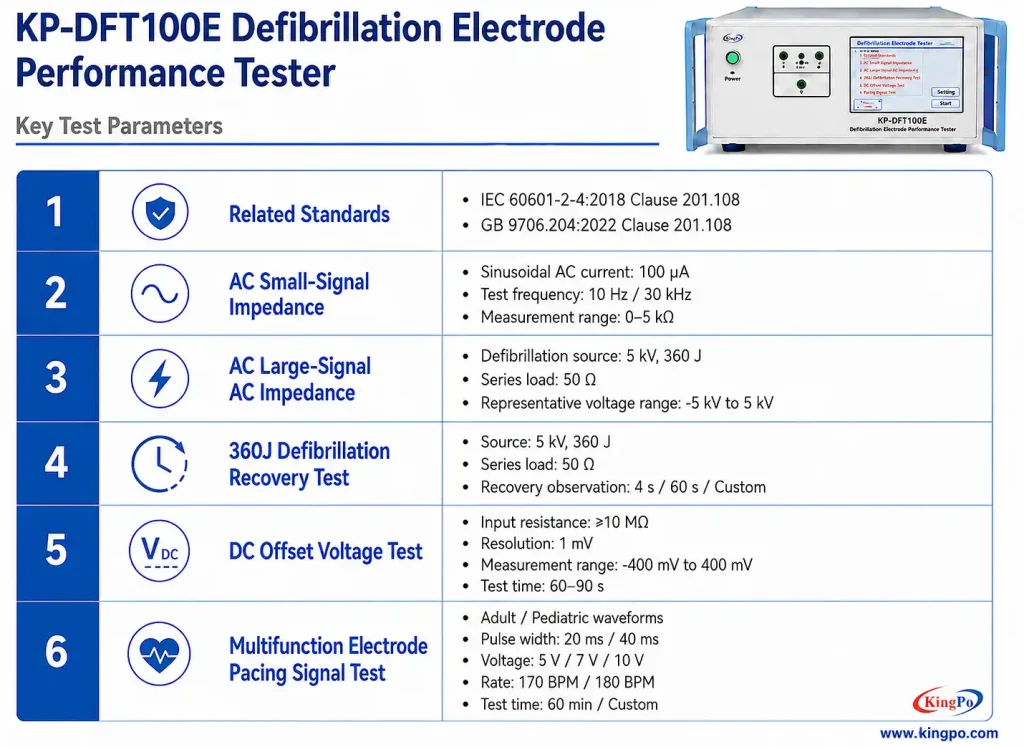
| AC Small-Signal Impedance | Sinusoidal AC current 100 μA; 10 Hz / 30 kHz; measurement range 0–5 kΩ | Evaluates electrode impedance under low-level signal conditions |
| AC Large-Signal Impedance | Defibrillation source 5 kV, 360 J; 50 Ω series load; measurement range -5 kV to 5 kV | Evaluates electrode behavior under high-energy defibrillation-related conditions |
| 360J Defibrillation Recovery | 5 kV, 360 J defibrillation source; 50 Ω series load; voltage range -5 V to 5 V; measurement time 4 s, 60 s or customized | Checks electrode recovery behavior after high-energy defibrillation exposure |
| DC Offset Voltage | DC input resistance ≥10 MΩ; 1 mV resolution; measurement range -400 mV to 400 mV; measurement time 60–90 s | Measures unwanted DC voltage offset generated by the electrode system |
| Pacing Signal Test | Adult and pediatric pacing waveform settings; 20 ms / 40 ms pulse width; 5 V / 7 V / 10 V waveform options; 170 BPM / 180 BPM; measurement time 60 min or customized | Verifies pacing signal-related performance of multifunction defibrillation electrodes |
-
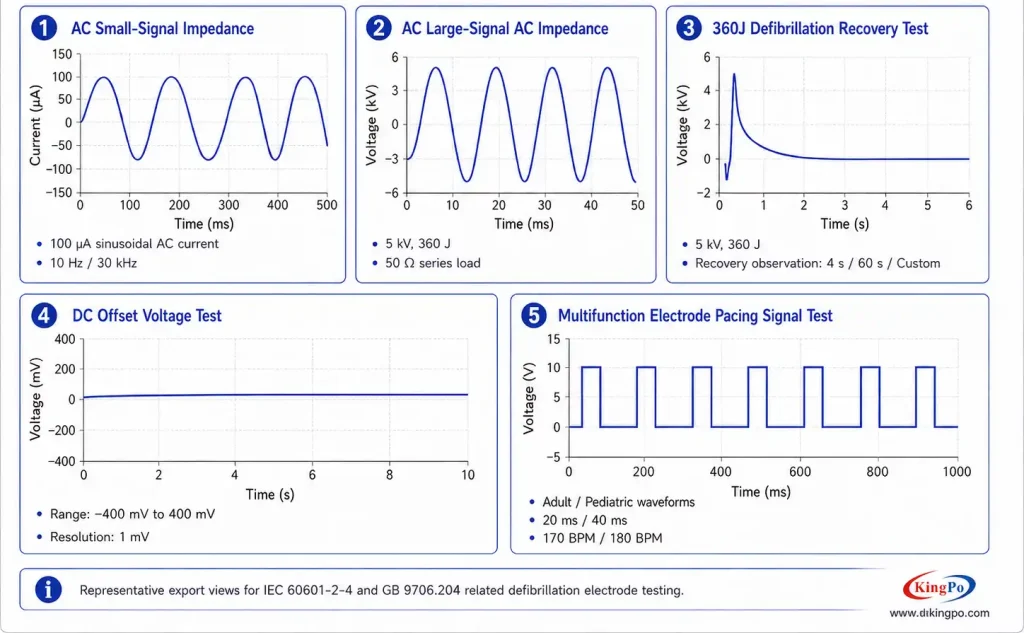
Main test parameters for KP-DFT100E defibrillation electrode testing.
Pacing Signal Test Conditions
The KP-DFT100E supports pacing waveform test conditions for adult and pediatric multifunction defibrillation electrodes.
- Adult pacing waveform, 20 ms: 20 ms, 10 V, 2.833 Hz, 170 BPM
- Adult pacing waveform, 40 ms: 40 ms, 7 V, 3.0 Hz, 180 BPM
- Pediatric pacing waveform, 20 ms: 20 ms, 5 V, 2.833 Hz, 170 BPM
- Pediatric pacing waveform, 40 ms: 40 ms, 5 V, 3.0 Hz, 180 BPM
- Measurement time: 60 min or customized
These waveform settings help laboratories evaluate whether multifunction defibrillation electrodes can support pacing signal transmission under defined test conditions.
Testing Principle
Disposable defibrillation electrodes act as the conductive interface between the defibrillation device and the patient. During use, the electrode must provide stable electrical contact, withstand high-energy defibrillation discharge, recover after energy delivery and support additional functions such as pacing signal transmission when required.
The KP-DFT100E applies different electrical test conditions to evaluate this performance. Low-level AC impedance testing checks electrode behavior under small-signal conditions. Large-signal impedance and defibrillation recovery testing use high-energy defibrillation-related conditions to evaluate performance during and after a 360J shock. DC offset voltage testing checks whether the electrode produces abnormal DC bias, while the pacing signal test evaluates multifunction electrode behavior under defined pacing waveform conditions.
This integrated test process helps laboratories assess the electrical performance of defibrillation electrodes more consistently than separate manual test setups.
Test Workflow
- Prepare the disposable defibrillation electrode sample according to the test procedure.
- Connect the electrode sample to the KP-DFT100E test interface.
- Select the required test item on the 7-inch touchscreen.
- Confirm the applicable standard clause and test condition.
- Start the built-in automatic test program.
- The instrument performs the selected test sequence and records measurement data.
- Review impedance, recovery voltage, DC offset or pacing signal-related results.
- Generate or export test data and report according to laboratory workflow.
- Remove the sample after the test is completed.
- Record sample condition, test result and any abnormal performance.
Operation Notes for Defibrillation Electrode Testing
To maintain repeatable and safe test results, the following practices are recommended:
- Confirm that the selected test item matches the applicable standard clause.
- Check electrode sample condition before connecting it to the tester.
- Ensure proper connection between the electrode and the test interface.
- Use the correct test mode for AC impedance, 360J recovery, DC offset or pacing signal testing.
- Do not treat the KP-DFT100E as a general-purpose defibrillator analyzer.
- Confirm laboratory safety requirements before performing high-voltage or high-energy test items.
- Review test data and report format before formal quality control or type testing support.
- For customized test time or special electrode designs, confirm the configuration before testing.
Applications and Laboratory Use
The KP-DFT100E Defibrillation Electrode Performance Tester is suitable for:
- Disposable defibrillation electrode manufacturers
- Multifunction defibrillation electrode manufacturers
- Medical device quality inspection institutions
- Third-party medical device testing laboratories
- R&D laboratories
- Research institutes
- Incoming inspection and production quality control
- Standard-related verification before certification or registration testing
Typical applications include product development verification, batch quality control, internal laboratory testing, type testing preparation and electrical performance documentation for disposable defibrillation electrodes.