
IEC 60601-1 Defibrillation-Proof and Energy Reduction Tester
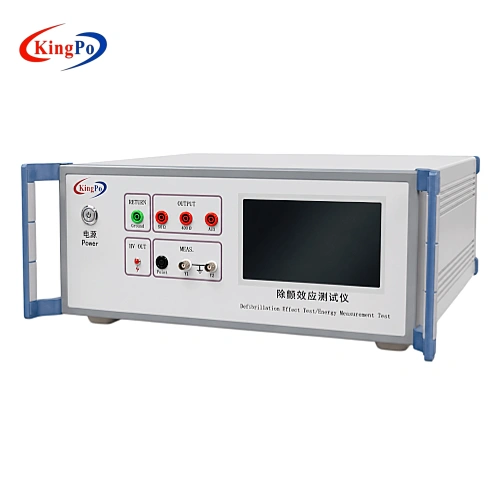
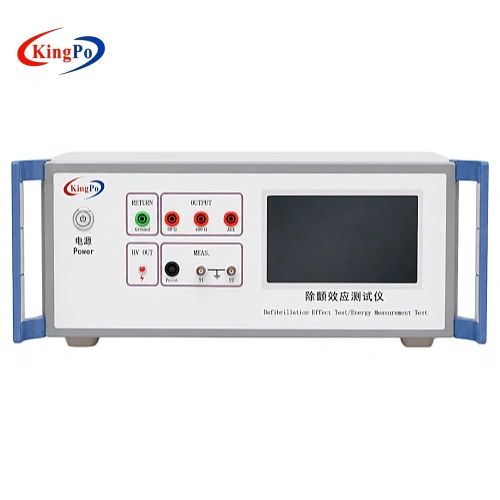
The KingPo KP3301 is an IEC 60601-1 defibrillation-proof and energy reduction tester for evaluating protection against the effects of defibrillation in electrocardiographs, ECG monitors, multifunction patient monitors and other compatible patient-connected medical electrical equipment.
It supports positive and negative charging voltages up to ±5.5 kV, common-mode and differential-mode testing, energy-reduction measurement, automatic Y1-Y2 voltage calculation and optional manual or automatic ECG lead switching.
- Applicable Standard Family: IEC 60601-1, relevant IEC 60601 particular standards, and applicable IEC 80601 particular standards for compatible patient-connected medical equipment, including multifunction patient monitors.
- Product Model: KP3301
- Charging Voltage: 0 to ±5.5 kV, accuracy ±1%
- Main Capacitance: 32 μF ±5%, rated 8 kV
- Selectable Inductance: 500 μH and 25 mH, tolerance ±5%
- Test Arrangements: Common-mode and differential-mode testing
- Energy Measurement: Automatic calculation with 1 J display resolution
- Lead Switching: Manual adapter or optional automatic defibrillation lead converter box
- Typical DUT: Electrocardiographs, ECG monitors, multifunction patient monitors and related patient-connected modules
Product Overview
Integrated Defibrillation-Related Testing for Patient-Connected Medical Equipment
Electrocardiographs, ECG monitors, multifunction patient monitors and other equipment connected to a patient may remain connected when a clinical defibrillation pulse is applied. Their patient-connected circuits may therefore require evaluation for protection against the effects of defibrillation, energy transmission and post-exposure electrical or functional performance.
The KP3301 integrates the high-voltage charging source, 32 μF main capacitor, selectable resistance and inductance networks, positive and negative polarity control, energy calculation, Y1-Y2 voltage calculation and internal physiological signal simulation into one test platform.
This integrated arrangement reduces repeated assembly of external test circuits and helps medical device manufacturers and laboratories establish a more controlled and repeatable test setup.
The primary product is the KP3301 main instrument. Depending on the DUT lead arrangement and laboratory workflow, it can be used with:
- A manual defibrillation adapter for direct lead-by-lead connection
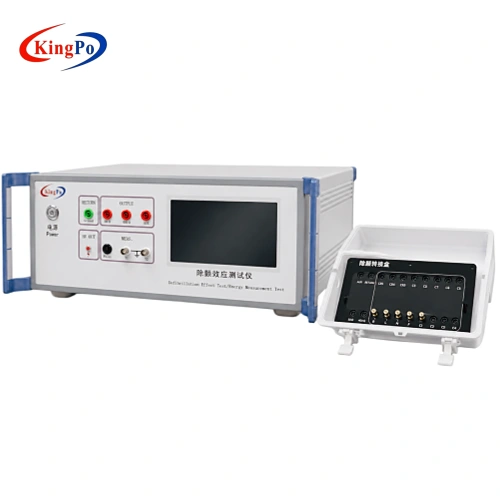
- An optional automatic defibrillation lead converter box for programmed ECG lead switching
- A DB9 serial communication cable used with the automatic converter configuration
- Output leads, Y1-Y2 test leads, grounding wires and connection accessories
What Buyers Need to Confirm First
IEC 60601-1 and selected particular standards for compatible patient-connected medical equipment
KP3301
Protection against the effects of defibrillation, energy reduction and Y1-Y2 residual or hazardous voltage evaluation
Common-mode and differential-mode testing
Electrocardiographs, ECG monitors, multifunction patient monitors, patient cables and compatible physiological monitoring modules
Confirm the applicable standard edition, test clause, DUT applied-part configuration, number of patient leads, required test mode and lead-switching method before ordering.
KP3301 Technical Specifications
| Instrument Parameter | Specification |
|---|---|
| Charging Voltage | 0 ~ ±5.5 kV ±1% |
| Main Capacitor | 32 μF ±5% (imported solid capacitor, 8 kV rating) |
| Inductance | 500 μH and 25 mH ±5% |
| Internal Resistance | 10 Ω and 11 Ω (automatically switch or set per standard) |
| Main Resistor (non-inductive) | 100 Ω, 50 Ω, 400 Ω ±1% |
| Internal Signal | Sine wave: 10 Hz, 0.5~10 mV (default 5 mV) Respiration rate: 5~60 rpm (default 27 rpm) |
| Voltage Control | Digital settings |
| Polarity Control | Positive/negative, digital settings |
| Control & Display | 7-inch LCD touchscreen |
| Voltage Resolution & Accuracy | 1 V, ±1% |
| Energy Test Mode | Operating with 25 mH inductance (meets energy reduction test requirements) Display resolution: 1 Joule |
| Energy Test Reference Values | No-load: R=10 Ω → theoretical 364 J ±1% R=11 Ω → theoretical 360 J ±1% |
| Y1-Y2 (Residual/Hazardous Voltage) | Automatically calculated (avoids oscilloscope interference errors) |
| Model Differences | KP3301: Manual defibrillator lead switching KP3301B: Includes automatic defibrillator lead converter box for fully automated ECG lead testing |
What the KP3301 Evaluates
Protection Against the Effects of Defibrillation
The KP3301 supports common-mode and differential-mode test arrangements for ECG-related equipment and other compatible patient-connected circuits. A controlled positive or negative high-voltage condition is applied to the selected DUT inputs through the required resistance and inductance network.
Depending on the applicable standard and equipment type, the evaluation may include electrical protection of patient-connected inputs, equipment recovery after exposure, continued operation of essential functions, residual or hazardous voltage, energy transmitted through the DUT and the condition of the applied-part circuit.
Energy Reduction Measurement
The KP3301 provides an energy reduction test mode using the 25 mH inductance configuration. The result is calculated automatically and displayed with a resolution of 1 J.
The theoretical no-load reference values are approximately 364 J with the 10 Ω configuration and approximately 360 J with the 11 Ω configuration. These values describe the specified no-load circuit conditions and should not be treated as universal pass/fail limits.
Y1-Y2 Residual or Hazardous Voltage
The KP3301 automatically calculates the Y1-Y2 residual or hazardous voltage result for the supported test arrangement. External waveform or voltage verification may still be required where specified by the applicable standard, laboratory procedure or quality system.
ECG and Respiration Signal Simulation
The built-in 10 Hz sine-wave signal, adjustable ECG amplitude and adjustable respiration-rate signal help the operator observe the response or recovery of compatible ECG and respiration channels without requiring a separate basic signal source for every setup.
Test Principle
The KP3301 simulates a controlled defibrillation-related electrical condition and applies it to the selected patient-connected inputs of the DUT.
- Identify the DUT, applied part and applicable standard clause.
- Select the common-mode or differential-mode test arrangement.
- Set the required positive or negative charging voltage.
- Select the required resistance and inductance network.
- Connect the DUT using the manual adapter or automatic lead converter box.
- Apply the required pulse or test sequence.
- Record the energy reduction or Y1-Y2 result where applicable.
- Check the electrical and functional condition of the DUT after exposure.
- Compare the results with the acceptance criteria of the applicable standard.
Common-Mode and Differential-Mode Testing
Common-Mode Test
In a common-mode arrangement, the applicable patient connections are grouped and exposed to the defibrillation-related test condition relative to another reference point in the circuit. This helps evaluate how the patient-connected input system responds when multiple leads are subjected to a common electrical stress.
Differential-Mode Test
In a differential-mode arrangement, the test voltage is applied between selected patient connections or lead groups. This helps evaluate the protection provided between individual applied-part inputs and the behavior of the corresponding input circuitry.
IEC 60601-2-25 and IEC 60601-2-27 include test arrangements for protection against the effects of defibrillation in electrocardiographs and ECG monitoring equipment. The exact circuit, lead grouping and acceptance criteria must be confirmed from the applicable edition and clause.
Manual and Automatic Lead-Switching Options
The KP3301 can be configured according to the number of ECG leads, test frequency and level of automation required by the laboratory.
Manual Defibrillation Adapter
The manual defibrillation adapter allows the operator to connect and switch the required ECG leads manually. After one lead or lead combination is tested, the operator changes the connection before starting the next test.
This configuration is suitable for occasional testing, customized lead arrangements, engineering investigation, DUTs with non-standard connectors and lower-volume laboratory work.
Automatic Defibrillation Lead Converter Box
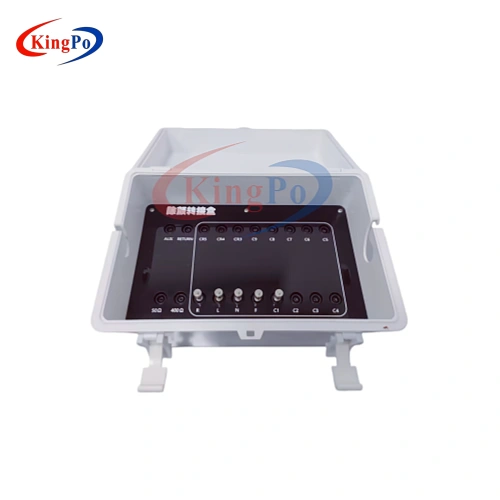
The optional automatic defibrillation lead converter box switches selected ECG leads according to the programmed test process. It is intended for repeated multi-lead ECG testing where the same pulse sequence must be applied to several lead combinations.
- Automatic switching of selected ECG leads
- Reduced repeated manual reconnection
- More consistent lead selection
- Improved repeatability between test cycles
- Reduced operator intervention
DB9 Serial Communication Cable
The DB9 serial communication cable is used with the automatic converter configuration to connect the KP3301 to the automatic lead converter box. The DUT connector, number of leads, lead-switching sequence and converter interface should be confirmed before quotation.
Applicable Standards and Equipment Scope
The original KingPo document references IEC 60601-1 and several particular standards related to patient-connected medical equipment. The correct test circuit must be selected according to the DUT, standard edition and applicable clause.
IEC 60601-1 Edition 3.2
IEC 60601-1 Edition 3.2 consists of IEC 60601-1:2005, Amendment 1:2012 and Amendment 2:2020. It contains the general requirements for basic safety and essential performance of medical electrical equipment. Where a particular standard exists, the general standard is not normally used alone.
IEC 60601-2-25:2011
IEC 60601-2-25 applies to the basic safety and essential performance of diagnostic electrocardiographs. The DUT lead configuration and applicable common-mode or differential-mode test circuit should be confirmed before testing.
IEC 60601-2-27:2011
IEC 60601-2-27 applies to electrocardiographic monitoring equipment used in hospitals and certain environments outside hospitals, including ambulances and air transport.
IEC 60601-2-34:2024
IEC 60601-2-34:2024 is the current IEC publication for the basic safety and essential performance of invasive blood pressure monitoring equipment. Applicability of the KP3301 circuit must be reviewed against the specific DUT input and clause.
IEC 80601-2-49:2018+A1:2024
IEC 80601-2-49 applies to multifunction patient monitors containing two or more physiological monitoring units connected to one patient. Individual ECG, invasive-pressure and other physiological units may also be subject to their respective particular standards.
Other Referenced Standards
The original KingPo document also lists IEC 60601-2-26, IEC 60601-2-30, GB 9706 series requirements, YY 0828, EC13 and EC53.
- IEC 60601-2-26 has been replaced by IEC 80601-2-26:2019+A1:2024 for electroencephalographs.
- IEC 60601-2-30 has been replaced by IEC 80601-2-30:2018 for automated non-invasive sphygmomanometers.
- IEC 60601-2-49 has been replaced by IEC 80601-2-49.
Their inclusion in a KP3301 project should not be assumed automatically. The exact standard, edition, clause and required electrical network must be confirmed before quotation.
Typical DUT Applications
The KP3301 is primarily intended for patient-connected equipment and modules requiring defibrillation-related electrical protection evaluation.
- Diagnostic electrocardiographs
- ECG monitoring equipment
- Multifunction patient monitors
- ECG patient cables and lead systems
- Respiration-monitoring input circuits
- Compatible invasive blood pressure monitoring inputs
- Compatible EEG or physiological monitoring inputs
- Medical electrical systems with patient-connected applied parts
- Medical device manufacturers
- Third-party testing laboratories
- Certification and inspection organizations
- Product development laboratories
- Medical electrical safety laboratories
- Quality assurance and type-testing departments
- Research and training institutions
The product’s suitability for a particular DUT depends on the applicable standard circuit, patient-lead configuration and required test method.
Configuration and Accessories
Main Instrument
KP3301 Defibrillation-Proof and Energy Reduction Tester
- Manual defibrillation adapter
- Automatic defibrillation lead converter box
- DB9 serial communication cable for the automatic converter configuration
- Electronic user manual
- Paper calibration certificate
- Certificate of conformity
- Warranty card
- Four-color output test signal cable
- Red and black output adapter cables with alligator clips
- Y1-Y2 test lead
- Yellow-green grounding wire
- Connection posts
- Aluminum test plate
- Three-core power cord
- Spare fuses
Selection and Configuration Guide
Before ordering the KP3301, confirm the following information:
Confirm the medical equipment type and whether the patient-connected input is ECG, respiration, invasive pressure or another compatible applied part.
Confirm the number and type of ECG or patient leads and whether manual or automatic lead switching is required.
Confirm common mode, differential mode or both, together with the required defibrillation protection, energy reduction or Y1-Y2 evaluation.
Confirm whether external waveform, voltage or energy verification is required and whether the project requires a standard or accredited calibration certificate.
The manual adapter is generally suitable for customized or lower-volume testing. The automatic converter box is more practical when several ECG leads must be tested repeatedly using the same sequence.
Compliance and Documentation Support
The KP3301 is designed to support selected defibrillation-proof, energy reduction and residual-voltage test arrangements associated with IEC 60601, IEC 80601 and related national or industry standards.
Applicable standard and edition, specific test clause, required test sequence and post-test acceptance criteria.
Selected resistance and inductance network, charging voltage and polarity, and measurement and verification instruments.
Applied-part classification and DUT lead arrangement.
Laboratory quality procedures.
Available Documentation:
Product datasheet, electronic user manual, calibration certificate, certificate of conformity and warranty documentation.
Technical Inquiry and Configuration Support
To review the appropriate KP3301 test configuration, please provide the available project information below. Not all details are required for the initial inquiry; KingPo can assist with the remaining configuration review.
- DUT manufacturer, model and medical equipment type
- Applicable standard, edition and test clause, if already identified
- Applied-part type, such as ECG, respiration, invasive pressure or another patient-connected input
- Number and type of ECG or patient leads
- Common-mode, differential-mode or combined test requirement
- Required charging voltage and polarity, if specified by the test procedure
- Energy-reduction and Y1-Y2 measurement requirements
- Manual lead switching or optional automatic lead converter box
- Photographs, pin definitions or drawings of the DUT connector and patient-lead interface
- Required calibration certificate, accredited calibration or traceability documentation
- Any customer-specific test report, cable, adapter or documentation requirements
Configuration support:KingPo will review the supplied information to confirm the applicable test network, lead-switching method, adapter or converter-box configuration, connection accessories and documentation package before quotation.
IEC 60601-1 Defibrillation-Proof and Energy Reduction Tester
Defibrillation-Proof and Energy Reduction Tester FAQs
Related Products


Related News
An ECG monitor may operate from a 12 VDC supply and measure patient signals at only the millivolt level. So […]
IEC published Interpretation Sheet 1 for IEC 60601-2-2 Amendment 1 in November 2025. It gives laboratories a useful reason to […]
Defibrillator Test Equipment Selection Guide A request for a “defibrillator tester” can describe several completely different laboratory tasks. The core […]
DENG Sha¹, ZHANG Chao², WU Shaohai¹ Corresponding author: FAN Xiang¹ Guangdong Institute of Medical Device Quality Supervision and Inspection, No. […]
Defibrillation electrode testing verifies whether disposable and multifunction electrode pads can maintain stable impedance, recover after a 360J shock, control […]
When selecting a defibrillator tester (also known as a defibrillator analyzer), biomedical engineers and clinical laboratories must focus on accuracy, […]
