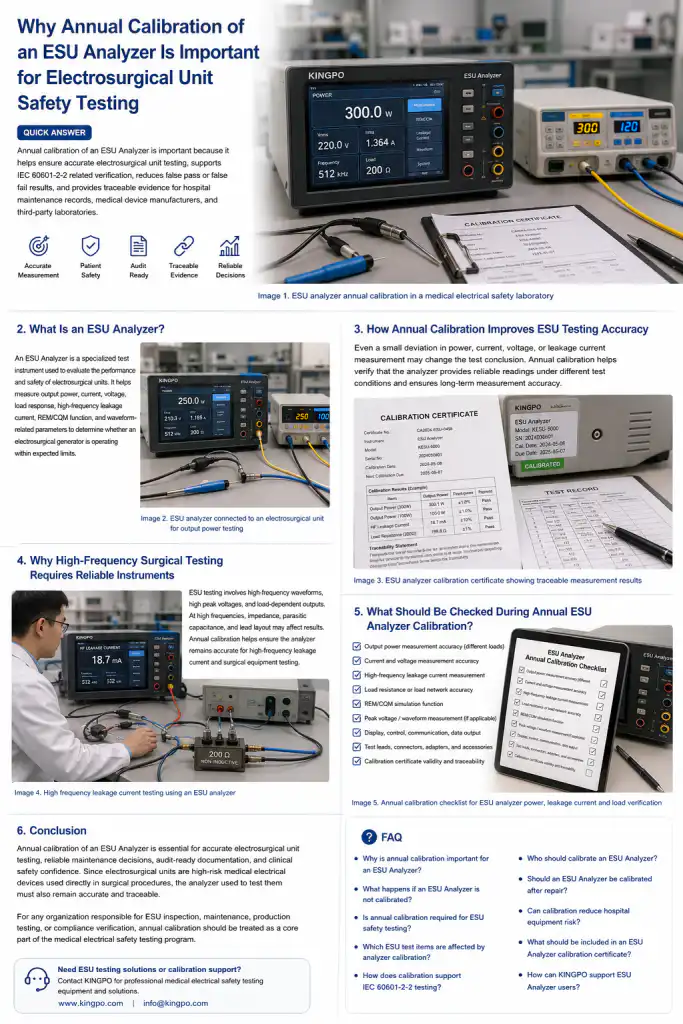
Quick Answer
Annual calibration of an ESU Analyzer is important because it helps ensure accurate electrosurgical unit testing, supports IEC 60601-2-2 related verification, reduces false pass or false fail results, and provides traceable evidence for hospital maintenance records, medical device manufacturers, and third-party laboratories.
Key Takeaways
An ESU Analyzer should be calibrated regularly to maintain reliable measurement accuracy.
Annual calibration helps verify output power, high-frequency leakage current, load response, REM/CQM simulation, and other ESU safety-related test functions.
A valid calibration certificate supports audit readiness, preventive maintenance documentation, and quality management.
Using an uncalibrated analyzer may lead to incorrect ESU test results, unnecessary downtime, or hidden clinical safety risks.
For high-risk medical electrical equipment such as electrosurgical units, annual calibration should be treated as part of the safety management process, not only as a routine administrative task.
What Is an ESU Analyzer?
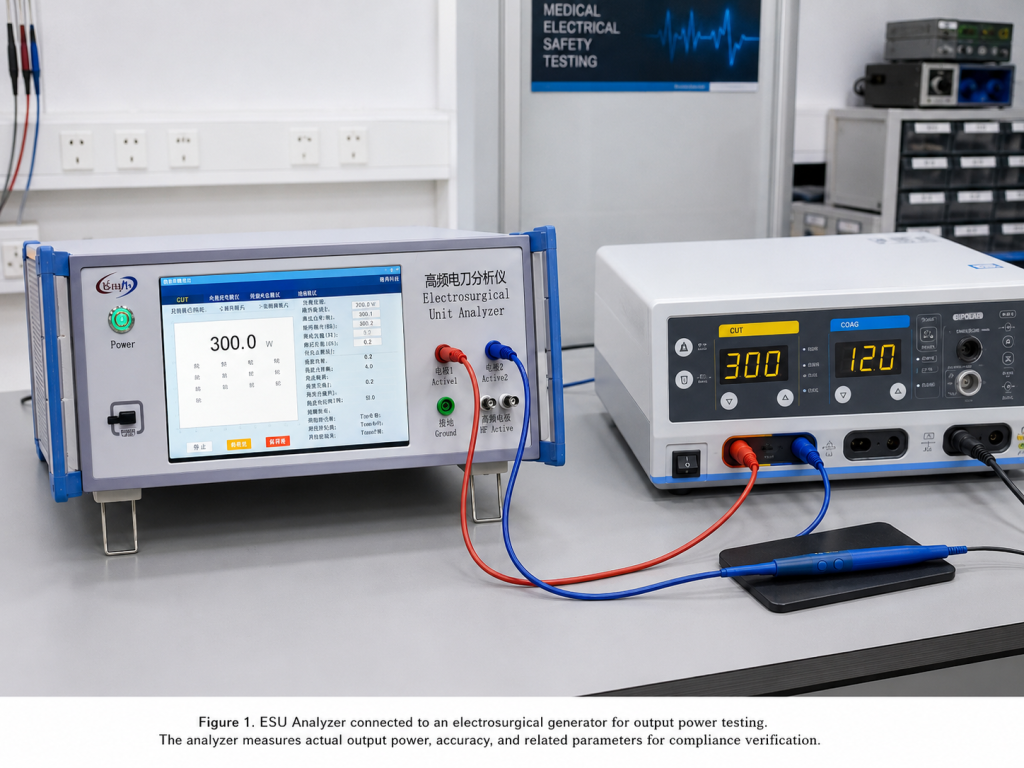
An ESU Analyzer is a specialized test instrument used to evaluate the performance and safety of electrosurgical units. Electrosurgical units generate high-frequency electrical energy for surgical cutting, coagulation, desiccation, and tissue treatment. Because these devices are used directly in clinical procedures, their output performance must be tested with reliable and accurate instruments.
A typical ESU Analyzer may be used to test output power, current, voltage, load response, high-frequency leakage current, return electrode monitoring function, contact quality monitoring, and waveform-related parameters. These measurements help biomedical engineers, manufacturers, and testing laboratories determine whether an electrosurgical generator is operating within expected limits.
Why Does an ESU Analyzer Need Annual Calibration?
An ESU Analyzer needs annual calibration because its internal measurement circuits, load networks, sensors, and electronic components may drift over time. This drift may be caused by frequent use, aging components, temperature and humidity changes, transportation, high-voltage exposure, or improper handling.
If the analyzer is not calibrated, the test result may no longer reflect the actual performance of the electrosurgical unit. In a medical electrical safety environment, inaccurate test results can affect maintenance decisions, compliance records, and clinical confidence.
Annual calibration confirms that the analyzer is still measuring within its specified accuracy range. It also provides documented evidence that the instrument remains suitable for ESU safety testing.
How Annual Calibration Improves ESU Testing Accuracy
The most direct benefit of annual calibration is measurement accuracy. During electrosurgical unit testing, even a small deviation in power, current, voltage, or leakage current measurement may change the test conclusion.
For example, if an ESU Analyzer reads lower than the actual output, an overpowered electrosurgical generator may be incorrectly accepted. If the analyzer reads higher than the actual output, a normal ESU may be incorrectly rejected and sent for unnecessary repair.
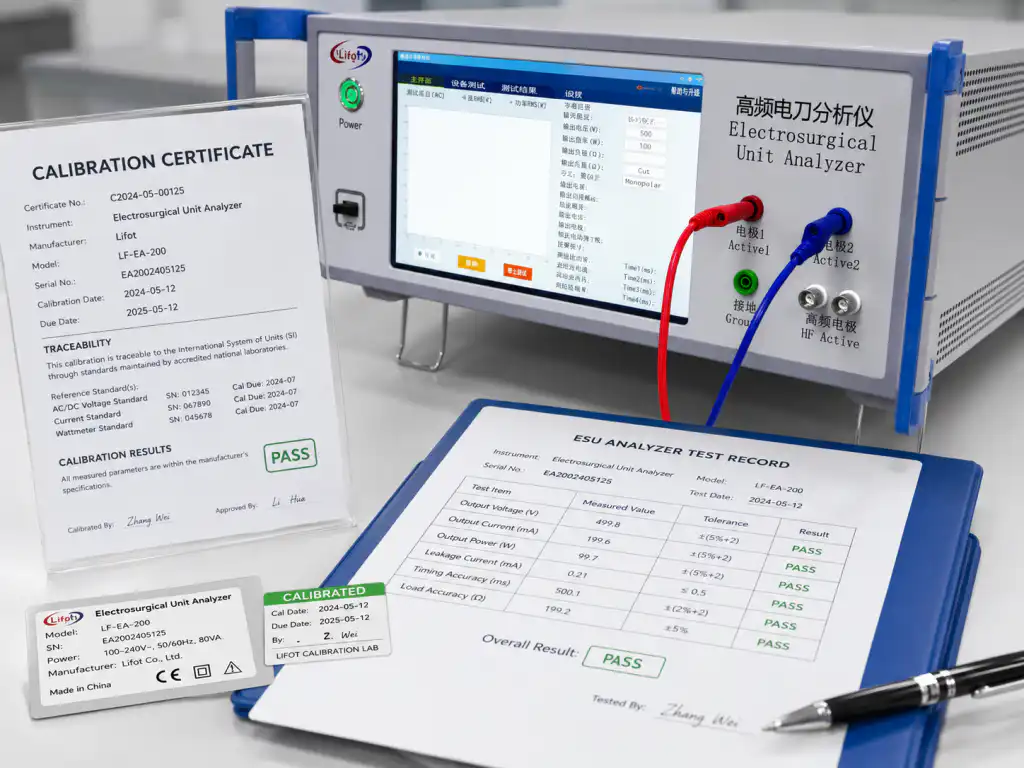
Annual calibration helps verify that the analyzer provides reliable readings under different test conditions. This is especially important when testing ESU output power at different load settings or checking high-frequency leakage current.
Supporting IEC 60601-2-2 Related Testing
IEC 60601-2-2 is widely used for high-frequency surgical equipment and high-frequency surgical accessories. In practical testing, ESU analyzers are commonly used to evaluate safety and performance-related parameters of electrosurgical generators.
A calibrated ESU Analyzer helps ensure that the measured values are meaningful and defensible. Without valid calibration, even a well-performed test may be questioned because the reliability of the measuring instrument cannot be proven.
For medical device manufacturers, annual analyzer calibration supports production quality control, design verification, final inspection, and internal laboratory management. For hospitals, it supports preventive maintenance records and electrical safety management. For third-party laboratories, it supports the credibility of test reports.
Reducing False Pass and False Fail Results
One of the most important reasons to calibrate an ESU Analyzer annually is to reduce the risk of false test conclusions.
A false pass occurs when an electrosurgical unit appears to meet the required test criteria, but the actual output or leakage current is abnormal. This may create potential risk during clinical use.
A false fail occurs when a normal ESU is incorrectly judged as defective. This can lead to unnecessary repair, additional cost, equipment downtime, and delayed clinical availability.
Annual calibration reduces both risks by confirming that the analyzer’s measurement channels, internal loads, leakage current functions, and simulation functions remain accurate.
Why High-Frequency Surgical Testing Requires Reliable Instruments
ESU testing is more complex than ordinary low-frequency electrical measurement. Electrosurgical generators may produce different waveforms, high peak voltages, high-frequency currents, and load-dependent output characteristics.
At high frequencies, measurement results may be influenced by impedance, parasitic capacitance, test lead layout, load stability, and analyzer condition. For this reason, the analyzer itself must be kept in a verified condition.
Annual calibration helps identify whether the ESU Analyzer is still suitable for high-frequency surgical equipment testing. It also helps detect possible problems before they affect daily testing work.
Calibration Provides Traceable Evidence for Quality Management
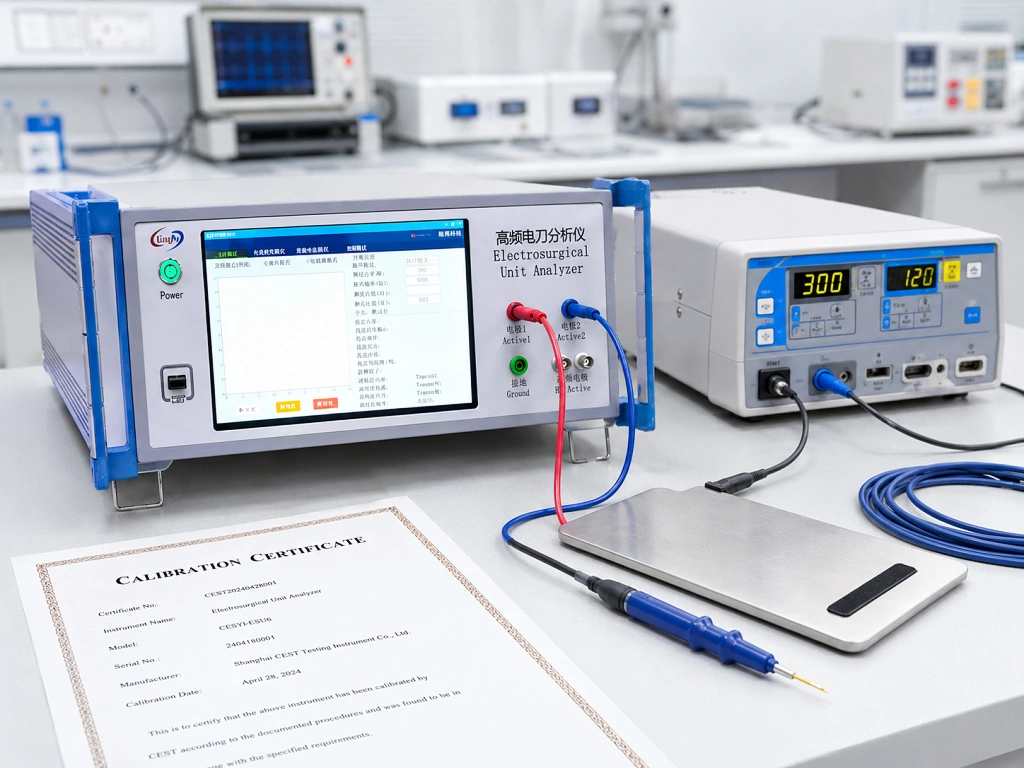
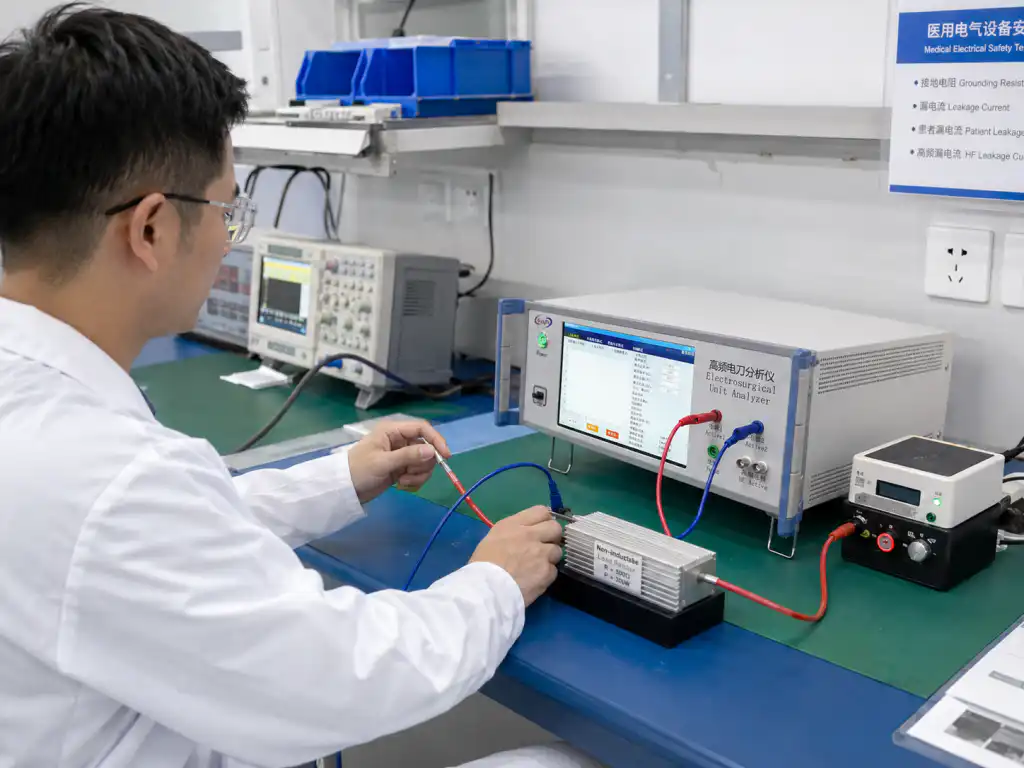
Calibration is not only about adjusting or checking a device. It is also about traceability. A valid calibration certificate shows that the analyzer has been compared with reference standards and that measurement uncertainty has been considered.
For hospitals, this supports medical equipment maintenance records. For manufacturers, it supports ISO 13485-style quality management and product release documentation. For testing laboratories, it supports internal quality control and customer audit requirements.
When a customer, auditor, or regulatory reviewer asks whether ESU test results are reliable, the calibration certificate is one of the most important supporting documents.
What Should Be Checked During Annual ESU Analyzer Calibration?
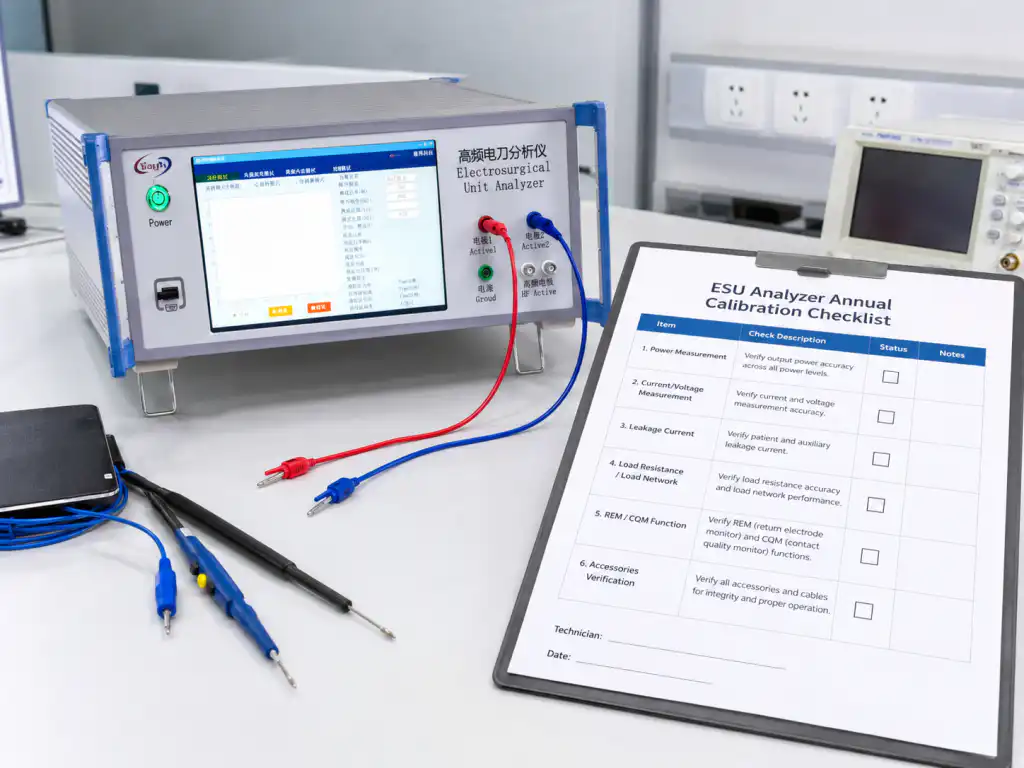
A complete annual calibration program should be based on the analyzer model, manufacturer’s specification, intended use, and laboratory quality system. In general, the following items should be considered:
Output power measurement accuracy under different load conditions
Current and voltage measurement accuracy
High-frequency leakage current measurement
Internal load resistance or load network accuracy
REM or CQM simulation function
Peak voltage or waveform-related measurement, if applicable
Display, control, communication, and data output functions
Test leads, connectors, adapters, and accessories
Calibration certificate validity and traceability information
How Often Should an ESU Analyzer Be Calibrated?
For many hospitals, manufacturers, and laboratories, annual calibration is a practical and commonly used interval. However, the actual calibration interval should also depend on the analyzer’s usage frequency, risk level, operating environment, transportation frequency, and internal quality requirements.
If the analyzer is used heavily, moved frequently, repaired, dropped, exposed to abnormal conditions, or suspected to produce unstable readings, calibration should be performed earlier instead of waiting for the next annual cycle.
Annual calibration should be considered the minimum routine practice for many professional ESU testing applications.
Who Needs Annual ESU Analyzer Calibration?
Annual calibration is especially important for:
Hospital biomedical engineering departments
Medical device manufacturers
Electrosurgical unit service providers
Third-party testing laboratories
Medical electrical safety laboratories
Regulatory and quality control laboratories
Organizations performing preventive maintenance for operating room equipment
In each of these environments, ESU Analyzer accuracy directly affects test confidence and equipment safety decisions.
Common Problems Caused by an Uncalibrated ESU Analyzer
An uncalibrated ESU Analyzer may cause several practical problems:
Unreliable output power readings
Incorrect leakage current test results
Inconsistent test data between different years
Questionable maintenance or inspection records
Higher risk of false pass or false fail decisions
Difficulty passing customer or quality system audits
Reduced confidence in ESU preventive maintenance results
For high-risk surgical equipment, these problems should not be ignored.
KINGPO ESU Analyzer Support for Medical Electrical Safety Testing
KINGPO provides professional testing solutions for medical electrical safety and electrosurgical unit verification. For laboratories that need ESU testing, annual calibration planning, or analyzer configuration support, KINGPO can help users select suitable equipment and build a more reliable test workflow.
Whether the application is hospital preventive maintenance, manufacturer quality control, after-repair verification, or third-party laboratory testing, a properly maintained and calibrated ESU Analyzer helps improve testing confidence and supports safer clinical equipment management.
Conclusion
Annual calibration of an ESU Analyzer is essential for accurate electrosurgical unit testing, reliable maintenance decisions, audit-ready documentation, and clinical safety confidence. Since electrosurgical units are high-risk medical electrical devices used directly in surgical procedures, the analyzer used to test them must also remain accurate and traceable.
For any organization responsible for ESU inspection, maintenance, production testing, or compliance verification, annual calibration should be treated as a core part of the medical electrical safety testing program.
FAQ
Why is annual calibration important for an ESU Analyzer?
Annual calibration helps confirm that the ESU Analyzer still measures output power, current, voltage, leakage current, and load response accurately. Without calibration, measurement drift may lead to incorrect ESU safety judgments, unreliable reports, or questionable maintenance records.
What happens if an ESU Analyzer is not calibrated?
If an ESU Analyzer is not calibrated, the test results may no longer be reliable. This can cause false pass results, false fail results, unnecessary repairs, hidden safety risks, and difficulty proving measurement reliability during quality audits.
Is annual calibration required for ESU safety testing?
Annual calibration is widely used as a practical interval for professional ESU testing. The exact interval should be determined by usage frequency, risk level, internal quality procedures, and manufacturer recommendations. Heavy-use instruments may require shorter intervals.
Which ESU test items are affected by analyzer calibration?
Calibration may affect output power measurement, current measurement, voltage measurement, high-frequency leakage current measurement, load resistance accuracy, REM/CQM simulation, peak voltage measurement, and waveform-related test functions, depending on the analyzer model.
How does calibration support IEC 60601-2-2 testing?
IEC 60601-2-2 focuses on high-frequency surgical equipment and accessories. A calibrated ESU Analyzer helps ensure that measurements used for related safety and performance verification are accurate, traceable, and defensible.
Who should calibrate an ESU Analyzer?
An ESU Analyzer should be calibrated by a qualified calibration laboratory or authorized service provider with suitable reference standards, documented procedures, and traceability. The calibration certificate should clearly state the measured items, results, uncertainty, and traceability information.
Should an ESU Analyzer be calibrated after repair?
Yes. If the analyzer has been repaired, dropped, modified, or exposed to abnormal operating conditions, it should be checked or calibrated before being used again for formal ESU testing. This helps avoid unreliable test results.
Can calibration reduce hospital equipment risk?
Yes. Calibration helps biomedical engineers make better decisions about whether electrosurgical units are safe for clinical use. Reliable ESU testing supports preventive maintenance, reduces unexpected equipment issues, and improves operating room safety confidence.
What should be included in an ESU Analyzer calibration certificate?
A useful certificate should include the instrument model, serial number, calibration date, calibration items, test results, acceptance criteria, uncertainty information, traceability statement, calibration laboratory details, and next recommended calibration date.
How can KINGPO support ESU Analyzer users?
KINGPO can support users with ESU Analyzer selection, medical electrical safety testing configuration, technical consultation, and calibration-related workflow planning. For hospitals, manufacturers, and laboratories, KINGPO helps build more reliable ESU testing solutions.