The terms salt fog test and salt spray test are often treated as if they describe two fundamentally different corrosion tests. In most international standards, however, the distinction is mainly terminology. The real engineering differences usually concern the test method—such as NSS, AASS, CASS or cyclic salt mist—the required environmental conditions, and the applicable product specification.
In most corrosion-testing standards, salt fog and salt spray refer to the same general principle: a saline solution is atomized to create a controlled corrosive atmosphere around test specimens. ASTM B117 itself uses the term “salt spray (fog).” The more important distinctions are between NSS, AASS, CASS and cyclic salt mist tests, each of which uses different conditions and serves different evaluation purposes.

Are Salt Fog and Salt Spray Tests Actually Different?
Usually, no. “Salt fog,” “salt spray” and “salt mist” are often different terms used for closely related corrosion-test environments rather than separate test mechanisms.
ASTM B117, for example, is formally titled Standard Practice for Operating Salt Spray (Fog) Apparatus. ISO 9227 uses the term salt spray tests, while IEC 60068 environmental testing uses the term salt mist.
Engineers should therefore not select a test simply because one document says “fog” and another says “spray.” The correct questions are: Which standard applies? Which method is required? What are the solution chemistry, pH, temperature, exposure cycle and acceptance criteria?
Salt Fog, Salt Spray and Salt Mist: Understanding the Terminology
The terminology varies among standards organizations and industries. This is one reason engineers searching for the “difference between salt fog and salt spray” often encounter conflicting explanations.
In practice, all three terms can describe an environment created by atomizing a saline solution into fine droplets inside a controlled corrosion-test chamber. Test specimens are exposed to the resulting corrosive atmosphere for a specified duration or test cycle.
| Standard | Terminology | Primary Focus |
|---|---|---|
| ASTM B117-26 | Salt Spray (Fog) | Defines the apparatus, procedures and environmental conditions for operating a controlled salt spray/fog chamber. |
| ISO 9227:2022 | Salt Spray Tests | Specifies NSS, AASS and CASS methods for metallic materials and protective coatings. |
| IEC 60068-2-11:2021 | Salt Mist — Test Ka | Environmental corrosion testing for electrotechnical components, equipment and materials. |
| IEC 60068-2-52:2017 | Salt Mist, Cyclic — Test Kb | Uses cyclic salt-mist exposure for products intended to withstand salt-laden atmospheres. |
Engineering takeaway: Do not assume that “salt fog” means a mild test while “salt spray” means that salt water is sprayed directly onto the specimen. Standard salt-spray equipment normally generates an atomized corrosive atmosphere rather than continuously directing a liquid jet at the product.
What Actually Changes? NSS, AASS and CASS Tests
When engineers need to distinguish between different salt corrosion tests, the more meaningful comparison is generally between NSS, AASS and CASS salt spray testing rather than between the words “fog” and “spray.”
ISO 9227:2022 specifies these three major methods. They differ primarily in solution chemistry, pH and operating temperature, which changes the corrosive environment and the types of materials or coating systems for which each method is useful.
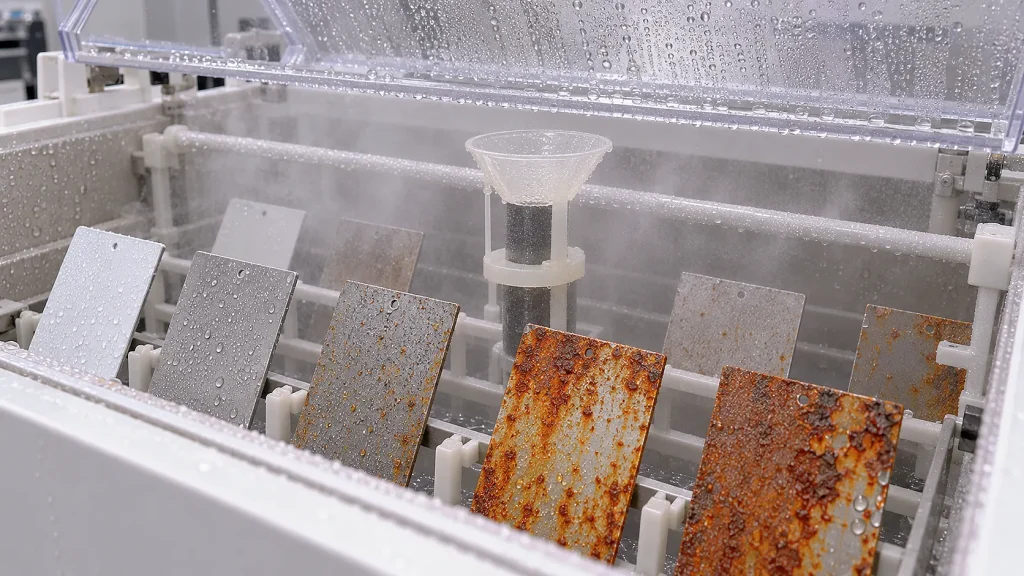
Neutral Salt Spray
NSS uses a neutral sodium chloride solution and is the most widely recognized general-purpose salt spray method.
It is commonly applied to metals, metallic coatings, conversion coatings, anodized surfaces and organic coatings on metallic substrates.
Acetic Acid Salt Spray
AASS acidifies the sodium chloride solution with acetic acid. The acidic environment changes corrosion behaviour and accelerates attack on certain coating systems.
It is used for selected decorative coatings, aluminium treatments and applications where an acidic salt spray environment is specified.
Copper-Accelerated Acetic Acid Salt Spray
CASS combines an acidic saline environment with copper acceleration and a higher chamber temperature.
It is particularly relevant to selected decorative nickel/chromium coating systems and other applications requiring a more aggressive laboratory corrosion environment.
| Method | General Environment | Typical Chamber Temperature | Collected Solution pH | Typical Engineering Use |
|---|---|---|---|---|
| NSS | Neutral sodium chloride solution | 35°C ± 2°C | 6.5–7.2 | General evaluation of metals, coatings and corrosion-protection systems |
| AASS | Acetic-acidified salt solution | 35°C ± 2°C | 3.1–3.3 | Selected decorative coatings and aluminium surface treatments |
| CASS | Copper-accelerated acidic salt solution | 50°C ± 2°C | 3.1–3.3 | More aggressive evaluation of selected decorative coating systems |
Important: These values are useful engineering references for ISO 9227-type testing. The applicable edition of the standard, the product specification and the customer’s test requirements remain the controlling documents. A compliance test should never be established from a general comparison table alone.
ASTM B117 vs ISO 9227 vs IEC 60068 Salt Mist Testing
A salt spray chamber may look similar regardless of the standard being used, but the test objective, operating conditions, specimen requirements, cycles and evaluation criteria can differ substantially.
| Standard | What It Defines | Typical Application | Important Point |
|---|---|---|---|
| ASTM B117-26 | Practice for operating salt spray (fog) apparatus and maintaining the test environment | Metals, coatings, automotive components, fasteners and numerous product specifications | Does not establish one universal product pass/fail requirement or one universal exposure duration. |
| ISO 9227:2022 | Apparatus, reagents and procedures for NSS, AASS and CASS | Metallic materials with or without permanent or temporary corrosion protection | Product-specific documents normally define test duration, specimen details and acceptance criteria. |
| IEC 60068-2-11:2021 | Test Ka: Salt mist | Electrotechnical components, equipment and materials | Used to evaluate corrosion resistance and coating quality in a salt-mist environment. |
| IEC 60068-2-52:2017 | Test Kb: Salt mist, cyclic | Components and equipment intended for salt-laden environments | Uses cyclic exposure instead of treating the test as one continuous salt-mist period. |
ASTM B117 Is a Test Environment Practice, Not a Universal Product Requirement
One common mistake is writing a specification such as “the product shall pass ASTM B117” without defining what “pass” actually means.
ASTM B117 provides the controlled corrosive environment and operating practice. A separate product or customer specification normally needs to define:
Typical Salt Spray Test Conditions Engineers Need to Control
Reliable corrosion testing depends on considerably more than simply filling a chamber with salt water. The laboratory must control the parameters that determine how the corrosive atmosphere reaches the specimen.
| Control Parameter | Why It Matters | What Engineers Should Verify |
|---|---|---|
| Salt concentration | Incorrect concentration changes the corrosive environment. | Solution preparation, water quality and collected-solution condition |
| pH | NSS, AASS and CASS require different chemical conditions. | Preparation pH and required collected-solution pH |
| Chamber temperature | Temperature affects test stability and corrosion behaviour. | Sensor accuracy, stability and actual operating temperature |
| Fog collection rate | Too little or too much deposition can invalidate the exposure environment. | Collection funnels and deposition across the exposure zone |
| Atomization | Poor atomization can produce uneven exposure or direct liquid impingement. | Nozzle condition, compressed-air quality and pressure |
| Specimen position | Orientation affects drainage, condensation and exposed area. | Angle, spacing, orientation and shielding |
| Condensate control | Dripping can create artificial localized corrosion. | Chamber geometry, lid design and specimen placement |
| Test duration | Exposure time normally comes from a product or customer specification. | Applicable product, customer or industry requirement |
For ISO 9227-type NSS, AASS and CASS testing, fog collection is commonly controlled at an average of approximately 1.5 mL/h ± 0.5 mL/h per 80 cm² horizontal collecting area. Stable collection across the exposure zone is an important indication that the chamber is generating an adequately distributed corrosive atmosphere.
How Does a Salt Spray Test Chamber Work?
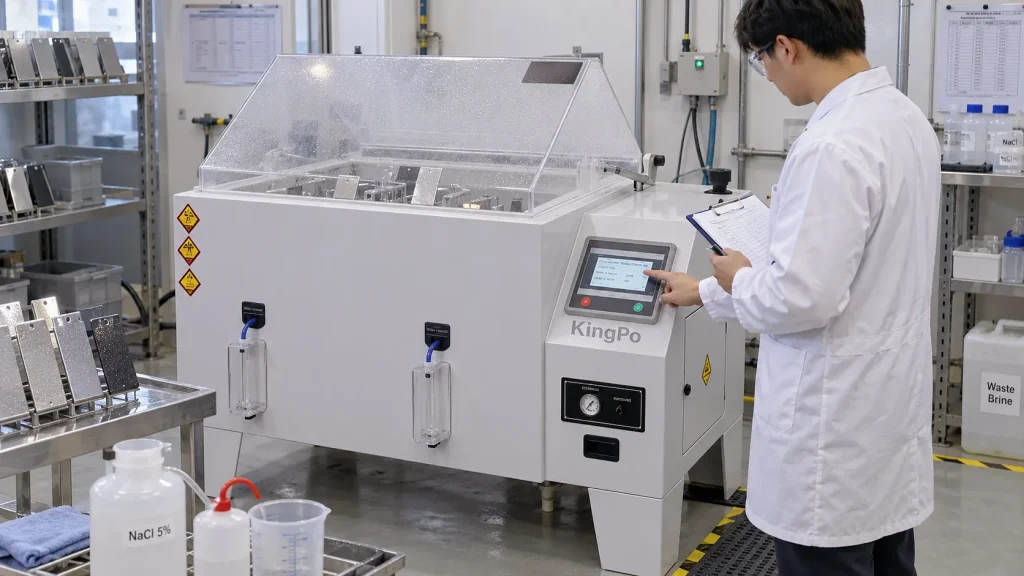
A standardized salt spray test chamber does not normally operate by aiming a high-flow liquid spray directly at the sample. Instead, it generates and distributes a controlled fine saline mist throughout the test volume.
Prepare Solution Prepare the required saline solution according to the selected test method.
Condition Air Clean compressed air is conditioned before reaching the atomizing system.
Atomize A precision nozzle converts the test solution into fine droplets.
Distribute Fog Chamber geometry distributes the corrosive atmosphere across the exposure area.
Verify Conditions Temperature, collection, chemistry and exposure time are monitored.
Why Fog Uniformity Matters
A chamber can display the correct temperature while still producing poor test reproducibility if salt deposition is uneven. Nozzle contamination, incorrect compressed-air conditions, specimen crowding or poor chamber geometry can all alter local exposure.
For this reason, a professional salt spray test should evaluate the complete exposure environment, not simply the temperature displayed by the controller.
How to Select a Salt Spray Test Chamber
Selecting a chamber only by nominal internal volume is a common procurement mistake. Engineers selecting environmental test chambers should first identify the required test method and then evaluate whether the chamber can maintain the relevant operating conditions with the intended specimen load.
Salt Spray Test Chamber for ASTM B117 & ISO 9227
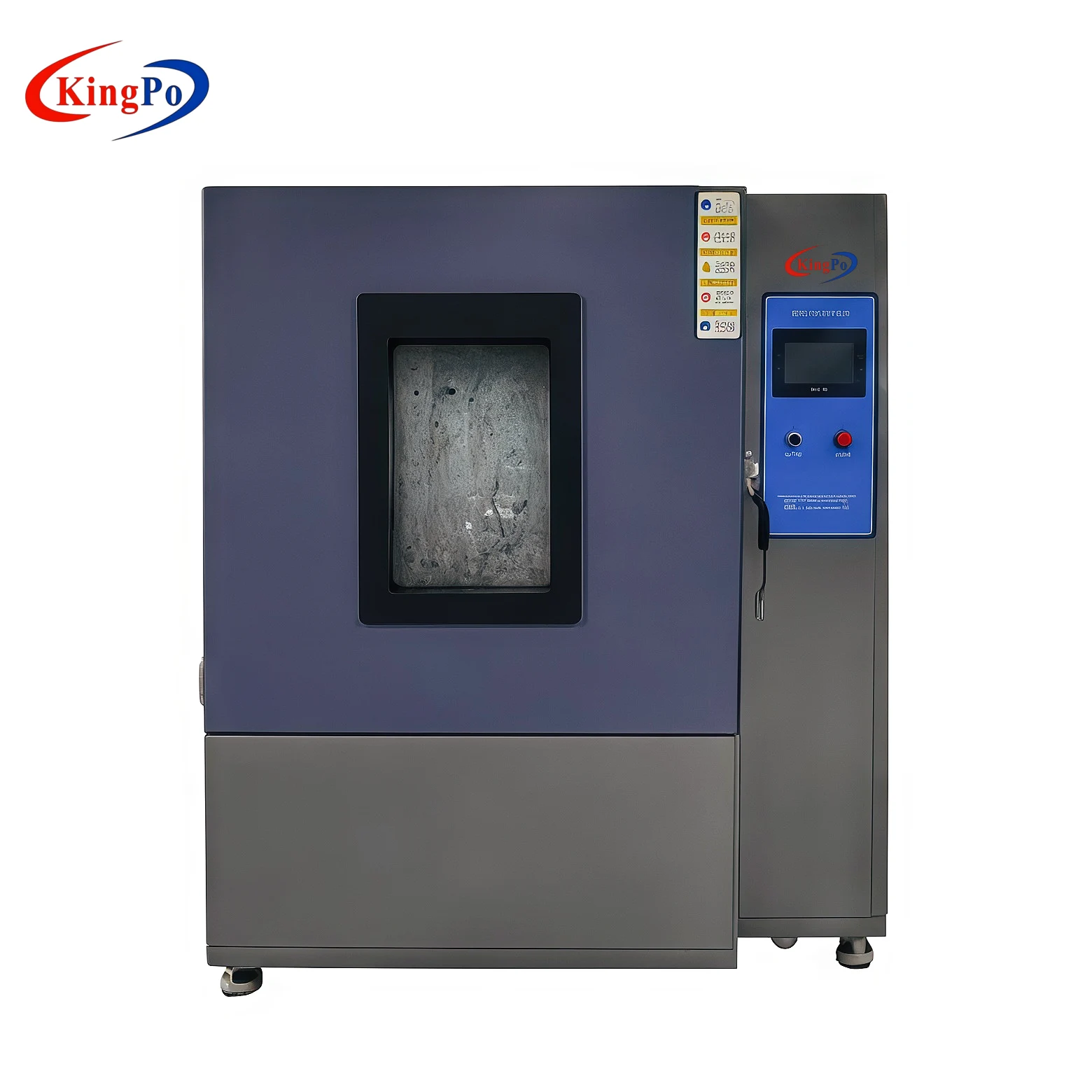
For laboratories performing NSS, AASS or optional CASS testing, KingPo provides a controlled salt spray test chamber with corrosion-resistant chamber construction, controlled atomization and configurable test capacity. The correct configuration should be selected according to the required standard, test method, specimen dimensions and laboratory workflow.
Common Salt Spray Testing Mistakes
Salt spray testing appears simple, but small deviations in chamber operation or specimen preparation can create significant differences in corrosion results.
NSS, AASS and CASS are chemically different test methods. Treating them as interchangeable can invalidate the test.
Temperature is only one parameter. Fog collection, solution chemistry, atomization and specimen arrangement also matter.
The objective is normally to create a controlled mist environment, not to wash the specimen with a direct liquid jet.
Closely packed specimens can shield one another and disturb mist circulation, producing non-uniform exposure.
Angle and position influence drainage, condensation and exposed area. Follow the applicable specification.
This can create localized conditions that do not represent the intended test environment.
Uncontrolled contaminants can affect solution chemistry and corrosion behaviour.
A chamber can appear to generate mist while deposition remains outside the required range.
Any deviation from the standard or customer specification should be controlled and recorded.
Salt spray tests are controlled accelerated comparisons; they are not universal lifetime-conversion models.
Can Salt Spray Test Hours Predict Real-World Service Life?

No universal conversion exists.
Statements such as “500 hours of salt spray equals five years outdoors” or “one salt spray hour equals several months of service” should not be treated as general engineering rules.
Real atmospheric corrosion depends on environmental variables that are not reproduced completely by a continuous salt spray test.
ASTM B117 cautions against assuming a direct correlation between stand-alone salt spray exposure and natural-environment performance unless suitable supporting field data are available.
ISO 9227 similarly treats salt spray testing primarily as a controlled method for evaluating whether the quality of materials or corrosion-protection systems is maintained. It should not be used as a universal method for predicting long-term field life.
So What Does a 500-Hour or 1000-Hour Salt Spray Requirement Mean?
It means that the product, coating or component must satisfy the defined acceptance criteria after exposure to the specified laboratory environment for that duration.
The significance of 500 hours or 1000 hours comes from the applicable product specification, customer requirement or validated qualification program—not from a universal formula converting test hours into calendar years.
Salt Fog vs Salt Spray: Engineering Summary
| Question | Practical Answer |
|---|---|
| Is salt fog different from salt spray? | Usually not as a fundamental test mechanism. The terms often describe the same general atomized saline test environment. |
| Does ASTM B117 distinguish salt spray from salt fog? | ASTM B117 uses both terms together: salt spray (fog). |
| What differences actually matter? | Standard, solution chemistry, pH, temperature, fog collection, cycle, specimen configuration and evaluation criteria. |
| What are NSS, AASS and CASS? | Three salt spray methods specified by ISO 9227 using different chemical and temperature conditions. |
| Is continuous salt spray the same as cyclic testing? | No. Cyclic testing introduces defined environmental phases and requires equipment capable of performing the specified sequence. |
| Can salt spray hours predict product lifetime? | Not through a universal conversion formula. Reliable field correlation requires product- and environment-specific evidence. |
Salt Fog and Salt Spray Test FAQs
1. What is the difference between a salt fog test and a salt spray test?
In most standards, the terms describe the same general principle: a saline solution is atomized inside a controlled chamber to create a corrosive mist or fog. ASTM B117 explicitly uses the expression “salt spray (fog).” Engineers should therefore focus on the applicable test standard and method rather than assuming salt fog and salt spray are fundamentally different tests.
2. Is ASTM B117 a salt fog or salt spray test?
It is both in terminology. ASTM B117 is titled Standard Practice for Operating Salt Spray (Fog) Apparatus. It specifies the apparatus, operating practice and environmental conditions, while product-specific requirements normally define exposure time and acceptance criteria.
3. What is the difference between NSS and CASS testing?
NSS uses a neutral sodium chloride environment and is widely used for general corrosion evaluation. CASS uses an acidified solution with copper acceleration and a higher test temperature. It is a different chemical environment commonly applied to selected decorative and protective coating systems.
4. What is AASS testing?
AASS means Acetic Acid Salt Spray. It uses a sodium chloride solution acidified with acetic acid. ISO 9227 specifies AASS alongside NSS and CASS. It is relevant to selected decorative coatings, aluminium surface treatments and applications requiring an acidic salt spray environment.
5. What temperature is used for salt spray testing?
The required temperature depends on the method. Under ISO 9227-type conditions, NSS and AASS typically operate at 35°C ± 2°C, while CASS operates at 50°C ± 2°C. Other standards or product specifications may require different conditions.
6. What is the purpose of a salt spray test?
Salt spray testing provides a controlled corrosive environment for evaluating materials, coatings and corrosion-protection systems. It is useful for quality control, detecting coating discontinuities and verifying that a specified corrosion-resistance requirement is maintained under standardized laboratory conditions.
7. Is salt spray testing the same as cyclic corrosion testing?
No. Traditional salt spray tests generally maintain a continuous defined corrosive environment, while cyclic corrosion tests alternate between different environmental phases. The chamber must support the exact sequence required by the applicable standard or customer specification.
8. Does passing 1000 hours of salt spray mean a product will last 10 years?
No. There is no universally valid conversion between salt spray hours and years of outdoor service. Real corrosion depends on climate, humidity, wet/dry cycling, pollutants, temperature, UV exposure, geometry and other factors.
9. How do I choose the correct salt spray chamber size?
Begin with actual specimen dimensions, quantity, required orientation and spacing rather than nominal chamber volume alone. The specimen arrangement must allow proper mist circulation and prevent shielding or dripping between samples.
10. What information should I provide when requesting a salt spray test chamber?
Provide the applicable standard, required method such as NSS, AASS or CASS, specimen dimensions and quantity, expected test duration, required chamber capacity, power supply, data-recording needs and calibration requirements. For cyclic testing, also provide the complete environmental sequence.
ASTM B117-26 — Standard Practice for Operating Salt Spray (Fog) Apparatus
ISO 9227:2022 — Corrosion tests in artificial atmospheres — Salt spray tests
IEC 60068-2-11:2021 — Environmental testing — Test Ka: Salt mist
IEC 60068-2-52:2017 — Environmental testing — Test Kb: Salt mist, cyclic
This article is intended as an engineering overview. Always use the official edition of the applicable standard and the relevant product specification when establishing a compliance test procedure.