IEC 60309 specifies plugs, fixed and portable socket-outlets, and appliance inlets primarily intended for industrial applications. IEC 60309-1 defines the general requirements, while IEC 60309-2 establishes dimensional compatibility for standardized pin-and-contact-tube configurations. Correct selection depends on rated voltage, frequency, current, pole arrangement, protective-earth position, clock position and the required ingress-protection level.
Industrial plugs and socket-outlets may look simple from the outside, but an IEC 60309 configuration contains considerably more information than its color or current rating. Two accessories with a similar circular housing can be electrically or mechanically incompatible because they are intended for different voltages, frequencies, pole arrangements or protective-earth positions.
This guide explains how IEC 60309 accessories are identified, how the major configuration parameters relate to one another, and how laboratories verify dimensional, electrical, mechanical and ingress-protection characteristics.
Key principle: an IEC 60309 accessory should not be identified from color or current rating alone. Voltage, frequency, pole configuration, protective-earth position, clock position and applicable IP rating must be considered together.
What Is IEC 60309?
IEC 60309 is a standards series covering plugs, socket-outlets and appliance inlets primarily intended for industrial use, both indoors and outdoors.
Typical applications include industrial machinery, factories, temporary power systems, construction sites, workshops, distribution equipment, event power systems and other environments where a more controlled and robust connection is required than a typical household plug and socket.
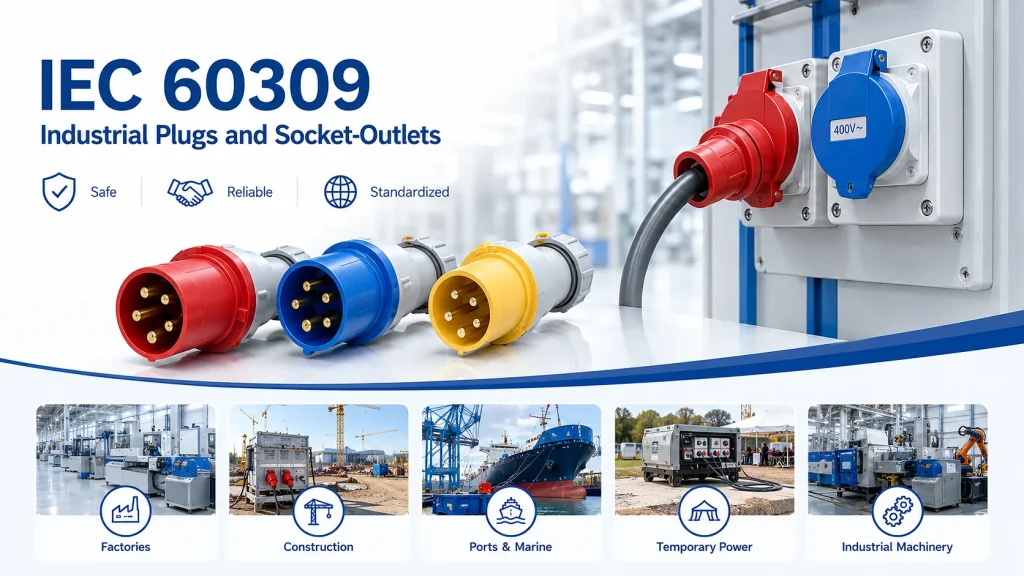
The standard system is designed not only to define electrical and mechanical requirements, but also to reduce the possibility of connecting accessories intended for incompatible electrical systems.
Current standard status
IEC 60309-1:2021 and IEC 60309-2:2021 are the fifth editions of the respective standards. IEC 60309-2:2021 is currently published as a corrected version incorporating Corrigendum 1 issued in August 2026.
Laboratories should always confirm the applicable standard edition and any amendments or corrigenda required by the certification or test program before beginning an evaluation.
IEC 60309-1 vs IEC 60309-2: What Is the Difference?
One of the easiest ways to understand the IEC 60309 series is to separate the general product requirements from the standardized interface dimensions.
| Standard | Main Role | Scope |
|---|---|---|
| IEC 60309-1:2021 | General requirements | Accessories up to 1,000 V AC/DC, AC frequency up to 500 Hz and rated current up to 800 A |
| IEC 60309-2:2021 | Dimensional compatibility of standardized pin-and-contact-tube accessories | Accessories up to 1,000 V AC/DC, AC frequency up to 500 Hz and rated current up to 125 A |
IEC 60309-2 is therefore not a replacement for IEC 60309-1. It is intended to be used together with Part 1.
A simple way to remember the difference is:
- IEC 60309-1: What general requirements must the accessory satisfy?
- IEC 60309-2: How must standardized interfaces be dimensioned so that compatible accessories mate correctly and incompatible configurations are prevented from mating?
IEC 60309 Terminology: Plug, Socket-Outlet and Appliance Inlet
Several accessory names appear repeatedly in IEC 60309 documentation. Understanding them makes the rest of the standard much easier to follow.
| Term | Practical Meaning |
|---|---|
| Plug | The cable-end accessory containing pins that is inserted into a corresponding socket-outlet. |
| Fixed socket-outlet | A socket-outlet installed on a wall, panel, enclosure or other fixed structure. |
| Portable socket-outlet | A cable-end socket accessory intended to receive a corresponding plug. |
| Appliance inlet | The power-entry accessory installed on equipment or machinery. |
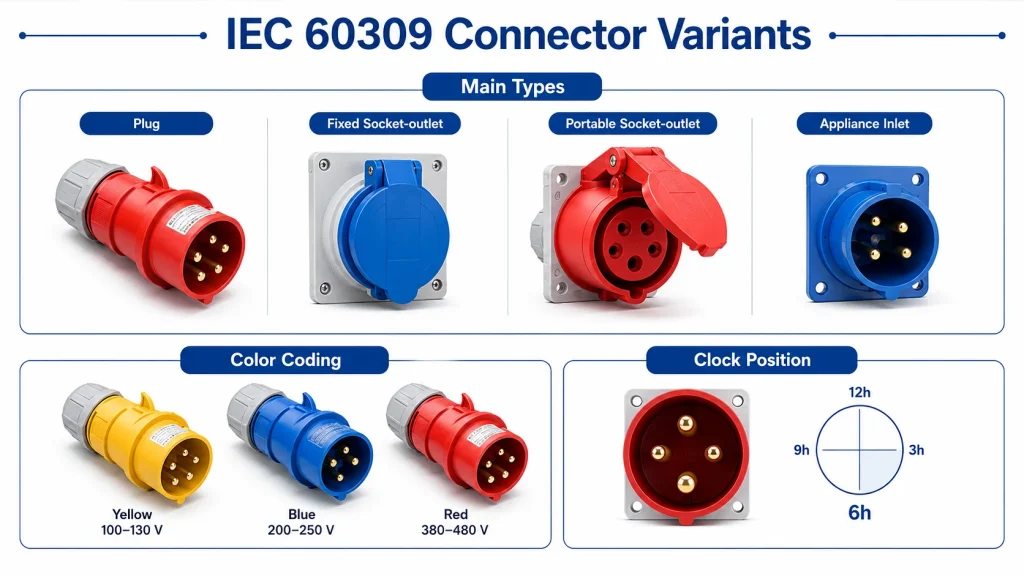
In general industry usage, the word connector is still widely used as a broad description for these accessories. IEC 60309-1:2021, however, replaced the earlier standard term “connector” with “portable socket-outlet” in the relevant terminology.
How Is an IEC 60309 Connector Configuration Identified?
An IEC 60309 accessory is identified by a combination of electrical, mechanical and environmental characteristics.
| Parameter | What It Tells You |
|---|---|
| Rated voltage | The electrical system for which the accessory is intended |
| Frequency | The applicable AC frequency range or DC application |
| Rated current | The standardized current class of the accessory |
| Pole configuration | The number and function of current-carrying, neutral and protective-earth contacts |
| Color | A visual indication associated with voltage or application range |
| Clock position | The position of the protective-earth contact used as part of the mechanical keying system |
| IP rating | The intended degree of protection against solid objects and/or water |
| Dimensional compatibility | Whether the standardized plug and socket geometry mates as required |
IEC 60309 Current Ratings
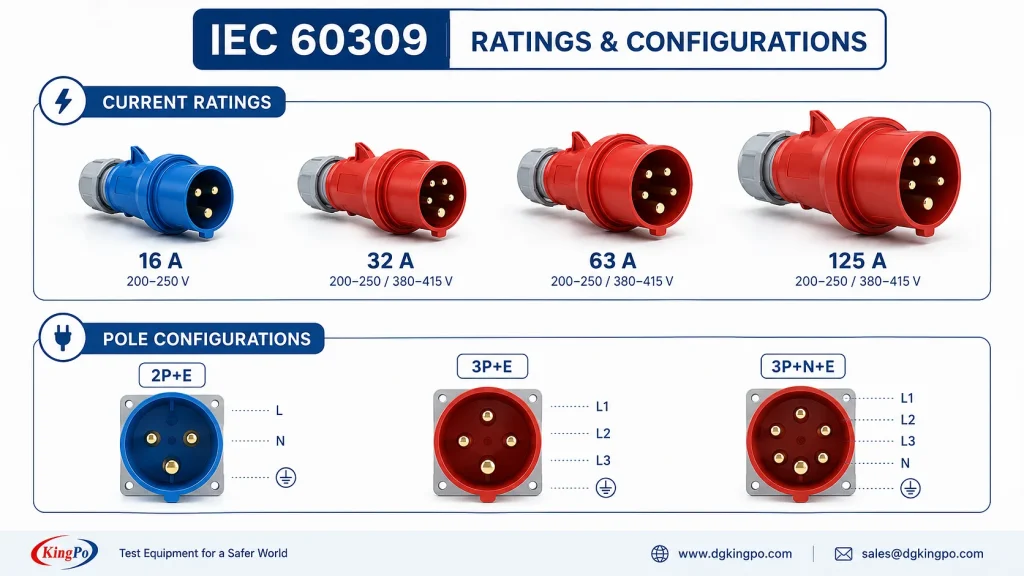
One of the most visible markings on an industrial plug or socket is its rated current.
For the standardized dimensional configurations commonly encountered under IEC 60309-2, the following paired ratings are widely used:
| Common Series I Rating | Corresponding Series II Rating |
|---|---|
| 16 A | 20 A |
| 32 A | 30 A |
| 63 A | 60 A |
| 125 A | 100 A |
These should not be interpreted as the only current ratings covered by the entire IEC 60309 series. IEC 60309-1 has a broader scope extending up to 800 A.
Cable sizing note: conductor size should be selected according to the accessory manufacturer’s terminal specification, cable ampacity, installation conditions and applicable wiring requirements. Connector current rating alone should not be treated as a universal conductor-sizing rule.
What Do 2P+E, 3P+E and 3P+N+E Mean?
Pole configuration describes the electrical contacts available in the accessory. Common IEC 60309 descriptions include:
| Configuration | Meaning |
|---|---|
| 2P+E | Two current-carrying conductors plus protective earth |
| 1P+N+E | One phase conductor, neutral and protective earth |
| 3P+E | Three phase conductors plus protective earth |
| 3P+N+E | Three phase conductors, neutral and protective earth |
The correct pole configuration therefore depends on the electrical supply and the equipment being powered. A three-phase load that does not require a neutral conductor can use a different configuration from equipment that requires both three phases and neutral.
IEC 60309 Color Coding and Clock Position
Color is one of the easiest IEC 60309 characteristics to recognize, but it is only one part of the identification system.
Common examples include:
- Yellow: commonly associated with 100–130 V configurations
- Blue: commonly associated with 200–250 V configurations
- Red: commonly associated with industrial three-phase voltage ranges such as 380–415 V
Other colors and voltage/frequency combinations also exist. The actual rating and configuration must therefore be confirmed from the accessory marking and mechanical keying arrangement rather than from color alone.
What Is the IEC 60309 Clock Position?
Imagine the front face of the socket-outlet as a clock dial. The location of the protective-earth contact can then be described using an hour position such as 4h, 6h or 9h.
Common example:
A 3P+E accessory intended for 380–415 V at 50/60 Hz commonly uses a 6h protective-earth position.
Changing the earth-contact position changes the mechanical arrangement and helps prevent an accessory designed for one voltage or frequency combination from mating with an incompatible configuration.
The clock position therefore acts as a form of mechanical keying. The system combines electrical markings, contact arrangement and mechanical geometry rather than relying on color alone.
Ingress Protection for IEC 60309 Accessories
IEC 60309 accessories are frequently used in industrial environments where they may be exposed to dust, rain, splashing water, washdown or other environmental conditions.
Depending on the accessory design and intended environment, different ingress-protection ratings may be specified.
| Example Rating | Typical Protection Context |
|---|---|
| IP44 | Protection against specified solid-object access and splashing-water conditions |
| IP67 | Dust-tight construction with protection for the specified temporary-immersion test conditions |
| IPX9 | High-pressure and high-temperature water-jet protection where the accessory is rated accordingly |
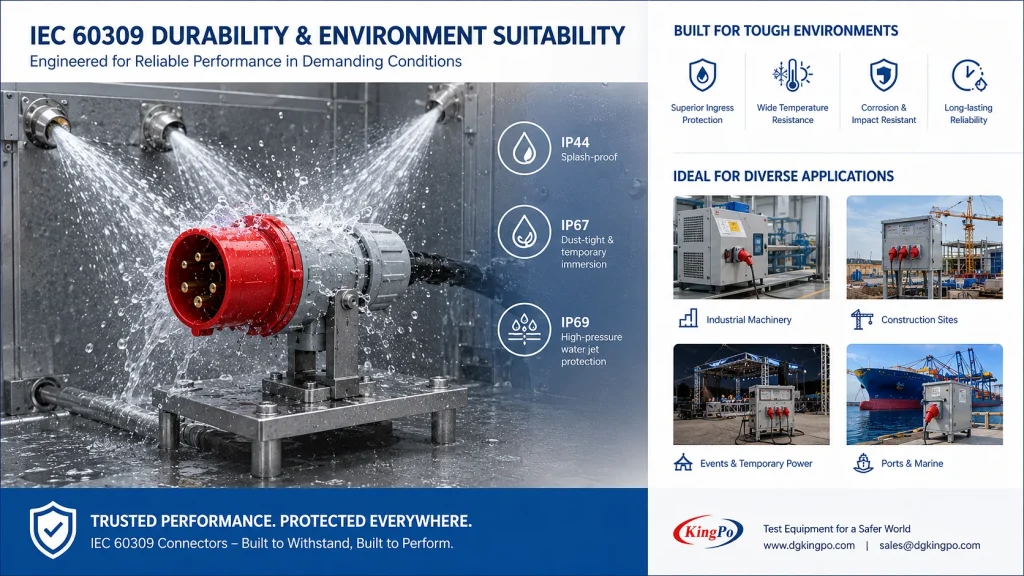
IEC 60309-2:2021 introduced additional IPX9 rating provisions compared with the previous edition.
Laboratories evaluating the claimed enclosure protection can use dedicated IEC 60529 IP Testing Equipment appropriate to the required protection level.
How Are IEC 60309 Plugs and Socket-Outlets Verified?
Dimensional compatibility is only one part of the product evaluation. A complete IEC 60309 assessment can involve several different testing disciplines, depending on the accessory type and claimed characteristics.
| Verification Area | What Is Evaluated? | Typical Laboratory Equipment |
|---|---|---|
| Dimensional compatibility | Pin positions, contact-tube geometry and standardized mating relationships | IEC 60309-2 dedicated gauges and dimensional fixtures |
| Electrical safety | Applicable earthing, insulation, dielectric, temperature and electrical characteristics | Electrical safety test instruments and dedicated circuits |
| Mechanical performance | Mechanical strength, retention, insertion/withdrawal characteristics and applicable endurance requirements | Plug/socket mechanical testers, force equipment and dedicated fixtures |
| Ingress protection | Claimed protection against dust and/or water | Dust chambers, water spray, water-jet, immersion or high-pressure water test systems |
| Product-specific requirements | Materials, terminals, shutters where applicable and other construction requirements | Dedicated gauges, fixtures and measurement equipment according to the applicable clause |
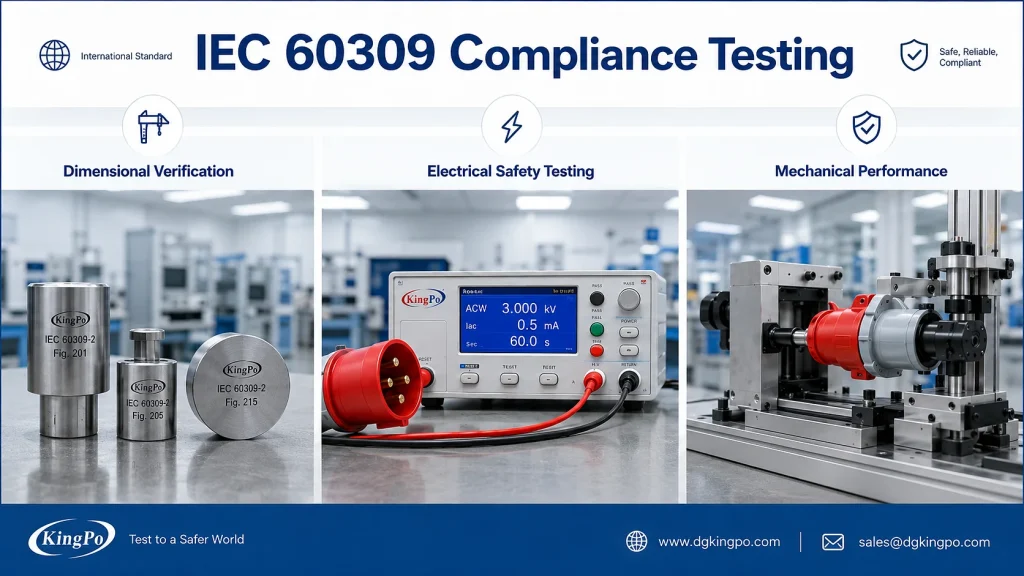
Important: this does not mean that every IEC 60309 plug manufactured must undergo the complete type-test program before shipment. Type testing, production quality control and routine inspection serve different purposes.
Type Testing vs Production Quality Control
It is useful to separate a product’s initial compliance evaluation from the checks performed during normal production.
| Stage | Purpose | Typical Approach |
|---|---|---|
| Design / Type Testing | Verify that a representative product design satisfies the applicable requirements | Broad test program including dimensional, electrical, mechanical and environmental tests as applicable |
| Production Quality Control | Monitor whether manufacturing remains consistent with the approved design | Process checks, dimensional inspection, gauges and sampling according to the manufacturer’s quality plan |
| Routine / Final Inspection | Detect manufacturing or assembly defects before shipment | Selected rapid checks appropriate to the product and production process |
Destructive, long-duration or environmental type tests are therefore not necessarily repeated on every production unit. The exact production inspection program depends on the applicable certification scheme, manufacturer’s quality plan and product requirements.
IEC 60309-2 Dimensional Compatibility and Test Gauges
IEC 60309-2 is particularly important to laboratories and manufacturers because standardized industrial plugs and socket-outlets must maintain defined mechanical compatibility.
A plug intended to mate with a corresponding socket-outlet must fit correctly, while an incompatible voltage, frequency or mechanical configuration should not be capable of unintended mating.
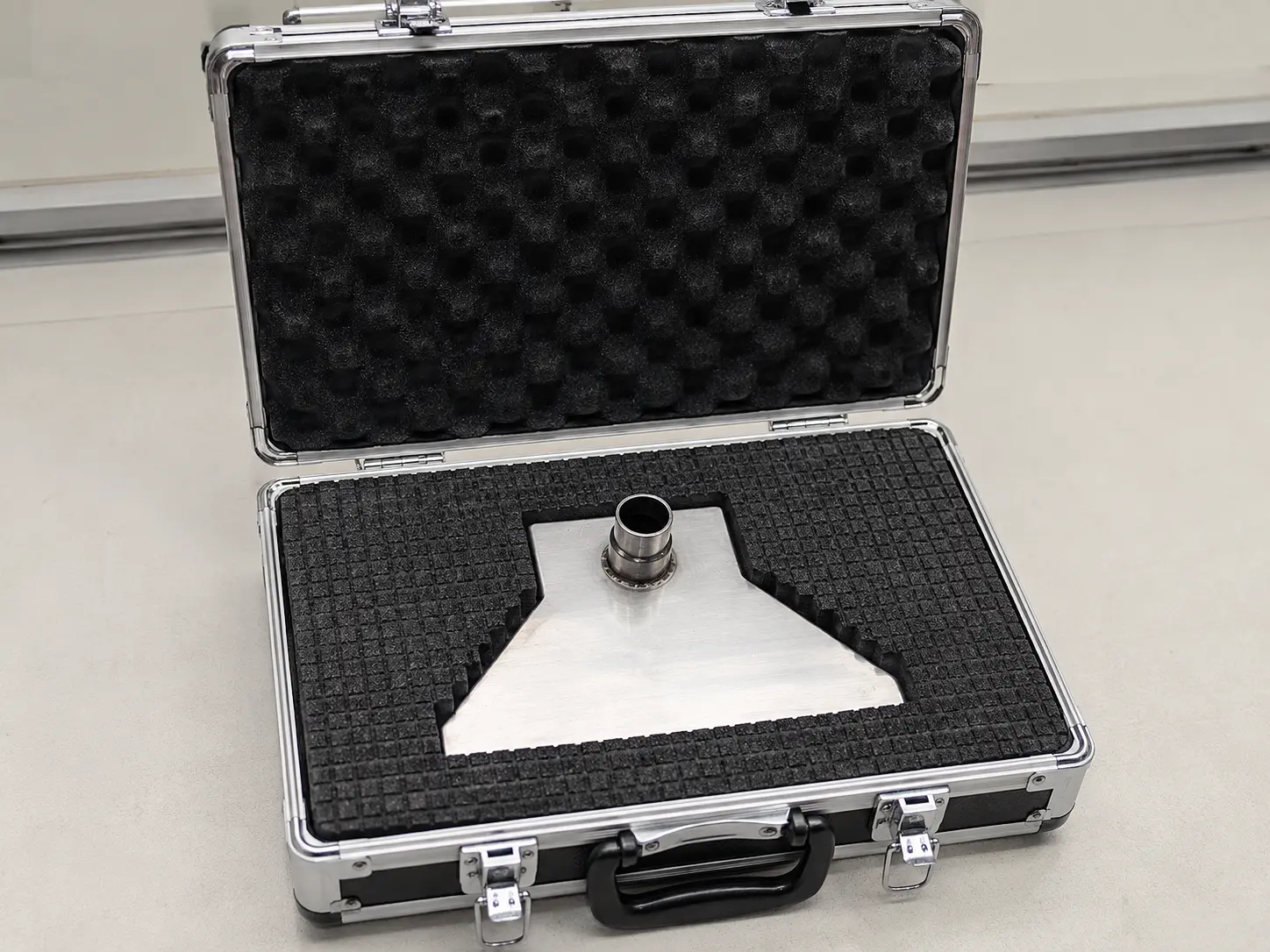
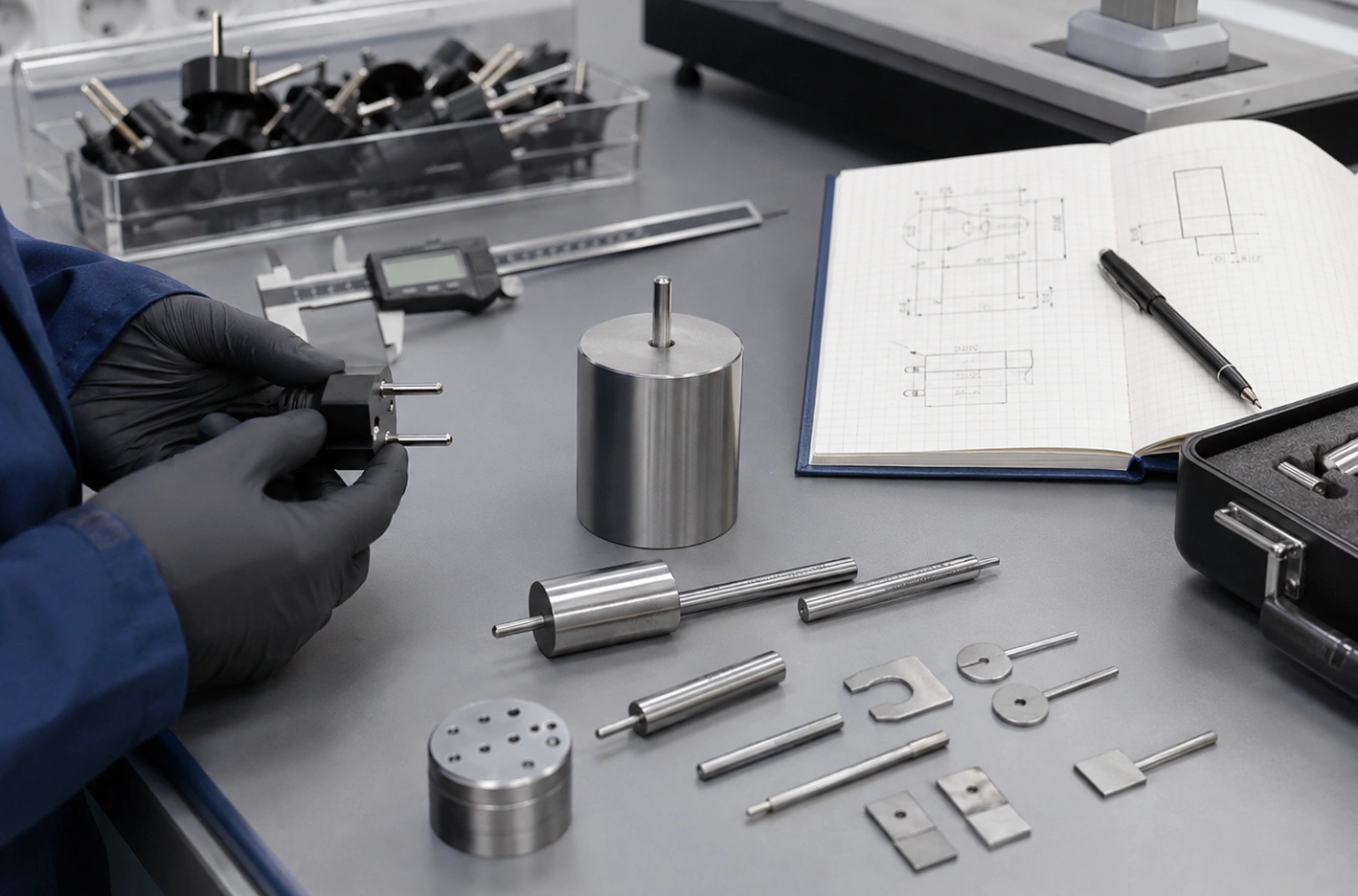
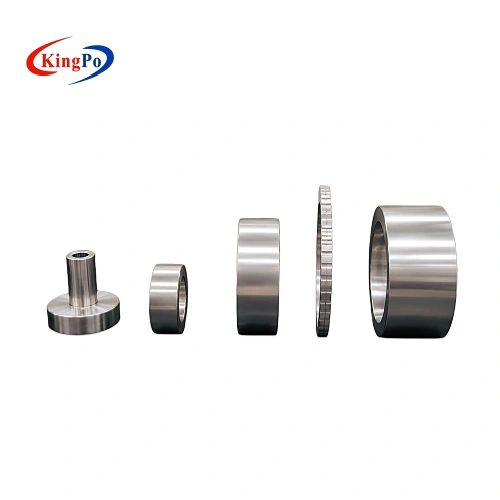
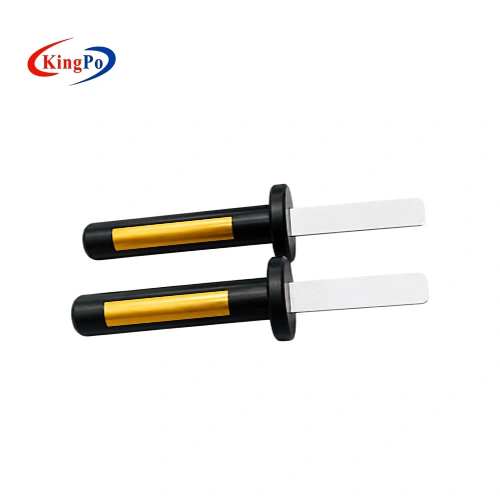
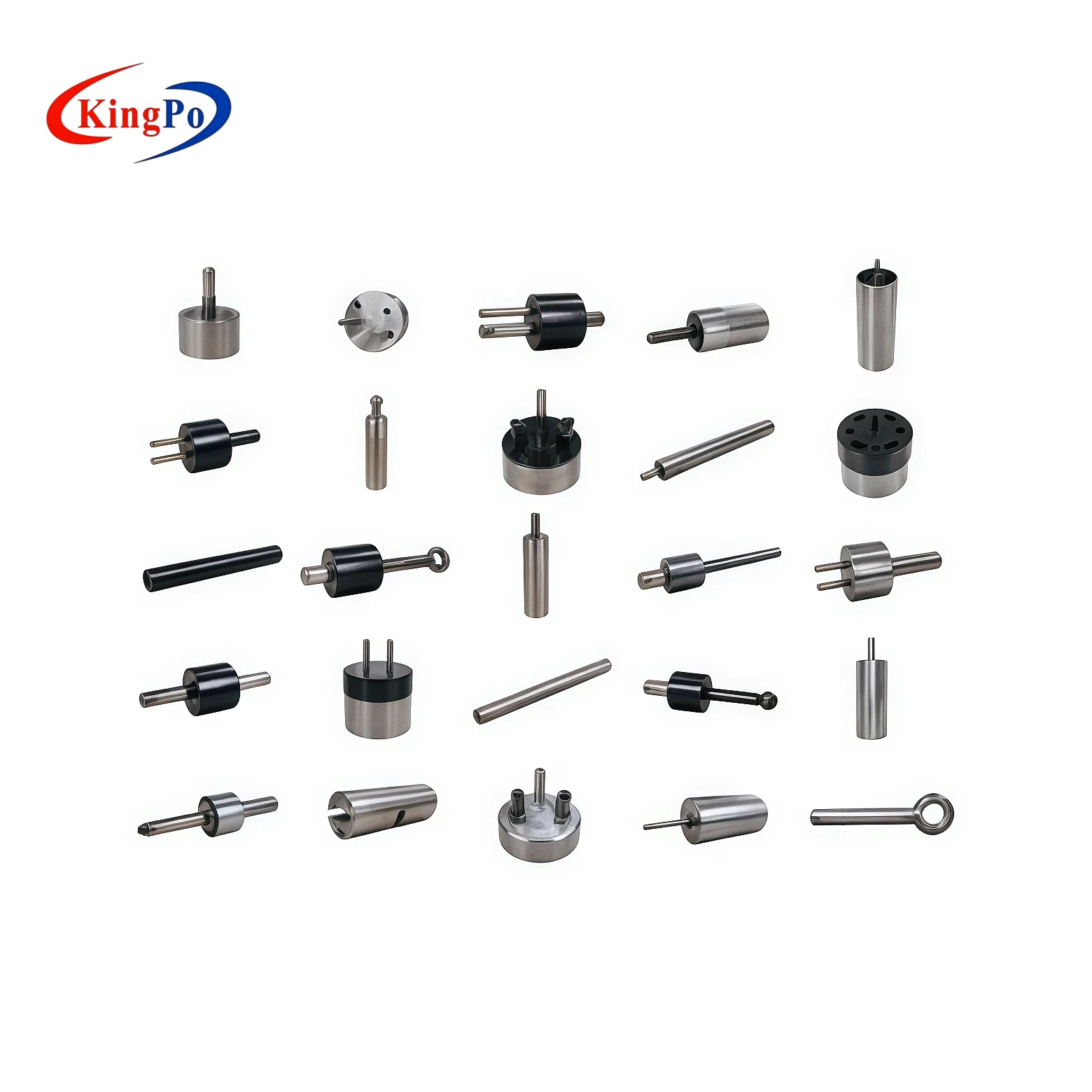
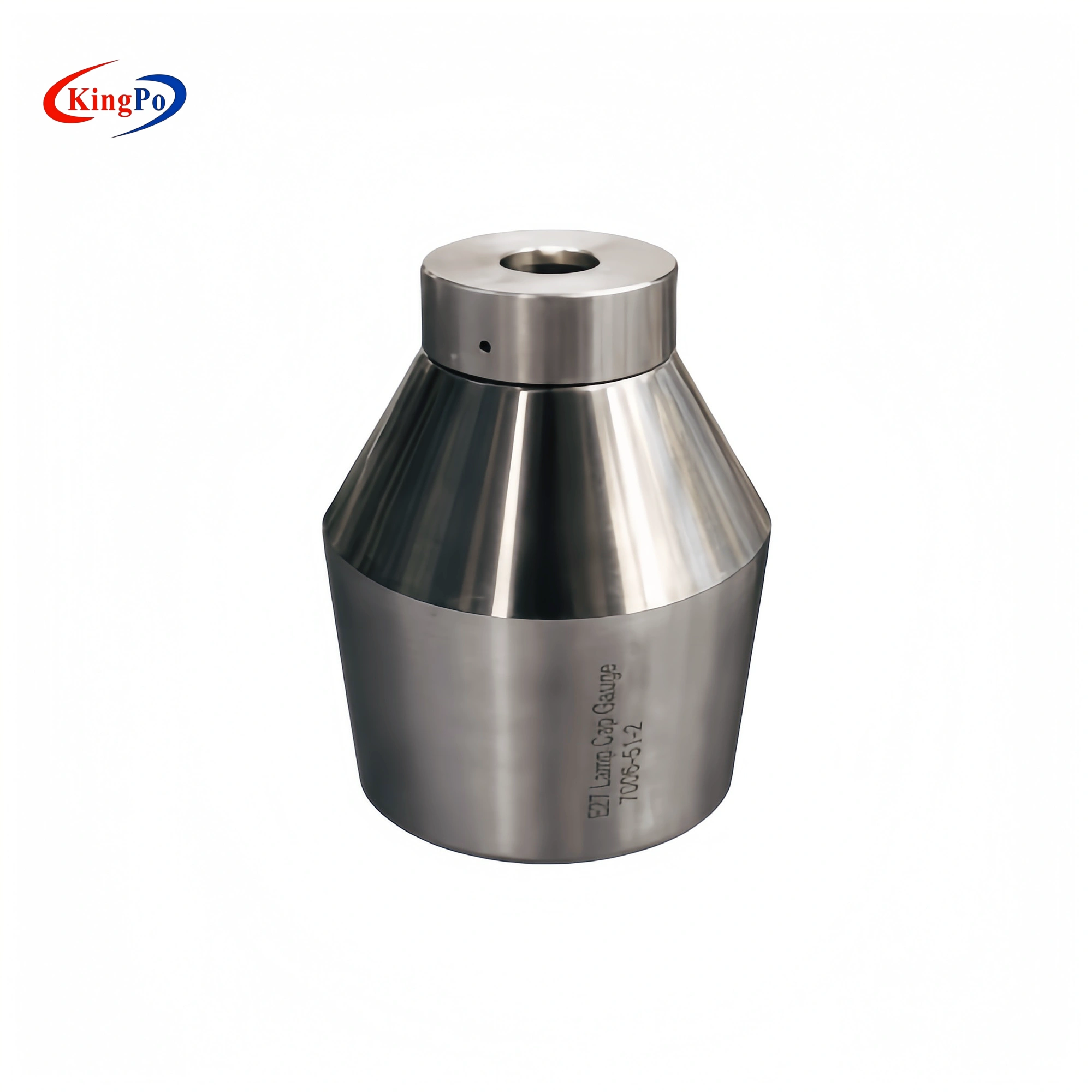
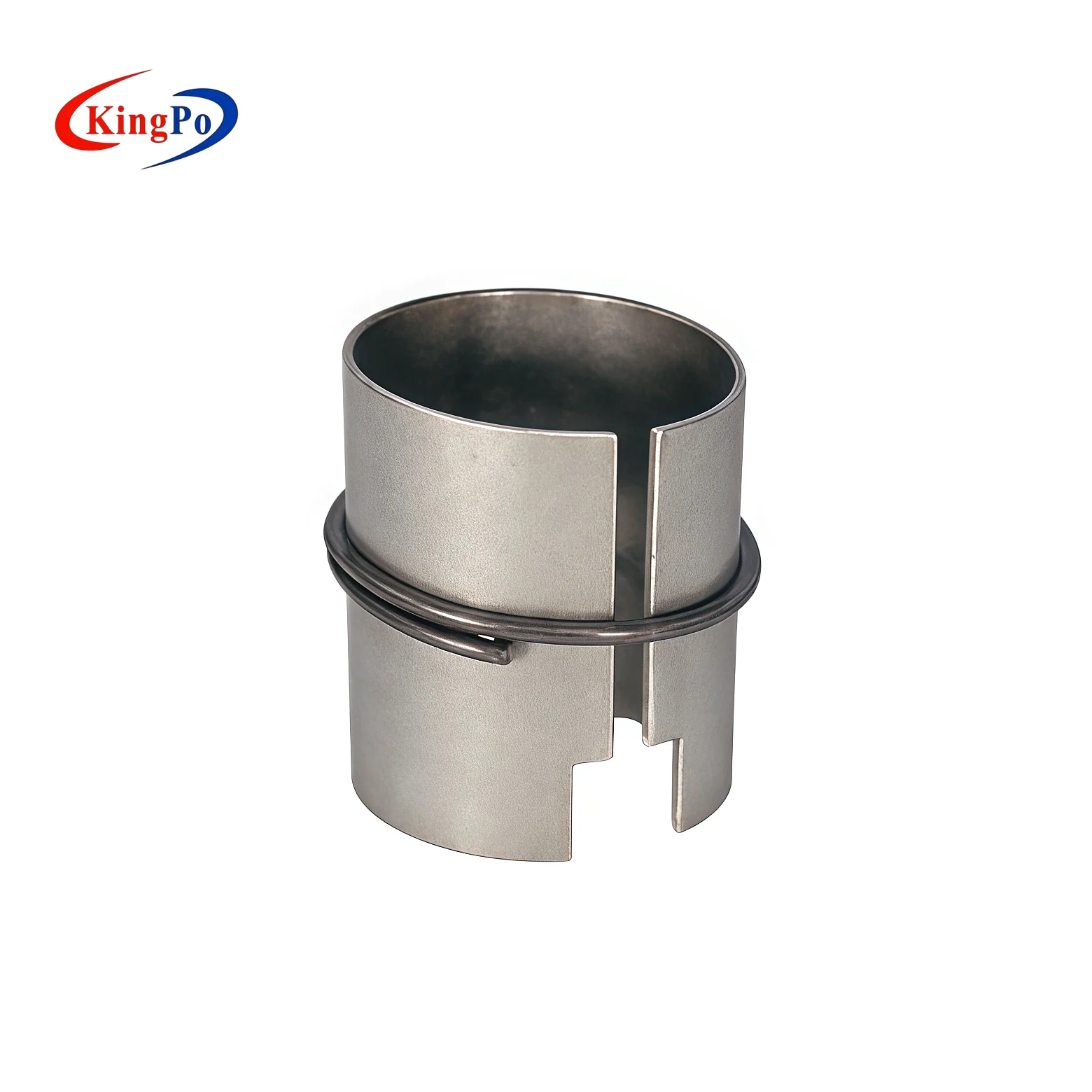
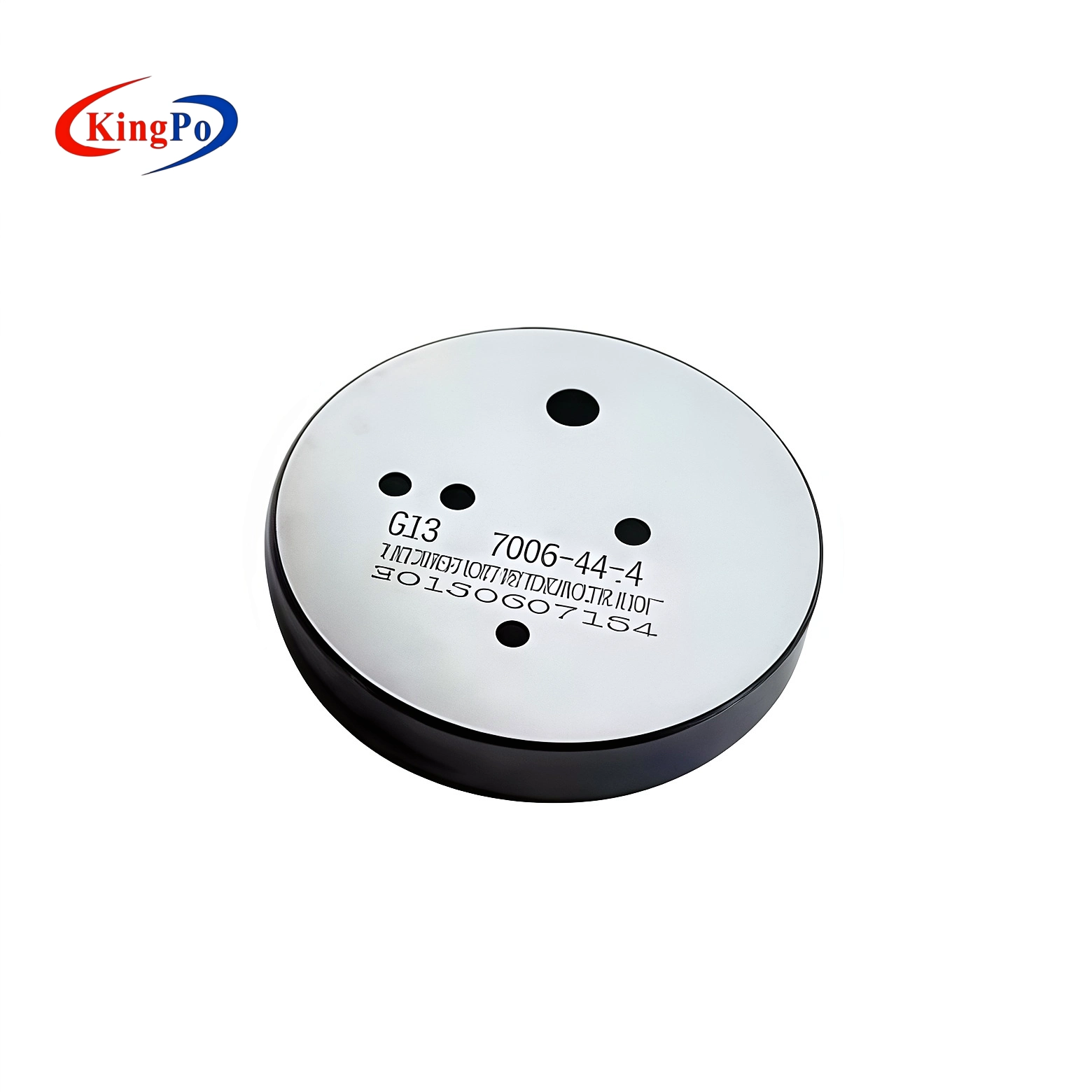
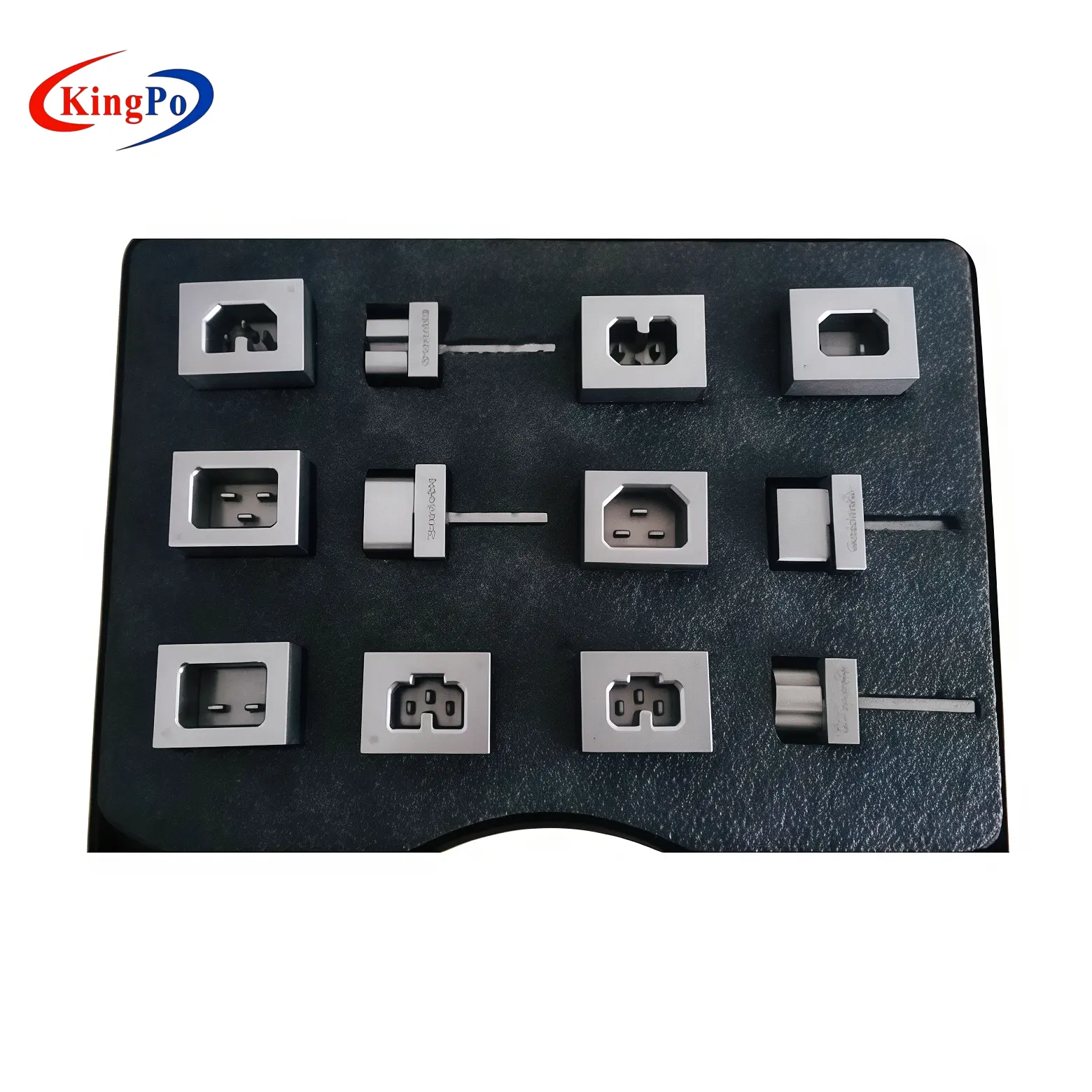
Ordinary dimensional tools such as calipers can be useful during general dimensional inspection, but some standardized compatibility checks are performed using dedicated IEC 60309-2 gauges and test fixtures.
Need the detailed gauge test procedure?
See the IEC 60309-2 Gauge Testing Guide for the dedicated dimensional verification workflow and applicable gauge figures.
Need the physical gauges?
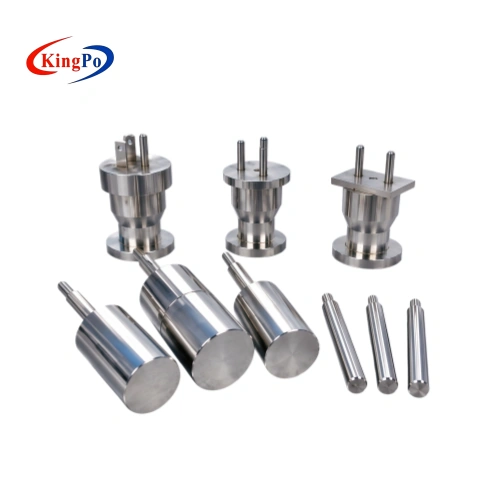
See the KingPo IEC 60309 Gauge Set for laboratory gauge configurations.
This separation is important: the present page explains the IEC 60309 configuration system and how accessories are selected, while the dedicated gauge guide explains how dimensional compatibility is actually evaluated in the laboratory.
How to Select the Correct IEC 60309 Configuration
A practical selection process can be reduced to seven engineering checks.
- Confirm the supply voltage. Identify the nominal operating voltage of the electrical system.
- Confirm AC/DC and frequency. Determine whether the accessory is intended for 50 Hz, 60 Hz, another AC frequency range or DC.
- Determine the required current rating. Select the standardized accessory current class appropriate to the equipment and circuit.
- Determine the pole configuration. Confirm whether the system requires phase conductors, neutral and protective earth.
- Check color and clock position. Use the accessory marking and protective-earth position to confirm the intended voltage/frequency configuration.
- Select the required ingress protection. Consider dust, rain, splash, washdown and other environmental exposure.
- Verify mechanical and dimensional compatibility. For manufacturing or conformity assessment, use the applicable IEC 60309-2 dimensional checks and dedicated gauges where required.
Example: Reading an IEC 60309 Connector Description
Consider a specification such as:
IEC 60309 — 32 A — 400 V — 3P+N+E — 6h — IP67
This description can be read as:
- IEC 60309: industrial plug/socket standard family
- 32 A: rated current
- 400 V: rated operating voltage
- 3P+N+E: three phases, neutral and protective earth
- 6h: protective-earth clock position for the applicable configuration
- IP67: specified ingress-protection rating
Reading the complete marking is much more reliable than attempting to identify an IEC 60309 accessory from housing color alone.
Common IEC 60309 Selection and Testing Mistakes
Choosing a Connector by Color Alone
Color is useful for rapid identification but does not define the complete electrical and mechanical configuration. Clock position, voltage, frequency and pole arrangement must also be confirmed.
Assuming 16 A, 32 A, 63 A and 125 A Are the Only IEC 60309 Ratings
These are common standardized dimensional ratings under IEC 60309-2, but IEC 60309-1 itself covers a broader current range.
Using Current Rating as a Universal Cable-Size Rule
Cable sizing depends on more than connector current rating. Terminal capacity, conductor type, installation conditions and applicable wiring requirements must also be considered.
Using Calipers as a Substitute for All Compatibility Gauges
Dimensional measurement can support quality inspection, but dedicated standardized gauges may be required where IEC 60309-2 specifies functional dimensional compatibility checks.
Assuming Every Production Unit Receives the Full Type-Test Program
Type testing, production quality control and routine inspection have different objectives. Environmental, endurance or destructive tests are not automatically repeated on every manufactured unit.
KingPo Test Equipment for IEC 60309 Verification
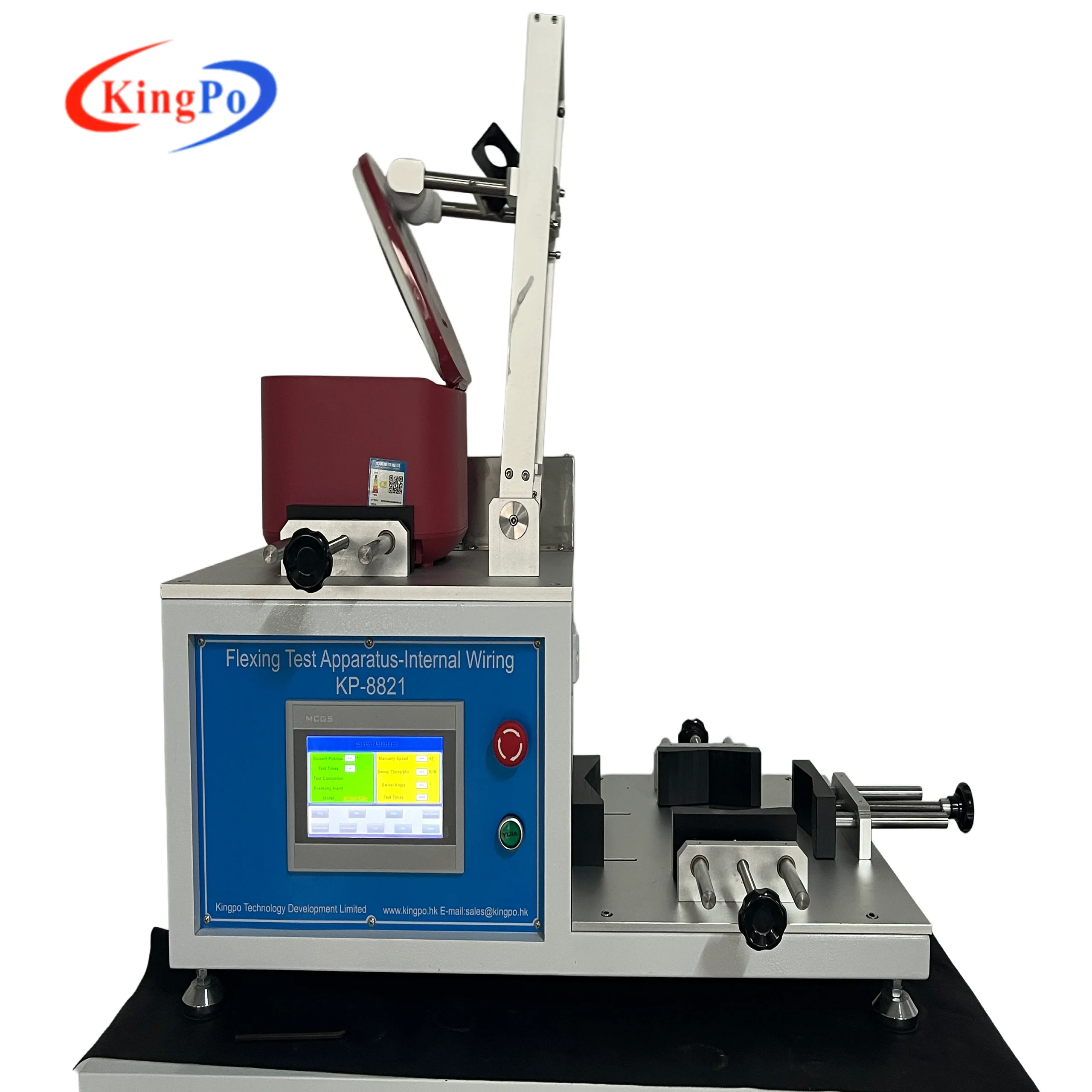
IEC 60309 product verification can require equipment from several laboratory disciplines. KingPo supplies dedicated test equipment and fixtures that can support dimensional, electrical, mechanical and ingress-protection evaluation according to the applicable test requirement.
| Requirement | KingPo Route |
|---|---|
| IEC 60309-2 dimensional compatibility | IEC 60309 Gauge Set |
| Gauge test method and application | IEC 60309-2 Gauge Testing Guide |
| IP dust and water verification | IEC 60529 IP Testing Equipment |
| Plug/socket laboratory equipment | Plug & Socket Testing Equipment |
The correct equipment depends on the test clause, accessory type, rated configuration and laboratory test scope. A gauge set, electrical safety instrument and IP test system therefore perform different functions and should not be treated as interchangeable equipment.
Frequently Asked Questions About IEC 60309
What is the difference between IEC 60309-1 and IEC 60309-2?
IEC 60309-1 defines general requirements for industrial plugs, socket-outlets and appliance inlets. IEC 60309-2 is used together with Part 1 and defines dimensional compatibility requirements for standardized pin-and-contact-tube configurations.
What do IEC 60309 connector colors mean?
Color provides a visual indication associated with rated voltage or application range. Common examples include yellow for 100–130 V, blue for 200–250 V and red for many three-phase industrial voltage configurations. Color alone is not sufficient for identification; voltage, frequency, pole arrangement and clock position must also be checked.
What does 6h mean on an IEC 60309 plug?
The “6h” marking refers to the clock-hour position of the protective-earth contact. This position forms part of the mechanical keying system that helps prevent accessories intended for incompatible voltage or frequency configurations from mating.
What is the difference between 3P+E and 3P+N+E?
3P+E provides three phase conductors plus protective earth. 3P+N+E provides the same three phases plus a neutral conductor and protective earth. The correct configuration depends on the supply system and equipment being connected.
Does every IEC 60309 plug need a complete IP and endurance test before shipment?
Not necessarily. A complete compliance or type-test program is normally performed on representative products. Production quality control and routine inspection use checks appropriate to the manufacturing process, certification program and applicable requirements. Long-duration, environmental or destructive tests are not automatically repeated on every unit.
Why are IEC 60309-2 gauges used?
Dedicated gauges help verify standardized dimensional and mating relationships for plugs, socket-outlets and appliance inlets. They are particularly useful where the standard requires functional dimensional compatibility checks that cannot be represented adequately by a few independent caliper measurements.
Discuss Your IEC 60309 Testing Requirement with KingPo
When planning an IEC 60309 test capability, provide the applicable standard edition, accessory type, current and voltage configuration, relevant test clause and the required dimensional, electrical, mechanical or IP verification scope.
KingPo can review the requirement and identify the appropriate gauge, plug/socket test fixture, electrical safety equipment or ingress-protection test configuration.