Technical Overview
IEC 60529 IP5X and IP6X dust testing evaluates how an enclosure protects against the ingress of dust under defined laboratory conditions. IP5X is a dust-protected classification: limited dust ingress may be permitted provided it does not interfere with correct operation or impair safety. IP6X is dust-tight: no dust ingress is permitted under the specified test conditions.
The most important point is that the test cannot be reduced to “put the sample in a dusty chamber for eight hours.” The enclosure category, pressure-reduction method, specimen configuration, chamber volume, talcum-powder quantity, air extraction and acceptance criteria all affect how the test is performed.
This guide focuses specifically on IEC 60529 dust testing for the first characteristic numerals 5 and 6. For the complete IP code structure and the relationship between dust and water ratings, see the IP Ratings Guide.
IP5X vs IP6X: What Is the Core Difference?
IP5X and IP6X use the same general dust-chamber principle, but their acceptance criteria are different. The distinction is not simply that IP6X uses “more dust” or “more time.”
| Item | IP5X | IP6X |
|---|---|---|
| Classification | Dust-protected | Dust-tight |
| Dust ingress | Limited ingress may be acceptable if it does not interfere with operation or impair safety. | No dust ingress is permitted under the specified test conditions. |
| Dust medium | Talcum powder meeting the IEC 60529 sieve requirement | Talcum powder meeting the same IEC 60529 sieve requirement |
| Vacuum / underpressure | Depends on the enclosure category and applicable product standard. | The base IEC 60529 method treats IP6X as a Category 1 enclosure test using pressure reduction. |
| Test duration | Determined by the applicable Category 1 or Category 2 method. | Determined by the Category 1 air-extraction conditions; it is not automatically a fixed eight-hour test. |
IMPORTANT
“IP5X = no vacuum” and “IP6X = optional vacuum” are not reliable general rules. The correct test setup depends on the enclosure category and the applicable standard requirements.
How IEC 60529 Dust Testing Works
Talcum Powder and Chamber Conditions
IEC 60529 uses fine talcum powder for the IP5X and IP6X dust-chamber test. The powder must satisfy the specified sieve condition, commonly described by a nominal sieve-wire diameter of 50 µm and a nominal gap width of 75 µm.
The specified quantity is 2 kg of talcum powder per cubic metre of test-chamber volume. This should not be described as a continuously controlled airborne “dust concentration” of 2 kg/m³. The requirement defines the amount of powder placed in the chamber relative to chamber volume.
| Test Element | Engineering Interpretation |
|---|---|
| Dust medium | Fine talcum powder meeting the specified IEC 60529 sieve condition. |
| Powder quantity | 2 kg per cubic metre of test-chamber volume. |
| Dust circulation | The chamber must maintain the talcum powder in suspension using a suitable circulation method. |
| Specimen position | The enclosure should be installed in the condition required by the test method and relevant product standard. |
Category 1 vs Category 2 Enclosures
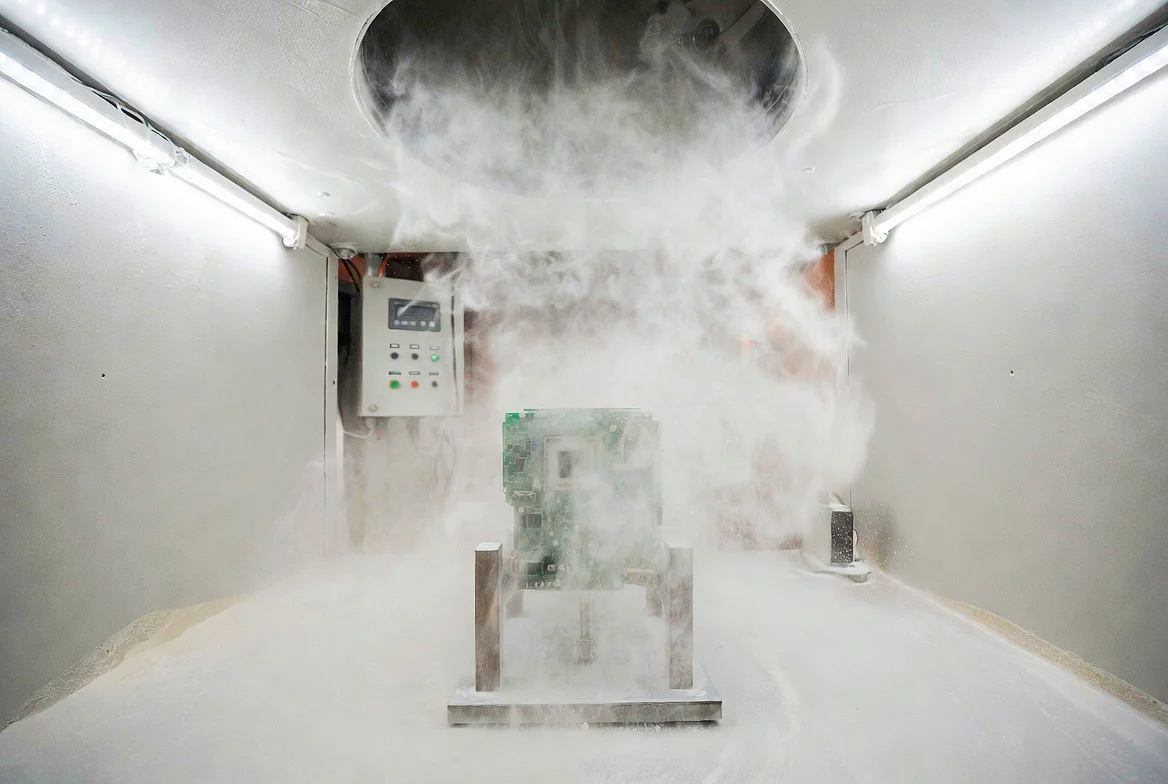
The enclosure category is one of the most important parts of IEC 60529 dust testing because it determines whether pressure reduction is applied to the specimen.
| Enclosure Category | Definition | Vacuum / Pressure Reduction |
|---|---|---|
| Category 1 | Normal operation can cause the pressure inside the enclosure to fall below the surrounding atmospheric pressure, for example due to thermal cycling. | Yes. A vacuum pump is used to maintain the required pressure difference and draw air through possible leakage paths. |
| Category 2 | No pressure difference relative to the surrounding air is present during normal operation. | No vacuum connection is used for the dust exposure. |
Under the base IEC 60529 dust-test method, an IP5X enclosure is treated as Category 1 unless the relevant product standard specifies Category 2. IP6X is tested using the Category 1 method. Product-specific standards can further define or modify the test conditions, so the applicable product standard should always be checked before the test plan is finalized.
How Is Vacuum Applied in a Category 1 Dust Test?
For a Category 1 enclosure, the specimen is connected to a vacuum system so that the internal pressure remains below the surrounding atmospheric pressure. The purpose is not to apply an arbitrary high vacuum. The system is used to draw a defined quantity of air through the enclosure while respecting the IEC 60529 extraction-rate and pressure-difference limits.
CATEGORY 1 TEST LOGIC
- The target extracted-air volume is based on the internal free volume of the test specimen.
- The extraction rate must remain within the limits defined by IEC 60529.
- The pressure depression must not exceed the specified maximum.
- The duration is determined by the extraction rate and total volume of air drawn through the enclosure.
In practical terms, the method uses a target of 80 times the specimen enclosure volume, an extraction rate not exceeding 60 enclosure volumes per hour, and a maximum pressure depression of 2 kPa. If an extraction rate of 40 to 60 enclosure volumes per hour is achieved, the test duration is 2 hours. If the rate remains below 40 volumes per hour at the permitted maximum depression, testing continues until 80 volumes have been drawn through or 8 hours have elapsed.
This is why a blanket statement such as “every IP6X dust test lasts eight hours” is incorrect.
IP5X Test Method and Acceptance Criteria
IP5X verifies that the enclosure is dust-protected rather than completely dust-tight. The laboratory should first determine the required enclosure category and then apply the corresponding dust-chamber method.
- Confirm the applicable standard and enclosure category. Review the product standard before deciding whether the IP5X test uses Category 1 or Category 2 conditions.
- Prepare a production-representative specimen. Cables, glands, covers, connectors, drain holes and other openings should be configured as required for the actual product.
- Calculate the required powder quantity. Base the talcum-powder amount on the test-chamber volume.
- Configure pressure reduction where required. For Category 1 testing, connect the specimen to the vacuum system and record the relevant pressure and airflow information.
- Run the specified exposure. Maintain the dust in suspension and follow the applicable time or air-extraction criteria.
- Inspect the specimen after exposure. Record the amount and location of any dust that entered the enclosure.
For IP5X, limited dust ingress can be acceptable. The protection is satisfactory only when dust has not accumulated in a quantity or location that could interfere with correct operation, impair safety, or create an unacceptable insulation or tracking condition under the applicable requirements.
IP6X Test Method and Acceptance Criteria
IP6X is a dust-tight classification. The dust-chamber principle and talcum-powder requirements are similar to IP5X, but the acceptance criterion is stricter and the base IEC 60529 method uses Category 1 pressure-reduction conditions.
- Confirm the target classification and product-specific requirements.
- Determine the internal free volume of the enclosure. This value is needed for the air-extraction calculation.
- Prepare and connect the specimen. Establish the vacuum connection at the appropriate location without creating an artificial leakage path.
- Load the required talcum powder and establish dust circulation.
- Control the pressure difference and extraction rate. Keep both within the IEC 60529 method limits.
- Complete the required air extraction or maximum test duration.
- Inspect the enclosure. IP6X requires no dust ingress under the specified test conditions.
What Must Be Confirmed Before the Test?
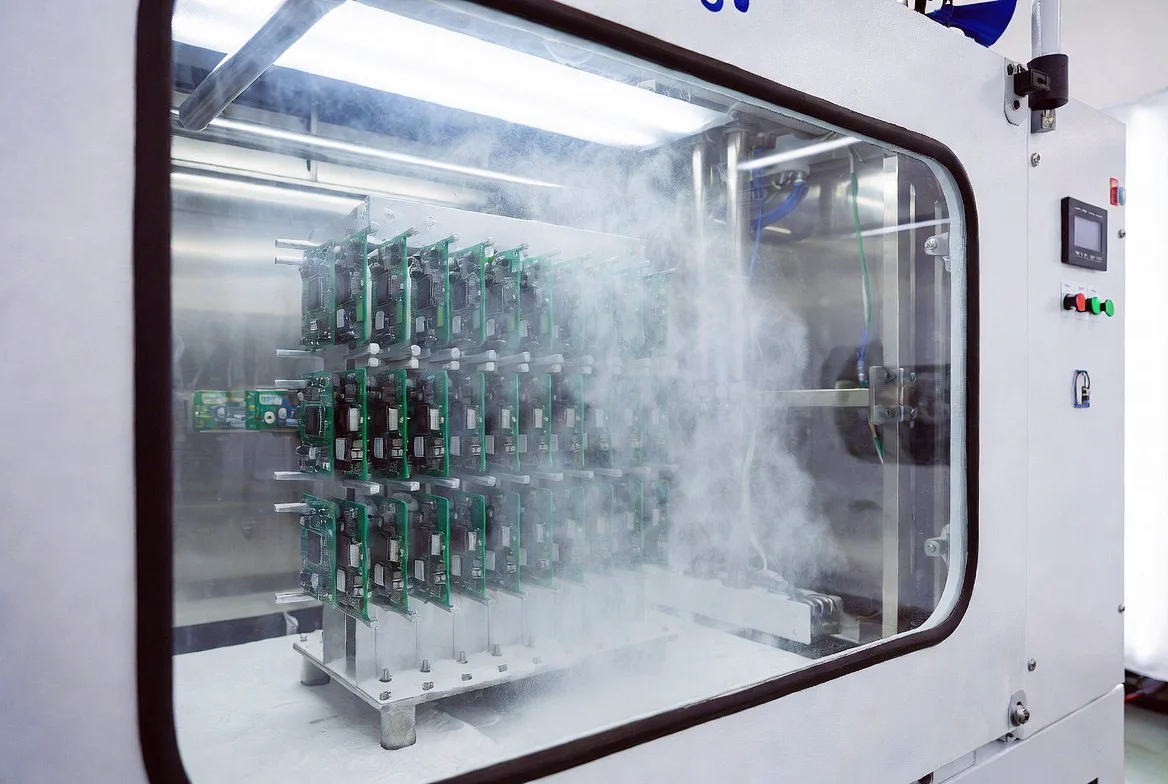
The laboratory should not select the chamber or vacuum settings from the final IP code alone. The following information should be defined before testing.
Standard and Classification
- Applicable IEC 60529 edition
- Relevant product standard
- IP5X or IP6X target
- Enclosure Category 1 or Category 2 where applicable
Specimen Information
- External dimensions and weight
- Internal free volume
- Normal mounting orientation
- Cable entries, drain holes and ventilation openings
- Operating or de-energized state
Test and Evaluation
- Vacuum connection method
- Pressure and airflow measurement
- Required test duration or extracted-air volume
- Post-test opening and inspection method
- Functional or electrical checks required afterward
Selecting an IEC 60529 Dust Test Chamber
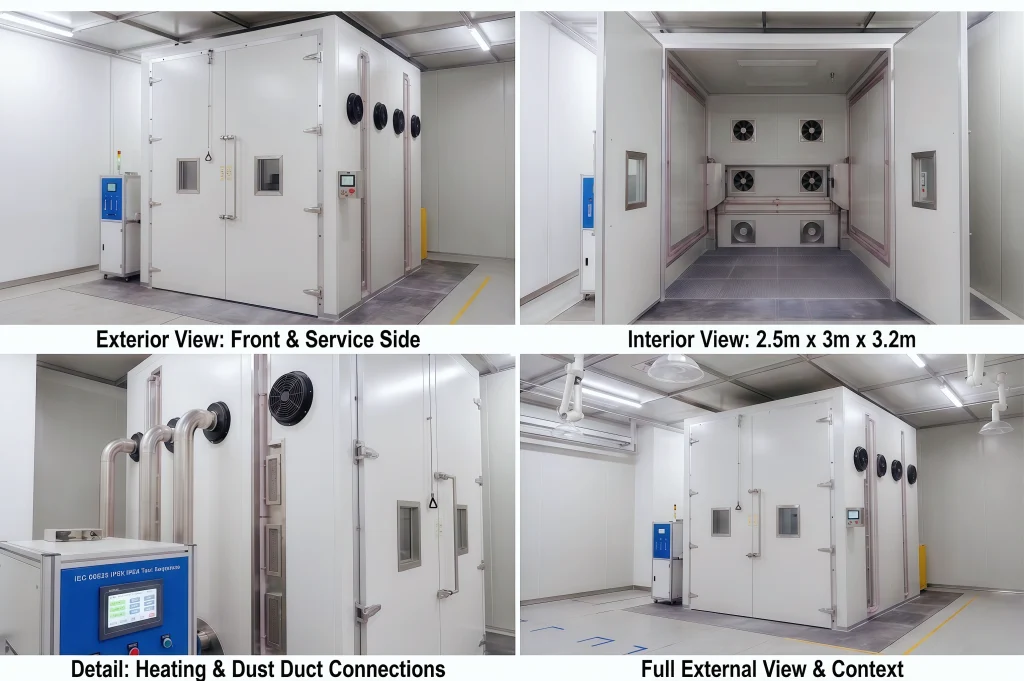
The correct chamber is selected from the specimen and test method, not only from the IP5X or IP6X label. A laboratory should confirm that the equipment can accommodate the specimen and reproduce the required dust and pressure-reduction conditions.
| Equipment Requirement | Why It Matters |
|---|---|
| Usable chamber volume | The specimen must fit with sufficient space for representative dust circulation and normal mounting. |
| Dust circulation system | The system must keep the required talcum powder adequately suspended in the closed chamber. |
| Vacuum capability | Required for Category 1 testing and must allow controlled pressure reduction rather than uncontrolled high vacuum. |
| Pressure and flow measurement | Category 1 testing depends on enclosure pressure difference, extraction rate and total air volume. |
| Specimen connections | Electrical connections and vacuum tubing should not create unintended leakage paths. |
| Control and recording | Timing, pressure, airflow and operating status should be sufficiently controlled and documented for the laboratory procedure. |
| Dust handling and safety | Sealing, filtration, cleaning and operator protection are important when handling fine talcum powder. |
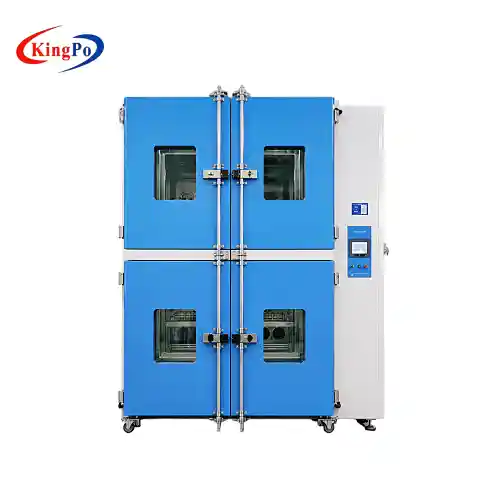
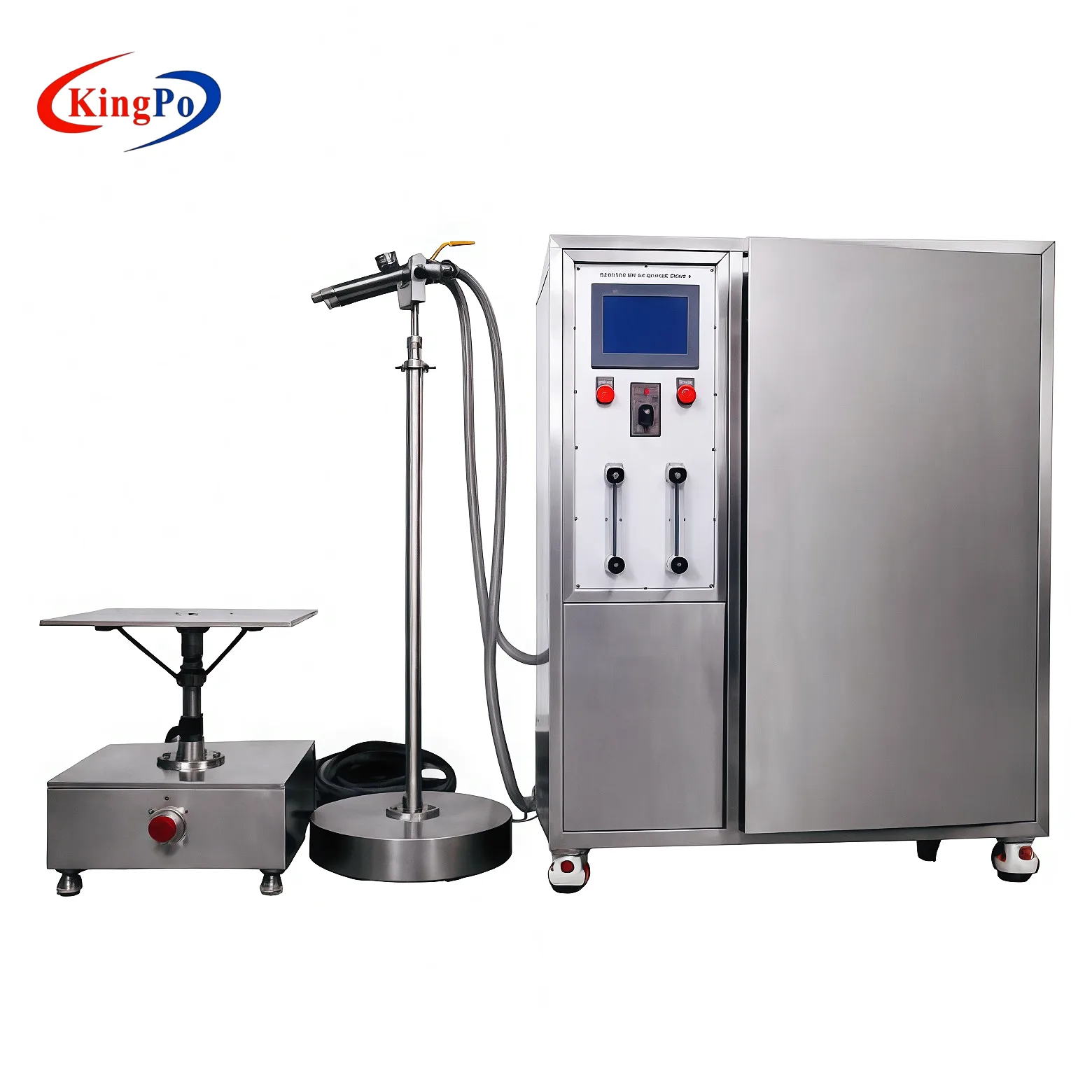
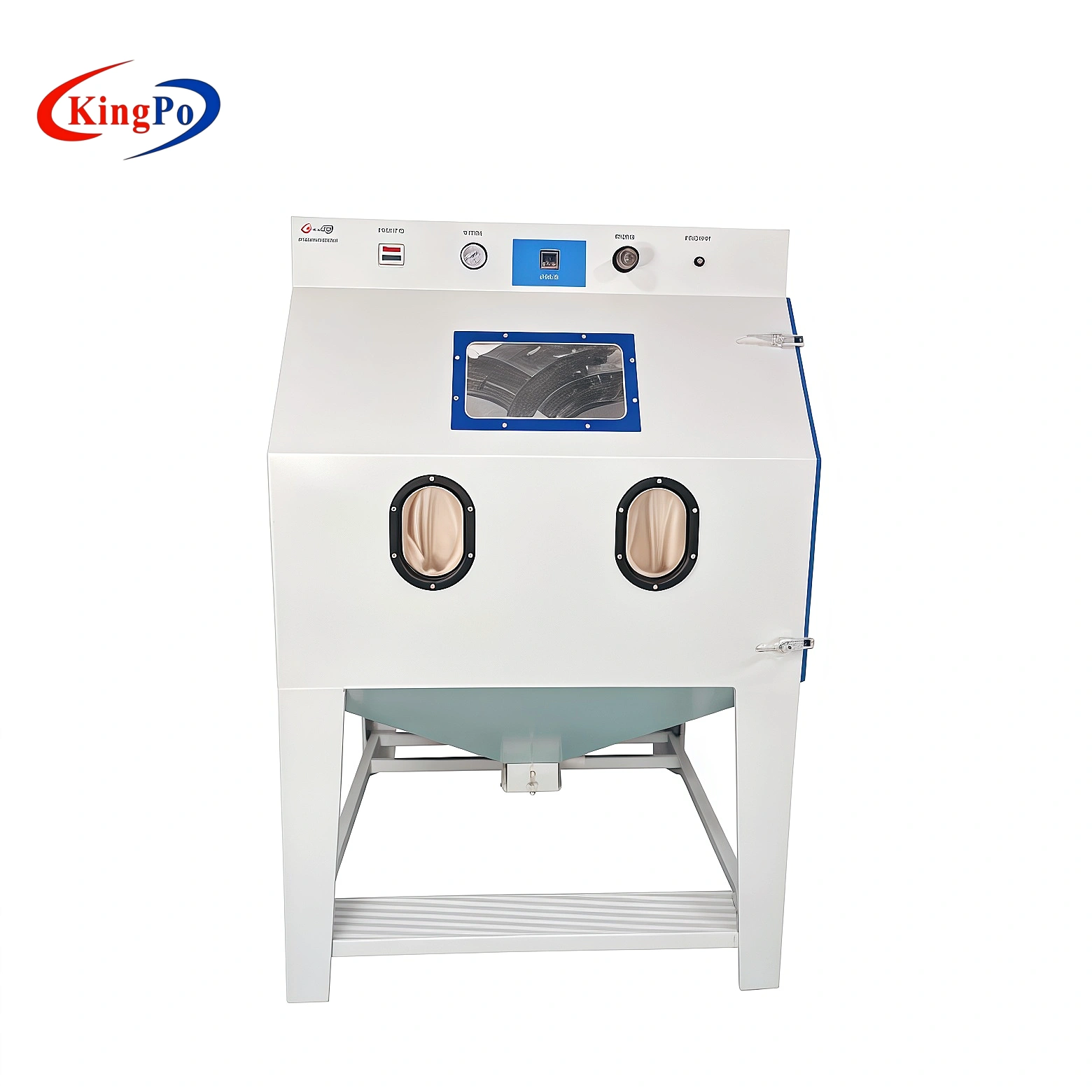
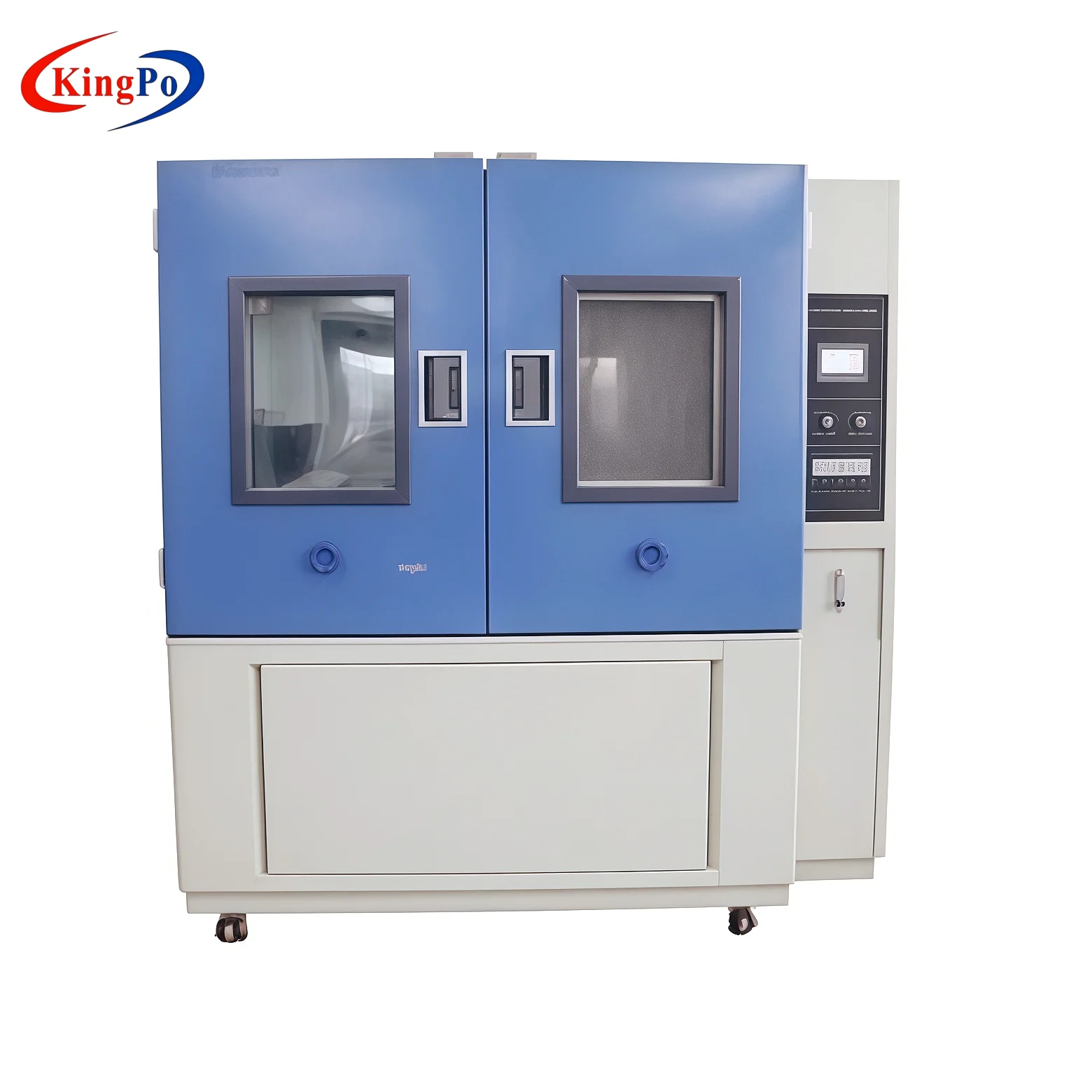
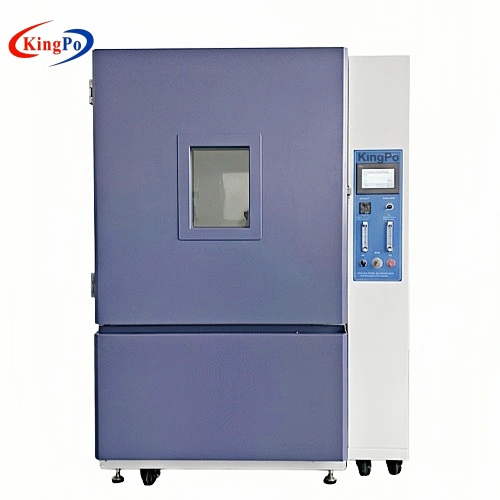
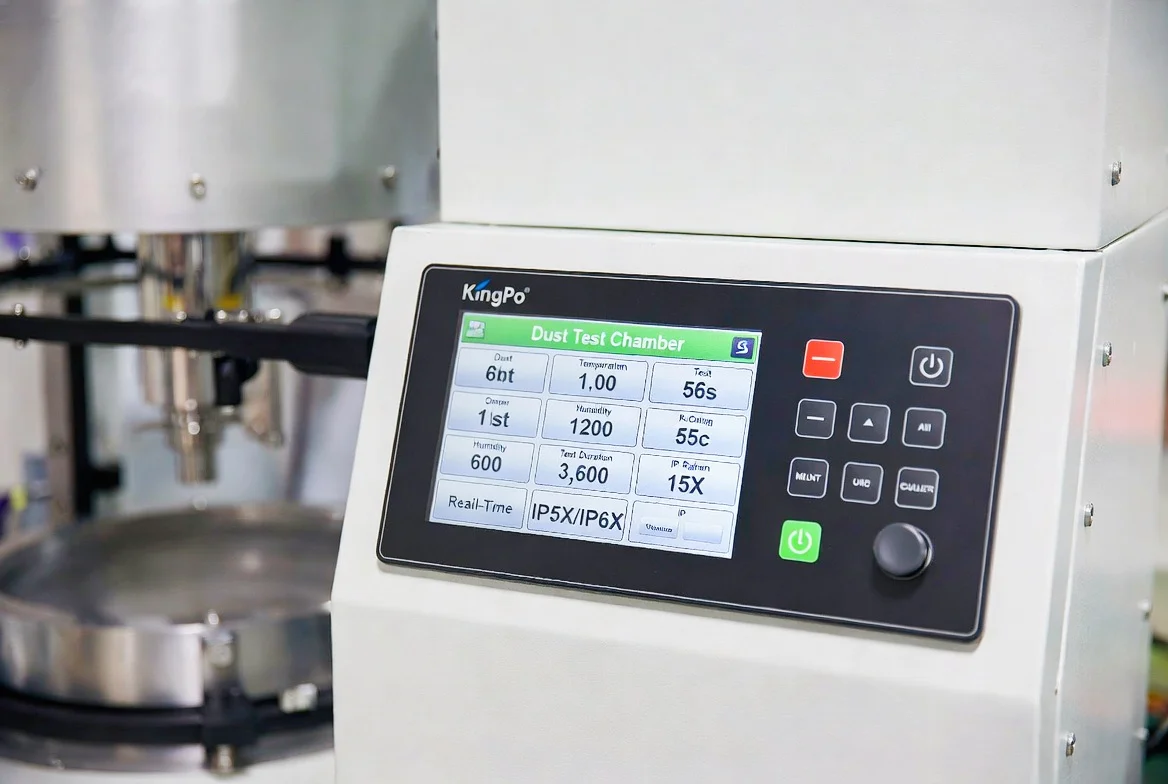
KingPo provides IEC 60529 sand and dust test chambers for IP5X and IP6X applications. The required chamber size, vacuum configuration and specimen interface should be confirmed from the actual test object and laboratory method rather than selected from a generic rating alone.
Common IP5X and IP6X Test Errors
| Common Error | Why It Is a Problem | Better Approach |
|---|---|---|
| Treating 2 kg/m³ as an airborne dust concentration | It changes the meaning of the IEC 60529 requirement. | Calculate the talcum-powder quantity from the test-chamber volume. |
| Assuming every test lasts eight hours | Category 1 duration depends on air-extraction conditions. | Determine duration from the correct Category 1 or Category 2 method. |
| Using vacuum based only on the IP numeral | IP5X can involve different enclosure categories. | Confirm enclosure category and product-standard requirements first. |
| Testing an unrepresentative enclosure | Missing cables, glands, vents or covers can change leakage paths. | Use a production-representative configuration. |
| Applying excessive vacuum | The objective is controlled pressure reduction, not an arbitrary stress test. | Control and record pressure depression within the prescribed method limit. |
| Using only a visual “dust/no dust” decision for IP5X | IP5X acceptance depends on the quantity and location of ingress and its effect on operation and safety. | Document ingress location and evaluate it against the applicable acceptance criteria. |
What Should an IP5X or IP6X Test Report Record?
A useful test report should make the test reproducible. Recording only “IP6X passed” is not enough for engineering review or later comparison.
- Applicable standard, edition and product-specific requirements
- Target classification: IP5X or IP6X
- Enclosure category and the basis used to determine it
- Specimen identification, dimensions, internal free volume and mounting position
- Status of doors, covers, drain holes, cable glands, connectors and ventilation openings
- Test-chamber identification and usable volume
- Talcum-powder specification and quantity used
- Vacuum connection location and configuration where applicable
- Pressure depression, extraction rate, total extracted-air volume and test duration where applicable
- Pre-test and post-test photographs
- Observed dust ingress and its location
- Functional, dielectric or other post-test checks required by the applicable product standard
- Final acceptance decision and any deviations from the planned procedure
Where Is IEC 60529 Dust Testing Used?
Dust-ingress testing may be relevant to electrical enclosures, outdoor controls, lighting equipment, industrial electronics, household appliances and other products that specify an IP5X or IP6X enclosure classification. Automotive, medical, aerospace and other regulated products may also require ingress testing, but the applicable test standard can differ by product category and regulatory framework.
IEC 60529 therefore should not be assumed to be the only dust-test standard for every industry. The product standard, customer specification and target market should be checked before the laboratory programme is defined.
Related KingPo IP Testing Resources
Frequently Asked Questions About IP5X and IP6X Dust Testing
What is the difference between IP5X and IP6X?
IP5X is dust-protected: limited dust ingress may be accepted if it does not interfere with correct operation or impair safety. IP6X is dust-tight: no dust ingress is permitted under the specified test conditions.
Does IP5X allow dust inside the enclosure?
Yes, limited ingress can be acceptable. The important question is where the dust enters, how much accumulates, and whether it affects operation, safety or insulation performance under the applicable acceptance criteria.
Does IP6X allow any dust ingress?
No. IP6X is the dust-tight classification and requires no dust ingress under the specified IEC 60529 test conditions.
Does every IP6X test require a vacuum?
Under the base IEC 60529 method, IP6X uses Category 1 pressure-reduction conditions. The laboratory should still review the applicable product standard because product-specific requirements can define additional conditions or modifications.
What are Category 1 and Category 2 enclosures?
Category 1 applies where normal operation can reduce internal enclosure pressure below the surrounding atmosphere; a controlled vacuum is used during the test. Category 2 applies where no such pressure difference is present and the specimen is not connected to a vacuum pump during dust exposure.
How much talcum powder is used for IEC 60529 dust testing?
The specified amount is 2 kg of talcum powder per cubic metre of test-chamber volume. This is the quantity of powder used in the chamber, not a requirement to continuously maintain an airborne concentration of 2 kg/m³.
How long does an IP5X or IP6X dust test take?
There is no single duration that applies to every test. Category 2 exposure uses the prescribed fixed duration, while Category 1 testing depends on the achieved extraction rate and total extracted-air volume. Under the IEC 60529 method, a Category 1 test may be completed in 2 hours at the specified extraction rate or continue until the required air volume is drawn through, subject to the maximum test duration.
What information is needed to select a dust test chamber?
At minimum, provide the required standard and IP rating, specimen dimensions and weight, internal free volume, mounting orientation, enclosure category where known, vacuum connection requirements, sample quantity and any required electrical operation during testing.
Conclusion
IEC 60529 IP5X and IP6X testing is not simply a comparison between “some dust” and “no dust.” A valid test depends on correctly classifying the enclosure, preparing a representative specimen, using the specified talcum powder quantity, applying pressure reduction where required, controlling the air-extraction conditions and evaluating the result against the correct acceptance criteria.
For equipment selection, the laboratory should start with the specimen and test method rather than a generic chamber specification. The chamber volume, dust-circulation system, vacuum capability, pressure and flow measurement, specimen interfaces and reporting requirements should all match the intended IP5X or IP6X test programme.
KingPo Dust Test Configuration Support
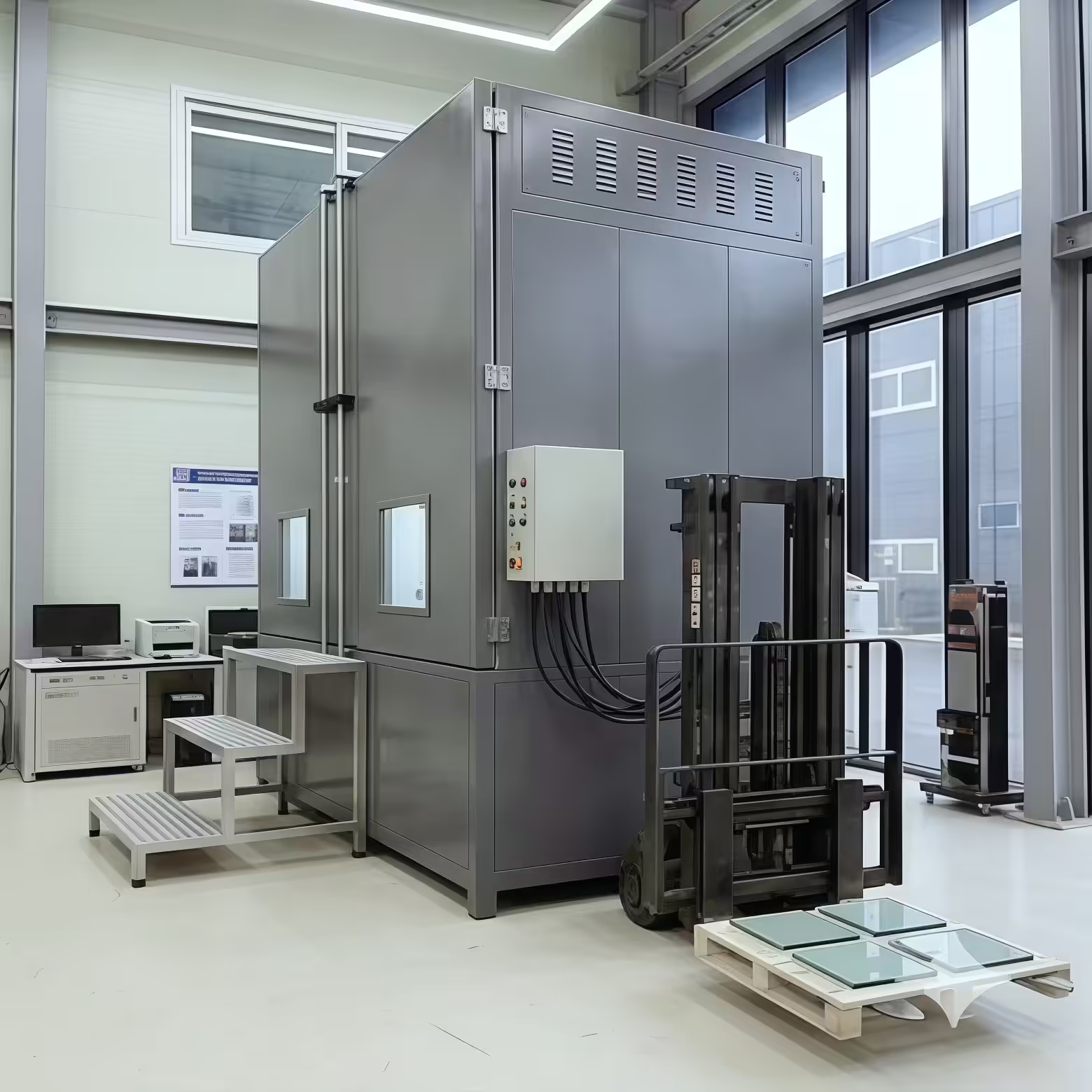
KingPo supplies dust-ingress test systems for IEC 60529 applications, including laboratory-size and larger enclosure configurations with dust circulation and pressure-reduction capability.
For equipment selection, provide the target IP rating, applicable product standard, specimen dimensions, internal free volume, mounting condition and required test quantity. Review the IEC 60529 Sand and Dust Test Chamber or the broader IP Testing Equipment Selection Guide.
Technical disclaimer: This article provides practical engineering guidance and does not reproduce or replace IEC 60529 or any product-specific standard. Final test conditions, enclosure classification and acceptance criteria must follow the applicable standard edition and approved laboratory procedure.