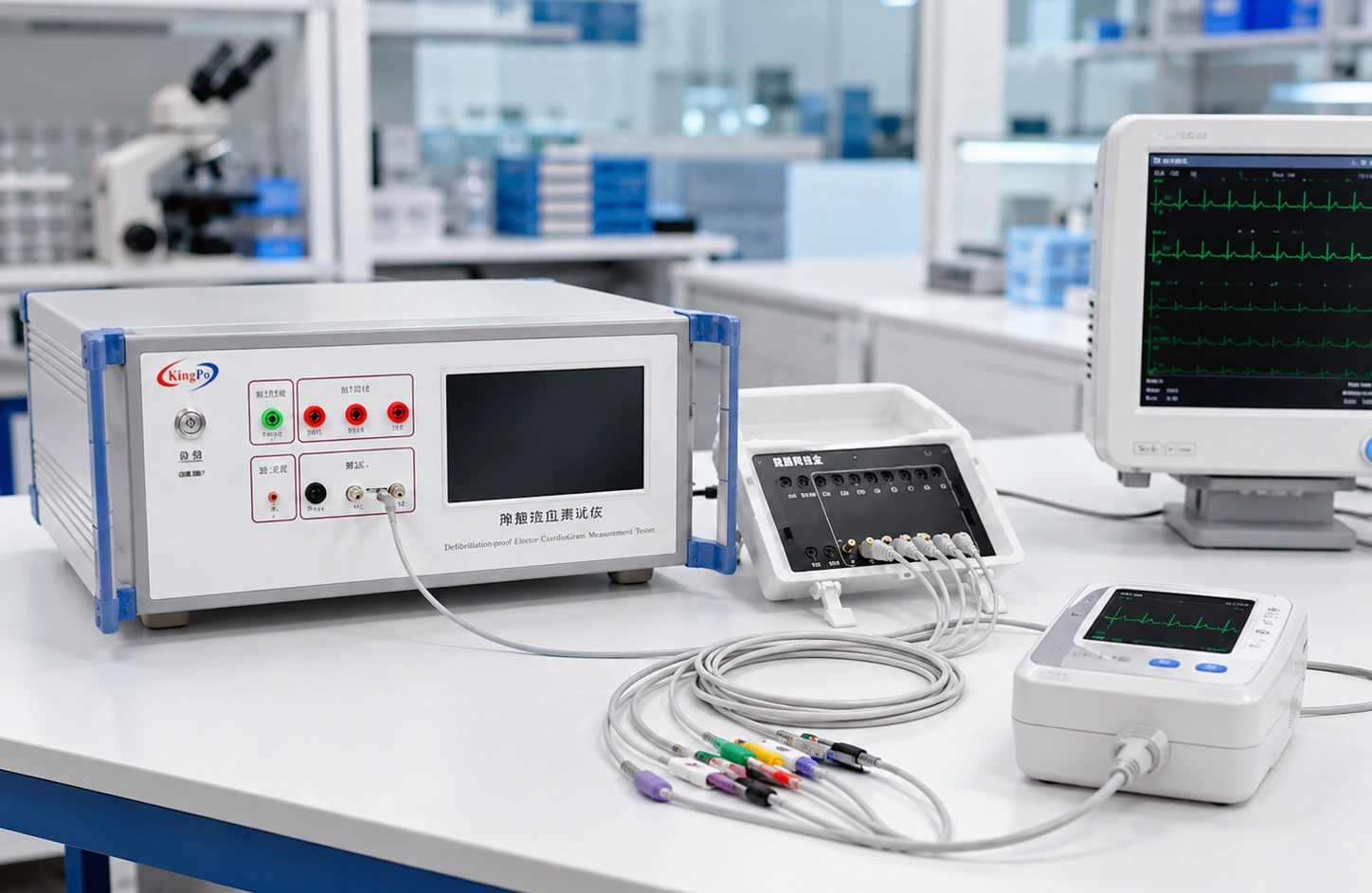
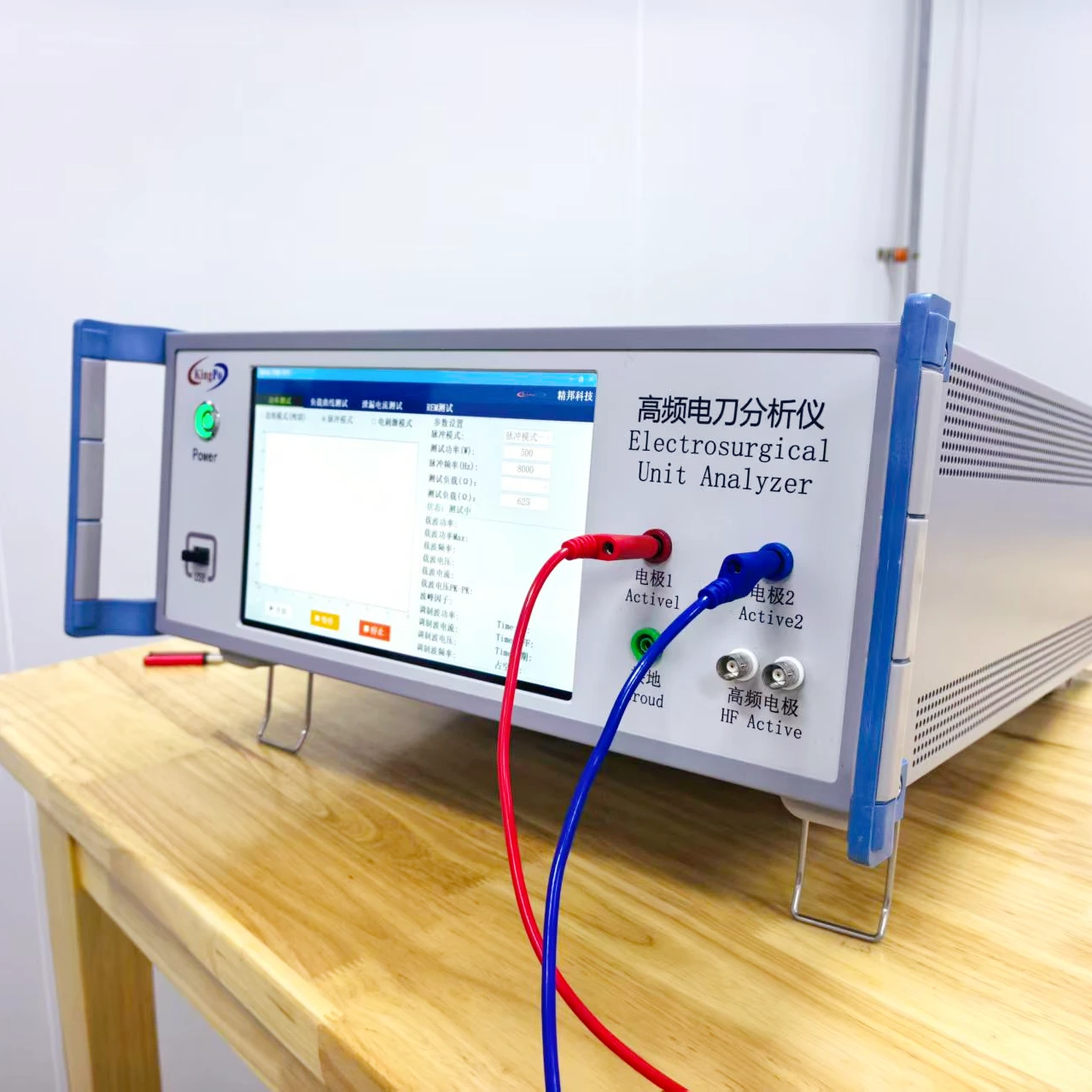
An ESU analyzer is a measurement instrument designed to evaluate the high-frequency electrical output of an electrosurgical generator. Depending on its configuration, it can measure output power, RMS current, peak voltage, high-frequency leakage current, waveform characteristics and crest factor, while advanced analyzers may also provide programmable test loads, REM/CQM impedance simulation and power-versus-load analysis.
Electrosurgical Analyzer / Electrosurgical Unit Analyzer
Electrosurgical generators / high-frequency surgical equipment
Power, RMS current, peak voltage, waveform, HF leakage and crest factor
Load curves, REM/CQM simulation, automated testing and reporting
Manufacturers, test laboratories, biomedical engineers and calibration teams
IEC 60601-2-2 for high-frequency surgical equipment
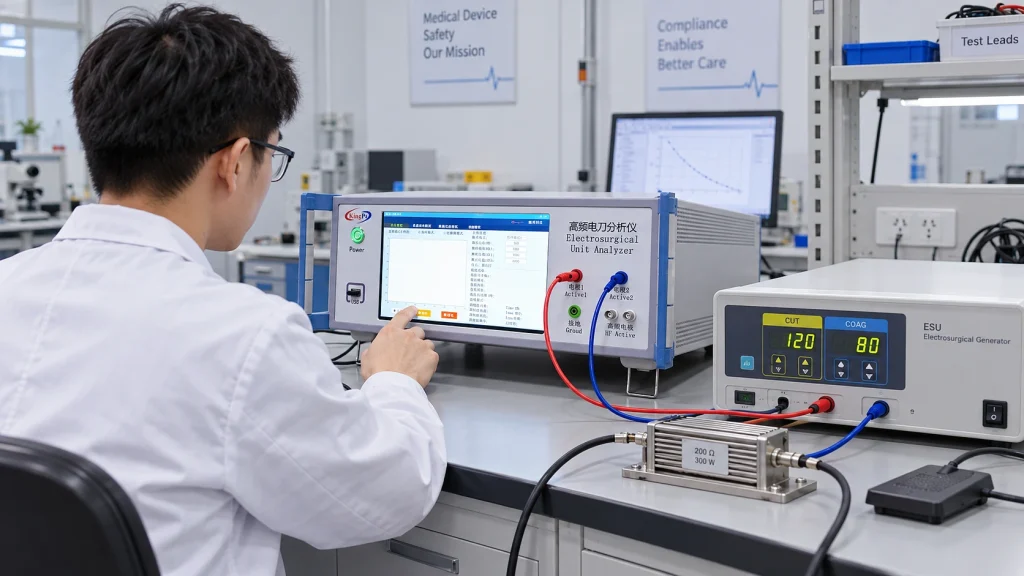
An ESU analyzer is a specialized high-frequency measurement instrument used to evaluate electrosurgical generators. The same type of instrument may also be described as an electrosurgical analyzer or electrosurgical unit analyzer.
Electrosurgical generators produce high-frequency electrical energy for operating modes such as cut, blend and coagulation. Unlike a simple low-frequency power source, the ESU output can include rapidly changing waveforms, high peak voltage, high crest factor and output behaviour that changes significantly with load impedance.
This means that an engineer cannot evaluate an ESU by measuring only one voltage or one power value. A useful analyzer must reproduce defined load conditions, capture high-frequency output accurately and help the user understand how the generator behaves across different operating modes and impedances.
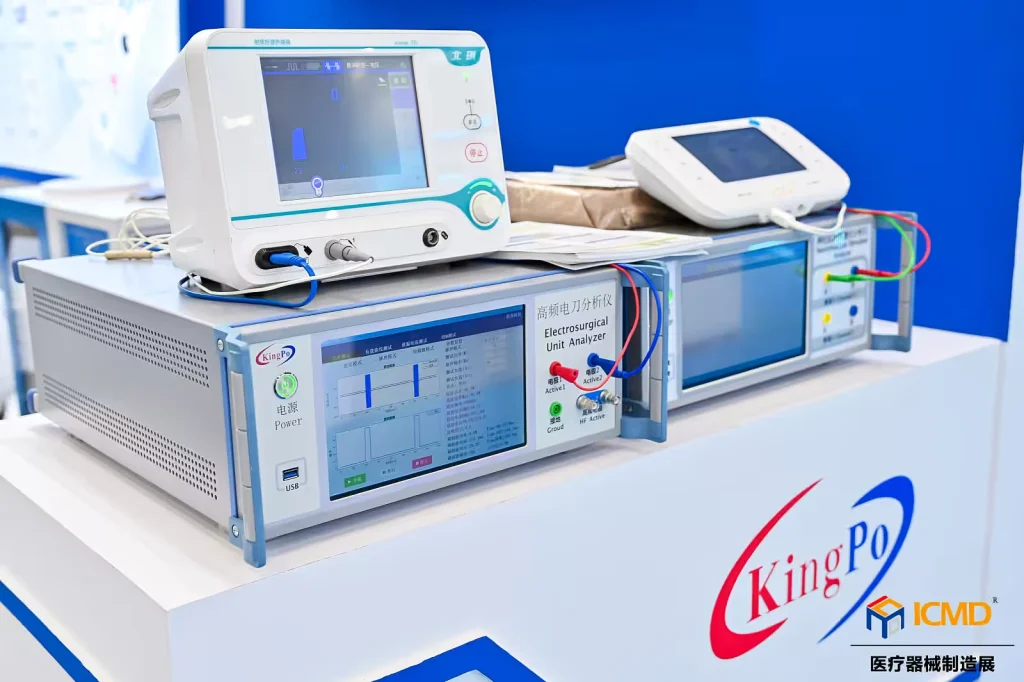 KingPo ESU analyzer and electrosurgical unit testing system displayed at ICMD
ESU Analyzer, Electrosurgical Analyzer and Electrosurgical Unit Analyzer
In most equipment discussions, ESU analyzer, electrosurgical analyzer and electrosurgical unit analyzer refer to the same general class of instrument: a test system designed to measure the high-frequency electrical performance of an electrosurgical generator.
The exact functions vary between models. Some analyzers focus primarily on power measurement, while more advanced systems may integrate programmable loads, HF leakage-current measurement, waveform display, peak-voltage measurement, crest-factor calculation, REM/CQM simulation and automated test sequences.
Engineering takeaway: the product name alone does not tell you whether an analyzer is suitable for your test program. The important questions are what electrical parameters it can measure, which load conditions it can reproduce, how it handles complex HF waveforms and which additional functions are integrated.
What Does an ESU Analyzer Measure?
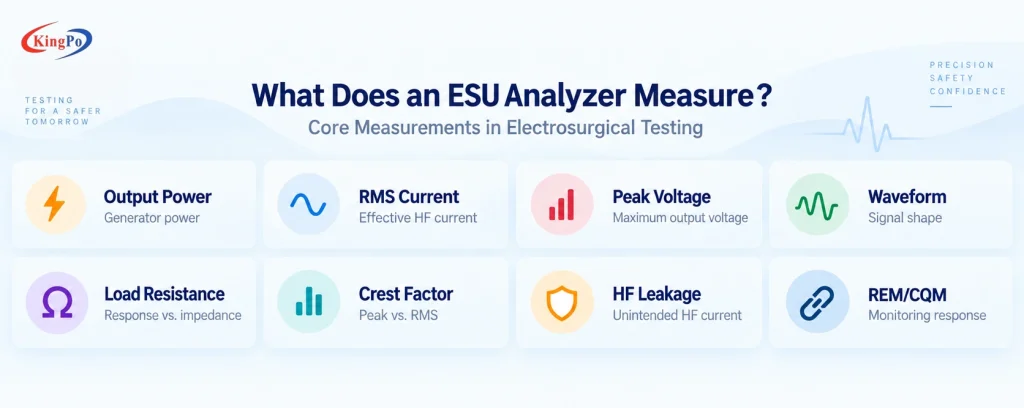
An electrosurgical analyzer does more than display a single wattage value. Engineers typically need to understand the relationship between voltage, current, power, load resistance and waveform behaviour under different generator modes.
| Measurement | What It Tells the Engineer | Typical Use |
|---|---|---|
| Output Power | How much HF power the generator delivers into a defined load | Cut, blend, coagulation and other operating modes |
| RMS Current | Effective HF current flowing through the selected load | Output characterization and load analysis |
| Peak Voltage | Maximum voltage excursion generated by the selected output mode | High-voltage output and waveform evaluation |
| Load Resistance | How generator output changes when connected load impedance changes | Power-versus-load curves |
| Crest Factor | Relationship between waveform peak amplitude and RMS value | Comparing continuous and strongly modulated ESU modes |
| HF Leakage Current | Unintended high-frequency current paths | Safety-related high-frequency measurements |
| Waveform | Signal shape, modulation and output behaviour over time | Engineering analysis and troubleshooting |
| REM / CQM Response | How the generator monitoring circuit responds to simulated return-electrode impedance | Alarm threshold and monitoring-function verification |
How Does an ESU Analyzer Work?
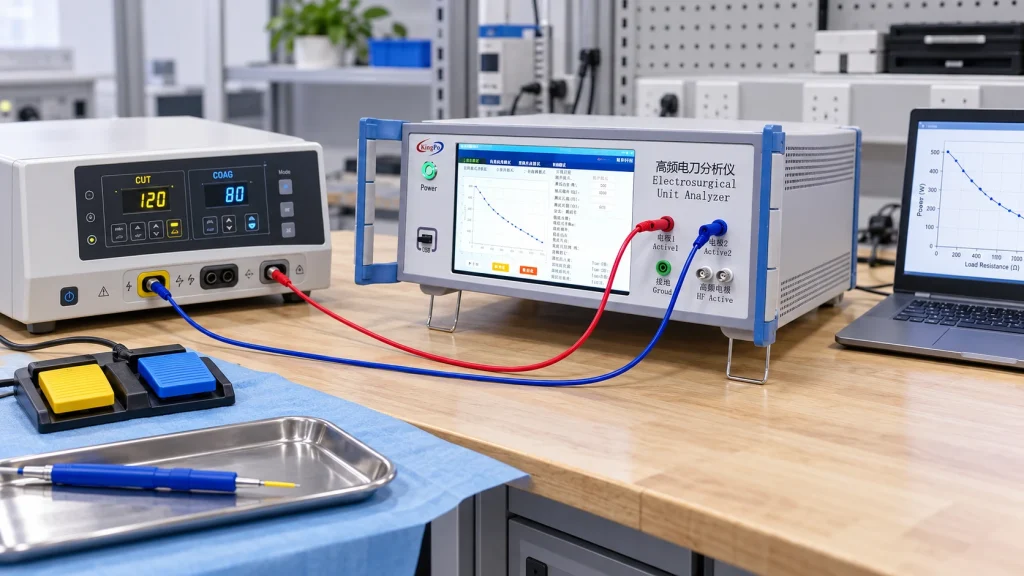
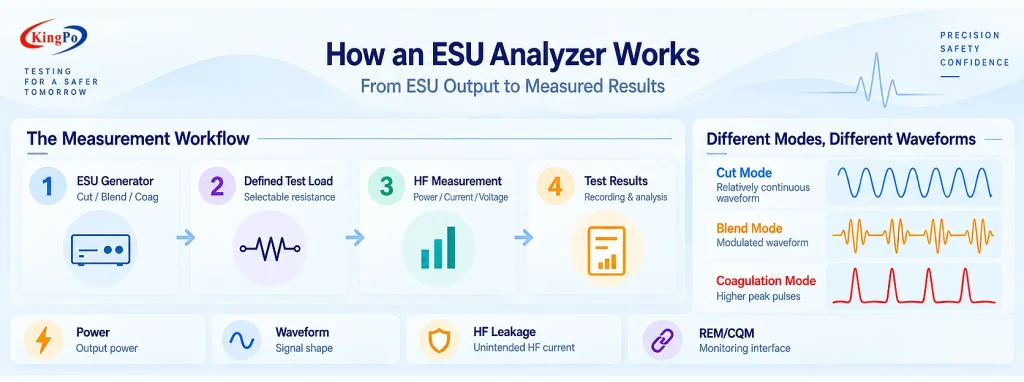
The basic measurement principle is straightforward: the electrosurgical generator delivers high-frequency energy into a known test load, and the analyzer measures the electrical behaviour of that output. The engineering difficulty lies in accurately handling high-frequency, high-voltage and highly modulated waveforms.
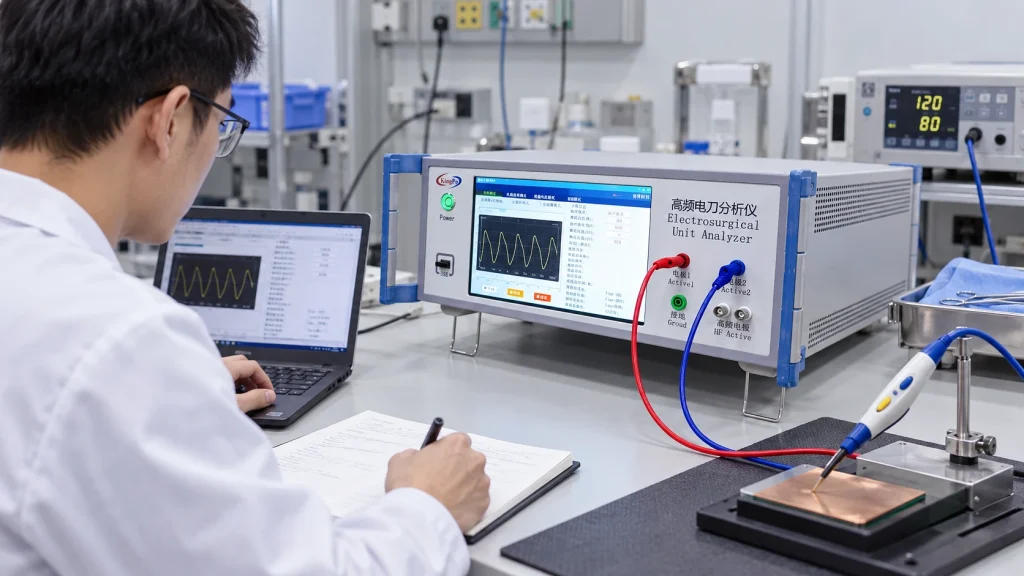
In practice, the engineer first selects the generator mode and an appropriate test load. The analyzer then measures parameters such as power, RMS current, peak voltage and waveform behaviour while the generator is activated.
For compliance-focused testing rather than general analyzer fundamentals, the IEC 60601-2-2 ESU testing guide explains how generator measurements, HF leakage, REM/CQM and separate neutral-electrode tests fit into a broader electrosurgical test program.
Why Does Load Resistance Matter in ESU Testing?
An electrosurgical generator does not necessarily deliver the same output power into every resistance. A generator may reach its maximum or rated output near one load value while producing less power at substantially lower or higher impedances.
For this reason, engineers often test the generator across multiple load resistances rather than at only one point. The resulting power-versus-load curve shows how the generator regulates energy delivery as impedance changes.
Selection rule: do not choose an ESU analyzer by maximum wattage alone. The available load-resistance range, load step or resolution, high-frequency measurement performance and peak-voltage capability may be equally important.
Why a Single Load Can Be Misleading
Two generators can produce similar power at one resistance but behave very differently across the rest of the load range. Multi-load testing therefore provides considerably more information about generator regulation, output consistency and operating-mode behaviour than a single-point wattage measurement.
Output Power Testing with an ESU Analyzer
Output power is one of the most common measurements performed on an electrosurgical generator. The analyzer connects the generator output to a known resistance and measures the energy delivered under the selected mode and power setting.
Engineers can repeat the measurement at different power settings and load values to determine whether the generator output follows the expected behaviour. This is useful for R&D evaluation, production verification, maintenance testing, troubleshooting and comparative performance analysis.
Often uses a relatively continuous output waveform and is commonly evaluated for output power and load behaviour.
Combines cutting and coagulation characteristics and may use a more strongly modulated waveform.
Waveform, Peak Voltage and Crest Factor
Electrosurgical outputs are not all simple continuous sine waves. Different operating modes can be continuous, pulsed, burst-modulated or otherwise shaped to produce different tissue effects.
Peak voltage indicates the highest instantaneous voltage reached by the waveform, while crest factor describes the relationship between the waveform’s peak amplitude and its RMS value. A waveform with a high crest factor can have relatively high voltage peaks even when its RMS value is much lower.
Because of these waveform characteristics, ESU measurements require appropriate high-frequency bandwidth, sampling performance and true-RMS capability. A general-purpose meter that works well at mains frequency may not accurately characterize a highly modulated electrosurgical output.
What Is High-Frequency Leakage Current in ESU Testing?
High-frequency leakage current refers to unintended HF current paths associated with electrosurgical generator output. Measuring these currents requires a test arrangement designed for the frequency range and output characteristics of an ESU.
This is different from the mains-frequency or general patient/touch leakage-current measurements commonly associated with medical electrical safety testing.
A general IEC 60601 leakage current tester and an ESU analyzer serve different measurement purposes. One should not automatically be treated as a substitute for the other.
What Are REM and CQM Functions?
REM is commonly used to describe a Return Electrode Monitor, while CQM refers to Contact Quality Monitoring. These functions monitor the return-electrode circuit and help the electrosurgical generator detect conditions that may indicate an unacceptable electrode connection.
An ESU analyzer with REM/CQM capability can simulate different impedance conditions and allow engineers to observe whether the generator detects the change, activates an alarm or changes its output according to its design.
This function evaluates the generator’s monitoring response. It should not be confused with measuring the electrical contact impedance of the neutral electrode itself.
What an ESU Analyzer Does Not Replace
One of the most important points when planning an electrosurgical laboratory is that an ESU analyzer is not a universal medical electrical safety tester. Different test objects require different measurement functions.
| Test Need | Main Test Object | Typical Equipment |
|---|---|---|
| Generator output performance | Electrosurgical generator | ESU analyzer |
| REM / CQM response | Generator monitoring circuit | ESU analyzer with impedance simulation |
| Neutral electrode contact impedance | Neutral electrode | Dedicated NE contact impedance tester |
| General medical leakage current | Medical electrical equipment | Medical electrical safety / leakage-current tester |
Practical point: an analyzer with REM/CQM simulation does not automatically perform every neutral-electrode test. REM/CQM evaluates the generator monitoring circuit, while neutral-electrode electrical and thermal characteristics may require dedicated equipment.
How to Choose an ESU Analyzer
A useful purchasing specification should be based on the generator types and test functions the laboratory actually needs to evaluate. Generic terms such as “high accuracy” or “easy to use” are not enough to determine whether one analyzer can replace another.
| Selection Parameter | Why It Matters |
|---|---|
| Maximum Power | Must cover the expected generator output and test margin. |
| Peak Voltage Range | High-crest-factor coagulation modes may produce substantial voltage peaks. |
| RMS Current Range | Required for accurate HF current and power characterization. |
| Frequency / Bandwidth | Determines whether complex HF generator outputs can be measured correctly. |
| Load Resistance Range | Determines which parts of the generator power-versus-load curve can be evaluated. |
| Load Step / Resolution | Smaller load increments allow more detailed output characterization. |
| HF Leakage Capability | Required when high-frequency leakage measurements are part of the test plan. |
| REM/CQM Range | Determines which monitoring thresholds and impedance conditions can be simulated. |
| Waveform Display | Useful for engineering analysis, mode comparison and troubleshooting. |
| Automation & Reporting | Important for repeated laboratory workflows, production verification and traceable reporting. |
Information to Confirm Before Ordering an ESU Analyzer
Providing the following information before quotation makes it much easier to determine whether the analyzer configuration matches the intended generator and laboratory workflow.
KingPo KP-8850 ESU Analyzer
For laboratories that require output-power testing, programmable load evaluation, high-frequency measurements, waveform analysis and REM/CQM functions, the KP-8850 electrosurgical unit analyzer provides an integrated platform for ESU performance and safety-related measurement. Final configuration should be selected according to generator output, required load range and the applicable test procedure.
Who Uses an ESU Analyzer?
| User | Typical Application |
|---|---|
| ESU Manufacturers | R&D verification, design validation and production quality control |
| Third-Party Laboratories | Performance and standards-related electrosurgical testing |
| Biomedical Engineering Teams | Preventive maintenance and post-repair verification |
| Calibration / Metrology Laboratories | Measurement verification and traceability support |
| Service Organizations | Troubleshooting and generator performance checks |
Organizations building a broader medical-device laboratory may also require additional medical test equipment for IEC 60601-1 electrical safety, neutral-electrode verification, defibrillator testing and other medical-device test functions.
ESU Analyzer FAQs
1. What is an ESU analyzer?
An ESU analyzer is a specialized measurement instrument for testing the high-frequency electrical output of electrosurgical generators. It can evaluate parameters such as output power, RMS current, peak voltage, load response and waveform characteristics. More advanced systems can also measure HF leakage and simulate REM/CQM return-electrode monitoring conditions.
2. Is an ESU analyzer the same as an electrosurgical analyzer?
Yes, these terms normally describe the same class of instrument. “ESU analyzer,” “electrosurgical analyzer” and “electrosurgical unit analyzer” are commonly used for equipment designed to measure electrosurgical generator outputs. Actual capabilities still vary significantly between models, so users should compare measurement ranges and functions rather than relying on terminology alone.
3. What does an ESU analyzer measure?
Typical measurements include output power, RMS current, peak voltage, load resistance, waveform characteristics and crest factor. Depending on the instrument, additional functions can include high-frequency leakage-current measurement, programmable load curves, REM/CQM impedance simulation, automated sequences and data reporting.
4. Why does an ESU analyzer need multiple load resistances?
Electrosurgical generator output changes with load impedance. Measuring only one resistance can therefore hide important differences in generator behaviour. Testing several loads allows engineers to build a power-versus-load curve and evaluate how the generator regulates output across a wider operating range.
5. What is crest factor in electrosurgical testing?
Crest factor describes the relationship between the peak amplitude of a waveform and its RMS value. Different electrosurgical modes can have significantly different crest factors. Coagulation-type waveforms, for example, may have much higher peaks relative to their RMS value than a more continuous cut waveform.
6. Can an ESU analyzer measure high-frequency leakage current?
Some ESU analyzers include high-frequency leakage-current measurement functions or can be used with the required HF test network. This function should be confirmed before purchase because HF leakage measurement is different from the general mains-frequency leakage-current tests performed by conventional medical electrical safety testers.
7. What is REM/CQM testing on an ESU analyzer?
REM/CQM testing simulates different return-electrode impedance conditions so engineers can evaluate how the electrosurgical generator’s monitoring circuit responds. The analyzer may be used to check monitoring range, alarm behaviour or response to abnormal impedance conditions, depending on the generator and applicable test procedure.
8. Does an ESU analyzer test the neutral electrode itself?
Not necessarily. REM/CQM simulation evaluates the generator’s monitoring circuit, while electrical characteristics of the neutral electrode itself may require dedicated equipment. For example, neutral-electrode contact impedance is a separate measurement function and should not be assumed to be covered by REM/CQM simulation.
9. Is an ESU analyzer used for IEC 60601-2-2 testing?
Yes. ESU analyzers are commonly used for measurements associated with high-frequency surgical equipment testing under IEC 60601-2-2. However, one analyzer should not automatically be treated as a complete IEC 60601-2-2 laboratory because some neutral-electrode, accessory and other requirements need separate test equipment.
10. How should I choose an ESU analyzer?
Start with the electrosurgical generators and test functions you need to cover. Compare maximum power, peak voltage, RMS current, measurement frequency, load-resistance range and resolution, HF leakage functions, REM/CQM range, waveform capability, automation, reporting and calibration requirements. Maximum wattage alone is not an adequate selection criterion.
Engineering Summary
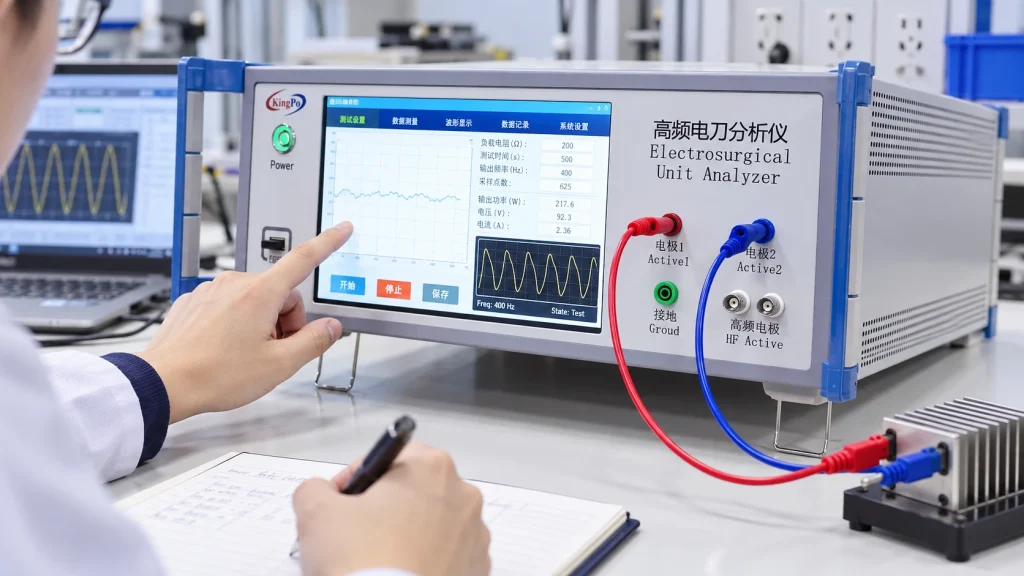
An ESU analyzer should be understood as a high-frequency measurement platform rather than simply a wattmeter for electrosurgical generators. The most useful analyzer is the one whose power range, peak-voltage capability, HF measurement performance, load architecture, waveform functions and REM/CQM features match the actual test program. For standards-focused laboratory planning, review the applicable IEC 60601-2-2 requirements separately before assuming that one instrument covers the complete test system.