Standards and Test Method Support
The system is designed to support selected mechanical test methods related to IEC 60601-1 and GB 9706.1-2020, especially requirements involving movement, stability, rough handling and mechanical stress resistance of ME equipment.
For bed-type ME equipment or medical bed applications, GB 9706.252 related movement requirements may also be reviewed according to the final product category and test program. The system supports test method implementation, while final compliance evaluation should follow the complete applicable standard, product configuration and laboratory test procedure.
System Configuration
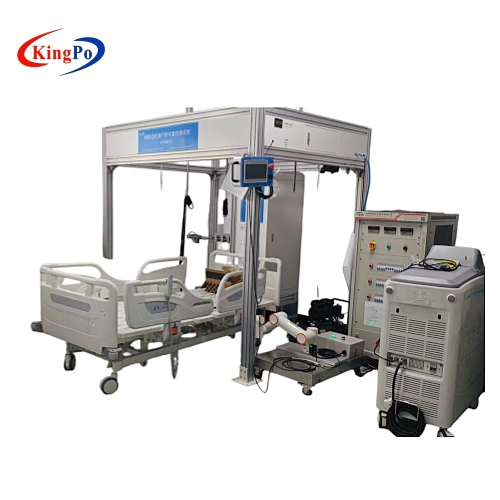
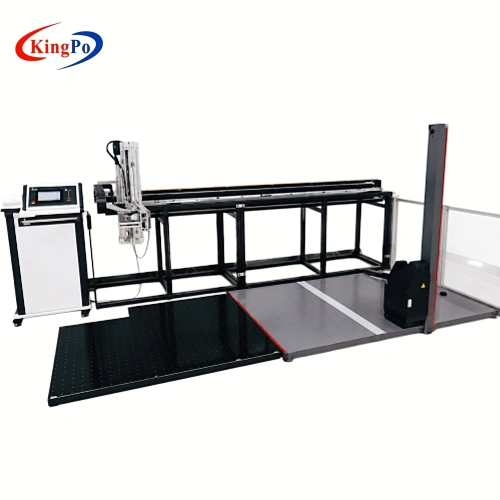
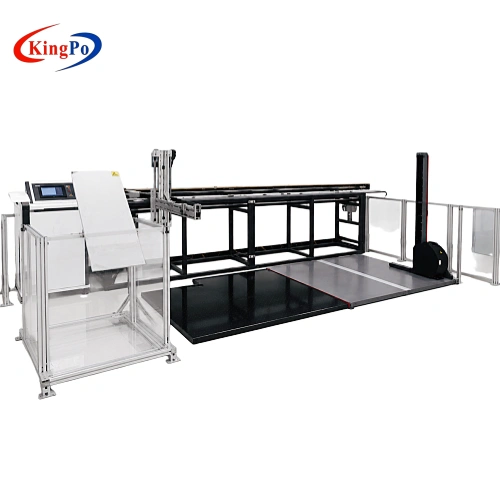
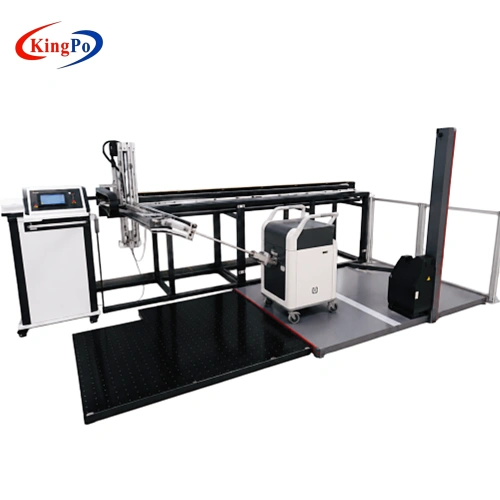
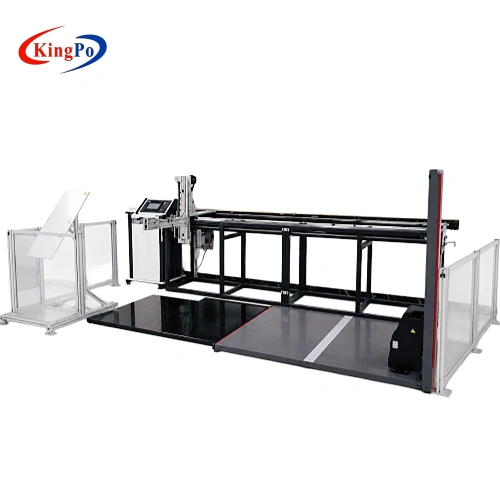
The system consists of a test platform, threshold device, door frame, replaceable obstacles, force sensor and pushing mechanism. It uses PLC control and servo motor horizontal drive, allowing operators to preset test speed, movement distance and test count through the touchscreen interface.
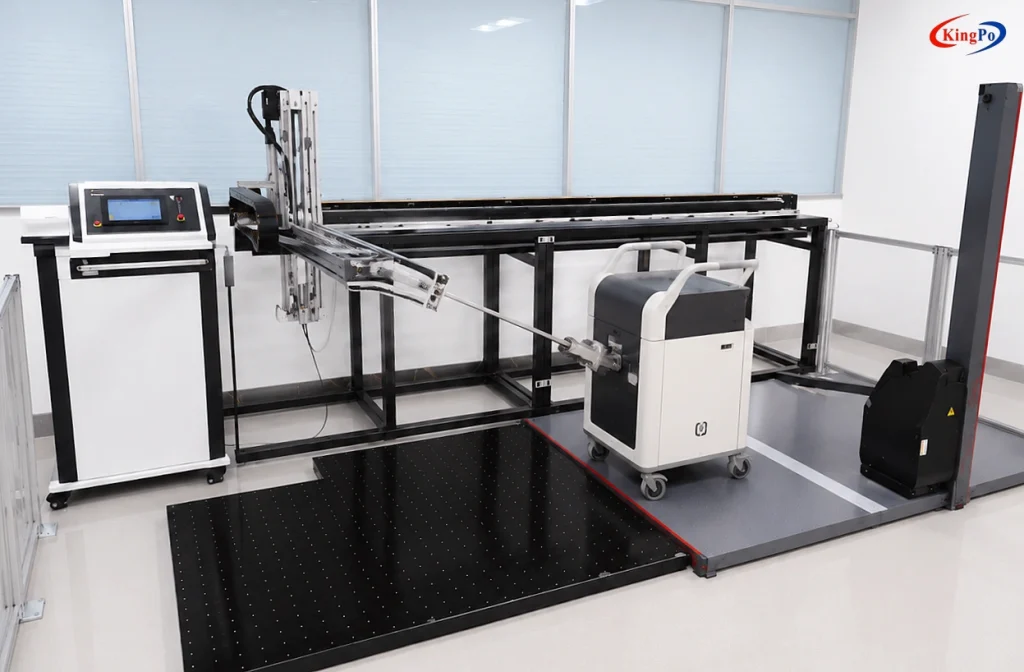
During testing, the ME equipment sample is placed on the platform and connected to the telescopic pushing arm. After the test starts, the system moves the sample through the selected threshold, obstacle, step or door frame path and displays the pushing or pulling force during operation.
Professional Construction and Technical Precision
The system integrates a servo-driven horizontal pushing mechanism, PLC control system, force sensor and replaceable obstacle platform into one test configuration. The 7-inch touchscreen allows operators to set speed, distance and test count, while the force sensor supports real-time force display during movement and impact testing.
The platform is designed with M8 threaded holes for fixing replaceable obstacles. This allows laboratories to configure different threshold, step and door frame test layouts according to sample size, wheelbase, obstacle type and laboratory space.
Core Test Scenarios
This system is mainly used to reproduce movement and rough handling conditions that mobile ME equipment may experience during clinical use, transport and relocation inside medical facilities.
Typical test scenarios include:
- Movement over a threshold or fixed vertical obstacle
- Ascending step shock
- Descending step shock
- Door frame impact
- Inclined platform movement
- Repeated pushing movement for wheeled ME equipment
- Transport-related mechanical stress simulation
These scenarios help manufacturers and laboratories evaluate whether wheeled or transportable ME equipment can maintain structural integrity, functional safety and stable movement after repeated mechanical stress.
ME Equipment Rough Handling Tester Specifications
Key System Specifications
| Item | Specification |
|---|---|
| Product Type | ME equipment threshold and rough handling test system |
| Related Standards | IEC 60601-1, GB 9706.1-2020 |
| Related Medical Bed Reference | GB 9706.252, where applicable to relevant bed-type ME equipment |
| Main Test Items | Movement over threshold, step shock, door frame impact, rough handling |
| Drive Method | Servo motor, horizontal drive |
| Control System | 7-inch touchscreen + PLC controller |
| Force Measurement | Force sensor with automatic force display |
| Test Count | 0–9999 times presettable |
| Test Platform | Platform with M8 threaded holes for replaceable obstacles |
| Safety Protection | Protective guardrail around the equipment |
| Power Supply | AC 220 V, 50 Hz |
| Equipment Size | 3500 × 2000 × 1800 mm; customizable according to laboratory layout |
Test Function Parameters
The following test functions are based on the rough handling and movement-related configuration described in the product specification. Actual fixture layout can be adjusted according to the sample size, wheelbase, obstacle type and laboratory space.
| Test Item | Key Parameters | Purpose |
| Movement Over Threshold | Fixed vertical obstacle, 10 × 85 × 1200 mm | Simulates threshold or raised obstacle crossing |
| Ascending Step Shock | Hardwood step, 40 × 1500 × 1200 mm | Simulates upward step impact |
| Descending Step Shock | Concrete step, 40 × 1000 × 1200 mm | Simulates downward step impact |
| Door Frame Shock | Hardwood door frame, 40 × 40 × 1500 mm | Simulates impact with a door frame |
| Inclined Platform Movement | 0–15° adjustable working table | Supports movement testing on inclined surfaces |
| Pushing / Pulling Force Range | 0–1000 N | Horizontal pushing and pulling force |
| Force Accuracy | ±1% | Force measurement |
| Test Speed | 0.8 m/s ± 0.1 m/s; adjustable 0–2 m/s | Controlled movement speed |
| Test Count | 0–9999 times presettable | Repeated rough handling evaluation |
Standards and Test Item Mapping
| Related Standard / Clause | Test Item | System Function |
| IEC 60601-1 | General requirements for basic safety and essential performance of ME equipment | Mechanical stress and rough handling evaluation |
| GB 9706.1-2020 9.4.2 | Mechanical stability and movement-related evaluation | Stability and movement test support |
| IEC 60601-1 / GB 9706.1-2020 9.4.2.4.2 | Movement-related mechanical test item | Controlled pushing movement simulation |
| IEC 60601-1 / GB 9706.1-2020 9.4.2.4.3 | Fixed vertical obstacle / threshold-related evaluation | Threshold and obstacle crossing test |
| IEC 60601-1 / GB 9706.1-2020 15.3.5 | Rough handling related test item | Step shock and door frame impact testing |
| GB 9706.252 201.9.4.2.4.3 | Medical bed related movement reference | Applicable when testing relevant bed-type ME equipment |
Testing Principle
The ME Equipment Rough Handling Tester simulates mechanical stress that mobile medical electrical equipment may experience during transport, relocation and daily clinical use.
The system drives the ME equipment sample horizontally through a controlled pushing mechanism. Depending on the selected setup, the sample can be moved across a threshold, fixed obstacle, step structure or door frame. During the movement, the force sensor monitors pushing or pulling force, while the PLC control system executes the preset speed, movement distance and test count.
This controlled process allows laboratories to reproduce transport-related mechanical stress more consistently than manual pushing or uncontrolled handling.
Test Workflow
The workflow below is a typical reference process for ME equipment threshold and rough handling testing. Actual steps may be adjusted according to the sample structure, selected clause and laboratory procedure.
- Place the ME equipment sample on the test platform.
- Select the required test item, such as threshold crossing, ascending step shock, descending step shock or door frame impact.
- Install the corresponding obstacle, step, threshold or door frame fixture.
- Fix the telescopic pushing arm at a suitable position on the sample.
- Set test speed, movement distance and test count on the touchscreen.
- Confirm the force sensor, pushing mechanism and protective guardrail status.
- Start the automatic test sequence.
- Monitor pushing force, sample movement and test condition.
- Stop the test and inspect the sample if abnormal resistance, excessive impact or visible damage occurs.
- Record the sample condition and test result after testing.
Applications and Laboratory Use
The ME Equipment Rough Handling Tester is suitable for mobile or transportable medical electrical equipment, including:
- Mobile medical electrical equipment
- Medical carts and trolley-type devices
- Wheeled diagnostic or therapeutic equipment
- Transportable hospital equipment
- Bed-type ME equipment requiring movement-related evaluation
- Equipment moved through thresholds, door frames, ramps or step transitions
- Equipment with casters, wheels or mobile bases used in hospital environments
Typical users include medical device manufacturers, R&D laboratories, quality control departments and third-party testing laboratories that need to verify mechanical strength, movement stability and rough handling resistance before product release or type testing.
Procurement Value
For manufacturers, this system helps standardize movement-related mechanical testing during product development, verification and quality control. It reduces manual test variation and provides a more repeatable way to evaluate whether mobile ME equipment can withstand threshold crossing, step impact and door frame impact in real use conditions.
For testing laboratories, the replaceable obstacle platform, presettable motion parameters, force display and configurable layout support flexible testing for different sample sizes, wheel configurations and test procedures.