KINGPO Technical Guide · Active Implantable Medical Devices
A technical overview of saline immersion, specimen preparation, continuous agitation and comparative liquid particle measurement for cochlear and auditory brainstem implant systems.
Clause 14.2
Cochlear Implant Testing
Liquid Particle Measurement
Particulate matter released from implantable medical device components is an important consideration in evaluating device safety and material performance. For cochlear and auditory brainstem implant systems, ISO 14708-7:2019 establishes specific requirements for evaluating unintended particulate matter released from implantable components intended to come into contact with body fluids during normal use.
Under Clause 14.2, the evaluation involves controlled saline immersion, temperature conditioning, continuous agitation and comparative particle measurement. The procedure requires careful preparation of the implantable specimen and a reference sample before particle counting and result evaluation.
Unlike conventional liquid particle testing, this application involves an implantable assembly that may include a receiver/stimulator housing, an internal coil, connecting leads and an electrode array. The specimen configuration, container dimensions, saline volume and agitation method must therefore be considered together when establishing a suitable laboratory procedure.
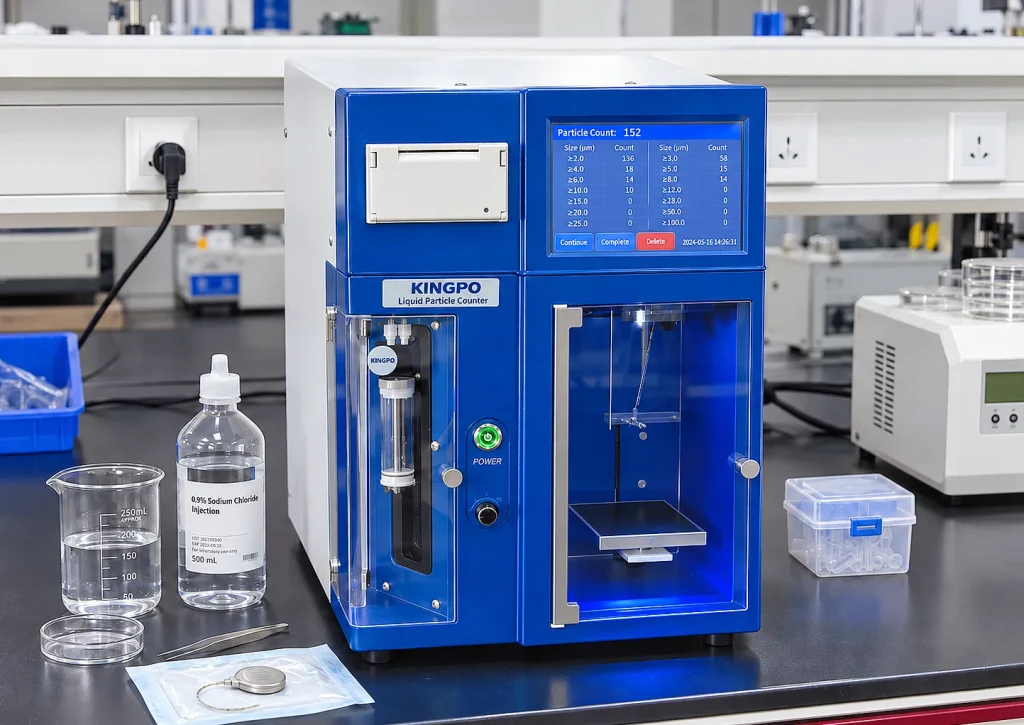
- This article examines the requirements of ISO 14708-7:2019 Clause 14.2 and discusses the engineering considerations involved in sample preparation, continuous agitation and quantitative particle measurement, including the application of the KINGPO KP-MP500D Liquid Particle Counter.
01Understanding Particulate Matter Testing for Cochlear Implants
Cochlear implant and auditory brainstem implant systems are active implantable medical devices designed to provide electrical stimulation of the auditory pathways.
Their implantable components are intended to remain inside the human body during normal operation. Components that come into contact with body fluids require appropriate evaluation of potential particulate matter release.
Particles may originate from material surfaces, component interfaces or manufacturing-related residues. Evaluating their presence in a controlled liquid environment provides information about particulate matter released from implantable components under specified test conditions.
ISO 14708-7:2019, Implants for Surgery — Active Implantable Medical Devices — Part 7: Particular Requirements for Cochlear and Auditory Brainstem Implant Systems, addresses this subject in Clause 14.2.
The purpose of the test is to evaluate whether an implantable component releases an unacceptable quantity of particulate matter when used as intended by the manufacturer.
The method is based on comparing the particle count in a specimen liquid with that in a reference liquid prepared from the same batch of saline solution.
This comparative approach is important because the particle count in the specimen may include background particles originating from the saline, container and sample handling process. Evaluating the difference between the specimen and reference results helps determine the excess particulate matter associated with the tested implantable component.
Reliable evaluation therefore depends on more than the particle counter itself. Specimen preparation, contamination control, temperature stability, continuous agitation and measurement performance all contribute to the overall testing process.
02ISO 14708-7:2019 Clause 14.2 — Test Requirements and Evaluation Criteria
Clause 14.2 specifies a saline immersion method for evaluating particulate matter released from implantable components intended to come into contact with body fluids during normal use.
The implantable part is removed aseptically from its non-reusable packaging and immersed in a bath of saline solution suitable for injection. The solution is maintained in a neutral glass container with a glass lid under specified temperature and agitation conditions.
A reference sample of similar saline volume is prepared from the same batch and maintained under comparable conditions.
2.1 Key Test Conditions
| Test Parameter | Requirement |
|---|---|
| Test Medium | Saline solution, approximately 9 g/L, suitable for injection |
| Container | Neutral glass container |
| Container Cover | Glass lid |
| Saline Volume | 5 ± 0.5 mL per cm² of implantable part surface area |
| Temperature | 37 ± 2°C |
| Exposure Duration | 8–18 hours |
| Agitation | Continuous throughout the exposure period |
| Reference Sample | Similar saline volume from the same batch |
| Reference Treatment | Maintained and agitated in a similar way to the specimen |
| Measurement | Apparatus suitable for particle-size measurement |
2.2 Saline Volume Calculation
The required saline volume is determined according to the surface area of the implantable part.
The relationship specified in the standard is:
V = saline volume (mL) · A = implantable part surface area (cm²)
For example, if the implantable part has a surface area of 4 cm², the nominal saline volume is 20 mL, with an applicable range of 18–22 mL.
This requirement is important when selecting the sample container. The container must accommodate the complete specimen and the calculated saline volume while allowing the implantable part to remain immersed.
2.3 Particle Measurement and Acceptance Criteria
After the specified exposure period, liquid samples from the specimen and reference containers are collected separately for particle measurement.
ISO 14708-7:2019 identifies suitable measurement apparatus, including instruments operating on the following principles:
- Light-blockage particle measurement.
- Electrical zone sensing, also known as the Coulter principle.
The evaluation is based on the excess average particle count from the specimen relative to the reference sample.
| Particle Size | Maximum Excess Average Count |
|---|---|
| Greater than 5.0 μm | 100 particles/mL |
| Greater than 25.0 μm | 5 particles/mL |
The measurement method, particle-size channel definitions, calibration characteristics and calculation procedure must be appropriate for the applicable standard requirements.
03Specimen Geometry and Sample Container Selection
Unlike conventional particulate matter testing involving small liquid samples, cochlear implant testing may require accommodation of a relatively complex implantable assembly.
A typical implantable configuration may include:
- Receiver/stimulator housing.
- Internal receiving coil.
- Connecting lead.
-
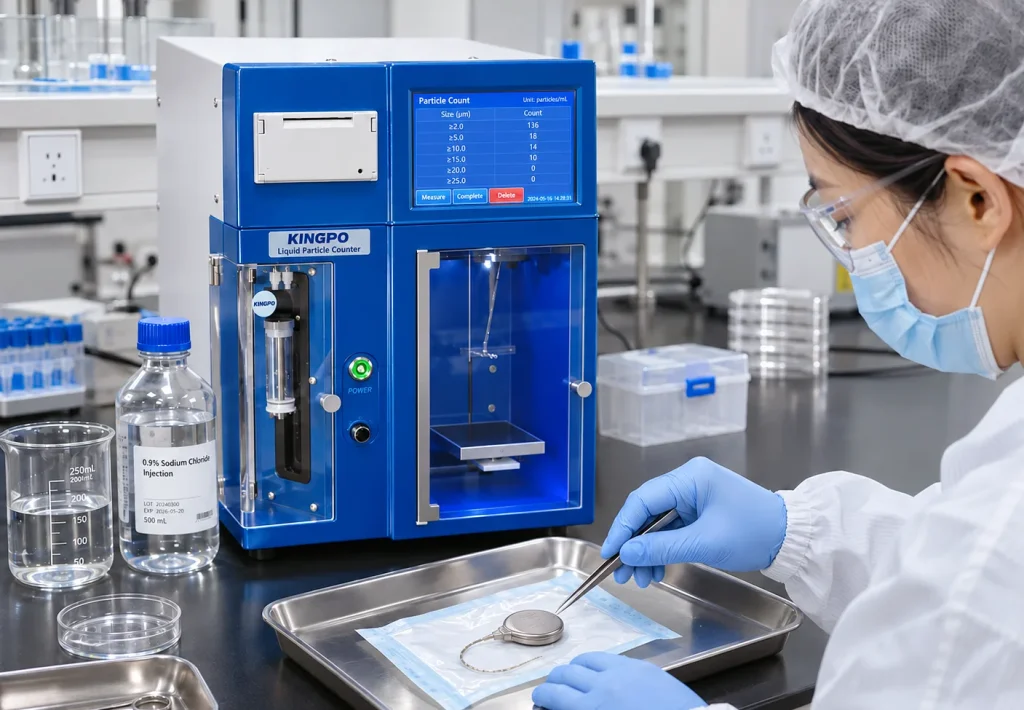
Implantable Device Sample Preparation for Particulate Testing - Intracochlear electrode array.
The overall specimen dimensions depend on the implant manufacturer, product model and electrode configuration.
For example, the external dimensions of the receiver/stimulator housing alone do not represent the complete specimen envelope. Connecting leads and electrode arrays may extend considerably beyond the main housing.
Consequently, the container should be selected according to the dimensions and geometry of the complete implantable part under evaluation.
3.1 Considerations for Different Implantable Configurations
Different cochlear implant manufacturers use different implant housing structures, coil arrangements and electrode configurations.
The sample preparation system should accommodate variations in:
- Overall specimen length.
- Receiver/stimulator housing dimensions.
- Coil diameter and thickness.
- Connecting lead length.
- Electrode array configuration.
The sample container should provide sufficient internal space for the complete specimen to be immersed without unnecessary bending, compression or contact with the container walls.
The actual implantable specimen configuration should be established before the container dimensions are finalized.
3.2 Glass Container Selection
ISO 14708-7:2019 specifies a neutral glass container with a glass lid.
For laboratory equipment development, a tall-form 1,000 mL neutral-glass vessel can be evaluated as an initial engineering configuration for accommodating larger implantable assemblies and longer connecting leads.
| Selection Parameter | Engineering Consideration |
|---|---|
| Container Capacity | Initial evaluation of a 1,000 mL vessel |
| Internal Diameter | Sufficient space for the receiver, coil and lead arrangement |
| Internal Height | Sufficient clearance for the complete specimen |
| Material | Suitable neutral glass |
| Cover | Compatible glass lid |
| Sample Position | Complete immersion without unnecessary contact |
| Agitation Space | Sufficient clearance for liquid movement |
3.3 Specimen Protection During Agitation
The specimen must remain in a suitable position throughout the exposure period.
Particular attention should be given to avoiding:
- Unnecessary contact between the implantable component and the glass container.
- Friction between the specimen and supporting structures.
- Damage or deformation of connecting leads.
- Additional particulate contamination introduced by sample holders or fixtures.
- Conditions that cause the specimen to move uncontrollably during agitation.
Any positioning or support arrangement should be evaluated to ensure that it does not introduce additional particles or interfere with the intended test conditions.
04Controlled Saline Preparation and Continuous Agitation
Temperature control and continuous agitation are essential parts of the particulate matter test procedure.
ISO 14708-7:2019 requires the saline bath to be maintained at 37 ± 2°C for a period of 8–18 hours, with agitation throughout the exposure period.
The specimen and reference samples must be treated under similar conditions.
4.1 Temperature-Controlled Sample Preparation
The saline solution must remain within the specified temperature range throughout the exposure period.
A controlled-temperature laboratory system provides the thermal environment required for this process.
Temperature monitoring should consider the actual conditions of the saline inside the glass containers rather than relying exclusively on the temperature displayed by the external heating system.
The heating arrangement should provide stable conditions for both the specimen and reference samples during extended operation.
4.2 Agitation Method Selection
The standard requires continuous agitation of the saline bath but does not prescribe a specific agitation mechanism.
Different methods may be considered during equipment development, provided they can maintain suitable liquid movement throughout the required exposure period.
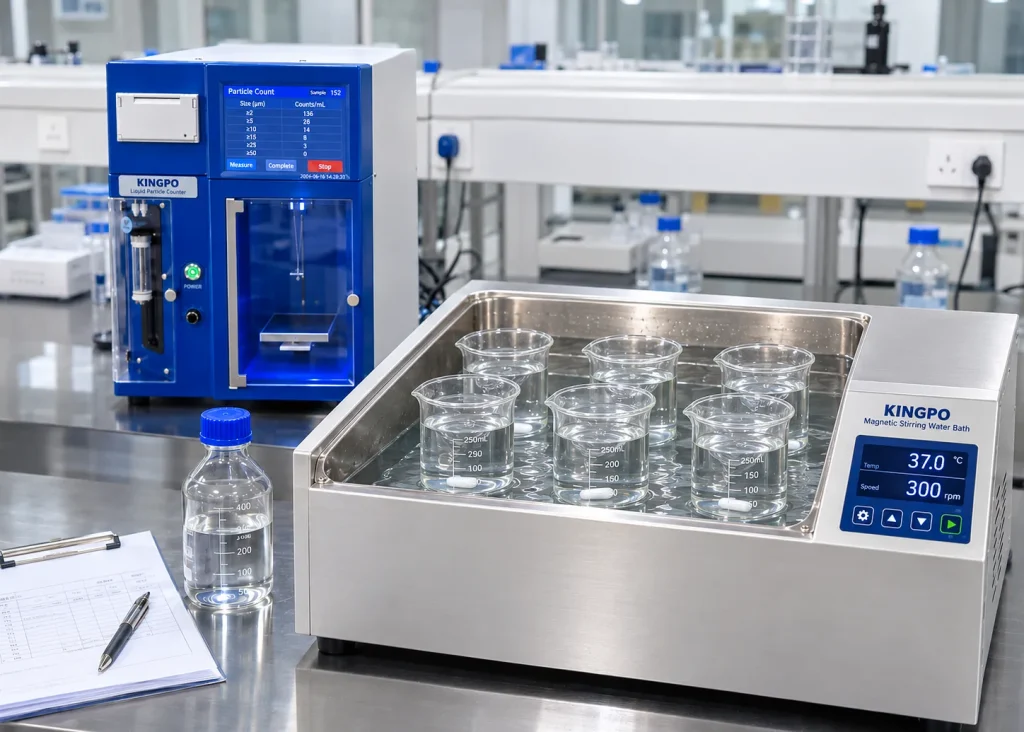
For cochlear implant specimens, the agitation mechanism requires additional engineering consideration because some implant designs incorporate internal magnets.
External magnetic fields and magnetic stirring arrangements should therefore be evaluated for possible interaction with the specimen, movement of the implantable assembly and potential contact with the container.
A non-magnetic mechanical agitation arrangement, such as a controlled reciprocating or rocking platform, is a design option worth evaluating for this application.
The selected arrangement should:
- Maintain continuous movement of the saline solution.
- Avoid unnecessary specimen movement or impact.
- Prevent abrasion between the specimen and container.
- Avoid introducing additional particles.
- Maintain comparable agitation conditions for specimen and reference samples.
- Support continuous operation throughout the 8–18-hour exposure period.
4.3 Separate Preparation of Specimen and Reference Samples
The specimen and reference samples must be prepared separately.
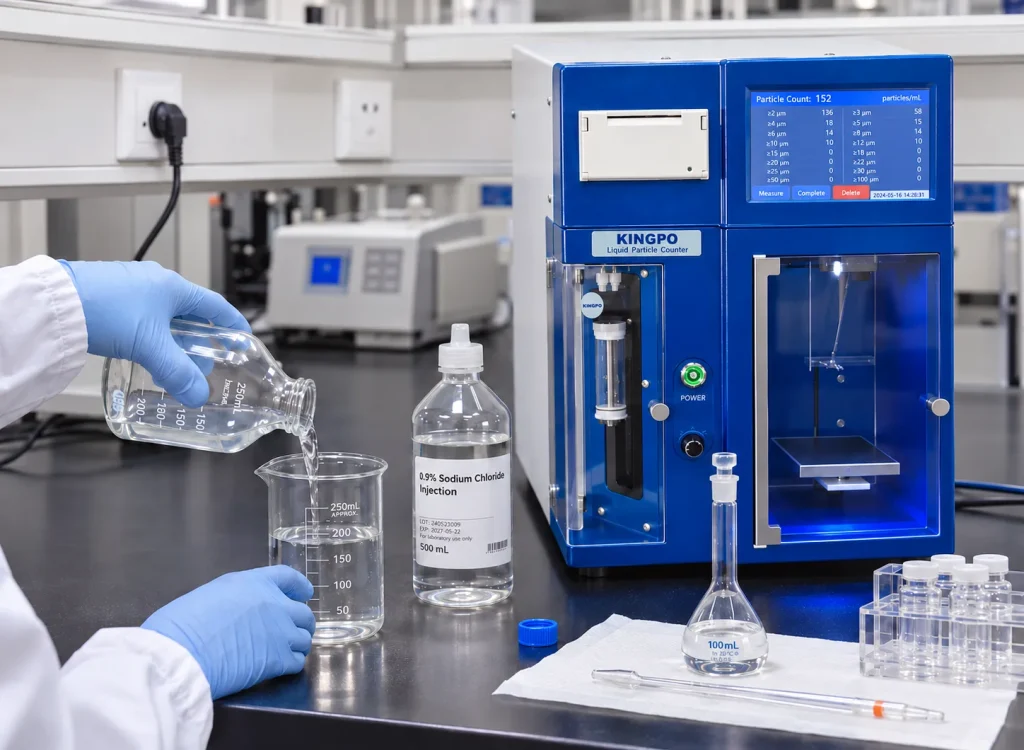
The reference sample should use saline from the same batch as the specimen preparation solution and have a similar volume.
Both containers should be maintained under comparable conditions, including:
- Temperature.
- Exposure duration.
- Container configuration.
- Agitation conditions.
- Sample handling procedures.
A dual-container arrangement can support simultaneous preparation and help maintain comparable processing conditions.
4.4 Extended Operating Requirements
The sample preparation system should be designed for continuous operation over the full 8–18-hour exposure period.
Important engineering considerations include:
- Stable temperature control.
- Reliable continuous agitation.
- Secure container positioning.
- Protection against evaporation and external contamination.
- Consistent treatment of reference and specimen samples.
These considerations help establish a repeatable preparation procedure before the subsequent particle measurement stage.
05Liquid Particle Measurement Using the KINGPO KP-MP500D
After the specified saline exposure period, the specimen and reference liquids are collected separately for quantitative particle measurement.
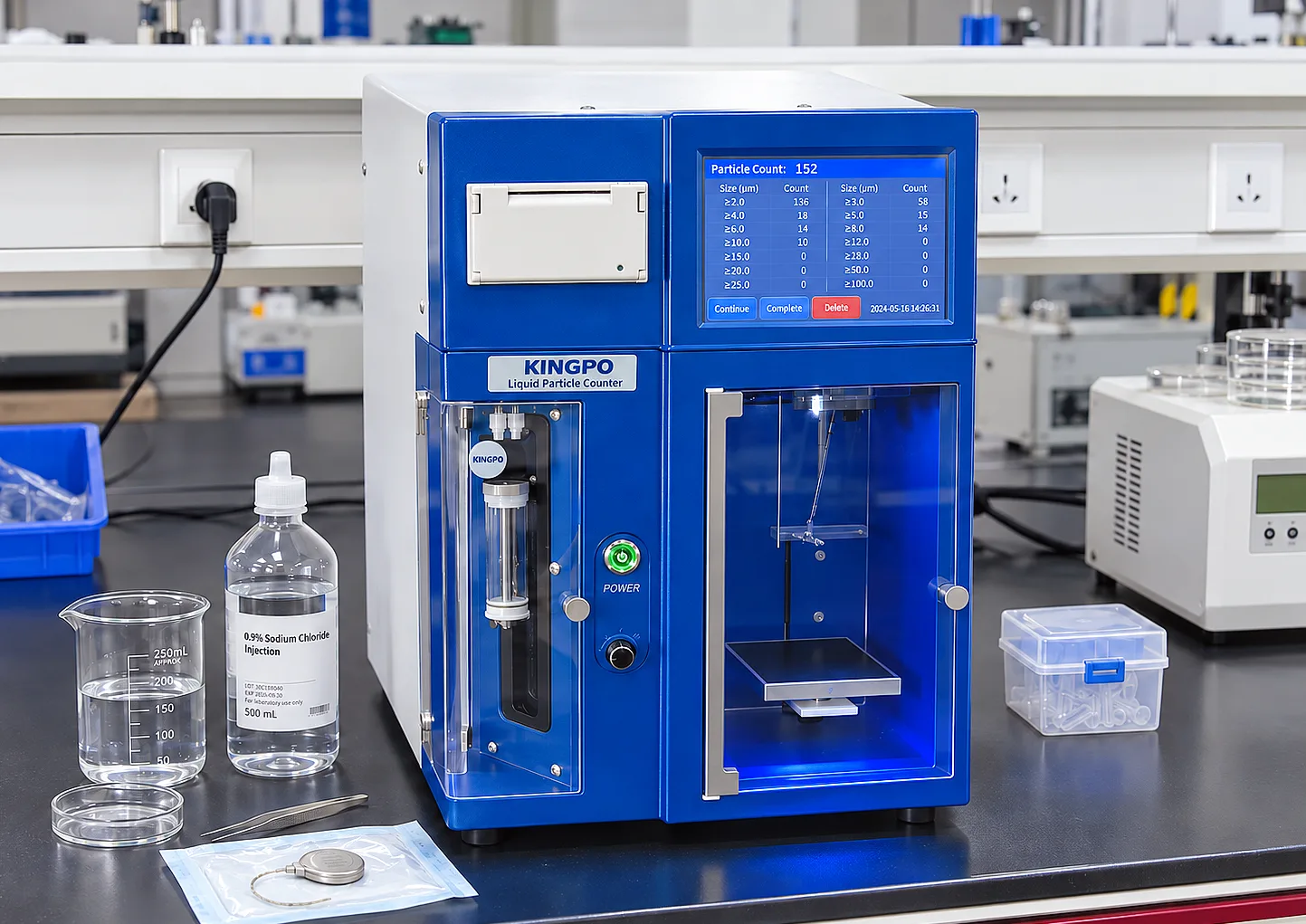
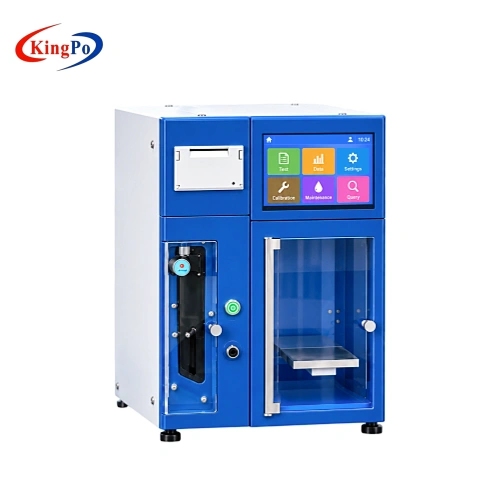
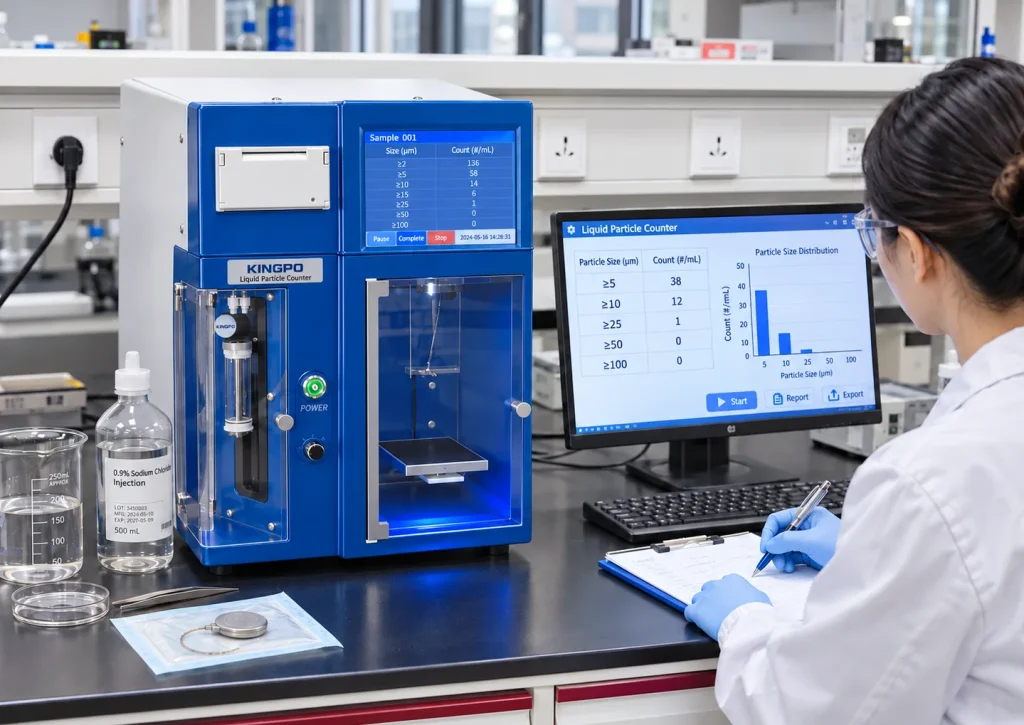
The KINGPO KP-MP500D Liquid Particle Counter is designed for particulate matter measurement in liquid samples and supports comparative particle analysis associated with ISO 14708-7:2019 Clause 14.2.
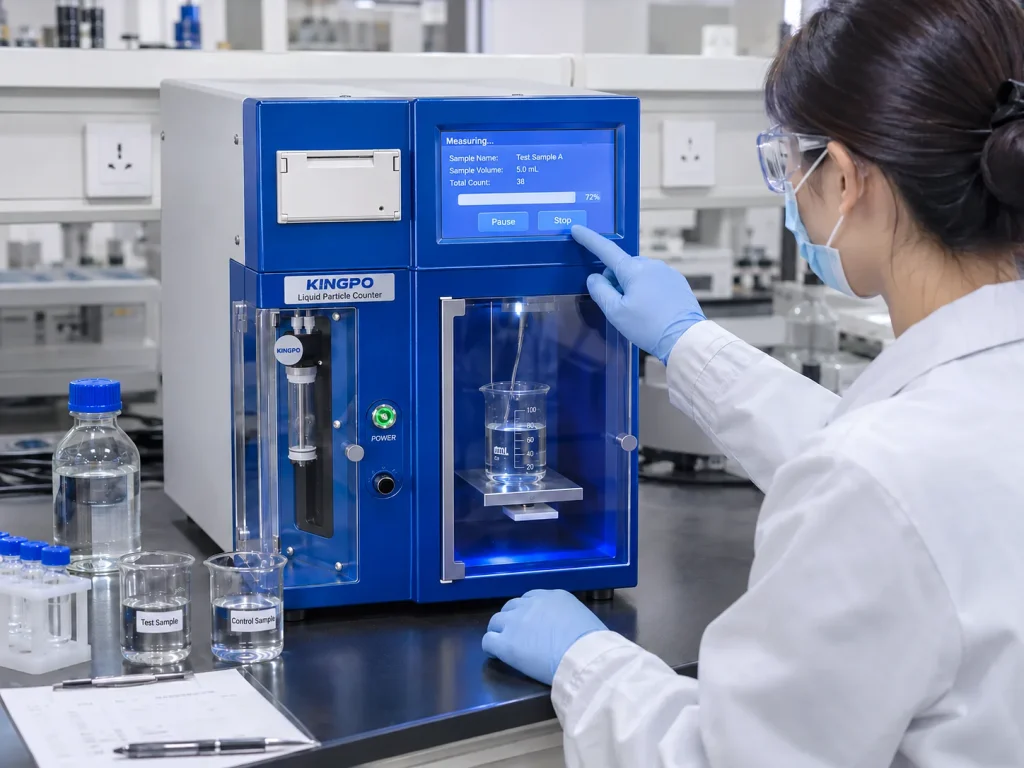
The instrument combines optical particle detection, quantitative liquid sampling, synchronized sample stirring, temperature control and test data management.
5.1 Particle Detection and Counting Thresholds
The KP-MP500D provides a specified particle detection range of 1–500 μm.
Its configurable counting thresholds include:
- ≥5 μm.
- ≥10 μm.
- ≥25 μm.
These channels provide particle-count information across different particle-size thresholds.
For ISO 14708-7 testing, particular attention is required for the standard’s evaluation limits of particles greater than 5.0 μm and greater than 25.0 μm.
The instrument’s configured thresholds and measurement response must be verified against these standard definitions before using the results for formal conformity assessment.
The manufacturer’s product documentation describes the detection system as optical particle detection. Its specific measurement principle should be confirmed to establish whether it corresponds to the measurement principles identified in the standard, such as light-blockage measurement.
5.2 Synchronized Reference and Test Sample Processing
The KP-MP500D incorporates a synchronized stirring arrangement for reference and test samples.
This arrangement allows both liquid samples to be processed under coordinated conditions during the instrument’s sample handling and measurement workflow.
Consistent sample handling is important because particles may not remain uniformly distributed throughout a liquid sample.
The stirring arrangement helps support repeatable sampling conditions and comparative particle measurement.
However, the instrument’s internal stirring function should not automatically be considered equivalent to the complete 8–18-hour saline exposure and agitation procedure.
Its suitability for the extended preparation stage must be verified separately against the specimen geometry, magnetic compatibility and actual operating configuration.
5.3 Quantitative Liquid Sampling
The KP-MP500D supports selectable sampling volumes starting from 0.1 mL.
Its specified sampling performance includes:
| Sampling Volume | Sampling Time |
|---|---|
| 5 mL | Less than 10 seconds |
| 100 mL | Less than 3 minutes |
The instrument also provides a specified particle concentration range of 0–10,000 particles/mL.
The sampling volume and number of measurements should be determined according to the applicable measurement procedure and laboratory requirements.
5.4 Measurement Performance and Data Management
The published technical specifications of the KP-MP500D include:
| Parameter | Specification |
|---|---|
| Particle Detection Range | 1–500 μm |
| Counting Thresholds | ≥5 μm, ≥10 μm, ≥25 μm |
| Particle Concentration Range | 0–10,000 particles/mL |
| Accuracy | ±5% |
| Relative Standard Deviation | ≤2% at standard particle concentration ≥1,000 particles/mL |
| Channel Resolution | ≥95% for the ≥10 μm channel |
| Minimum Sampling Volume | 0.1 mL |
| Temperature Control | 37°C ± 2°C |
| Stirring Speed | 0–1,500 r/min |
| Sample Processing | Simultaneous reference and test sample stirring |
The instrument software supports:
- Test method configuration.
- Calibration management.
- Historical data queries.
- Measurement result management.
- Test data storage and output.
These functions help laboratories organize particle measurement records and maintain data for subsequent comparative evaluation.
5.5 Measurement Validation for Formal Evaluation
Before using the KP-MP500D for formal ISO 14708-7 conformity assessment, its measurement suitability should be established.
In particular, verification should cover:
- The specific particle detection principle and its correspondence with the standard’s measurement method.
- The relationship between the instrument’s ≥5 μm and ≥25 μm channels and the standard’s greater-than thresholds.
- Calibration and particle-size measurement characteristics.
- Background particle counts and contamination control.
- Measurement performance at low particle concentrations relevant to the acceptance criteria.
- Repeatability of specimen and reference sample measurements.
For example, the standard limits the excess average count for particles greater than 25.0 μm to 5 particles/mL.
06From Sample Preparation to Comparative Particle Evaluation
The particulate matter testing process can be organized into three main stages, with each stage serving a different function.
1
Specimen Preparation
Aseptically prepare the complete implantable specimen, determine its relevant surface area and calculate the required saline volume. Prepare a separate reference sample using saline from the same batch.
2
Conditioning & Agitation
Maintain specimen and reference containers at 37 ± 2°C for 8–18 hours, with continuous and comparable agitation throughout the exposure period.
3
Particle Measurement
Collect the specimen and reference liquids separately, measure particle counts and calculate the excess average count for evaluation against the standard.
Stage 1 — Implantable Specimen Preparation
The implantable component is removed aseptically from its non-reusable packaging.
The complete implantable specimen is identified and its relevant surface area determined according to the applicable test procedure.
The required saline volume is calculated using the relationship specified in ISO 14708-7:2019.
The specimen is immersed in the saline solution inside a neutral glass container with a glass lid.
A reference sample is prepared separately using a similar volume of saline from the same batch.
Stage 2 — Temperature Conditioning and Continuous Agitation
The specimen and reference containers are maintained at 37 ± 2°C for 8–18 hours.
Continuous agitation is maintained throughout the exposure period.
The agitation system should provide comparable conditions for both samples while avoiding unnecessary specimen movement, contact or contamination.
For implant systems incorporating internal magnets, the selected agitation mechanism should be evaluated for compatibility with the specimen.
Stage 3 — Particle Measurement and Comparative Evaluation
Following the exposure period, the specimen and reference liquids are collected separately.
Both samples are transferred to the KP-MP500D for quantitative particle measurement.
The particle counts at the configured measurement thresholds are recorded and compared.
The laboratory determines the excess average particle count from the specimen relative to the reference sample and evaluates the results against the acceptance criteria specified in ISO 14708-7:2019 Clause 14.2.
The final assessment should follow the standard’s measurement principles, particle-size definitions and calculation procedure.
Workflow Summary
| Testing Stage | Main Operation | Equipment or System |
|---|---|---|
| Specimen Preparation | Aseptic removal and specimen arrangement | Laboratory preparation |
| Saline Preparation | Prepare saline and calculate required volume | Laboratory preparation |
| Temperature Conditioning | Maintain 37 ± 2°C | Controlled-temperature system |
| Continuous Agitation | Agitate throughout 8–18 hours | Agitation system |
| Reference Preparation | Prepare and process reference saline separately | Reference sample station |
| Particle Measurement | Quantitative liquid particle counting | KP-MP500D |
| Comparative Evaluation | Calculate excess average particle counts | Measurement software and laboratory analysis |
This arrangement separates specimen preparation, extended saline exposure and subsequent particle measurement, providing a structured approach to particulate matter evaluation.
07Laboratory Applications and Testing Capability Development
Particulate matter evaluation is relevant to the development, verification and quality assessment of active implantable medical devices.
For laboratories working with cochlear and auditory brainstem implant systems, the ability to prepare complete implantable specimens under controlled conditions and perform quantitative liquid particle measurement is an important part of establishing the relevant testing capability.
Typical laboratory applications include:
- Particulate matter evaluation of cochlear implant components.
- Saline extraction and particle release assessment.
- Comparative particle counting of specimen and reference samples.
- Particle measurement under controlled temperature and agitation conditions.
- Implantable medical device research and development.
- Laboratory quality verification and testing.
The selection of sample containers, agitation mechanisms and particle measurement instruments should be based on the specimen configuration, surface area, applicable standard requirements and verified laboratory procedures.
The overall objective is to establish a repeatable testing process that controls sample preparation conditions and provides reliable comparative particle measurement data.
Supporting Cochlear Implant Testing Laboratories
Reliable particulate matter evaluation requires coordinated control of specimen preparation, saline volume, temperature, agitation and particle measurement.
For cochlear implant systems, the geometry of the complete implantable assembly introduces additional considerations when selecting containers and designing the agitation arrangement.
A suitable laboratory configuration should therefore address the complete test process rather than treating particle counting as an isolated measurement operation.
KINGPO provides liquid particle measurement equipment and laboratory testing solutions to support the development of testing capabilities for cochlear implant and related active implantable medical device applications.
The final equipment configuration should be established through technical review and method verification against the applicable standard.
Standard Reference
ISO 14708-7:2019
Implants for Surgery — Active Implantable Medical Devices — Part 7: Particular Requirements for Cochlear and Auditory Brainstem Implant Systems.
Clause 14.2 — Protection from Unintentional Biological Effects Being Caused by the Active Implantable Medical Device.
Official standard information: ISO 14708-7:2019
Related equipment: KINGPO KP-MP500D Liquid Particle Counter
This article is intended as a technical overview of the standard and laboratory equipment considerations. Formal conformity assessment should be performed using the applicable official standard, validated measurement methods and laboratory procedures.