 Quick Answer
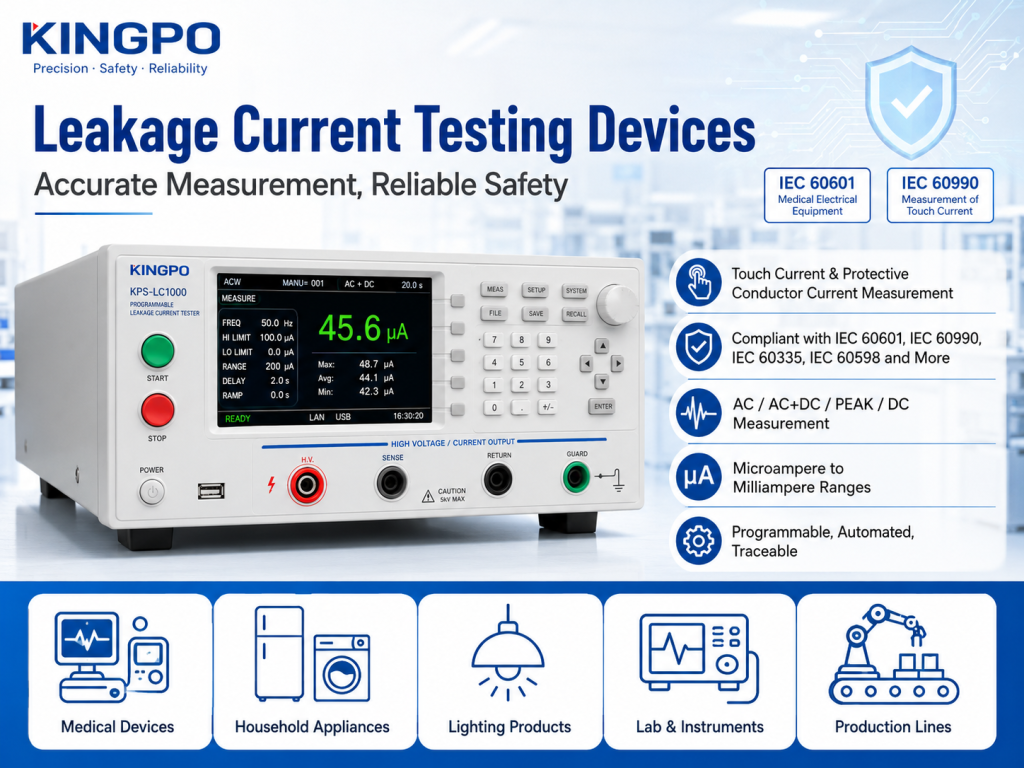
Leakage current testing devices are used to measure unintended current that may flow from live parts, insulation systems, accessible conductive parts, protective earth conductors or applied parts. These devices help manufacturers and laboratories evaluate electric shock risk, insulation performance and product safety compliance. KINGPO provides programmable leakage current testing equipment for IEC 60601-1, IEC 60990, IEC 60335-1, IEC 60598-1, IEC 61010-1 and related electrical safety standards, supporting medical electrical equipment, household appliances, lighting products, laboratory instruments and production-line safety testing.
What Are Leakage Current Testing Devices?
Leakage current testing devices are electrical safety instruments used to measure small unintended currents that may flow through insulation, protective earth conductors, accessible metal parts or simulated human body networks. In product safety testing, these currents are important because even a small current may represent an electric shock hazard, especially when the equipment is used by patients, operators or consumers.
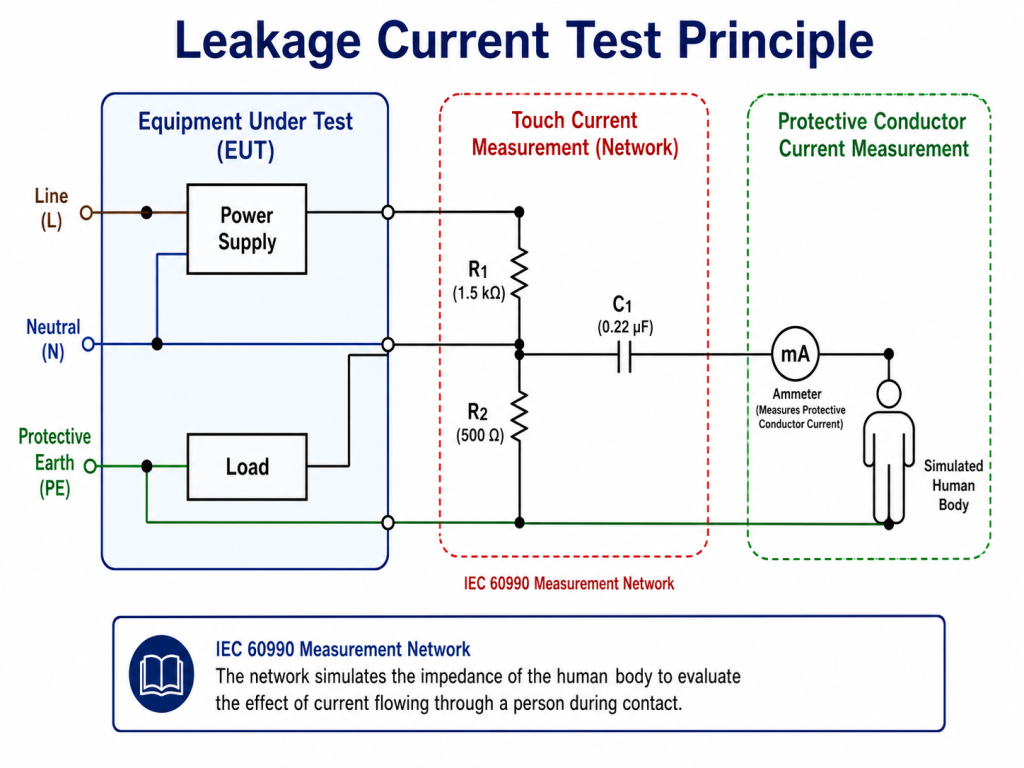
According to IEC 60990:2016, leakage-related measurement methods cover touch current and protective conductor current. The standard explains that touch current measurement uses networks representing human body impedance, while protective conductor current refers to current flowing through a protective conductor. IEC 60990 also clarifies that it defines measurement methods rather than product-specific limit values.
In practical laboratories, leakage current testing devices are used for:
| Application Area | Typical Purpose |
|---|---|
| Medical electrical equipment | Measuring touch current, patient leakage current and protective earth-related leakage |
| Household appliances | Checking leakage current under normal and fault conditions |
| Lighting products | Evaluating accessible conductive parts and insulation safety |
| Laboratory instruments | Verifying user safety for measurement and control equipment |
| Power supplies and chargers | Checking leakage between primary circuits, secondary circuits and accessible outputs |
| Production lines | Fast pass/fail safety screening before shipment |
KINGPO’s IEC 60601-1 programmable leakage current tester is positioned for medical electrical safety testing and supports multiple related standards, including IEC 60601-1, IEC 61010-1, IEC 60335-1, IEC 60950-1, IEC 60065, IEC 60598-1 and IEC 60990.
Why Leakage Current Testing Matters
Leakage current testing is not just a routine electrical check. It is a core safety evaluation because it verifies whether a product may expose users to unintended current paths during normal operation or under single fault conditions.
For household appliances, leakage current can arise from insulation aging, moisture, contamination, damaged wiring, EMI filters or insufficient creepage and clearance. For medical electrical equipment, the risk is more sensitive because current may pass through a patient-contact pathway or applied part.
The FDA recognized consensus standards database lists ANSI/AAMI ES60601-1, based on IEC 60601-1, as a standard for medical electrical equipment basic safety and essential performance. This confirms the importance of IEC 60601-1-based electrical safety evaluation in medical device compliance.
Main Types of Leakage Current Testing Devices
1. Programmable Leakage Current Tester
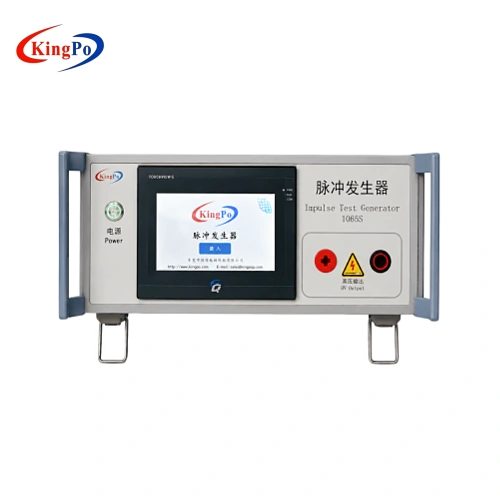
A programmable leakage current tester is a benchtop instrument used for formal compliance testing. It usually integrates test voltage control, measurement circuits, simulated human body networks, current range selection, timing, pass/fail judgment and data recording.
KINGPO’s programmable leakage current tester supports AC, AC+DC, PEAK and DC measurement modes, with current ranges of 20 μA, 200 μA, 2 mA and 20 mA. It also supports programmable upper and lower limits, a 5.6-inch TFT display, Excel export via U-disk, RS232 and PLC interfaces, and optional LAN/RS485/USB integration for automated testing systems.
This type of device is suitable for:
| Use Case | Why It Is Suitable |
|---|---|
| Type testing | Supports standard-based leakage current evaluation |
| R&D validation | Helps engineers compare leakage under different designs |
| Production testing | Enables programmable pass/fail screening |
| Medical device testing | Supports IEC 60601-1-related leakage current modes |
| Third-party laboratories | Provides traceable test data and report support |
2. Medical Electrical Safety Analyzer
A medical electrical safety analyzer is a specialized leakage current testing device for medical equipment. It is used to evaluate patient safety, operator safety, applied parts, protective earth, enclosure leakage and single fault conditions.
Compared with general household appliance leakage testers, medical electrical safety testing requires more detailed test paths and stricter attention to applied parts. For example, patient leakage current, patient auxiliary current and mains-on-applied-part conditions may be relevant depending on the medical device structure and classification.
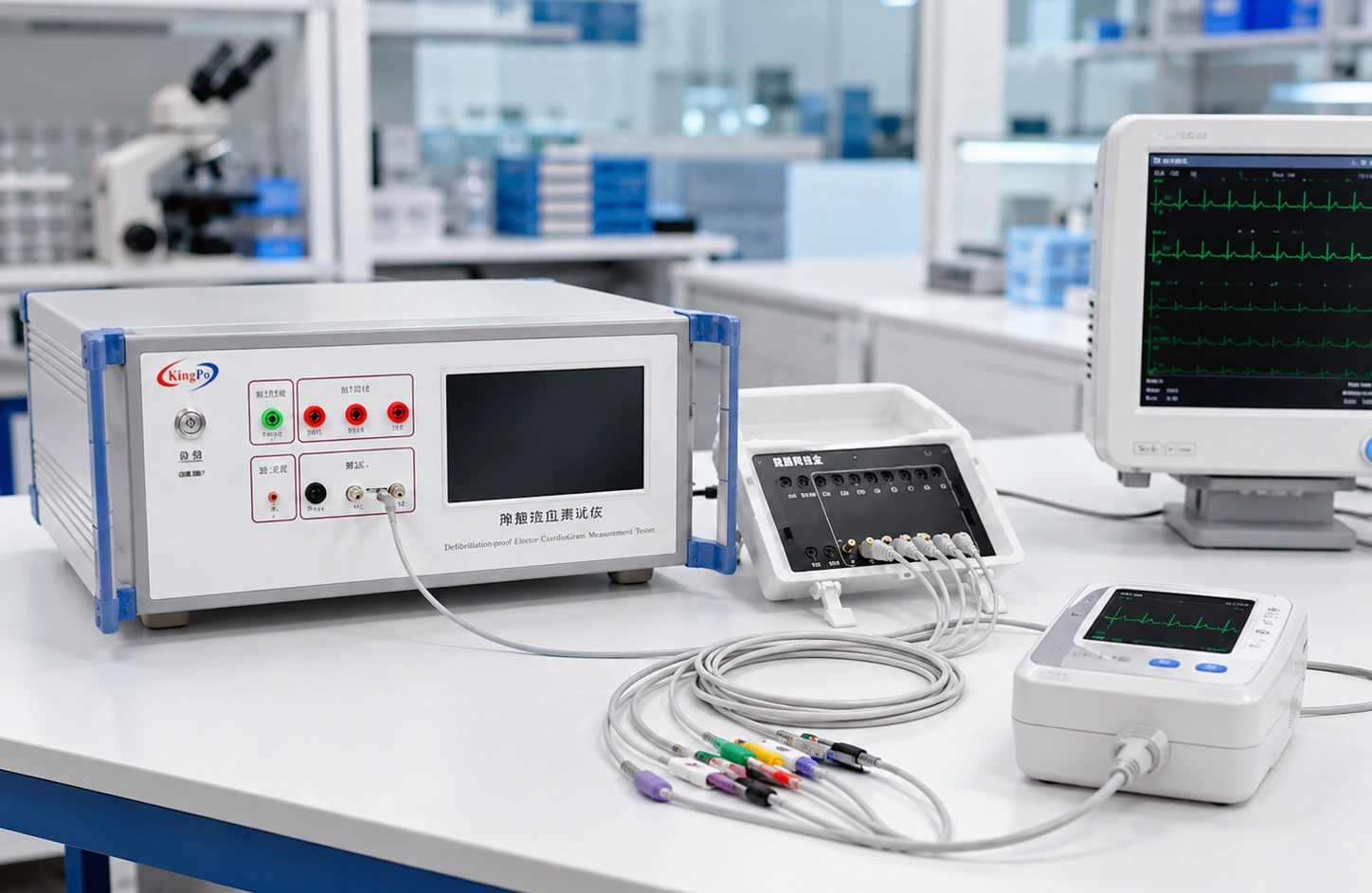
KINGPO’s IEC 60601 programmable leakage current tester is designed for automated measurement of touch current and protective conductor current on medical electrical equipment and other electrical products according to IEC 60601-1 and related standards.
3. Touch Current Tester
A touch current tester measures the current that may pass through a person when touching accessible conductive parts of a product. This is especially important for products with metal enclosures, user controls, output ports, handles or conductive panels.
The key element of a touch current test is the measuring network. IEC 60990 states that touch current measurement methods are based on the possible effects of current flowing through the human body and use networks representing human body impedance.
Typical touch current test points include:
| Test Point | Example Product Area |
|---|---|
| Metal enclosure | Laboratory instrument, power supply, industrial controller |
| Accessible screw or panel | Household appliance, lighting fixture |
| External output connector | Charger, adapter, medical accessory |
| Handle or user control | Handheld tool, medical device handle |
| Patient-contact area | Applied part of medical electrical equipment |
4. Protective Conductor Current Tester
Protective conductor current testing measures current flowing through the protective earth conductor. This is important for Class I equipment where protective earth is part of the shock protection strategy.
A high protective conductor current may indicate insulation degradation, excessive capacitive leakage, EMI filter design issues or abnormal current paths. In product validation, it is usually evaluated together with touch current, dielectric strength, insulation resistance and protective earth continuity.
5. Clamp-Type Leakage Current Meter
A leakage current clamp meter is mainly used for field troubleshooting and maintenance. It allows technicians to measure leakage current without disconnecting circuits. This is useful for identifying nuisance tripping of residual current devices, insulation deterioration in installed equipment and leakage imbalance in electrical systems.
However, clamp meters are generally not a replacement for standard-based compliance leakage current testers. Formal product compliance testing requires correct measurement networks, defined test conditions, rated voltage operation, fault simulation and documented pass/fail judgment.
6. Integrated Electrical Safety Test System
An integrated electrical safety test system combines multiple safety tests in one station, such as hipot testing, insulation resistance, ground bond, leakage current and functional testing.
This type of system is especially useful for production lines where every product must be tested quickly and consistently. KINGPO’s electrical safety equipment category covers safety and reliability testing equipment, including leakage current and related IEC safety test applications.
Leakage Current Test Standards: Which Standards Apply?
Different products use different leakage current limits, test networks and test conditions. The tester should be selected according to the product standard, not only according to current range.
| Standard | Product Area | Leakage Current Relevance |
|---|---|---|
| IEC 60990 | General measurement method | Touch current and protective conductor current measurement methods |
| IEC 60601-1 | Medical electrical equipment | Patient safety, operator safety, applied parts and single fault testing |
| IEC 60335-1 | Household and similar appliances | Leakage current and electric strength for appliances |
| IEC 60598-1 | Luminaires | Leakage current and insulation safety for lighting products |
| IEC 61010-1 | Measurement, control and laboratory equipment | Electrical safety for lab and measurement instruments |
| IEC 62368-1 | Audio/video, IT and communication technology equipment | Hazard-based electrical safety evaluation |
| IEC 60065 / IEC 60950-1 | Legacy AV / IT equipment standards | Still relevant for some older product categories or markets |
KINGPO’s programmable leakage current tester lists support for IEC 60601-1, IEC 61010-1, IEC 60335-1, IEC 60950-1, IEC 60065, IEC 60598-1 and IEC 60990, making it suitable for both medical and general electrical safety testing workflows.
How to Perform a Leakage Current Test
A leakage current test should be performed according to the applicable product standard. The exact connection method, measuring network, voltage condition, operating mode and limit value may vary. However, the general workflow is usually as follows.
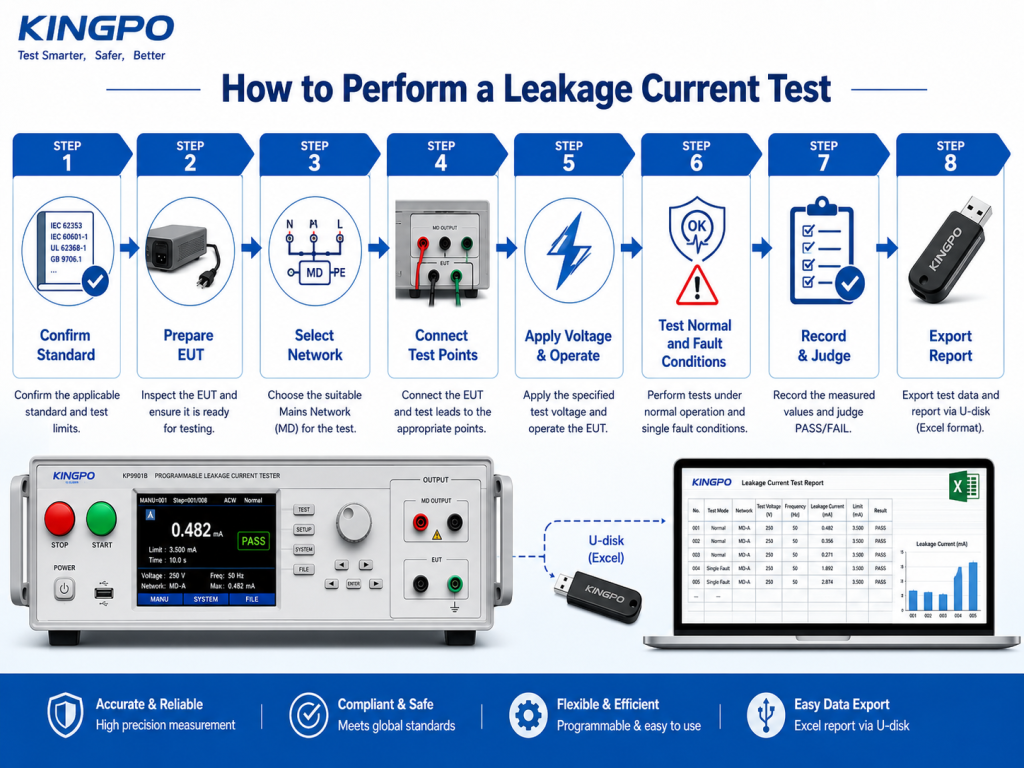
Step 1: Confirm the Product Category and Standard
Before selecting a test mode, confirm whether the product is a medical device, household appliance, lighting product, power supply, laboratory instrument or IT/AV product. This determines the correct standard, test network and leakage current limit.
Step 2: Prepare the Equipment Under Test
The equipment under test should be complete, clean, dry and configured in the operating mode most likely to produce the highest leakage current. For appliances, this may include maximum heating or motor operation. For medical devices, applied parts and patient-contact circuits must be considered.
Step 3: Select the Correct Measurement Network
The test engineer should select the measurement network required by the applicable standard. IEC 60990-based testing uses defined networks representing human body impedance for touch current measurement.
Step 4: Connect the EUT and Test Points
Connect the EUT to the leakage current tester output. Then connect the accessible conductive parts, protective earth conductor, applied parts or specified test points to the tester measurement input according to the standard test diagram.
Step 5: Apply Rated Voltage and Operate the EUT
The EUT should be energized under rated operating voltage. The tester measures leakage current while the product is running in the selected operating mode.
Step 6: Test Normal and Single Fault Conditions
Many standards require testing under both normal condition and single fault condition. Common fault simulations may include reversed polarity, open protective earth, interrupted neutral, disconnected components or other specified fault states.
Standard-based leakage current procedures typically require testing under both normal and single fault conditions that leakage current should be measured under normal operation and possible single fault conditions, and that reversed line and neutral connections may need to be tested separately for AC-powered equipment.
Step 7: Record the Maximum Value and Judge Compliance
Record the maximum measured leakage current, test mode, measuring network, voltage, frequency, polarity, environmental conditions and fault state. Compare the result with the limit specified in the applicable standard.
Step 8: Export and Archive the Test Report
For laboratory audits and certification preparation, the leakage current tester should provide repeatable, traceable and exportable records. KINGPO’s tester supports Excel-format export via U-disk, making it easier to organize compliance documentation.
KINGPO Leakage Current Testing Solution
KINGPO’s programmable leakage current tester is designed for laboratories, medical device manufacturers, household appliance manufacturers, lighting manufacturers, electrical safety departments and automated production-line integrators.
Key Features of KINGPO Programmable Leakage Current Tester
| Feature | KINGPO Capability | Practical Value |
|---|---|---|
| Multi-standard support | IEC 60601-1, IEC 61010-1, IEC 60335-1, IEC 60598-1, IEC 60990 and others | One platform for medical and general electrical safety testing |
| Measurement modes | AC, AC+DC, PEAK, DC | Captures different leakage characteristics |
| Current ranges | 20 μA / 200 μA / 2 mA / 20 mA | Suitable for microampere and milliampere leakage evaluation |
| Test voltage range | 30.0 V to 300.0 V | Covers common rated-voltage test scenarios |
| Data export | Excel export via U-disk | Supports traceable compliance reporting |
| Automation interface | RS232, PLC, optional LAN/RS485/USB | Suitable for automated production test systems |
| Built-in auxiliary power | Isolated auxiliary supply | Useful for medical equipment testing |
| Programmable limits | Upper/lower current limits | Fast pass/fail judgment |
| Multi-step files | Up to 30 groups and 99 steps per group listed in product parameters | Efficient for multi-product or multi-condition test plans |
KINGPO’s official product page describes the tester as a high-precision, multi-standard safety tester for automated leakage current measurement on medical electrical equipment and other electrical products.
KINGPO vs Generic Leakage Current Testing Devices
| Comparison Point | Generic Leakage Current Tester | KINGPO Programmable Leakage Current Tester |
|---|---|---|
| Target use | Basic appliance leakage measurement | Medical, household, lighting and multi-standard safety testing |
| Measurement modes | Often limited to AC/RMS | AC, AC+DC, PEAK and DC |
| Standard coverage | May support one or two standards | IEC 60601-1, IEC 60990, IEC 60335-1, IEC 60598-1, IEC 61010-1 and more |
| Data management | Manual reading or basic memory | Excel export via U-disk and file management |
| Automation | Limited | RS232, PLC and optional LAN/RS485/USB |
| Medical device suitability | Not always suitable | Built for IEC 60601-related medical electrical safety testing |
| Production-line use | Depends on model | Programmable limits and automation interfaces support batch testing |
Common Leakage Current Test Failures and Engineering Causes
| Failure Symptom | Possible Cause | Engineering Action |
|---|---|---|
| High touch current | Excessive capacitive coupling or poor insulation | Review insulation design, EMI filter and creepage/clearance |
| High protective conductor current | Leakage through earth path or filter network | Check power entry module and protective earth design |
| Unstable readings | Poor test lead contact or environmental interference | Secure test leads, reduce stray capacitance, confirm grounding |
| Pass in normal condition, fail in fault condition | Weak single-fault protection | Improve insulation, isolation or protective circuit design |
| Medical device patient leakage failure | Applied part isolation issue | Review applied part classification and isolation barrier |
| Production data inconsistency | Operator variation or manual procedure | Use programmable test sequences and barcode/data export |
How to Choose the Right Leakage Current Testing Device
Before purchasing a leakage current testing device, laboratories and manufacturers should confirm the following points:
- Applicable standard
A household appliance tester may not be enough for medical device leakage current testing. - Measurement network
The tester should support the human body network or standard network required by the applicable standard. - Current range and resolution
Medical devices may require microampere-level measurement, while industrial products may need wider milliampere-range capability. - Measurement mode
AC, DC, AC+DC and peak detection may be required depending on the standard and circuit behavior. - Test voltage and auxiliary power capacity
The tester must support the EUT’s rated operating voltage and power demand. - Fault condition simulation
Confirm whether the instrument or test setup can support polarity reversal, earth interruption or other required fault states. - Data export and traceability
For certification and audits, Excel export, report storage and calibration traceability are important. - Automation interface
Production-line users should consider PLC, RS232, LAN, USB or barcode integration. - Medical device compatibility
For IEC 60601-1 testing, confirm applied-part-related test needs before choosing a general-purpose leakage tester. - Engineering support
Leakage current failures often require design analysis, not only instrument operation. Supplier engineering support can reduce debugging time. 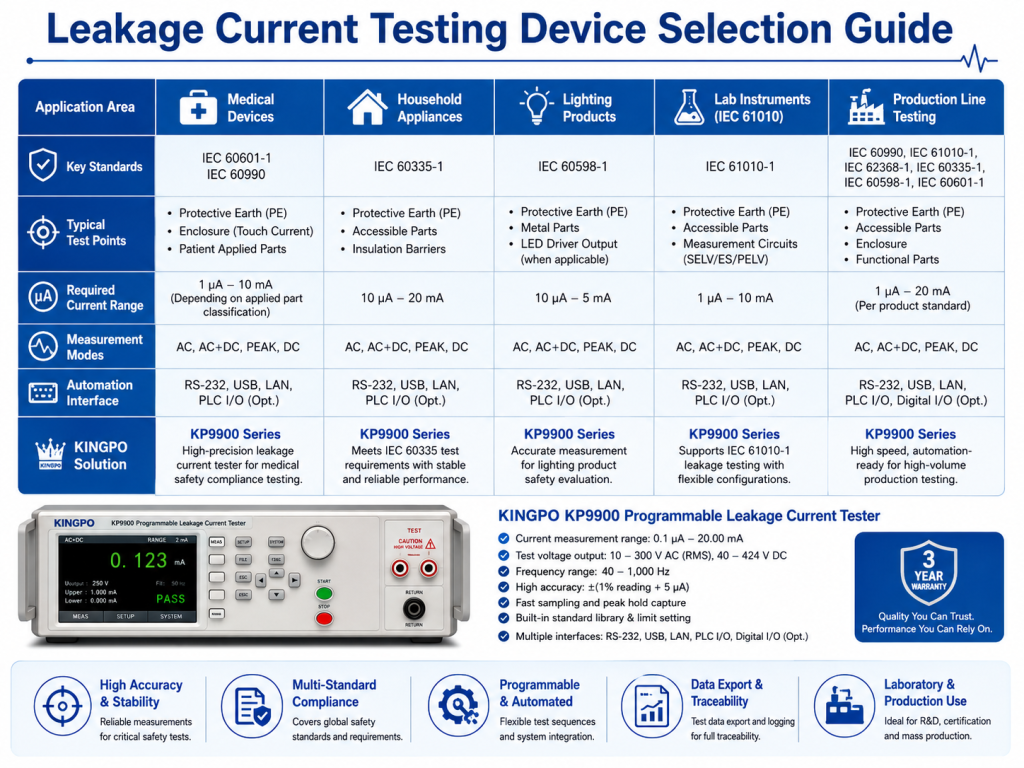
Industries That Use KINGPO Leakage Current Testing Devices
Medical Device Manufacturers
Medical device manufacturers use leakage current testers during design validation, type testing preparation, production quality control and regulatory documentation. KINGPO’s IEC 60601-1 programmable leakage current tester supports medical electrical safety workflows, including touch current and protective conductor current measurement.
Household Appliance Manufacturers
Household appliance manufacturers use leakage current testing to verify safety for products such as refrigerators, washing machines, kitchen appliances, heaters, hair dryers and motor-operated appliances.
Lighting Product Manufacturers
Lighting products require leakage current testing because luminaires may include metal housings, drivers, LED modules and accessible conductive parts. IEC 60598-1-related leakage current verification is important for lighting safety.
Laboratory and Measurement Equipment Manufacturers
IEC 61010-1-related products, such as laboratory instruments and control equipment, require electrical safety testing to reduce operator shock risk.
Production-Line Test Integrators
Automated test integrators need programmable instruments with communication interfaces, barcode traceability, limit judgment and exportable test data. KINGPO’s interfaces and Excel export support this type of workflow.
FAQ: Leakage Current Testing Devices
What is a leakage current testing device?
A leakage current testing device is an electrical safety instrument that measures unintended current flowing through insulation, protective earth, accessible conductive parts or simulated human body networks. It is used to evaluate electric shock risk and product compliance.
Is leakage current the same as touch current?
Not exactly. Touch current refers to current that may flow through a human body when touching accessible parts. Leakage current is a broader concept that may include earth leakage, enclosure leakage, patient leakage or protective conductor current depending on the product and standard.
Which standard defines touch current measurement methods?
IEC 60990 defines methods for measuring touch current and protective conductor current, including networks representing human body impedance.
What is the difference between a clamp leakage meter and a programmable leakage current tester?
A clamp leakage meter is mainly used for field troubleshooting without disconnecting the circuit. A programmable leakage current tester is used for standard-based compliance testing with defined networks, controlled test voltage, pass/fail limits and documented results.
Why is leakage current testing important for medical devices?
Medical devices may contact patients directly or indirectly. Leakage current through applied parts or accessible conductive parts can create patient and operator risk, so IEC 60601-1-related leakage current testing is a critical part of medical electrical safety evaluation.
What standards does KINGPO’s programmable leakage current tester support?
KINGPO lists support for IEC 60601-1, IEC 61010-1, IEC 60335-1, IEC 60950-1, IEC 60065, IEC 60598-1 and IEC 60990.
What current ranges does KINGPO’s leakage current tester provide?
KINGPO’s programmable leakage current tester lists 20 μA, 200 μA, 2 mA and 20 mA current ranges with programmable upper and lower limits.
Can KINGPO leakage current testers be used in automated production lines?
Yes. KINGPO’s tester provides RS232 and PLC interfaces, with optional LAN, RS485, USB and scan code gun support, making it suitable for automated safety testing systems.
What data export function does KINGPO provide?
KINGPO’s programmable leakage current tester supports Excel-format export via U-disk, helping laboratories and manufacturers create traceable test records.
How do I choose a leakage current testing device?
Choose based on product category, applicable standard, current range, measurement mode, human body network, test voltage, automation interface, data export needs and whether medical-device-specific leakage current testing is required.
Conclusion
Leakage current testing devices are essential tools for electrical safety, product compliance and risk control. They help engineers measure unintended current paths that may create electric shock hazards for users, operators or patients.
A strong leakage current testing program should not rely only on one instrument reading. It should combine the correct standard, measuring network, test voltage, product operating mode, normal and single fault conditions, polarity checks, data recording and engineering analysis.
KINGPO provides programmable leakage current testing solutions for medical electrical equipment, household appliances, lighting products, laboratory instruments and production-line safety testing. With multi-standard support, AC/AC+DC/PEAK/DC measurement modes, microampere-to-milliampere ranges, Excel data export and automation interfaces, KINGPO leakage current testing devices are designed for laboratories and manufacturers that need repeatable, traceable and compliance-ready electrical safety results.