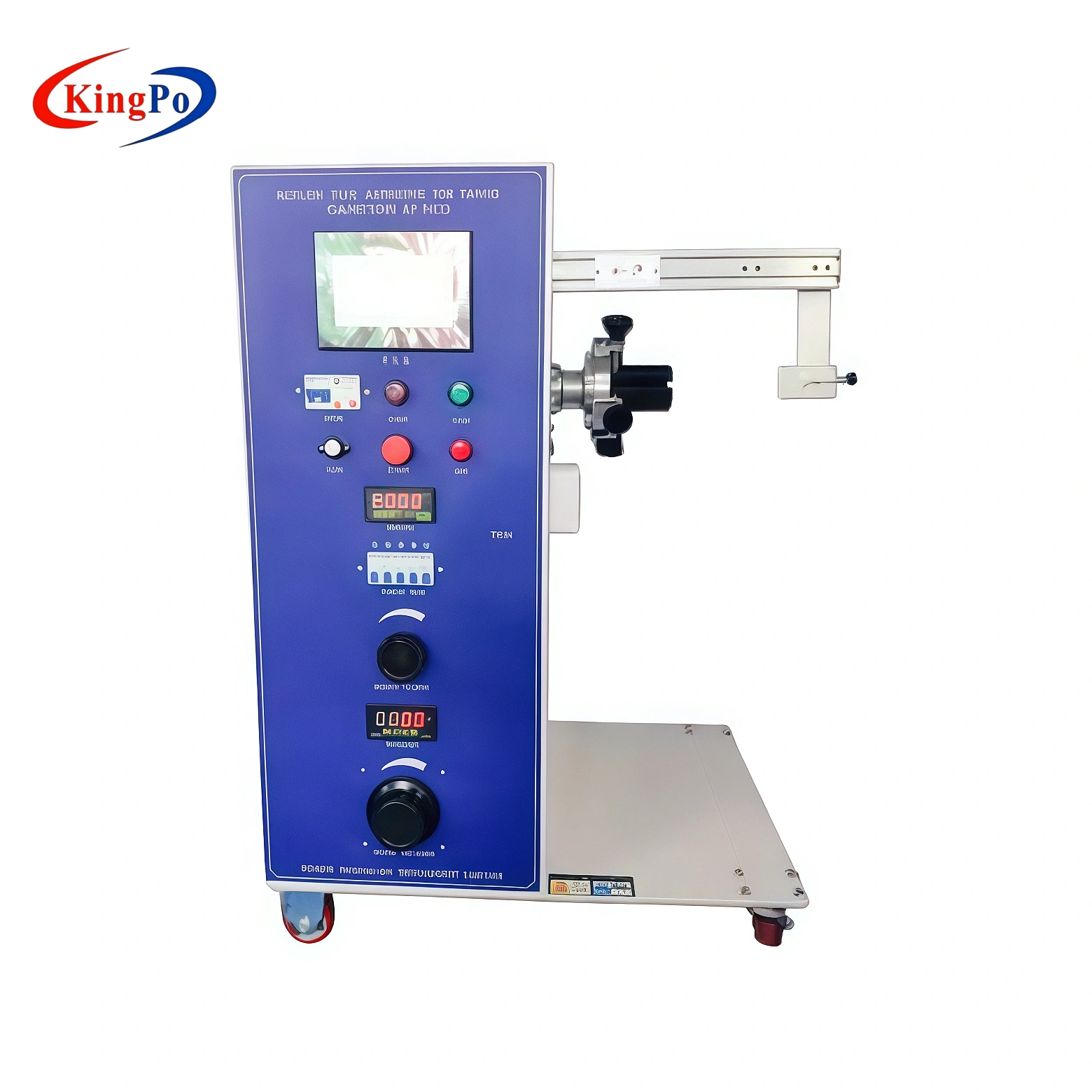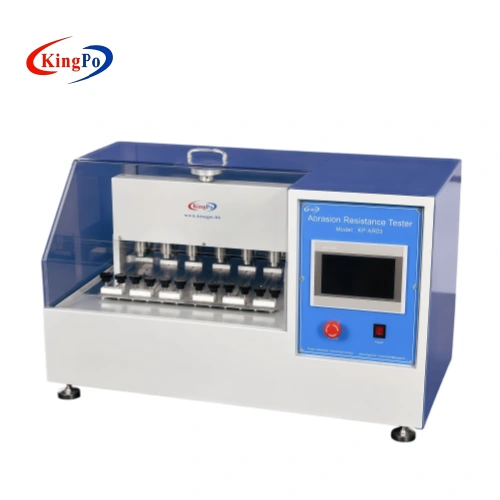
UL 719 Abrasion Resistance Tester for flat cable jacket abrasion testing, shown with 6 test stations and touch screen control panel.
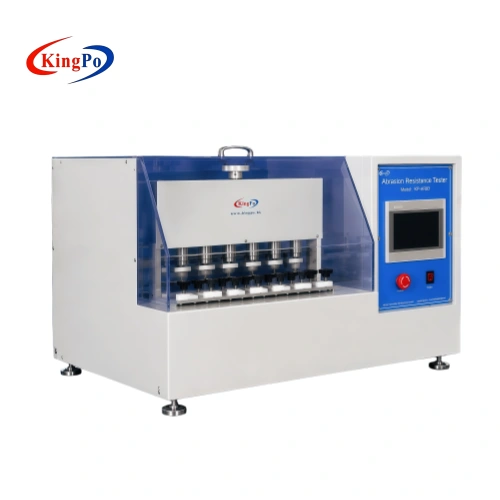
UL 719 Abrasion Resistance Tester showing the 6-station test area for repeatable flat cable jacket abrasion resistance evaluation.
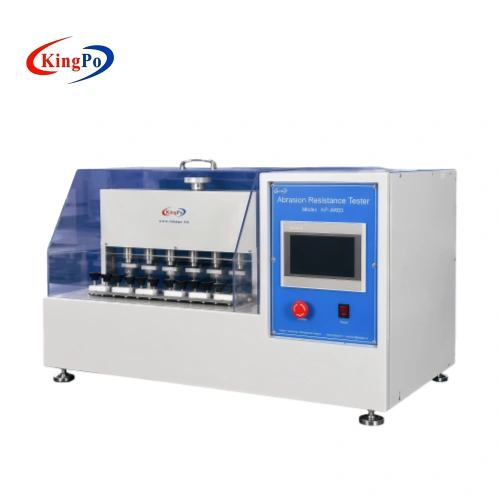
Right front view of the UL 719 Abrasion Resistance Tester used for flat cable jacket abrasion testing at 30 times per minute.
UL 719 Abrasion Resistance Tester for flat cable jacket abrasion testing, shown with 6 test stations and touch screen control panel.
UL 719 Abrasion Resistance Tester showing the 6-station test area for repeatable flat cable jacket abrasion resistance evaluation.
Right front view of the UL 719 Abrasion Resistance Tester used for flat cable jacket abrasion testing at 30 times per minute.

UL 719 Abrasion Resistance Tester

The UL 719 Abrasion Resistance Tester is designed for evaluating the abrasion resistance of flat cable jackets according to UL 719 Clause 7.14. It performs a reciprocating abrasion test at 30 times per minute with a 150 mm / approximately 6 inch stroke, helping laboratories assess whether the cable jacket can withstand repeated mechanical wear under defined test conditions.

  • Designed for UL 719 Clause 7.14 flat cable jacket abrasion testing
  • 6 test stations for multiple specimens
  • Reciprocating movement at 30 times per minute
  • Moving distance: 150 mm, approximately 6 inch stroke
  • PLC + touch screen control
  • Servo motor drive for stable reciprocating motion
  • Run count setting from 0 to 9999
  • Test weight: 13.34 ± 0.14 N, 6 pieces

UL 719 Abrasion Resistance Tester Overview

Product Overview

The UL 719 Abrasion Resistance Tester is used to test the jacket abrasion resistance of flat cables. During testing, straight cable specimens are fixed on a horizontal steel plate, while weighted abrasion tools are positioned over the specimens. The specimen plate then reciprocates horizontally so that the cable jacket is subjected to repeated abrasion.

This equipment is suitable for cable manufacturers, third-party laboratories, certification preparation teams, R&D departments and quality control departments that need to verify the mechanical durability of flat cable jackets.

The system provides controlled reciprocating abrasion conditions for repeatable product development, quality inspection and compliance preparation.

Technical Parameters

Test Performance and Control Information

Parameter Specification Remark or Notes
Product name UL 719 Abrasion Resistance Tester For flat cable jacket abrasion testing
Model number KP-AR03 Original product model
Applicable standard UL 719 Clause 7.14 Abrasion resistance test of jacket on flat cable
Test station 6 stations For testing multiple specimens
Control method PLC + touch screen For operation and parameter setting
Drive mode Servo motor For stable reciprocating movement
Moving distance 150 mm Approximately 6 inch stroke
Moving speed 30 times per minute Reciprocating abrasion speed
Number of runs 0 to 9999, settable For test cycle control
Test weight 13.34 ± 0.14 N, 6 pieces Applied to abrasion tools

Equipment and Ordering Information

Parameter Specification Remark or Notes
Brand KingPo Original product supplier
Place of origin China Original product page information
Certification ISO 17025 Confirm certificate scope before ordering
Equipment size 1320 × 660 × 1250 mm Overall machine size
Equipment weight Approx. 100 kg Confirm installation space before order
Power supply AC220V±10%, 50–60Hz Confirm local power before order
Supply capacity 200 sets per month Confirm according to production schedule

Testing Principle and Result Evaluation
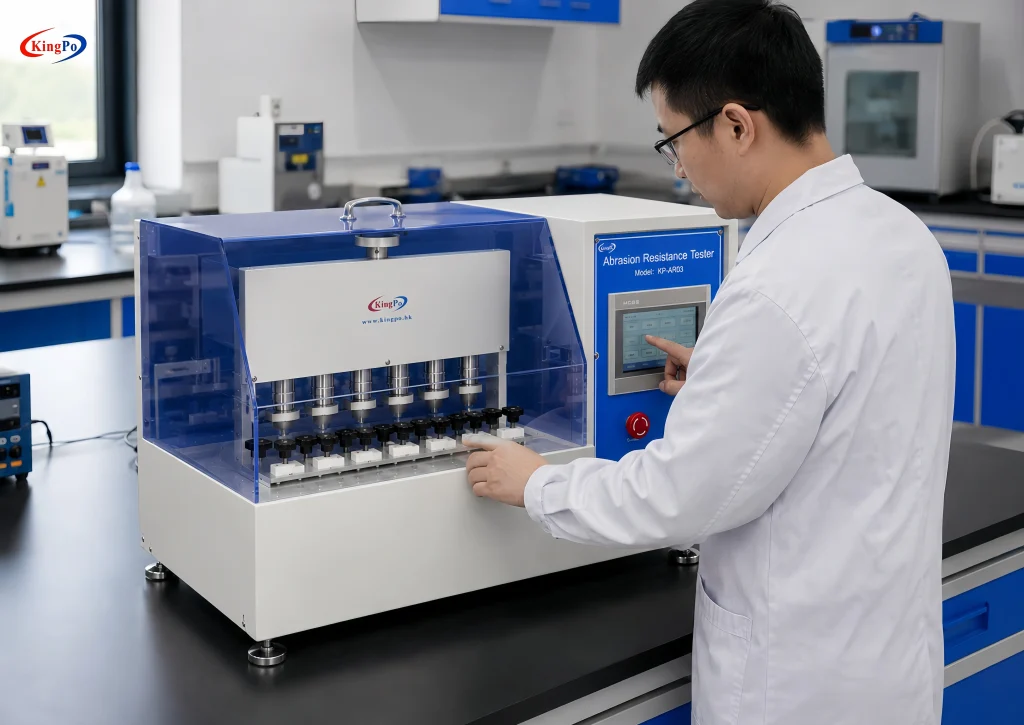
Laboratory technician operating the UL 719 Abrasion Resistance Tester for flat cable jacket abrasion testing in a controlled lab environment.
UL 719 Abrasion Resistance Tester

The UL 719 Abrasion Resistance Tester evaluates the abrasion resistance of flat cable jackets through repeated reciprocating abrasion. Cable specimens are fixed on a horizontal steel plate, and weighted abrasion tools are positioned above the required test area.

During testing, the specimen plate moves horizontally at 30 times per minute with a 150 mm / approximately 6 inch stroke. The abrasion tool applies a defined load to the cable jacket while the repeated movement rubs the jacket surface under controlled conditions.

The operator should monitor the jacket surface during the test and record whether penetration occurs. The test continues until jacket penetration occurs or the required number of cycles is reached. Final evaluation should follow UL 719 Clause 7.14 and the laboratory acceptance criteria.

Specimen Fixing

Cable specimens are fixed on a horizontal steel plate, and weighted abrasion tools are positioned above the required test area.

Reciprocating Abrasion

The specimen plate moves horizontally at 30 times per minute with a 150 mm / approximately 6 inch stroke.

Result Evaluation

The test continues until jacket penetration occurs or the required number of cycles is reached.

Common Error Mitigation

Reliable flat cable jacket abrasion testing depends on correct specimen preparation, tool alignment and stable test movement. Laboratories should avoid:

● Using twisted, bent or damaged cable specimens ● Cutting specimens to the wrong length
● Failing to secure specimens firmly at both ends ● Allowing the specimen to move during testing
● Misaligning the abrasion tool teeth with the specimen axis ● Using worn or damaged abrasion tools
● Applying an incorrect test weight ● Setting the wrong reciprocating speed or stroke length
● Forgetting to reset the counter before testing ● Recording only pass/fail results without noting the penetration cycle count

Specimen Preparation and Test Notes

Before testing, straight untwisted cable specimens should be prepared according to the applicable test procedure. The original procedure information describes six straight untwisted specimens of 15 inch / 380 mm cut from finished flat cable.

The specimens should be fixed flat and parallel on the steel plate, with the abrasion tools correctly positioned over the required test area. The counter should be reset before the test starts, and the operator should confirm the test weight, stroke length and reciprocating speed.

During testing, the jacket condition should be monitored until jacket penetration occurs or the specified cycle count is completed. The original procedure describes testing at 30 cycles per minute, with a 6 inch / 150 mm stroke, until jacket penetration or 70 complete cycles are reached.

Maintenance and Documentation Support

Maintenance:

The test plate, abrasion tools, teeth, fixtures and moving mechanism should be inspected regularly. Worn abrasion tools, loose fixtures or unstable reciprocating movement may affect test repeatability.

After testing, cable debris and jacket particles should be removed from the test area. The abrasion tools and steel plate should be kept clean and dry. The test weight, stroke length and movement stability should be checked periodically according to the laboratory procedure.

For formal laboratory use, recommended documentation includes:

● Equipment specification
● Calibration certificate or inspection record
● Abrasion tool condition record
● Test weight verification record
● Specimen preparation record
● Stroke length and speed setting record
● Cycle count record
● Jacket penetration observation
● Final test report according to laboratory procedure

Standards Compliance Notes

This tester is designed to support UL 719 Clause 7.14 abrasion resistance testing of flat cable jackets. Final compliance depends on the complete test procedure, specimen preparation, abrasion tool condition, applied load, reciprocating speed, stroke length, monitoring method and acceptance criteria.

The equipment should be described as a test system for supporting UL 719 flat cable jacket abrasion testing, not as a product certification result. If ISO 17025 calibration documentation is required, the certificate scope and covered parameters should be confirmed before ordering.

Download UL 719 Abrasion Resistance Tester Catalog

Download the KINGPO product catalog for the UL 719 abrasion resistance tester, including product information, test application notes and quotation reference details for wire and cable abrasion testing.

Technical Inquiry & Configuration Support

Before requesting a quotation, customers are recommended to provide the following information:

  • Applicable standard: UL 719 Clause 7.14 or internal laboratory procedure
  • Cable type and cable size
  • Flat cable jacket material
  • Required number of test stations
  • Required stroke length and speed
  • Required test weight
  • Required documentation or calibration certificate
  • Local power supply
  • Required delivery time
  • Packaging and shipping requirement

Based on this information, KingPo can confirm whether the KP-AR03 UL 719 Abrasion Resistance Tester is suitable for the customer’s flat cable jacket abrasion test requirement.

UL 719 Abrasion Resistance Tester

UL 719 Abrasion Resistance Tester FAQs

What is the UL 719 Abrasion Resistance Tester used for?
The UL 719 Abrasion Resistance Tester is used to evaluate the abrasion resistance of flat cable jackets. It checks whether the cable jacket can withstand repeated rubbing under defined test conditions.
Which standard does this tester follow?
This tester is designed according to UL 719 Clause 7.14, which covers abrasion resistance testing for flat cable jackets.
How many test stations does the tester have?
The tester has 6 test stations, allowing six cable specimens to be tested under the defined abrasion condition.
What is the moving speed of the tester?
The moving speed is 30 times per minute, matching the required reciprocating abrasion movement described in the original product information.
What is the stroke length?
The moving distance is 150 mm, approximately equivalent to a 6 inch stroke.
What test weight is used?
The tester uses 13.34 ± 0.14 N weights, with 6 pieces listed in the original product information.
What type of cable is this tester used for?
It is mainly used for finished flat cable specimens where the jacket abrasion resistance needs to be evaluated according to UL 719.
Can the number of test runs be set?
Yes. The number of runs can be set from 0 to 9999, allowing the operator to control the required test cycle count.
What should be checked before testing?
The operator should check specimen length, specimen fixing, abrasion tool position, test weight, stroke setting, reciprocating speed and counter reset before starting the test.
Is ISO 17025 documentation available?
ISO 17025 documentation may be available according to order requirements. Customers should confirm the certificate scope and covered parameters before ordering.

Related Products

Related News

DENG Sha¹, ZHANG Chao², WU Shaohai¹    Corresponding author: FAN Xiang¹ Guangdong Institute of Medical Device Quality Supervision and Inspection, No. […]

Quick Answer Leakage current testing devices are used to measure unintended current that may flow from live parts, insulation systems, […]

KINGPO IPX9K Test Equipment ensures automotive components meet industry standards for water ingress protection, boosting reliability and certification success.
Follow this 2026 step-by-step leakage current test guide for accurate results, safety compliance, and meeting IEC 60601-1 standards in electrical devices.

KingPo blowing sand and dust test chambers are widely used for evaluating the dust ingress protection performance of various products […]

For plastic insulation frames, given the high heat generated by the copper wires and iron core, if the flame retardant […]

A dust test chamber simulates dusty environments to assess product durability, ensuring devices meet standards and perform reliably in harsh conditions.
KP-8850 ESU Analyzer offers unmatched precision, versatile modes, and safety, setting a new standard for Electrosurgery Analyzers in medical testing.
Scroll to Top

Get A Free Quote Now !

Contact Form
If you have any questions, please do not hesitate to contact us.