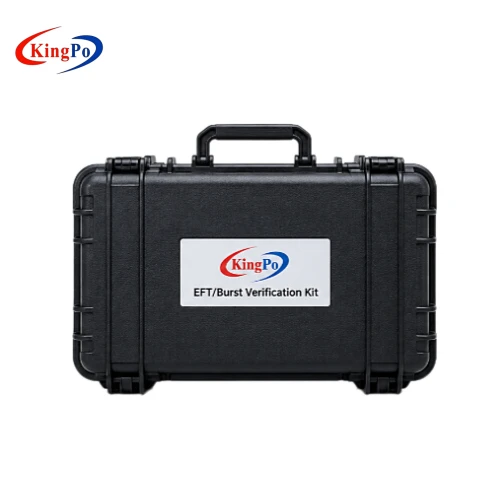
Product Overview
An EFT/Burst immunity test depends not only on the generator voltage setting but also on whether the generator produces the expected pulse waveform under the load conditions defined for verification.
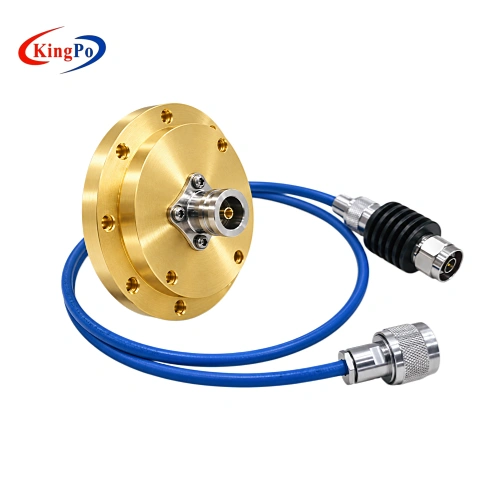
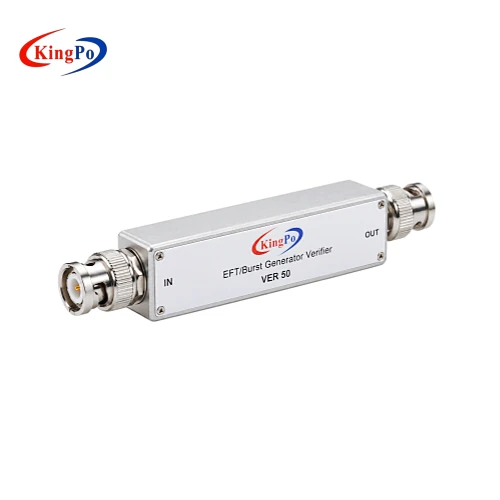
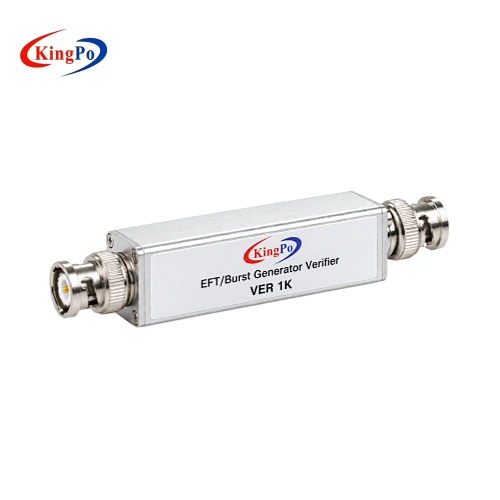
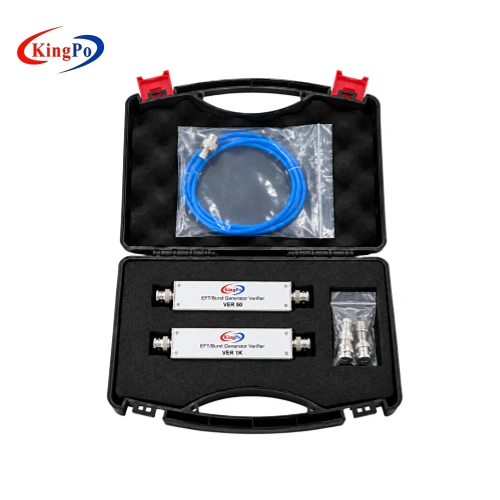
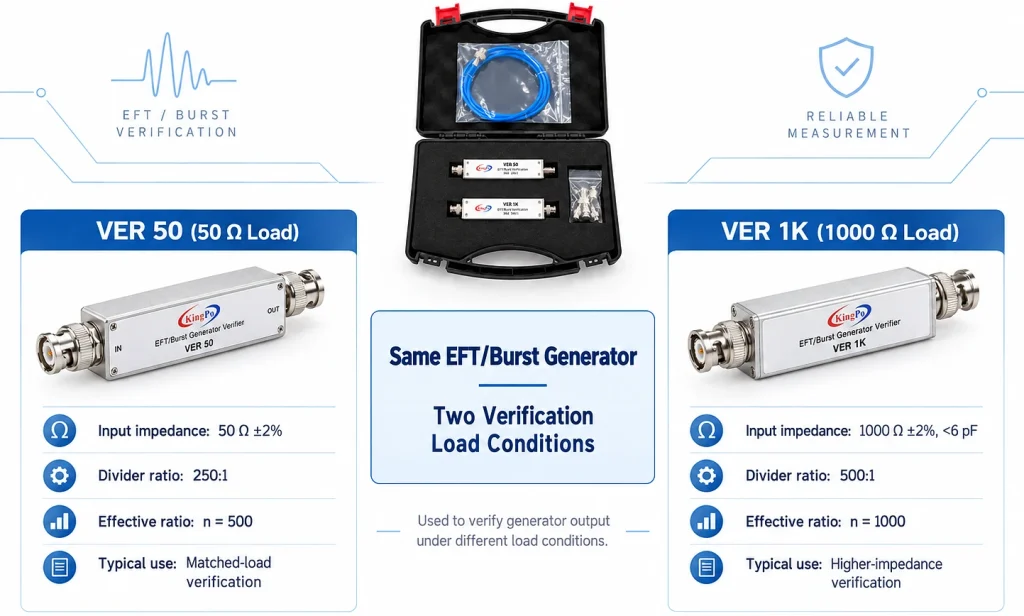
The EFT/Burst Verification Kit provides dedicated 50 Ω and 1000 Ω loads so the generator output can be measured under repeatable electrical conditions.
The 50 Ω load is used for verification at the generator’s 50 Ω coaxial output and can also be used, with the appropriate adapter, at the DUT output of the coupling network. The 1000 Ω load provides the second generator-output condition required for evaluating burst waveform behavior under a higher-impedance load.
The measurement output of each adapter is designed for connection to a 50 Ω measurement system, allowing the attenuated waveform to be observed with an oscilloscope.
The kit is therefore intended for verification and calibration-support work on EFT/Burst generators, rather than for applying immunity pulses directly to the DUT.
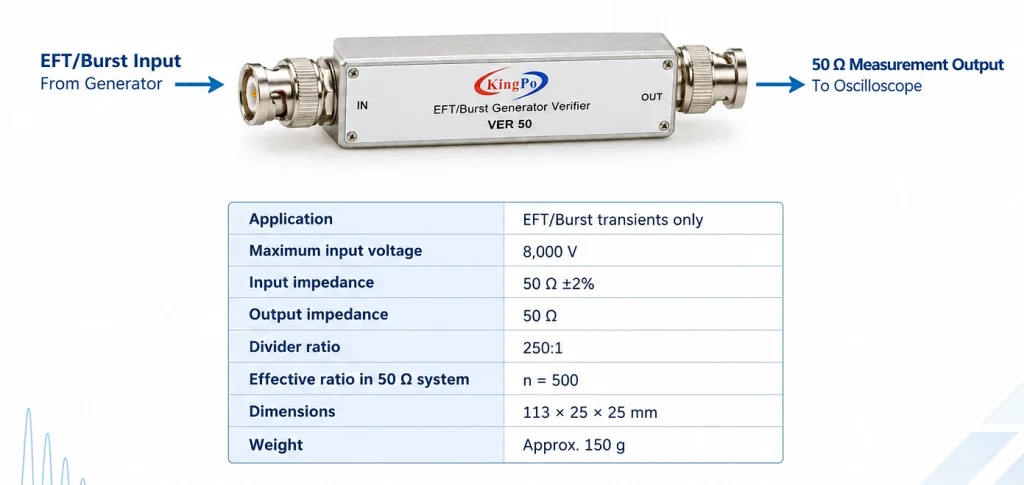
Technical Specifications
| Parameter | 50 Ω Verification Adapter | 1000 Ω Verification Adapter |
|---|---|---|
| Application | EFT/Burst transients only | EFT/Burst transients only |
| Maximum Input Voltage | 8,000 V | 8,000 V |
| Input Impedance | 50 Ω ±2% | 1000 Ω ±2%, <6 pF |
| Output Impedance | 50 Ω | 50 Ω |
| Nominal Divider Ratio | 250:1 | 500:1 |
| Effective Ratio in 50 Ω Measurement System | n = 500 | n = 1000 |
| Dimensions | 113 × 25 × 25 mm | 113 × 25 × 25 mm |
| Weight | Approx. 150 g | Approx. 150 g |
Generator Output Verification
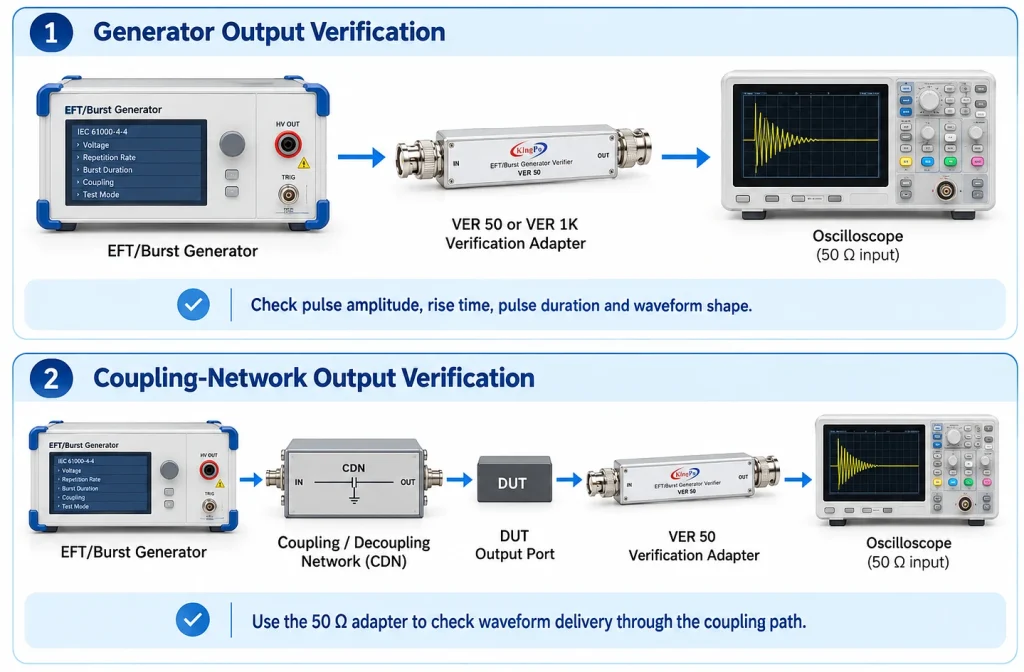
The main verification point is the 50 Ω coaxial high-voltage output of the EFT/Burst generator.
For this check, the appropriate verification load is connected to the generator output and the attenuated signal is measured with an oscilloscope.
Two separate load conditions are used:
Verification with the 50 Ω Load
The 50 Ω verification adapter provides the matched-load condition.
This setup is used to observe the pulse waveform produced by the generator when terminated by 50 Ω.
Verification with the 1000 Ω Load
The 1000 Ω verification adapter is then used to evaluate the generator under the higher-impedance condition.
Comparing the measured waveform against the applicable verification criteria helps the laboratory determine whether the generator continues to perform as required.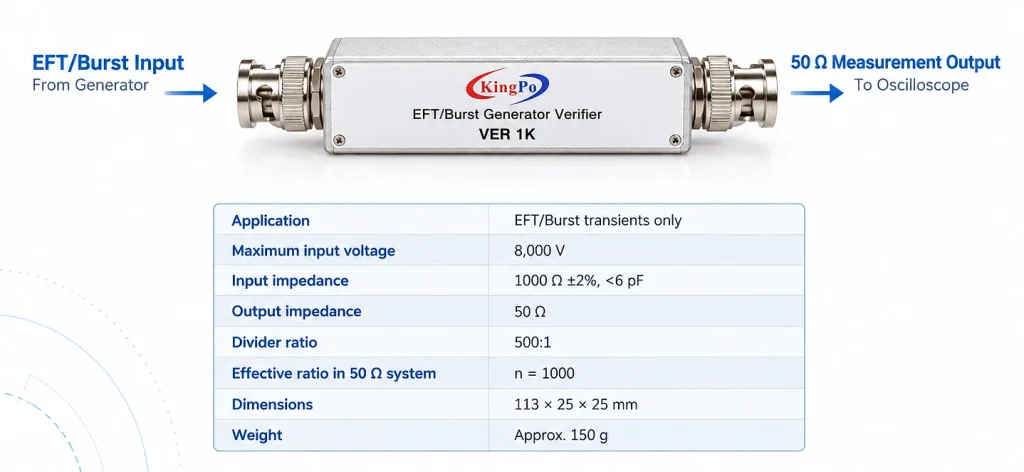
Coupling-Network Output Verification
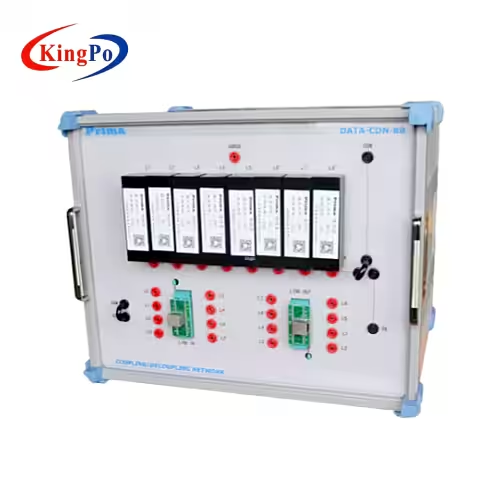
EFT/Burst pulses applied to mains supply lines normally pass through a coupling/decoupling network before reaching the DUT.
The waveform can therefore also be checked at the DUT output of the coupling network.
For this application, the kit provides connection accessories that allow the 50 Ω verification load to be connected appropriately to the coupling-network output.
→
→
→
→
This is useful when engineers need to confirm not only that the generator itself is producing the expected waveform, but also that the burst waveform is being delivered correctly through the coupling path.
What Should Be Checked During Verification?
The kit provides the electrical load and attenuation interface required for waveform measurement.
Depending on the applicable procedure, engineers may review parameters such as:
pulse peak amplitude;pulse rise time;pulse duration;waveform shape;
positive and negative polarity response;repeatability between verification runs.
The verification kit itself does not perform automatic Pass/Fail analysis. These parameters are measured and evaluated using the connected oscilloscope and the applicable standard criteria.
Applicable Standard
IEC 61000-4-4 — Electrical Fast Transient/Burst Immunity Test
IEC 61000-4-4 establishes a common and reproducible method for evaluating immunity to repetitive electrical fast transients/bursts on supply, signal, control and earth ports.
The current IEC publication is IEC 61000-4-4:2012, Edition 3.0.
For generator verification, the EFT/Burst pulse source is checked under defined load and measurement conditions before relying on it for DUT immunity testing.
This distinction is important when selecting equipment: the verification kit is an accessory for checking the test system, not a replacement for the transient generator itself.
Additional ISO 7637 Application
The verification kit can also be used in ISO 7637 Annex D-related applications where the required test configuration calls for compatible burst/transient verification loads.
Because ISO 7637 contains multiple parts and editions, customers should confirm the exact applicable document, annex, generator configuration and required connection before quotation.
IEC 61000-4-4 should remain the primary standard focus of this product page.
Typical Laboratory Applications
Routine Generator Verification
Repeat defined 50 Ω and 1000 Ω checks as part of the laboratory’s equipment-control procedure to confirm that the generator response remains consistent.
Before Important EMC Testing
A verification check can be performed before critical DUT testing when the laboratory wants additional confidence in the generator setup.
After Repair or Maintenance
Repeat the waveform verification after generator repair, internal service, output-stage replacement or other changes that could affect pulse performance.
Troubleshooting Unexpected DUT Results
If DUT immunity results suddenly change, checking the EFT/Burst generator with known verification loads helps determine whether the transient source or coupling path should be investigated.
Coupling-Network Performance Checks
Use the 50 Ω load and appropriate adapter to measure the burst waveform at the coupling-network DUT output.