Product Overview
An ESD generator may correctly display a selected test voltage such as 2 kV, 4 kV or 8 kV, but that indication alone does not confirm that the actual discharge-current waveform is correct.
For reliable electrostatic discharge immunity testing, the output of the ESD generator must be characterized through a suitable current measurement system.
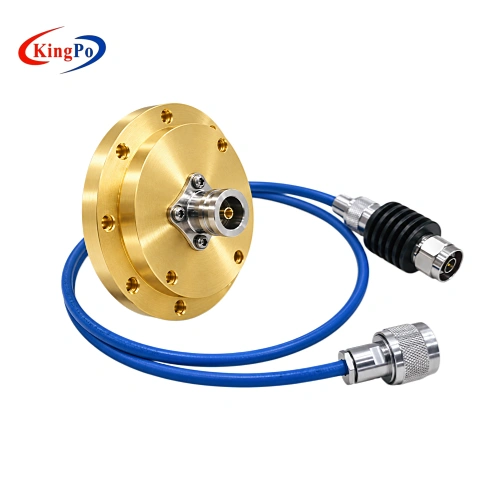
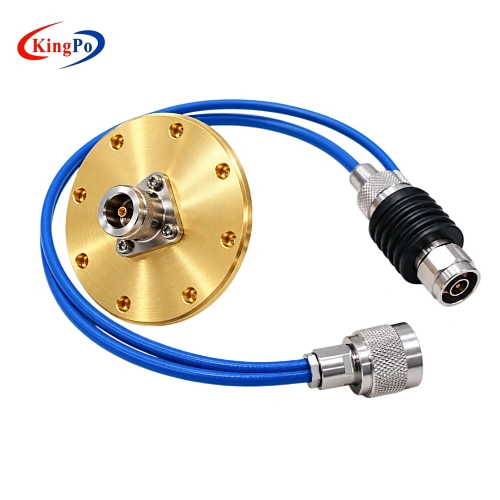
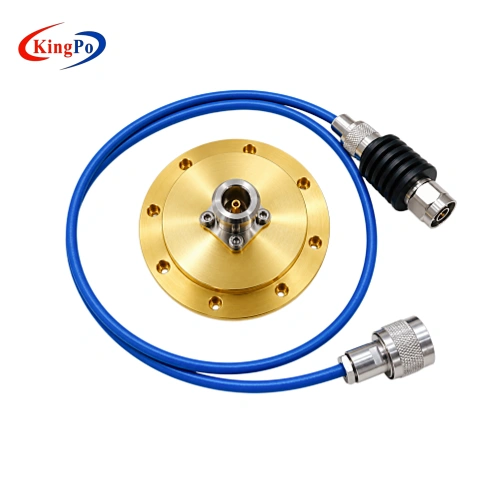
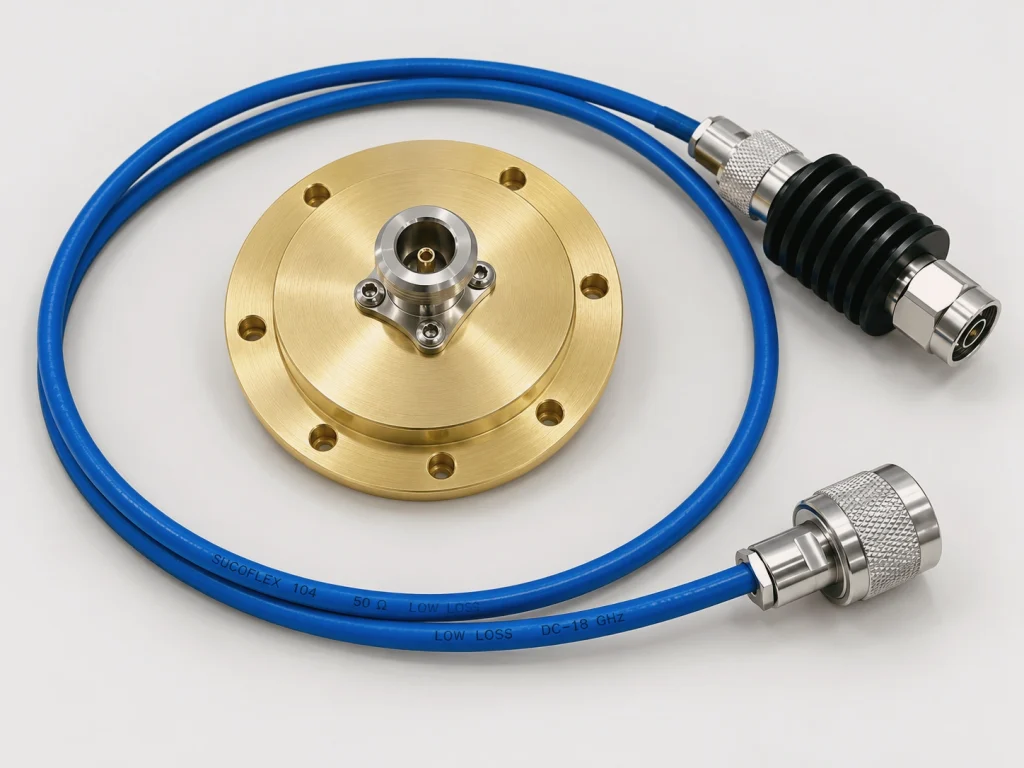
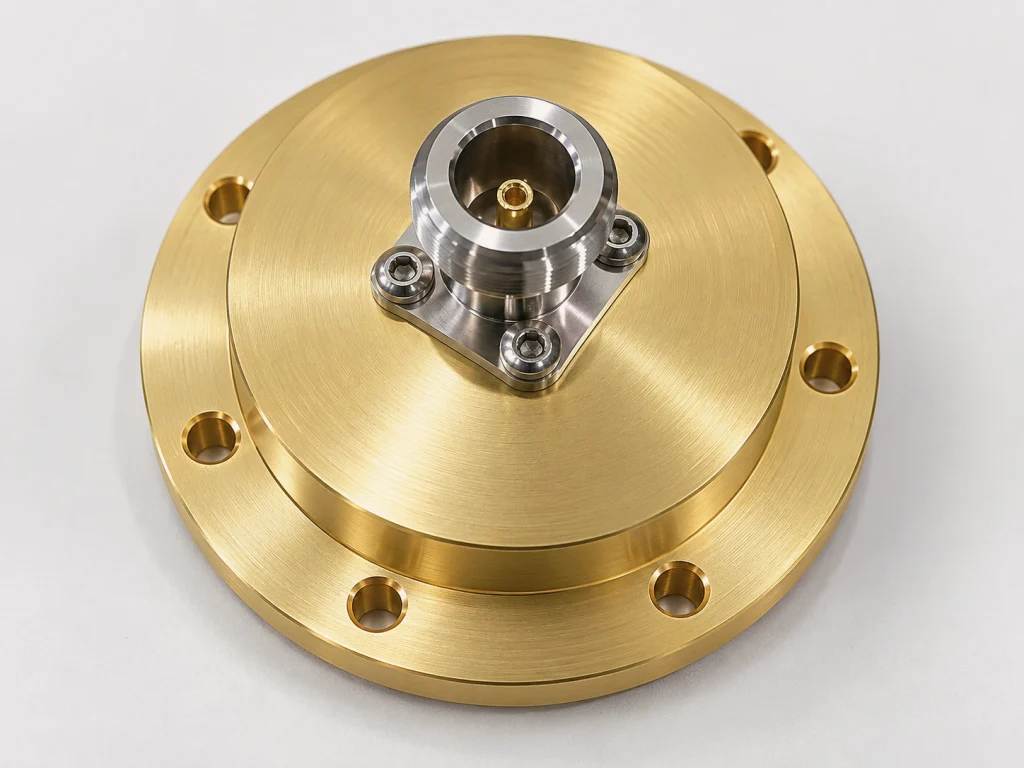
The ESD Calibration Target provides the interface required for this measurement.
During verification, the ESD generator is discharged directly onto the target. The resulting current pulse is converted into an electrical signal and transferred through an attenuator and coaxial cable to a high-bandwidth oscilloscope.
The oscilloscope waveform can then be used to evaluate the main characteristics of the discharge pulse, including the initial current peak, rise time and current values at defined time points.
The ESD Calibration Target uses a 2 Ω ±5% measuring resistor, supports ESD test voltages up to ±30 kV, and provides defined insertion-loss performance for the complete target–attenuator–cable measurement chain.
Technical Specifications
| Parameter | Specification |
|---|---|
| Product Type | Coaxial ESD current calibration target |
| Measuring Resistor | 2 Ω ±5% |
| Reference Design Standard | IEC 61000-4-2 Ed.2:2008 |
| European Reference | EN 61000-4-2:2009 |
| Additional Application Reference | ISO 10605 |
| ESD Test Voltage | Up to ±30 kV |
| Insertion Loss | ±0.5 dB up to 1 GHz |
| Insertion Loss | ±1.2 dB up to 4 GHz |
| Output | Coaxial N male connector |
| Target Dimensions | Ø70 × 30 mm |
| Target Weight | Approx. 400 g |
| Included Attenuator | 20 dB |
| Included Cable | 1 m RG400 coaxial cable |
| Optional Accessory | 50 Ω conical adapter line |
| Installation Reference | Shielded-room wall or metal plate ≥1.2 m × 1.2 m |
Why ESD Generator Waveform Verification Is Required
IEC 61000-4-2 establishes a reproducible method for evaluating the immunity of electrical and electronic equipment to electrostatic discharge.
A complete ESD immunity test depends not only on the DUT and selected test voltage, but also on whether the ESD generator produces the intended discharge waveform.
The current IEC edition, IEC 61000-4-2:2025, continues to address the ideal discharge-current waveform, test equipment, test setup and calibration of the current measurement system.
In practical laboratory work, this means that an ESD generator should not be judged only by the voltage displayed on its front panel.
Its actual discharge-current waveform must also be checked.
Initial peak current
10%–90% rise time of the initial peak
Current at 30 ns
Current at 60 ns
These four waveform characteristics are used to evaluate whether the ESD generator produces the required discharge-current pulse.
For laboratories, this verification helps distinguish a DUT failure from a possible problem with the ESD generator or measurement setup.
How the ESD Calibration Target Works
The measurement principle is straightforward:
→
ESD Current Target
→
20 dB Attenuator
→
RG400 Coaxial Cable
→
High-Bandwidth Oscilloscope
When the ESD generator discharges onto the target, the current passes through the target’s measuring element.
The target converts the discharge current into a corresponding voltage signal. Because the ESD pulse is both fast and relatively high in amplitude, the output is passed through an attenuator before reaching the oscilloscope.
The oscilloscope then captures the waveform so that the required current characteristics can be evaluated.
Relationship Between Discharge Current and Measured Voltage
For this measurement configuration:
- Ip = discharge current in amperes
- Vm = voltage measured by the oscilloscope in volts
For example, a discharge current of 7.5 A corresponds to an oscilloscope reading of approximately 1.5 V under the specified 2 Ω target and 20 dB attenuation arrangement.
This relationship applies to the defined measurement chain. If the target, attenuation or connection arrangement changes, the conversion relationship should be verified accordingly.
What Is Measured During ESD Waveform Verification?
Initial Peak Current
The initial peak represents the highest current produced at the beginning of the ESD pulse.
It is one of the primary parameters used to characterize the output of the ESD generator.
10%–90% Rise Time
Rise time describes how quickly the initial current pulse increases from 10% to 90% of its peak value.
Because this transition is extremely fast, oscilloscope bandwidth, target frequency response, cable performance and physical test setup can all influence the measurement.
Current at 30 ns
The current value at 30 ns is used to evaluate the waveform after the initial discharge peak.
This provides information about the intermediate portion of the ESD current pulse.
Current at 60 ns
The current value at 60 ns evaluates the later part of the waveform.
Together with the initial peak and rise time, the 30 ns and 60 ns measurements provide a more complete picture of ESD generator performance than the programmed discharge voltage alone.
The Complete Target–Attenuator–Cable Measurement Chain
A technically important point is that the current target should not be considered independently from the rest of the RF measurement path.
The specified insertion-loss performance applies to the complete:
Target + Attenuator + Cable chain.
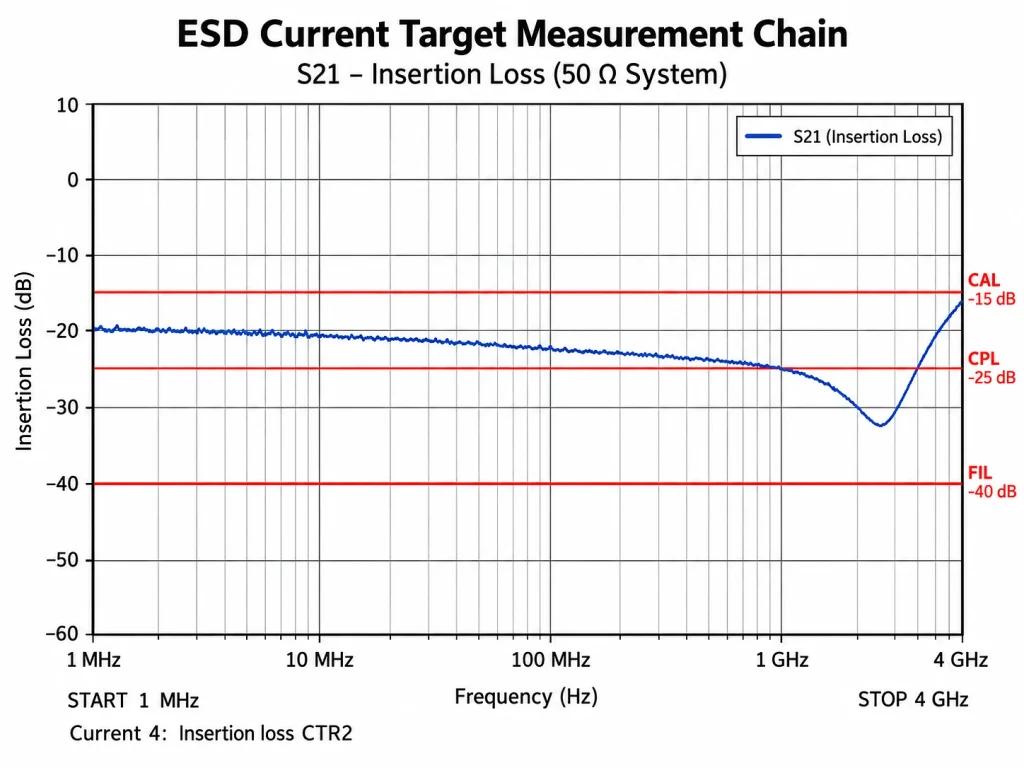
Insertion loss is evaluated for the complete Target–Attenuator–Cable chain rather than for the target alone.
This matters in actual laboratory use.
Changing the cable, attenuator or connector arrangement may change the frequency response of the measurement system and therefore affect the captured ESD waveform.
For calibration or traceable verification work, laboratories should therefore define and maintain the complete measurement chain.
Typical Measurement Setup
The ESD calibration target is one component of the complete verification setup. It is not a standalone automatic ESD calibration system.
The target is installed in the wall of a shielded room or in a conductive metal plate of at least 1.2 m × 1.2 m.
The physical arrangement of the ESD generator is also important.
The ground-return cable should be positioned carefully because its geometry can significantly affect the measured waveform, particularly the current readings at 30 ns and 60 ns. Incorrect routing may introduce oscillations that distort the observed pulse.
This is why ESD waveform verification should be treated as a complete measurement setup rather than simply connecting a target to an oscilloscope.
ESD-CTR2-AD 50 Ω Conical Adapter Line
The optional 50 Ω conical adapter serves a different purpose from the ESD current target.
The current target is used when measuring the discharge produced by the ESD generator.
The 50 Ω conical adapter is used when verifying the RF characteristics of the current-target measurement system.
It provides a transition between a 50 Ω coaxial measurement connection and the geometry of the current target.
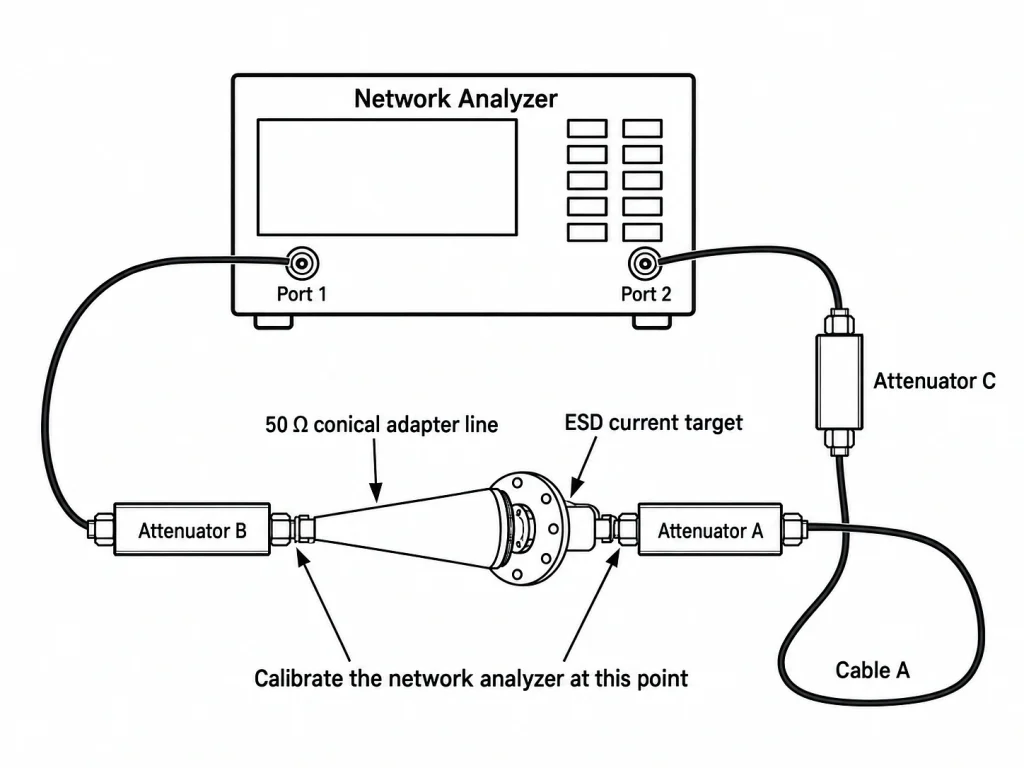
50 Ω ±2% from DC to 4 GHz
When two adapter lines are mounted face-to-face, the verification configuration provides:
- reflection coefficient better than 30 dB up to 1 GHz;
- reflection coefficient better than 20 dB up to 4 GHz;
- insertion loss below 0.3 dB in the stated configuration.
Current Target vs. Verification Adapter
| Component | Primary Function |
|---|---|
| ESD Current Target | Captures the discharge-current waveform generated by the ESD simulator |
| 20 dB Attenuator | Reduces the signal to a suitable level for oscilloscope measurement |
| RG400 Coaxial Cable | Transfers the measured signal to the oscilloscope |
| 50 Ω Conical Adapter | Used for frequency-domain verification of the current-target measurement chain |
The conical adapter therefore does not need to be treated as a separate ESD test instrument. It is an optional verification accessory for the current target.
Applicable Standards and Edition Considerations
IEC 61000-4-2
The target is designed with reference to:
IEC 61000-4-2 Ed.2:2008
and:
EN 61000-4-2:2009
IEC has subsequently published IEC 61000-4-2:2025 Edition 3, which is now the current IEC edition. The current edition covers the discharge-current waveform, test equipment, test setup and calibration requirements for ESD immunity testing.
ISO 10605
ISO 10605 is also relevant to automotive ESD testing applications.
The currently published edition is ISO 10605:2023 — Road vehicles — Test methods for electrical disturbances from electrostatic discharge. It covers ESD test methods for automotive electronic modules and complete vehicles.
For automotive projects, customers should provide the required ISO 10605 test configuration and applicable generator setup before the target configuration is confirmed.
Typical Laboratory Applications
EMC Test Laboratories
EMC laboratories can use the current target to verify ESD generator waveform performance before scheduled testing or as part of periodic equipment checks.
This is especially useful when unexpected DUT results need to be separated from possible ESD generator or measurement-system issues.
Calibration and Metrology Laboratories
Calibration laboratories can integrate the target into an ESD generator calibration setup together with the appropriate oscilloscope, attenuator, cable and verification accessories.
The current target supplies the measurement interface; it does not by itself provide a complete calibration result or uncertainty statement.
Certification Laboratories
Certification and third-party testing laboratories operating IEC 61000-4-2 test systems may use a dedicated current target for periodic generator verification and equipment quality control.
Electrical and Electronic Manufacturers
Manufacturers with in-house EMC laboratories can use the target for routine checks of their ESD simulators, troubleshooting and long-term monitoring of test-system performance.
Automotive EMC Laboratories
For laboratories performing ISO 10605 testing, the current target may form part of the ESD simulator verification setup. Applicability should be confirmed against the required ISO 10605 edition and project-specific test arrangement.