
Cookware Handle Torque Tester | UL 1026 Handle Strength Test Equipment
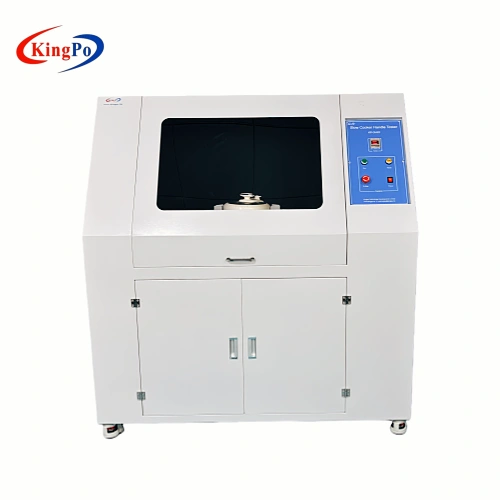
The Cookware Handle Torque Tester, model KP-DH22, is designed for UL 1026 related handle strength evaluation of household cooking appliances, especially slow cookers with carrying handles. This product is commonly searched as a cookware handle torque tester by buyers looking for handle strength and attachment reliability test equipment.
The KP-DH22 performs repeated vertical lifting cycles on loaded samples to evaluate handle durability, lifting strength and resistance to failure during normal use and handling. It helps manufacturers verify whether the handle assembly and connection points can remain secure when the appliance is repeatedly lifted under loaded conditions.
- Related Standard: UL 1026 – Standard for Safety for Electric Household Cooking and Food Serving Appliances
- Commercial Search Term: Cookware Handle Torque Tester
- Actual Test Method: Repeated vertical lifting with loaded sample
- Test Objects: Household cooking appliances with carrying handles, especially slow cookers
- Main Test Items: Handle strength, lifting durability and attachment reliability
- Maximum Sample Weight: 60 kg
- Lifting Height: >305 mm
- Test Speed: 1 cycle per second
- Maximum Test Cycles: 9999 times
- Applications: Household appliance manufacturers, safety testing laboratories, quality control departments and certification support laboratories
Cookware Handle Torque Tester Overview
Standards and Test Method Support
The KP-DH22 is designed to support the handle strength test for slow cookers according to UL 1026 related requirements.
UL 1026 covers electric household cooking and food serving appliances. For slow cookers and similar appliances with carrying handles, handle strength evaluation is important because the product may be moved while loaded. If the handle or its attachment structure fails during use, hot contents may spill and create a user safety risk.
During testing, the appliance sample is loaded to the required test condition and repeatedly lifted by the handle. The test helps manufacturers evaluate whether the handle assembly, fixing points and surrounding body structure remain secure after repeated mechanical stress.
System Configuration
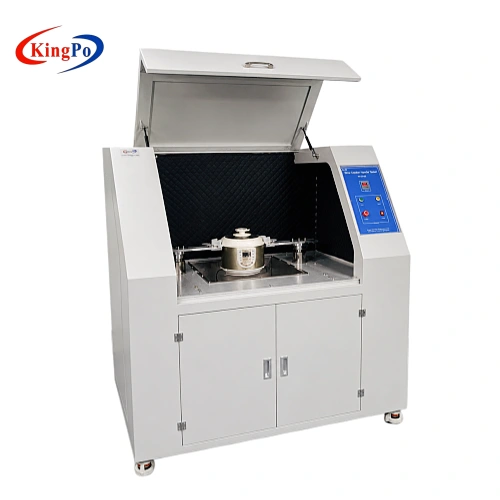
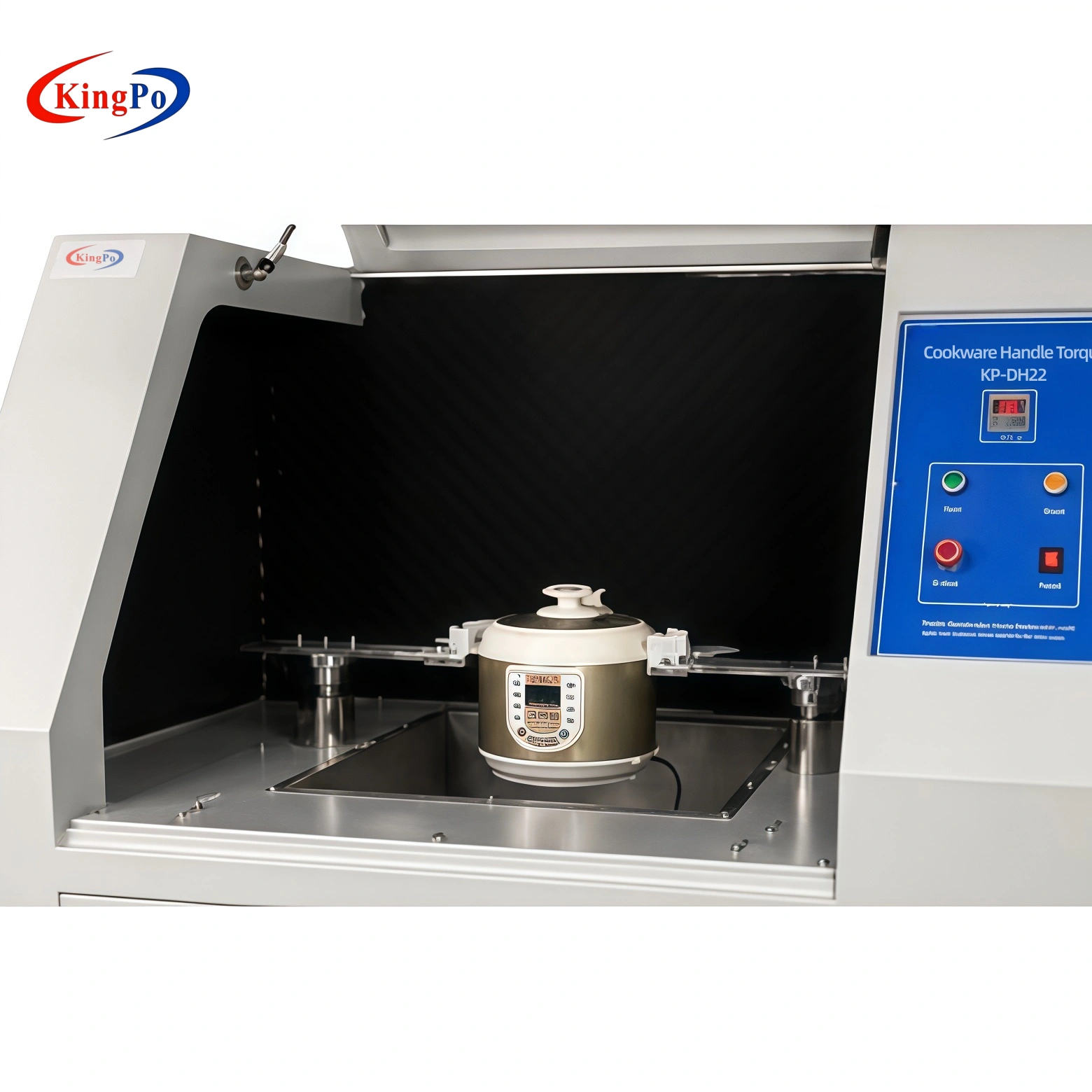
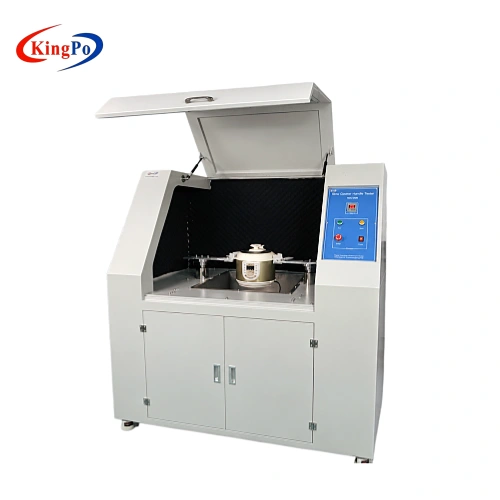
The KP-DH22 integrates a vertical lifting mechanism, sample holding fixture, cycle counter, control panel, protective enclosure and emergency stop function into one dedicated handle strength testing system.
Operators can set the required number of test cycles through the control panel. After the loaded sample is fixed in position and the protective door is closed, the equipment performs repeated lifting cycles automatically. The system stops when the preset number of cycles is reached.
Although the product may be searched as a cookware handle torque tester, the KP-DH22 is configured for repeated lifting strength evaluation rather than rotational torque loading. This wording helps match buyer search behavior while keeping the technical description accurate.
Key Advantages
| Engineering Design | Customer Benefit |
|---|---|
| UL 1026 related handle strength test design | Supports handle durability evaluation for household cooking appliances |
| Repeated vertical lifting at 1 cycle per second | Provides controlled and repeatable mechanical stress conditions |
| Lifting height greater than 305 mm | Supports the required lifting movement for slow cooker handle testing |
| Maximum sample weight up to 60 kg | Allows loaded appliance testing using steel balls or equivalent weight |
| Adjustable cycle count up to 9999 times | Suitable for durability verification, QC inspection and type test preparation |
| Protective enclosure and emergency stop function | Helps improve operator safety during repeated lifting tests |
Test Capability and Operation Features
The KP-DH22 is engineered for reliable and repeatable handle strength evaluation under controlled lifting conditions.
- Supports handle widths from 51 mm to 102 mm
- Supports loaded samples up to 60 kg
- Allows test cycle setting up to 9999 times
- Performs repeated lifting at 1 cycle per second
- Provides simple cycle setting, Run, Reset and Emergency Stop operation
- Includes emergency stop function for immediate halt
- Provides visible test operation through the protective door
This configuration allows laboratories to perform standardized handle strength testing efficiently while maintaining safe operation.
KP-DH22 Cookware Handle Torque Tester Technical Specifications
General Configuration
| Item | Specification | Function |
| Model | KP-DH22 | Handle strength tester for UL 1026 related testing |
| Product Type | Cookware Handle Torque / Handle Strength Test Equipment | Evaluates durability of carrying handles on household cooking appliances |
| Related Standard | UL 1026 | Supports handle strength testing for slow cookers |
| Power Supply | AC 220 V, 50 Hz | Standard laboratory power requirement |
| Maximum Sample Weight | 60 kg | Supports loaded sample testing |
| Equipment Dimensions | 1600 × 1050 × 1710 mm | Floor-standing laboratory equipment layout reference |
Test Parameters
| Item | Specification | Function |
| Lifting Speed | 1 cycle per second | Provides controlled repeated lifting cycle speed |
| Lifting Height | >305 mm | Supports handle stress evaluation during vertical lifting |
| Handle Width Range | 51–102 mm | Supports slow cooker handles within the specified width range |
| Maximum Test Cycles | 9999 times | Supports repeated durability testing |
| Loading Method | Steel balls added to reach three times the standard weight | Simulates loaded test condition |
| Operation Mode | Cycle setting, Run, Reset and Emergency Stop | Supports basic automatic test operation and safety control |
Testing Principle
The handle strength test evaluates the ability of cookware and slow cooker handles to withstand repeated lifting under loaded conditions.
Before testing, the sample is weighed and filled with steel balls to reach three times the standard weight according to the test procedure. The loaded appliance is then fixed on the equipment and repeatedly lifted by its handles to a height greater than 305 mm at a rate of 1 cycle per second.
This repeated mechanical stress helps determine whether the handles and their attachment points maintain structural integrity without deformation, cracking, loosening or detachment. The test is particularly important for appliances containing hot liquids, where handle failure may create safety risks during handling.
Test Result Evaluation
After the repeated lifting test, the handle assembly and connection points should be inspected for visible damage, loosening, cracking, deformation or detachment. The cooker body should also be checked to confirm whether the handle mounting area remains structurally secure after the preset number of lifting cycles.
For formal testing, the final judgment should follow the applicable UL 1026 requirement, customer test procedure and laboratory acceptance criteria.
Test Workflow
- Read the relevant sections of UL 1026 and the operation manual before testing.
- Measure the weight of the empty slow cooker sample.
- Fill the sample with steel balls to reach three times the standard weight.
- Secure the loaded sample onto the equipment fixture.
- Close the protective door.
- Set the desired number of test cycles on the control panel.
- Press the “Run” button to start automatic testing.
- The equipment automatically stops once the preset number of cycles is completed.
- Open the door and inspect the sample handles for damage, deformation or loosening.
- Record test results and sample condition.
- Remove the sample and reset the counter if needed for the next test.
Operation Notes and Safety Requirements
To ensure safe and reliable test results, the following practices should be observed:
- Do not open the equipment door while the machine is in operation.
- The operating speed has been factory-set. Do not adjust the frequency converter inside the electrical cabinet.
- If the sample handle shows signs of failure or damage during testing, press the Emergency Stop button immediately.
- Ensure that the sample is properly secured before starting the test.
- Verify that the total loaded weight does not exceed the equipment’s maximum capacity of 60 kg.
- Check the handle width and fixture position before each test series.
- Perform regular inspection of the lifting mechanism, sample fixture, cycle counter and safety protection functions.
Applications and Laboratory Use
The KP-DH22 is especially useful for manufacturers that need to verify handle reliability before product certification, mass production release or supplier quality approval.
It is suitable for handle strength testing of:
- Slow cookers
- Electric cooking pots with carrying handles
- Household cooking appliances with handle structures
- Similar cooking and food serving appliances requiring handle strength evaluation
Typical Users
- Household appliance manufacturers
- Slow cooker manufacturers
- Electrical safety testing laboratories
- Third-party certification and inspection bodies
- Quality control and R&D departments
- Compliance testing organizations
Metrological Integrity and Validation
Before delivery, KingPo performs factory verification of key mechanical and control functions, including lifting motion, cycle counting, speed control and safety protection functions.
Regular verification of lifting height, cycle speed, fixture condition, cycle counter and mechanical integrity is recommended to maintain consistent test results in accordance with laboratory quality procedures.
For formal test programs, customers should confirm the applicable standard version, loading condition, sample preparation method and acceptance criteria before implementation.
Technical Inquiry and Expert Support
KingPo offers the KP-DH22 Cookware Handle Torque Tester for UL 1026 related handle durability evaluation.Our engineering team can provide support for test setup, fixture customization, test cycle setting and result interpretation according to your specific appliance design and laboratory requirements.
To recommend the correct configuration, please provide:
- Appliance type and handle design details
- Sample dimensions and maximum loaded weight
- Handle width and handle position
- Required test load
- Target number of test cycles
- Required standard or internal test procedure
- Any specific fixture or sample holding requirements
- Laboratory power supply and space constraints
Referenced Standards
* UL 1026 — Standard for Safety for Electric Household Cooking and Food Serving Appliances (Handle Strength Test for Slow Cookers)
Cookware Handle Torque Tester Detail Display
FAQ
Related Products


Related News
Abstract / Technical Summary Selecting the right energy efficiency testing equipment is essential for appliance manufacturers to meet IEC, GB, […]
The Defibrillation Immunity Testing Requirements for Active Implantable Medical Devices (AIMDs): Standards Breakdown, Visual Insights, and Recommendation for the KP-1050S […]
External defibrillators are performance‑critical devices. According to KingPo manufacturing and metrology protocols, for third‑party calibration and certification laboratories—and for manufacturers’ […]
Abstract Thermage, a non-invasive radiofrequency (RF) skin tightening technology, is widely used in medical aesthetics. With operating frequencies increasing to […]
Technical Insight for IEC 60601-2-2 High-Frequency Surgical Equipment Testing High-frequency electrosurgical units (ESU) operate in the radio frequency range above […]
