BREAST PUMP SAFETY TESTING
IEC 60335-2-125 Clause 22.101: Breast Pump Backflow Protection Test
IEC 60335-2-125:2026 introduces particular safety requirements for electric breast pump appliances for expressing breast milk. Clause 22.101 addresses backflow protection, requiring the appliance or collection container assembly to prevent breast milk from entering the vacuum tubing or vacuum source.
The prescribed test uses a coloured water solution to evaluate the effectiveness of the backflow protection system under specified operating conditions.
- Maximum-capacity filling of the collection container
- Worst-case position expected in normal use
- Operation at rated voltage and highest flow rate
- Continuous test duration of 30 minutes, followed by inspection of four specified areas
Understanding Breast Pump Backflow Protection
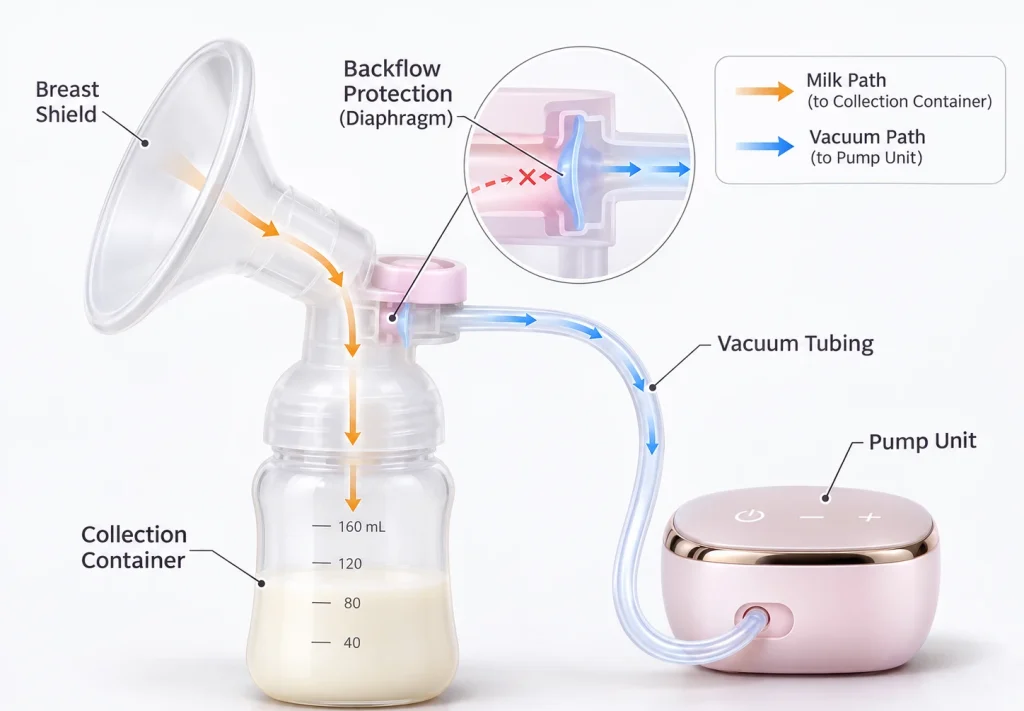
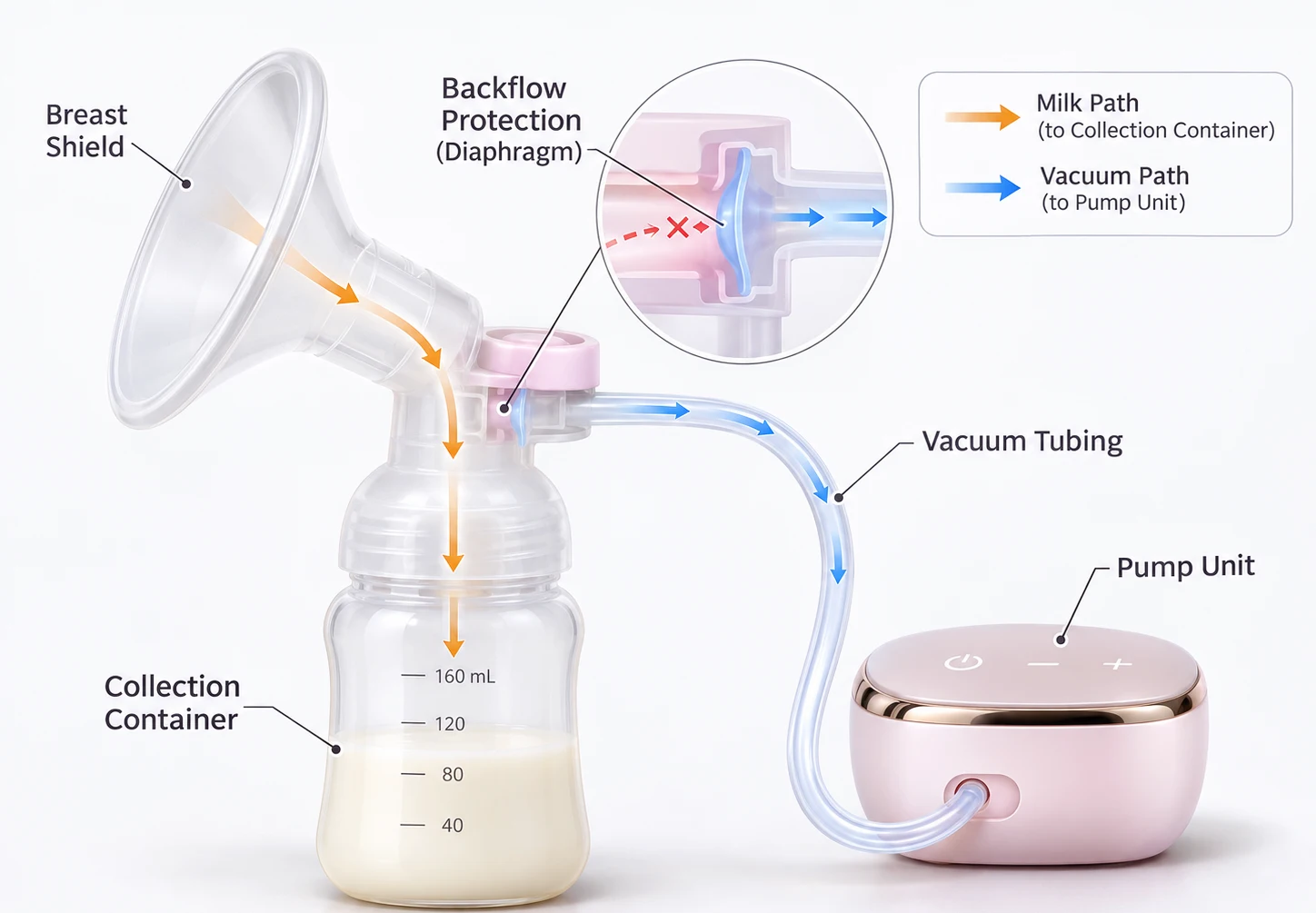
An electric breast pump uses a vacuum source to generate negative pressure. The breast shield, collection container and vacuum tubing work together to support milk expression and collection.
During normal operation, milk is directed into the collection container while the vacuum system maintains the required suction. The backflow protection structure separates the liquid collection path from the vacuum path, preventing collected liquid from travelling towards the vacuum source.
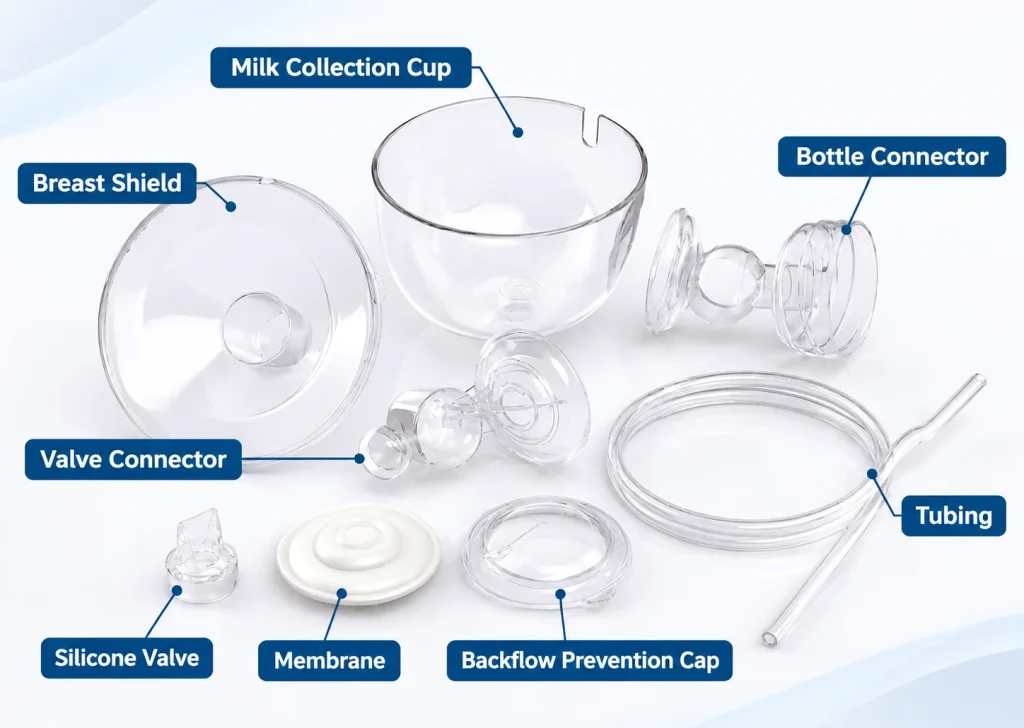
Depending on the product design, backflow protection may involve a diaphragm, valve, sealed collection chamber or other structural arrangement. The exact configuration varies between breast pump models.
Key engineering consideration
Clause 22.101 does not prescribe one particular backflow valve design. Instead, it evaluates whether the complete appliance or collection container assembly prevents coloured water from reaching the vacuum tubing, vacuum source, electronic circuits and non-cleanable parts during the specified test.
IEC 60335-2-125 Clause 22.101: Test Requirements
Clause 22.101 requires breast pump appliances or their collection container assemblies to incorporate backflow protection. Compliance is checked by operating the appliance with a coloured water solution under the specified test conditions.
| Test parameter | Requirement |
|---|---|
| Test medium | Water containing a non-surfactant coloured dye |
| Container filling | Maximum capacity |
| Assembly | According to the manufacturer’s instructions, including vacuum tubing if available |
| Test position | Worst-case position expected in normal use |
| Operating voltage | Rated voltage |
| Operating condition | As intended, at the highest flow rate |
| Test duration | 30 minutes |
Test Setup and Configuration
Before starting the test, the complete breast pump assembly must be prepared according to the product instructions. The test arrangement should allow the coloured water to enter through the breast shield while the appliance operates under its intended conditions.
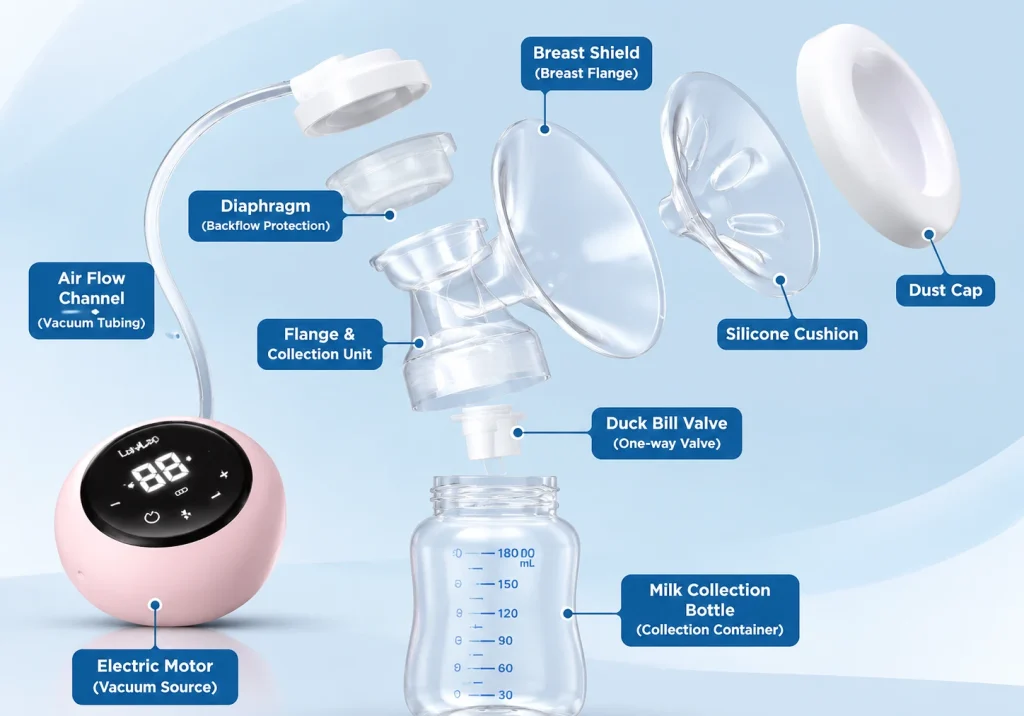
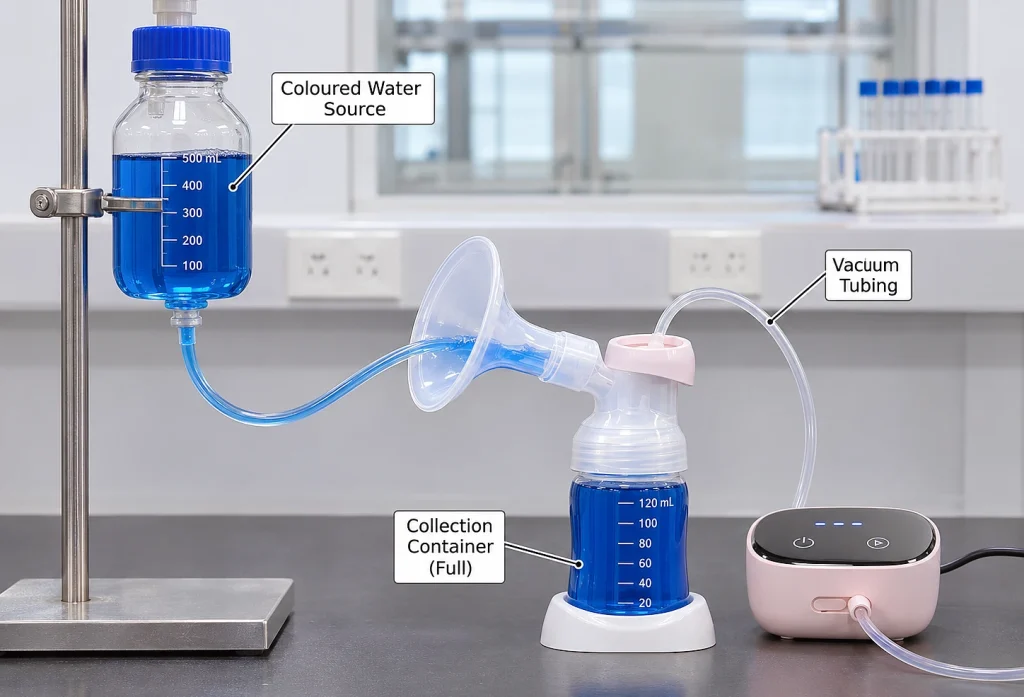
Test components and preparation
- Breast pump appliance: The complete appliance under evaluation, including its vacuum source and normal operating components.
- Collection container assembly: The original container and associated components required for normal operation.
- Vacuum tubing: The tubing supplied with the appliance, where applicable.
- Coloured water solution: Water containing a non-surfactant coloured dye to make liquid migration detectable.
- Coloured water source: A water source connected to the breast shield to allow coloured water to flow into the collection container.
- Rated voltage supply: A suitable power supply for operating the appliance at its rated voltage.
Important: Dye selection
The standard specifically requires a non-surfactant coloured dye. Surfactants can change the surface properties of the liquid and may affect its behaviour during the test. The test solution should therefore be prepared without surfactant additives.
Breast Pump Backflow Protection Test Procedure
The following procedure follows the sequence specified in Clause 22.101.
Prepare the Coloured Water Solution
Prepare water containing a non-surfactant coloured dye. The colour should provide sufficient contrast to identify any liquid migration into the protected areas.
Fill the Collection Container
Fill the collection container with the coloured water solution to its maximum capacity. This establishes the specified full-container test condition.
Assemble the Breast Pump
Assemble the collection container assembly and vacuum tubing, if available, according to the manufacturer’s instructions. All relevant connections and protective components should be installed in their intended positions.
Position the Appliance
Place the assembled appliance in the worst-case position expected in normal use. The position should be determined from the product’s intended use and assembly configuration rather than assuming that an arbitrary inverted or tilted position is required.
Connect the Coloured Water Source
Attach the coloured water source to the breast shield. Arrange the supply so that water flows into the collection container during operation.
Operate at Rated Voltage
Supply the appliance at its rated voltage and operate it as intended, ensuring that coloured water flows into the collection container.
Run the Test for 30 Minutes
Conduct the test for 30 minutes at the highest flow rate. Maintain the specified assembly and operating conditions throughout the test.
Inspect the Appliance After Testing
After the test, examine the specified protected areas for any trace of coloured water. The appliance must satisfy all four acceptance criteria described below.
Inspection and Acceptance Criteria
The final assessment focuses on whether coloured water has crossed the backflow protection boundary and reached areas that must remain free from liquid contamination.
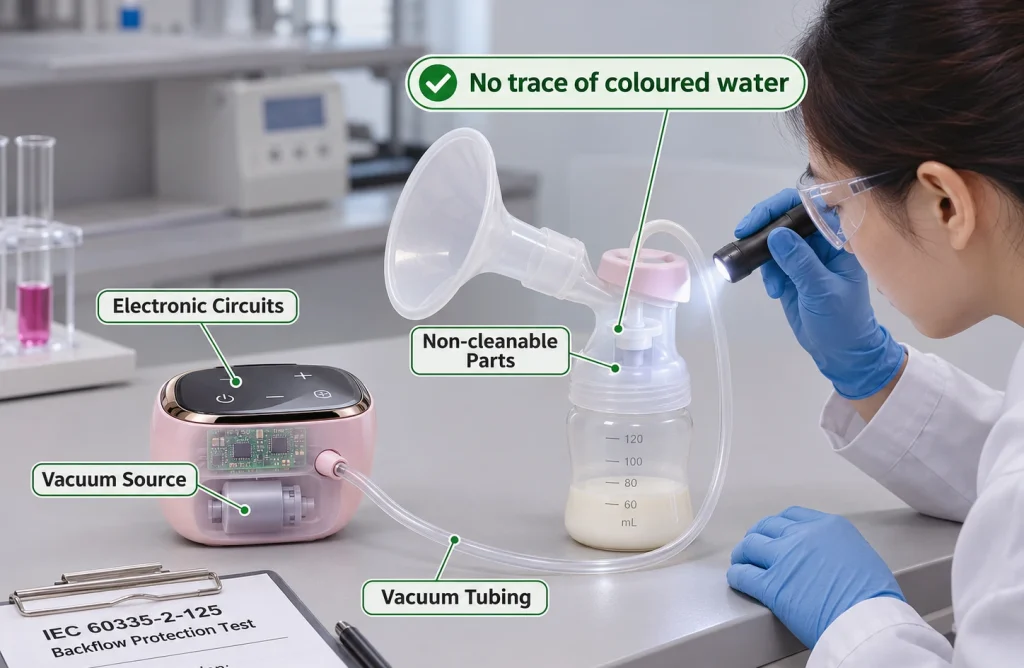
| Inspection area | Acceptance criterion |
|---|---|
| Vacuum tubing | No trace of coloured water |
| Vacuum source | No trace of coloured water |
| Electronic circuits | No trace of coloured water |
| Non-cleanable parts | No trace of coloured water |
Pass Criteria
No trace of coloured water shall be present in the vacuum tubing, vacuum source, on electronic circuits or on non-cleanable parts after completion of the test.
Critical Testing Considerations
1. Maximum Container Capacity
The collection container must be filled to its maximum capacity, not merely partially filled to simulate ordinary milk collection. This establishes the full-container condition specified by the standard and allows the backflow protection system to be evaluated under the prescribed test arrangement.
2. Worst-Case Position in Normal Use
The worst-case position is an important part of the test. The orientation of the collection container, the arrangement of the tubing and the location of the protective components can influence the potential movement of liquid.
The selected position must represent a foreseeable condition in normal use. An arbitrary upside-down or side-lying position should not be treated as mandatory unless it is consistent with the intended use of the appliance.
3. Highest Flow Rate Is Not the Same as Highest Vacuum Level
Clause 22.101 specifies operation at the highest flow rate. This should not be confused with the maximum vacuum level specified separately in Clause 22.102.
The clause does not provide a numerical flow-rate value or a separate flow-measurement procedure in the stated test method. The applicable highest-flow operating condition therefore needs to be identified for the appliance under evaluation without automatically substituting its maximum vacuum setting.
4. The Full 30-Minute Operating Period
The appliance must operate for the specified 30-minute period at the highest flow rate. The assessment is based on the absence of coloured water in the four protected areas after testing.
Related Vacuum Safety Requirements: Clauses 22.102 and 22.103
In addition to backflow protection, IEC 60335-2-125 addresses the vacuum characteristics of breast pump appliances. Clauses 22.102 and 22.103 establish separate requirements for maximum vacuum and baseline vacuum.
| Clause | Test characteristic | Limit |
|---|---|---|
| 22.101 | Backflow protection | No trace of coloured water in the four specified areas |
| 22.102 | Maximum vacuum level under normal and single fault conditions | 533 hPa (400 mmHg) |
| 22.103 | Baseline vacuum of cyclic-vacuum appliances that do not return to atmospheric pressure | 176 hPa (132 mmHg) under normal conditions |
Clause 22.102 – Maximum Vacuum Level
Under both normal and single fault conditions, the maximum vacuum level must not exceed 533 hPa (400 mmHg).
The test uses an artificial breast inserted into the breast shield to establish a seal. A pressure gauge is connected to the test setup, and the appliance is operated at rated voltage in the mode that generates the highest vacuum level until stabilization is reached.
The measurement system volume, including tubing, sensors and dead volume, must be minimized or compensated to ensure that the highest vacuum level is recorded.
Important single fault conditions: The standard identifies damaged backflow protection and sustained vacuum caused by continuous pump operation as examples of single fault conditions.
Clause 22.103 – Baseline Vacuum
For breast pump appliances generating cyclic vacuum that does not return to atmospheric pressure, the baseline vacuum must not exceed 176 hPa (132 mmHg) under normal conditions.
The appliance is assembled according to its instructions, fitted with an artificial breast to establish a seal, and connected to a pressure gauge. It is then operated at rated voltage in the mode that generates the highest baseline vacuum until stabilization is achieved.
Do not confuse these three test characteristics
- Clause 22.101 evaluates liquid backflow protection.
- Clause 22.102 evaluates maximum vacuum under normal and single fault conditions.
- Clause 22.103 evaluates baseline vacuum for specified cyclic-vacuum appliances.
Scope of IEC 60335-2-125:2026
IEC 60335-2-125:2026 applies to electric breast pump appliances for expressing breast milk for household and similar purposes, with a rated voltage not exceeding 250 V. This includes DC-supplied and battery-operated appliances.
Certain appliances not intended for normal household use, such as those used outdoors or at lactation specialist offices, can also fall within its scope if they present a potential hazard to the public.
The standard does not apply to:
- Breast pump appliances for expressing breast milk intended for medical purposes, which fall under the IEC 60601 series.
- Electric massage appliances for household and similar purposes covered by IEC 60335-2-32.
- Electric liquid pumps for household and similar purposes covered by IEC 60335-2-41.
In some jurisdictions, breast pump appliances are classified as medical devices. The standard recognizes this distinction and aligns certain requirements between the relevant standards to help avoid confusion.
IEC 60335-2-125 is used together with the applicable edition of IEC 60335-1, as specified by the standard.
For a broader overview of household appliance safety requirements and related testing equipment, see the KINGPO IEC 60335-2 Series Test Equipment Guide.
Conclusion
The backflow protection test in IEC 60335-2-125 Clause 22.101 is an important evaluation of the liquid isolation design in electric breast pump appliances.
By using a non-surfactant coloured water solution, filling the collection container to maximum capacity, selecting the worst-case position expected in normal use and operating the appliance at its highest flow rate for 30 minutes, laboratories can evaluate whether the backflow protection system prevents liquid from reaching critical internal areas.
Together with the vacuum-related requirements in Clauses 22.102 and 22.103, these tests provide a more complete understanding of the construction and operating safety of breast pump appliances.
Standard Reference
IEC 60335-2-125:2026 – Household and similar electrical appliances – Safety – Part 2-125: Particular requirements for breast pump appliances for expressing breast milk.