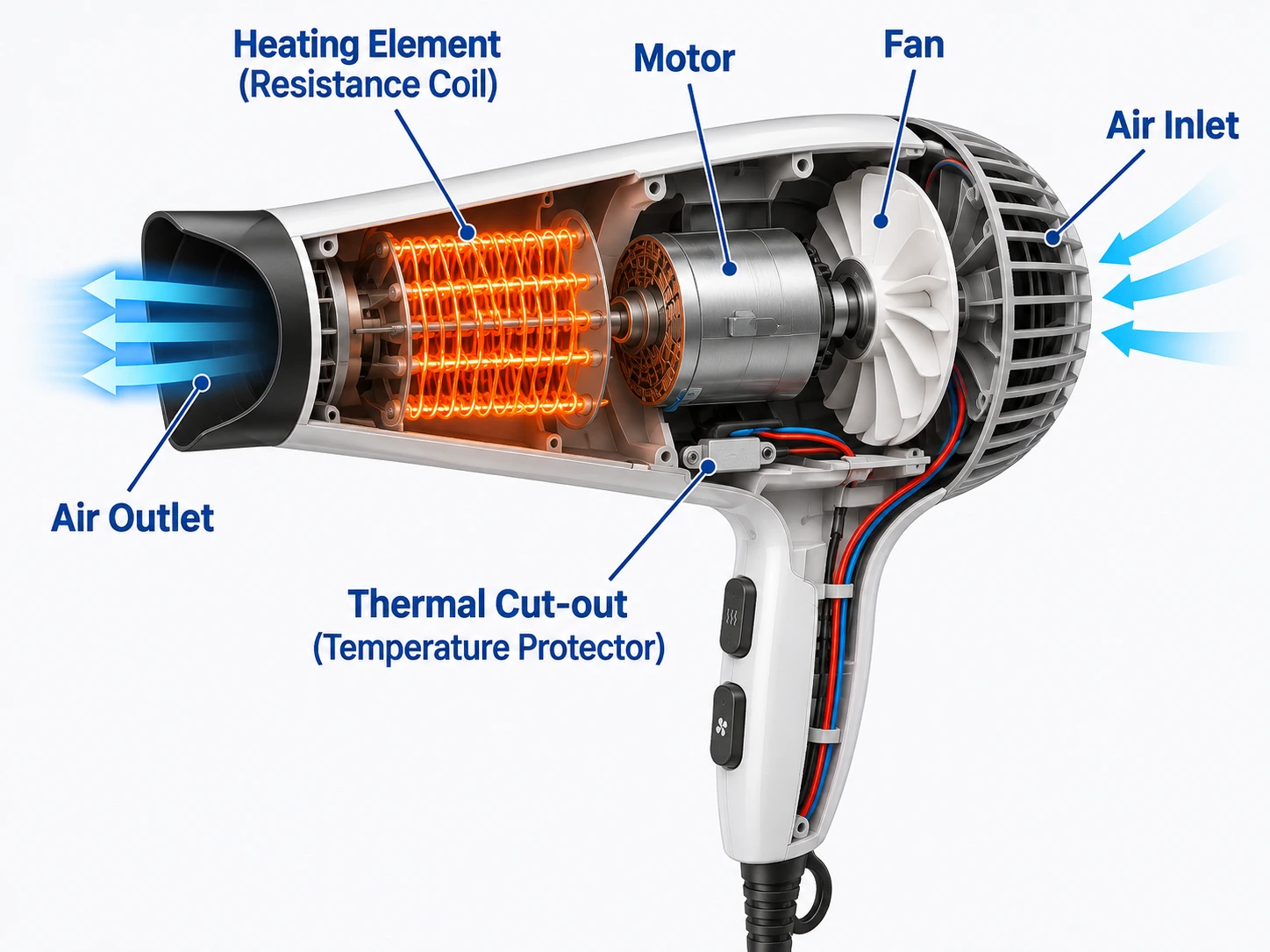
Handheld hair dryers are subject to several abnormal operation tests under IEC 60335-2-23. However, determining which tests actually apply requires more than following the general requirements of IEC 60335-1. Appliance construction, motor type, heating element design and protective devices all influence the test configuration.
One of the most common mistakes in laboratory testing is applying the general requirements without first checking the modifications introduced by the particular standard. This can lead to incorrect test arrangements, unnecessary locked-rotor tests, or confusion between restricted heat dissipation and reduced motor-speed testing.
This article reviews the abnormal operation requirements in Clause 19 of IEC 60335-2-23:2026, focusing on handheld hair dryers. It explains the applicability of the main test clauses, the differences between commonly confused test procedures, and the practical considerations involved in setting up a laboratory test.
Applicable Standards: IEC 60335-1 and IEC 60335-2-23
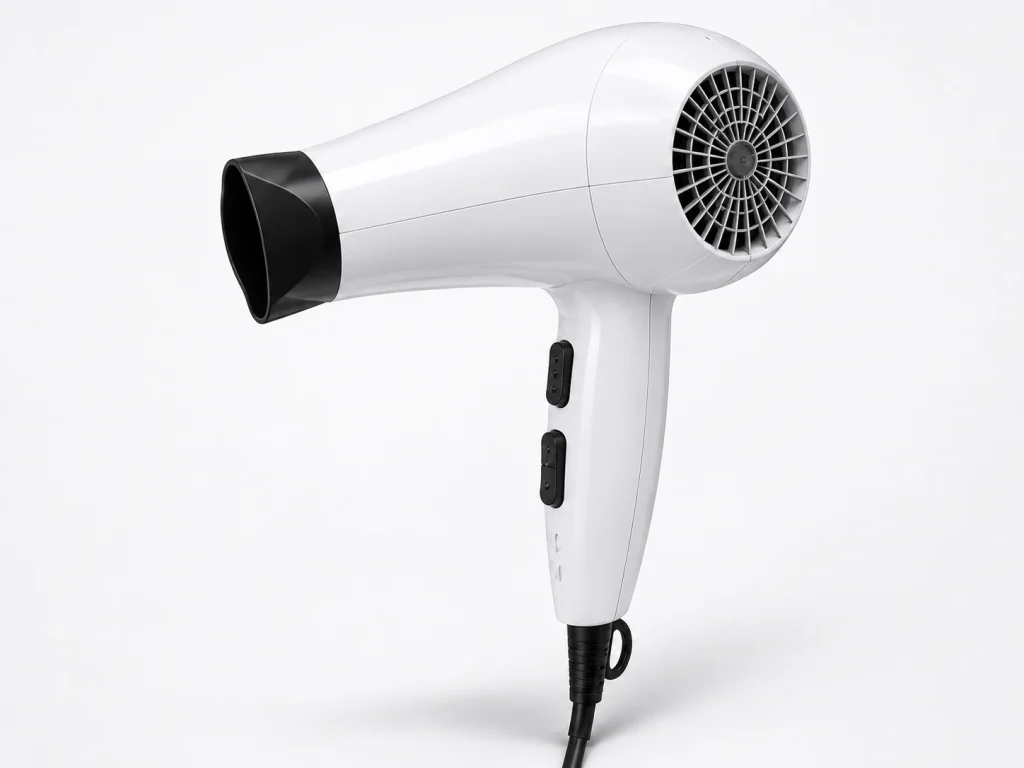
IEC 60335-1 establishes the general safety requirements for household and similar electrical appliances. IEC 60335-2-23 provides particular requirements for hair care and similar appliances, including handheld hair dryers, curling irons, hair straighteners and hand dryers.
The particular standard supplements or modifies the corresponding requirements in Part 1. When a particular subclause is not specifically modified or replaced, the relevant general requirements of Part 1 remain applicable as far as reasonable.
This relationship is important when preparing a test plan. Laboratories should not simply copy the test sequence from IEC 60335-1 without reviewing the applicable Part 2 requirements.
Standard edition update
IEC 60335-2-23:2026, Edition 7.0, was published on 16 February 2026. It replaces the previous consolidated edition IEC 60335-2-23:2016+AMD1:2019 and introduces technical revisions, including alignment with IEC 60335-1:2020 and clarification of the appliance positioning requirements in Clause 19.2.
Official reference: IEC 60335-2-23:2026 – Official IEC Publication
For a broader overview of household appliance safety requirements and related test equipment, refer to the KINGPO IEC 60335-1 test equipment guide.
Clause 19: Which Abnormal Operation Tests Apply to Hair Dryers?
Before starting the tests, the laboratory should review the appliance construction and identify the relevant abnormal operating conditions.
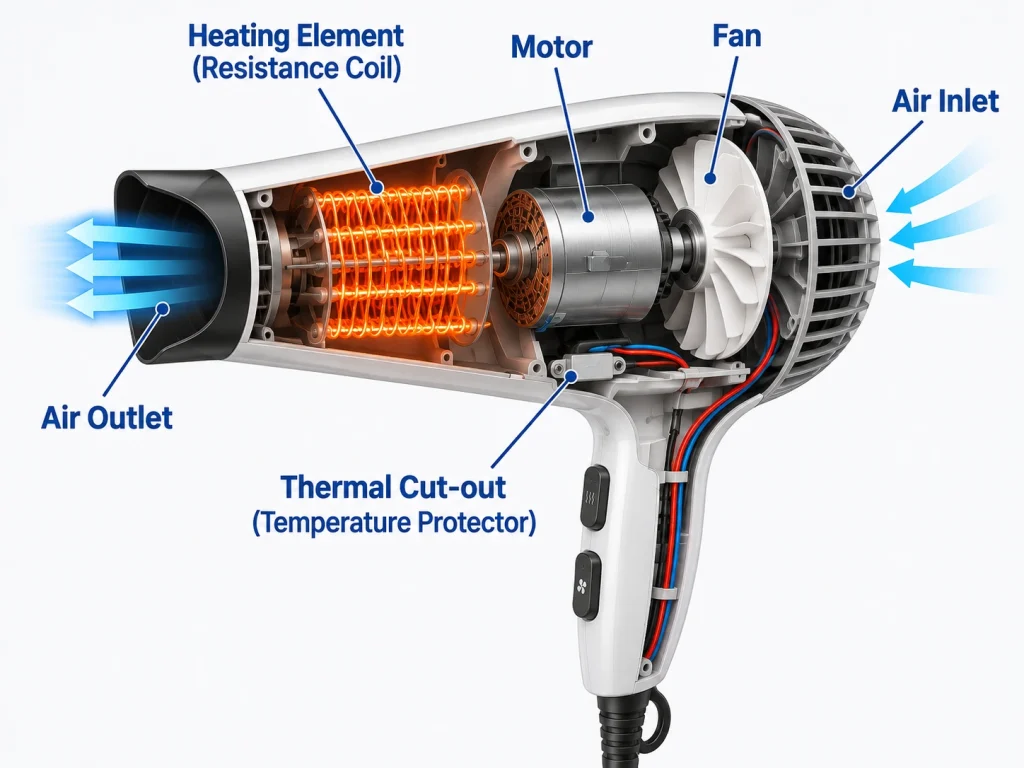
The following table provides an initial applicability reference for a typical portable handheld hair dryer. It is not a universal exemption list. The final assessment must take into account the actual appliance design, motor configuration, heating element and protective circuit.
| Clause | Test Item | Applicability |
|---|---|---|
| 19.1 | General abnormal operation requirements | Applicable |
| 19.2 | Restricted heat dissipation | Applicable |
| 19.3 | Restricted heat dissipation at increased power input | Applicable |
| 19.4 | Short-circuiting temperature-limiting controls | Depending on control design |
| 19.5 | Heating element sheath connection test | Only for applicable class and heating element constructions |
| 19.6 | PTC heating element overvoltage test | Only when PTC elements are incorporated |
| 19.7 | Motor stalled-condition test | Assess separately; do not assume a blanket handheld exemption |
| 19.8 | Multi-phase motor test | Generally not applicable to single-phase models |
| 19.9 | Running overload test | Not applicable under IEC 60335-2-23 |
| 19.10 | Series motor overspeed test | Depending on motor construction |
| 19.11 | Electronic circuit fault testing | Depending on electronic circuit design |
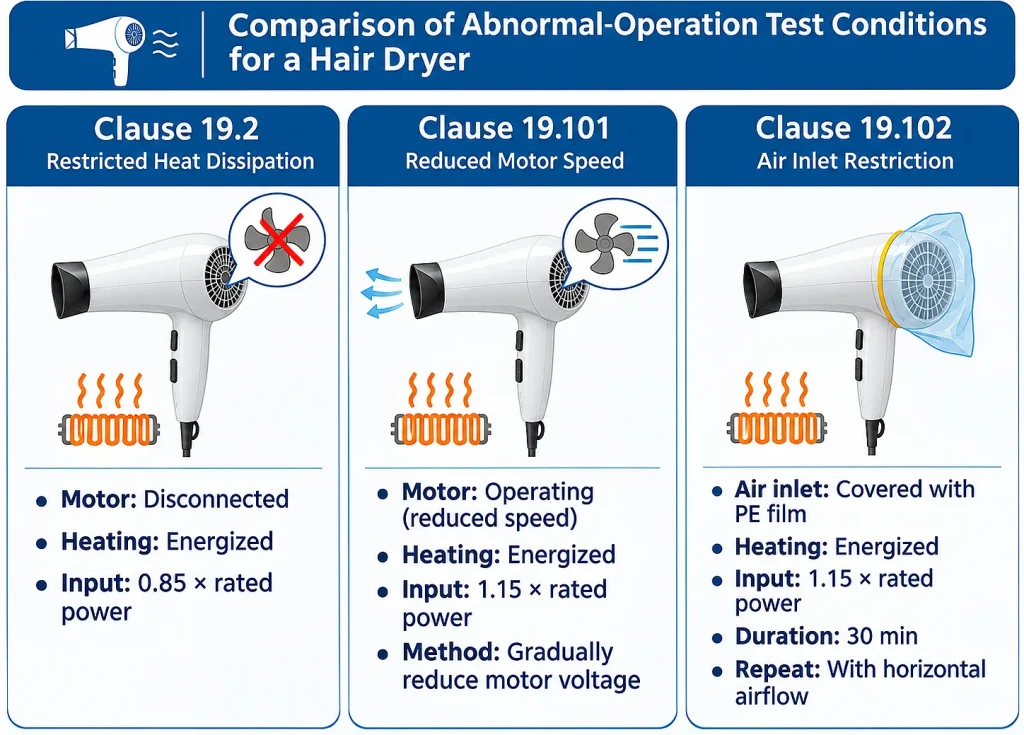
| 19.101 | Reduced motor speed test | Hair dryer-specific test |
| 19.102 | Air inlet restriction using polyethylene film | Portable hair dryer-specific test |
The following sections focus on the test conditions that require particular attention during laboratory preparation.
Restricted Heat Dissipation: Clauses 19.2 and 19.3
Clause 19.2 – Restricted Heat Dissipation
Clause 19.2 evaluates the appliance under abnormal conditions in which normal heat dissipation is restricted. For hair dryers, the particular standard specifies how the restricted airflow and appliance positioning are established.
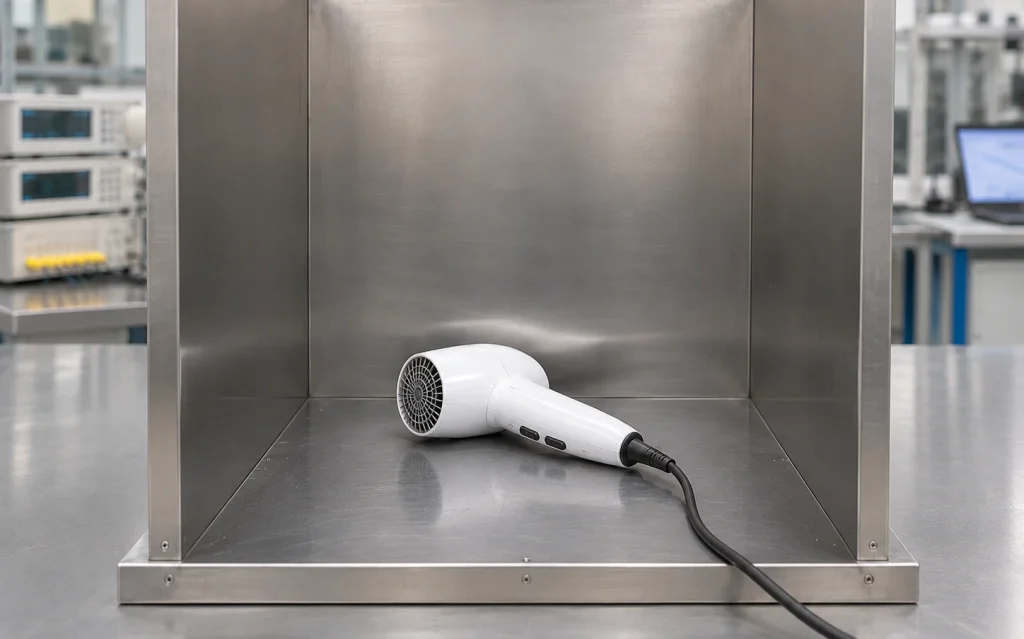
The main test considerations include:
- The motor is disconnected.
- Handheld hair dryers are placed on the floor of the test corner, away from the walls, in a stable position of normal use.
- For handheld appliances without an integral rest, the specified close-to-wall positioning condition is also considered where applicable.
- For hair dryers with flexible hood attachments, the motor also operates while airflow through the hose is restricted to obtain the most unfavourable result.
Under the general requirements of Part 1, the test voltage is determined before the test to provide 0.85 times the rated power input under normal operating conditions. This voltage is maintained throughout the test.
An important update in the 2026 edition is the clarification of the test-corner positioning conditions. Laboratories should not automatically reuse an older test arrangement without checking the exact positioning requirements in the current edition.
Clause 19.3 – Increased Power Input
Clause 19.3 repeats the test of 19.2, but with a higher supply voltage corresponding to 1.24 times the rated power input under normal operating conditions.
The restricted heat dissipation conditions remain relevant. The difference is the increased electrical input, which creates a more demanding thermal condition.
Key difference
Clause 19.2: 0.85 × rated power input.
Clause 19.3: 1.24 × rated power input.
Both tests address restricted heat dissipation, but they use different supply conditions.
Temperature Controls and Heating Element Conditions
Clause 19.4 – Short-Circuiting Temperature-Limiting Controls
This test applies to appliances incorporating controls that limit temperature during the heating test of Clause 11.
The appliance is operated under the conditions specified in Clause 11, with the relevant temperature-limiting control short-circuited. If more than one control is incorporated, the controls are short-circuited individually.
The purpose is to evaluate whether the appliance remains safe when a temperature-limiting control fails to operate as intended.
Clause 19.5 – Heating Element Sheath Connection
Clause 19.5 is not a universal test for all hair dryers. It concerns Class 0I and Class I appliances incorporating tubular sheathed or embedded heating elements.
The test involves connecting one end of the heating element to its sheath, followed by a reversed-polarity test with the other end connected to the sheath, subject to the exceptions specified in Part 1.
Under IEC 60335-2-23:2026, portable hair dryers are required to be Class II or Class III. Therefore, this test is generally not triggered by the classification of a typical portable handheld hair dryer. Fixed hair dryers intended for permanent connection to fixed wiring are among the specified exceptions that may be Class I.
The actual applicability should be established from the product classification and heating element construction.
Clause 19.6 – PTC Heating Element Overvoltage Test
Clause 19.6 applies only when the appliance incorporates PTC heating elements.
The appliance is initially operated at rated voltage until steady conditions are established. The working voltage of the PTC heating element is then increased in steps until the specified test limit is reached or the element ruptures, whichever occurs first.
If the hair dryer uses conventional resistance heating elements rather than PTC elements, this test is not applicable.
Motor-Related Tests: Clauses 19.7 to 19.10
Clause 19.7 – Motor Stalled-Condition Test
Clause 19.7 is one of the most frequently misunderstood requirements when applying IEC 60335-1 to handheld hair dryers.
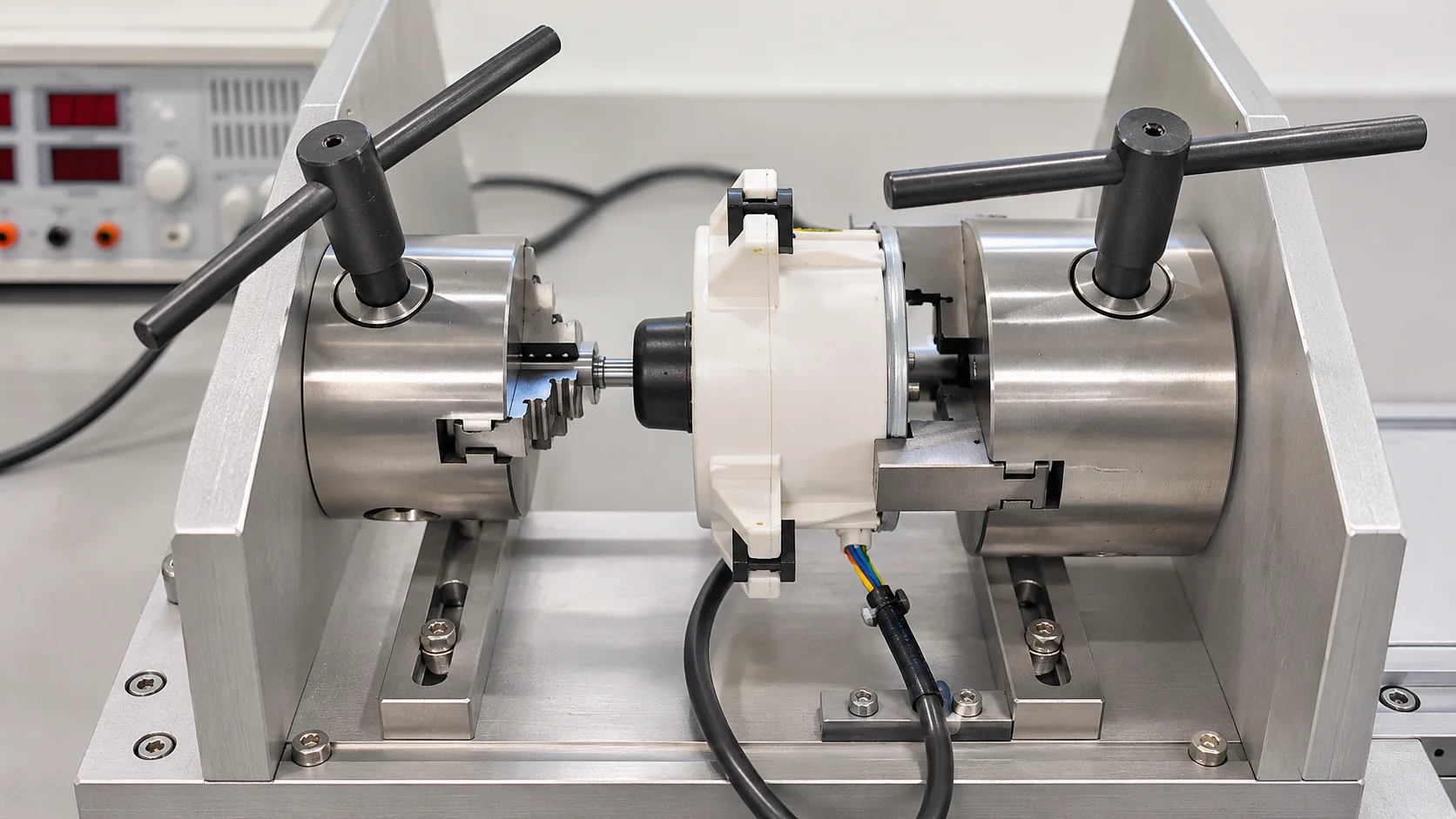
The general test under Part 1 involves operating the motor under stalled conditions. Depending on the motor design, this is achieved by locking the rotor or the relevant moving parts.
IEC 60335-2-23 modifies the test duration by specifying a five-minute test except for:
- Handheld appliances;
- Appliances that have to be kept switched on by hand;
- Appliances incorporating a timer.
During and after the test, the appliance shall not emit flames.
Important interpretation
The exception for handheld appliances relates to the specified five-minute test duration. It should not be interpreted as an automatic exemption from the underlying stalled-condition test in Clause 19.7 of Part 1.
Laboratories should assess the applicable motor test requirements separately instead of marking the entire clause as not applicable solely because the product is handheld.
For more information about the general motor stalled-condition test, see the KINGPO technical article: Motor Locked-Rotor Testing Under IEC 60335-1 Clause 19.7.
Clause 19.8 – Multi-Phase Motor Test
Clause 19.8 concerns appliances incorporating multi-phase motors. One phase is disconnected, and the appliance is operated under normal operating conditions at rated voltage.
Most portable handheld hair dryers use single-phase motor configurations. In such cases, the multi-phase motor test is generally not applicable.
Clause 19.9 – Running Overload Test
Clause 19.9 of Part 1 addresses running overload conditions for motors intended to be remotely or automatically controlled, or liable to operate continuously.
However, IEC 60335-2-23 explicitly states that Clause 19.9 is not applicable. This particular modification should be followed rather than independently applying the general Part 1 requirement.
Clause 19.10 – Series Motor Overspeed Test
Clause 19.10 applies to appliances incorporating series motors. Under Part 1, the motor is operated with the lowest possible load and supplied at 1.3 times rated voltage for one minute.
IEC 60335-2-23 adds an important test condition: the heating elements must be disconnected or switched off during this test.
This prevents the overspeed assessment from being confused with the heating-element abnormal operation tests.
Clause 19.11 – Electronic Circuit Fault Testing
Modern hair dryers may incorporate electronic motor controllers, temperature sensors, switching circuits and electronic protective functions.
Where electronic circuits are present, the relevant fault conditions must be evaluated in accordance with Clause 19.11 of Part 1. Clause 19.12 may also apply where the safety of the appliance depends on the operation of a miniature fuse-link.
The applicable fault conditions depend on the actual circuit design. Circuit diagrams and protective component functions should be reviewed before determining the test sequence.
Hair Dryer-Specific Tests: Clauses 19.101 and 19.102
These two tests are particularly important because they are specifically added for hair dryers under Clause 19.1. Although both evaluate abnormal airflow and thermal protection conditions, their test methods are different.
Clause 19.101 – Reduced Motor Speed Test
Clause 19.101 evaluates the thermal behaviour of a hair dryer when the fan operates at a reduced speed while the heating element continues to receive increased power.
The test procedure can be summarized as follows:
- Operate the hair dryer under the conditions specified in Clause 11 until steady conditions are established.
- Maintain the power input to the heating element at 1.15 times rated power input.
- Gradually reduce the voltage at the motor terminals until the thermal cut-out operates.
- Reduce the motor voltage at a rate of 1 V per minute for motors with a working voltage not exceeding 30 V, or 5 V per minute for motors with a working voltage exceeding 30 V.
- Increase the motor voltage in 1 V increments until the thermal cut-out no longer operates. This establishes the minimum voltage condition without thermal cut-out operation.
- Operate the appliance until steady conditions are established.
- Repeat the test with the heat-setting switch in each position, maintaining the specified heating-element power condition.
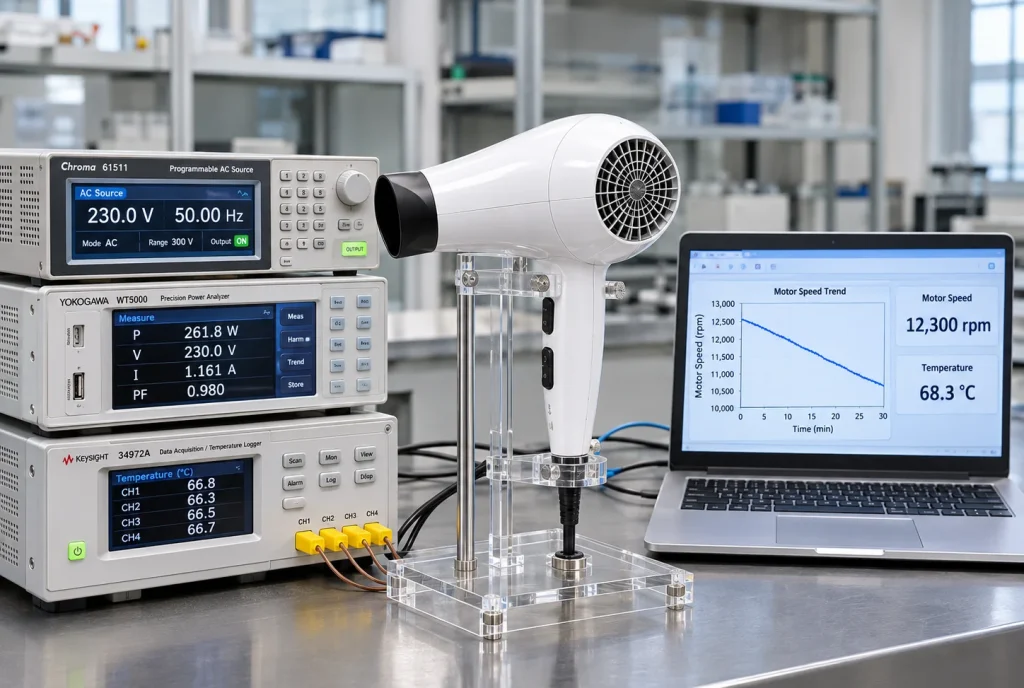
The purpose is to identify the motor operating condition at which airflow is reduced sufficiently to create an unfavourable thermal condition without triggering the thermal cut-out.
One important point in the 2026 edition is the revised procedure for identifying the minimum motor voltage without thermal cut-out operation. The voltage is first decreased until the cut-out operates and then increased in 1 V increments until the cut-out no longer operates.
Key testing considerations
- Motor voltage and heating-element power must be controlled appropriately and independently.
- Motor speed should be monitored throughout the procedure.
- Thermal cut-out operation must be clearly identified and recorded.
- Each applicable heat-setting position must be evaluated.
Clause 19.102 – Air Inlet Restriction Using Polyethylene Film
Clause 19.102 evaluates the hair dryer under restricted air inlet conditions. This simulates a situation in which the rear air intake is obstructed by hair or other foreign material.
The specified polyethylene film has the following dimensions:
- Material: Polyethylene (PE) film;
- Approximate dimensions: 200 mm × 200 mm;
- Thickness: 50 μm.
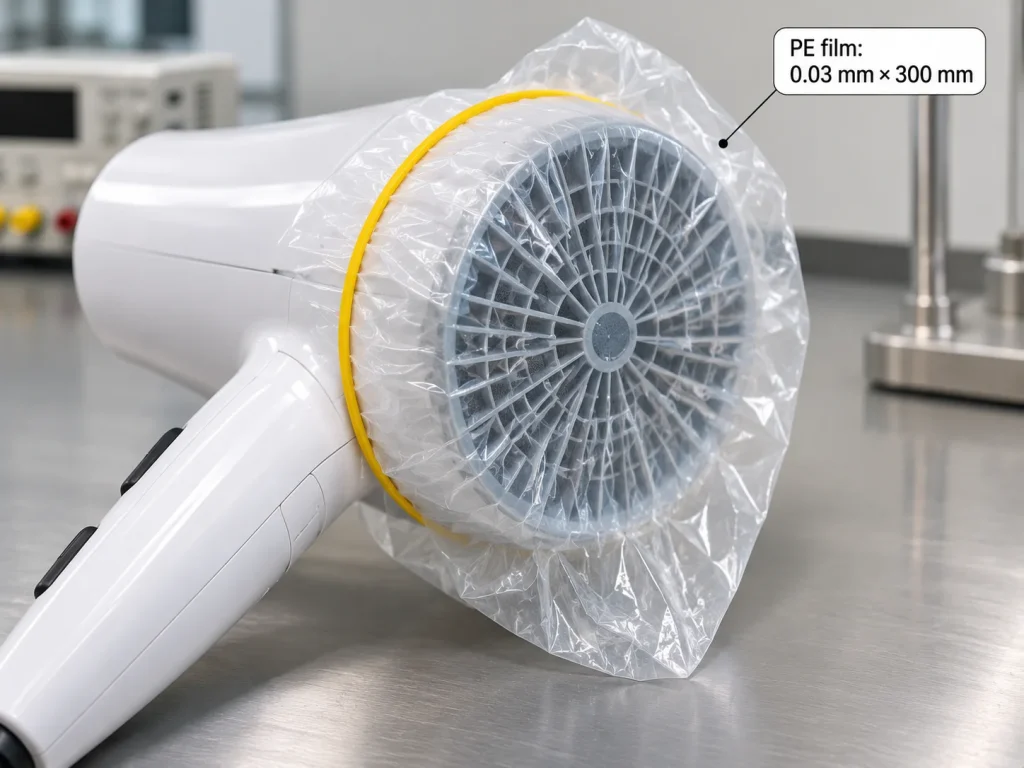
The test is conducted as follows:
- Operate the portable hair dryer under normal operating conditions at 1.15 times rated power input.
- Place the polyethylene film against the air inlet.
- Move the film in different directions to reduce airflow and establish the most unfavourable conditions.
- Operate the appliance for 30 minutes.
- Repeat the test with the airflow directed horizontally.
The most unfavourable condition is generally obtained by positioning the film so that the thermal cut-out is prevented from operating.
It is important to understand that the purpose is not simply to completely seal the air inlet. The film position must be adjusted to establish the specified most unfavourable thermal condition.
19.101 vs. 19.102: What is the difference?
| Comparison | 19.101 | 19.102 |
|---|---|---|
| Method | Reduce motor voltage | Restrict air inlet |
| Motor | Operates at reduced speed | Operates under normal conditions |
| Airflow | Reduced by motor speed | Reduced by PE film |
| Heating input | 1.15 × rated power input | 1.15 × rated power input |
| Test duration | Until steady conditions are established | 30 minutes, then repeat horizontally |
Test Equipment and Laboratory Setup
Accurate abnormal operation testing requires coordinated control of electrical input, motor operation, airflow and temperature measurement.
A typical laboratory arrangement may include the following equipment:
| Equipment | Purpose |
|---|---|
| Adjustable power supply | Provides controlled electrical input and motor voltage adjustment. |
| Power analyzer | Monitors voltage, current and power input. |
| Temperature acquisition system | Records temperatures at relevant components and monitoring points. |
| Motor speed measurement device | Monitors motor speed during reduced-speed testing. |
| Test corner and positioning fixtures | Establishes the specified restricted heat dissipation conditions. |
| PE film and positioning accessories | Provides controlled air inlet restriction for Clause 19.102. |
For Clause 19.101, the laboratory setup should allow the motor supply condition to be adjusted while maintaining the required heating-element power input. A single common voltage adjustment that changes both motor and heater input may not be sufficient for this test arrangement.
Temperature, motor speed, electrical input and protective-device operation should be recorded in a coordinated manner to support repeatable testing and traceable results.
Common Testing Mistakes to Avoid
Several errors can occur when laboratories prepare abnormal operation tests for handheld hair dryers.
1. Applying IEC 60335-1 without checking Part 2 modifications
The particular requirements of IEC 60335-2-23 must be considered before deciding the test sequence. Some requirements are modified, some are explicitly not applicable, and additional hair dryer-specific tests are introduced.
2. Treating Clause 19.7 as automatically exempt
The handheld exception in the five-minute duration provision should not be interpreted as a blanket exemption from the underlying stalled-condition assessment.
3. Confusing Clauses 19.2 and 19.101
Clause 19.2 disconnects the motor to establish restricted heat dissipation. Clause 19.101 keeps the motor running at a reduced speed while maintaining the specified heating-element power input.
4. Treating Clause 19.102 as a simple air inlet sealing test
The PE film must be positioned to establish the most unfavourable airflow condition. Completely sealing the inlet without evaluating the thermal cut-out condition does not necessarily establish the required test condition.
5. Ignoring the updated 2026 test procedure
The revised motor-voltage determination procedure in Clause 19.101 and the clarified test-corner positioning in Clause 19.2 should be considered when updating existing laboratory procedures.
Conclusion
Abnormal operation testing of handheld hair dryers involves several different failure scenarios. Although they all belong to Clause 19, their objectives and test arrangements are not interchangeable.
A reliable test plan should begin with an assessment of the appliance construction, motor type, heating element, temperature controls and electronic protection. The applicable requirements of IEC 60335-1 must then be combined with the specific modifications and additional tests in IEC 60335-2-23.
Particular attention should be given to the differences between restricted heat dissipation, motor speed reduction and air inlet restriction. These distinctions are essential for establishing the correct test conditions and obtaining meaningful safety evaluation results.
KINGPO provides household appliance safety testing equipment, customized fixtures and integrated testing solutions for laboratories and manufacturers. Our technical team supports test equipment selection and system configuration according to applicable IEC standards and specific testing requirements.
Explore our IEC 60335-2 series testing equipment guide for further information about appliance-specific safety testing solutions.