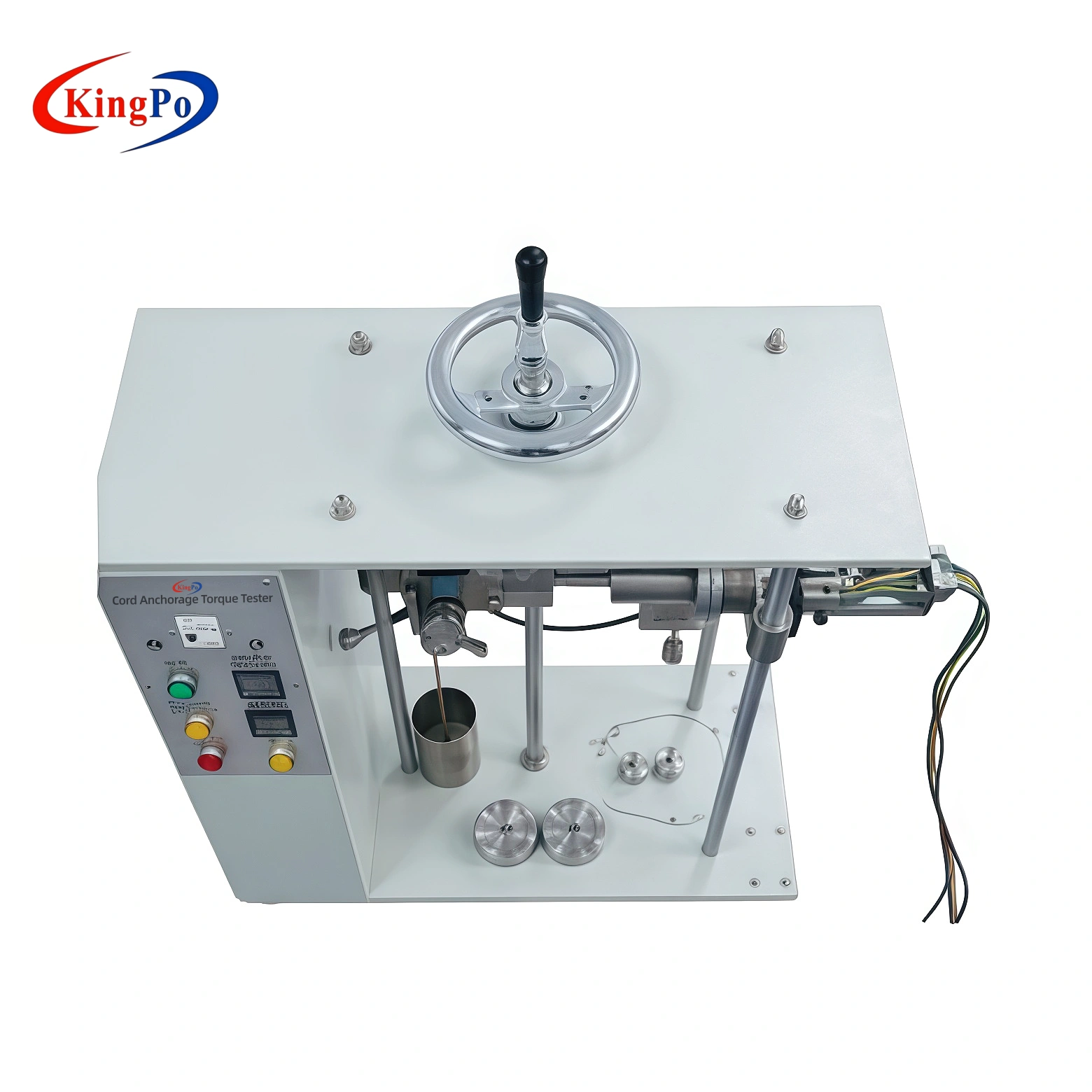
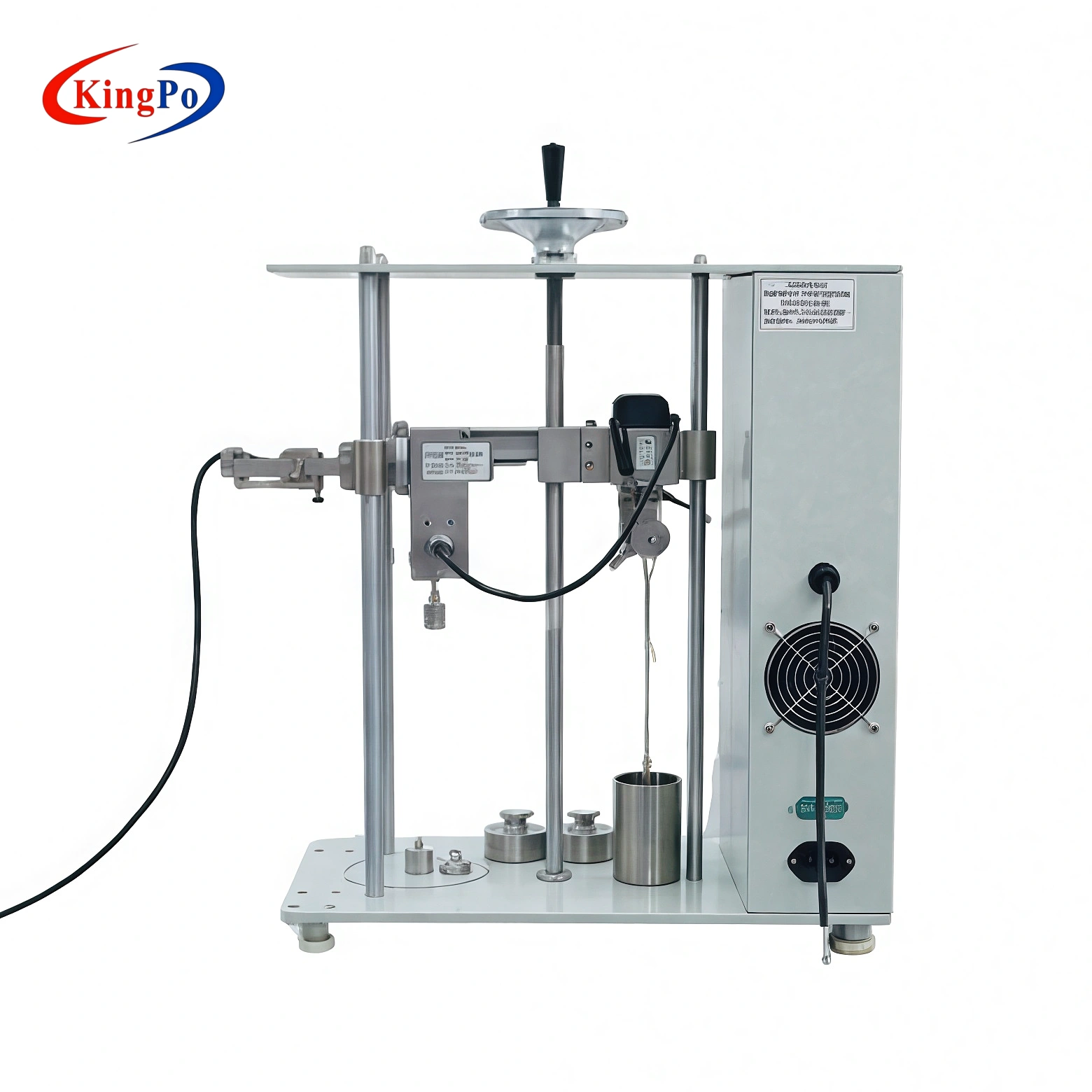
Cord Anchorage Torque Tester IEC 60335-1 Clause 25.15 / IEC60950-1-class3.2.6
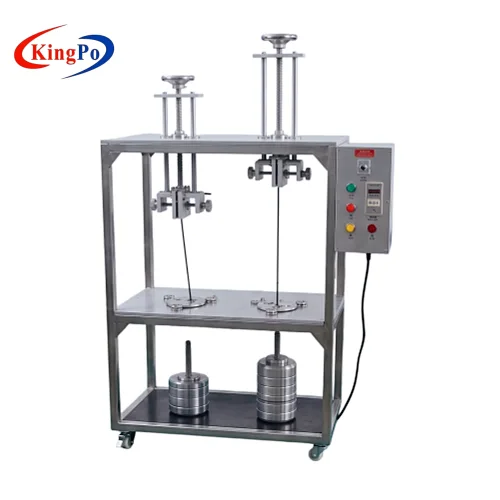
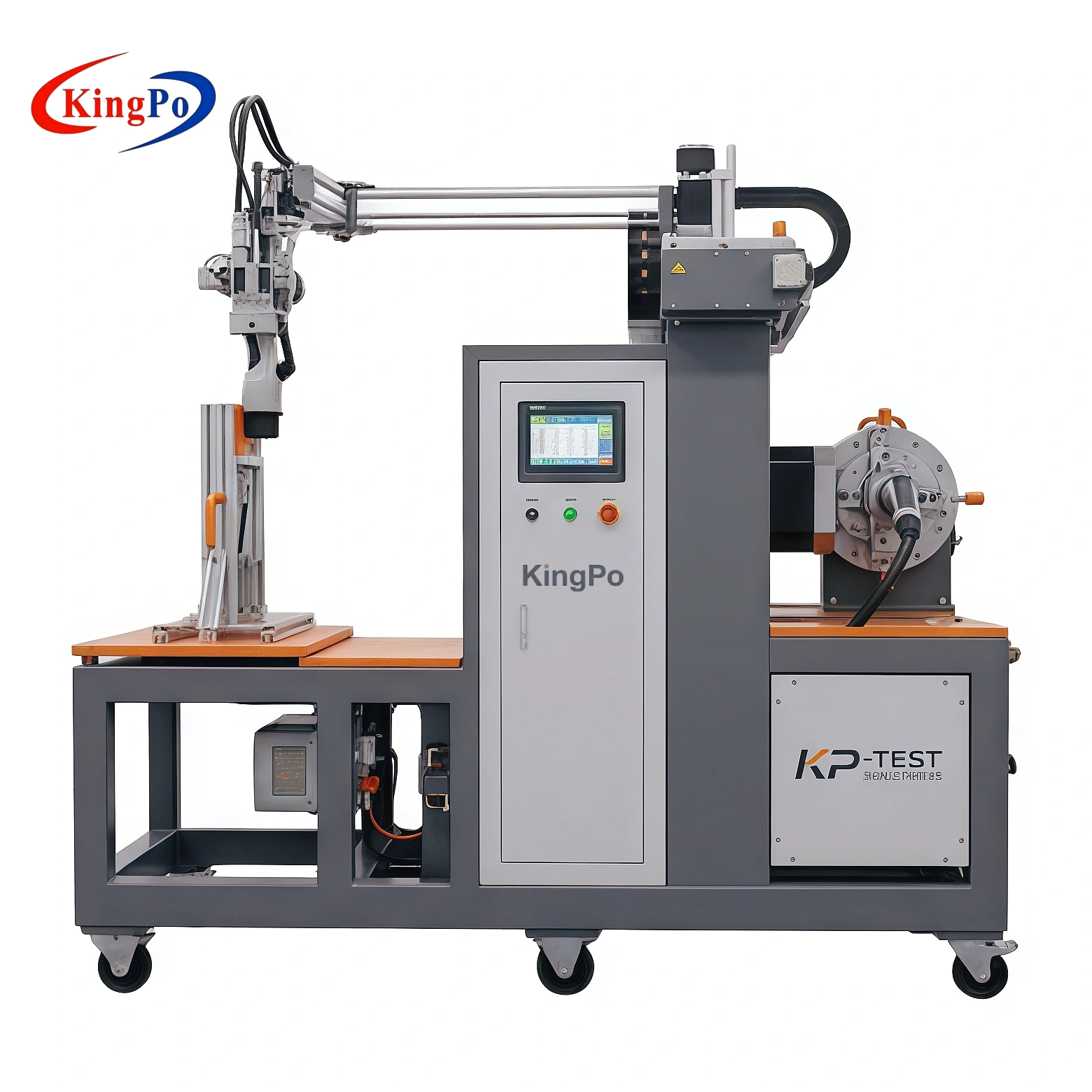
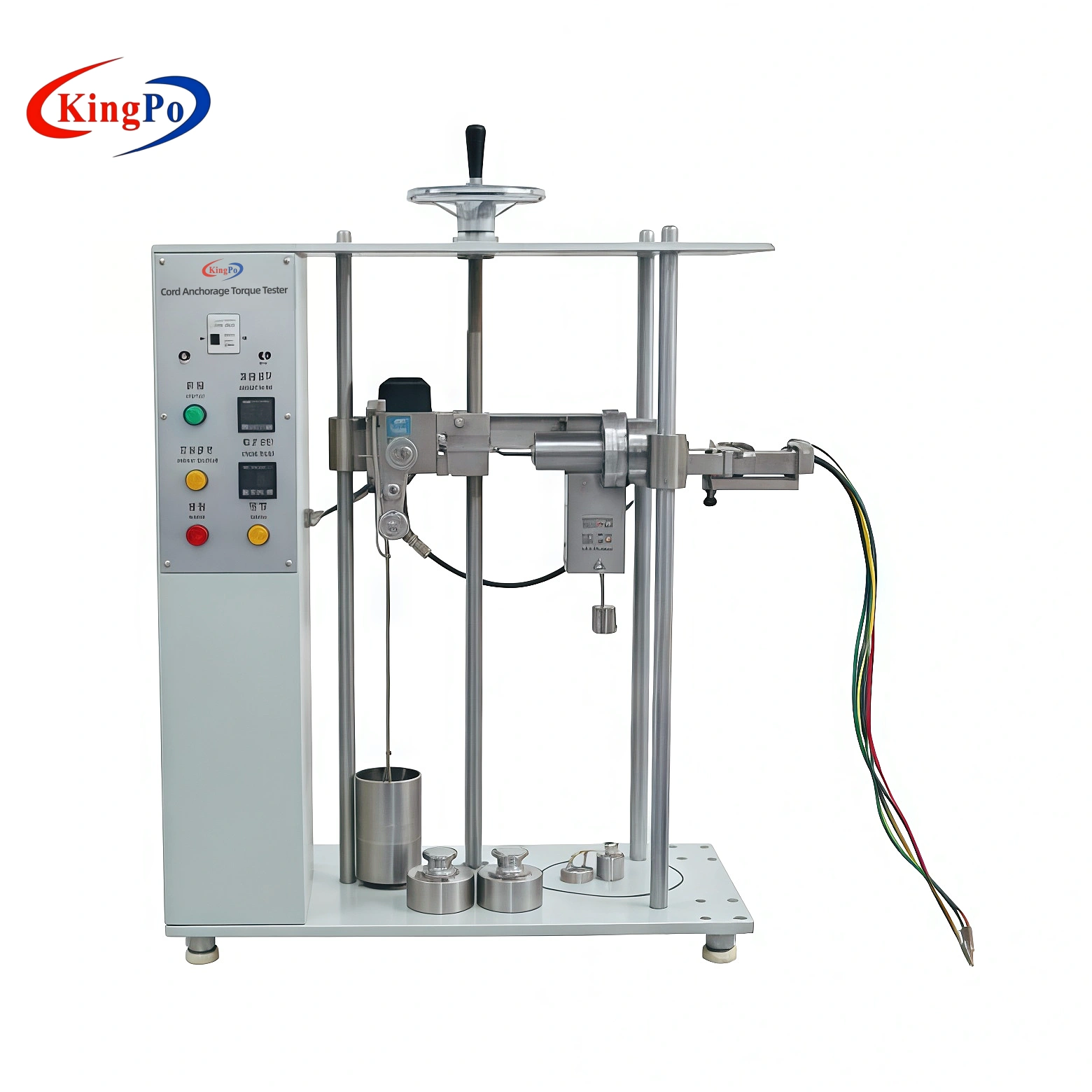
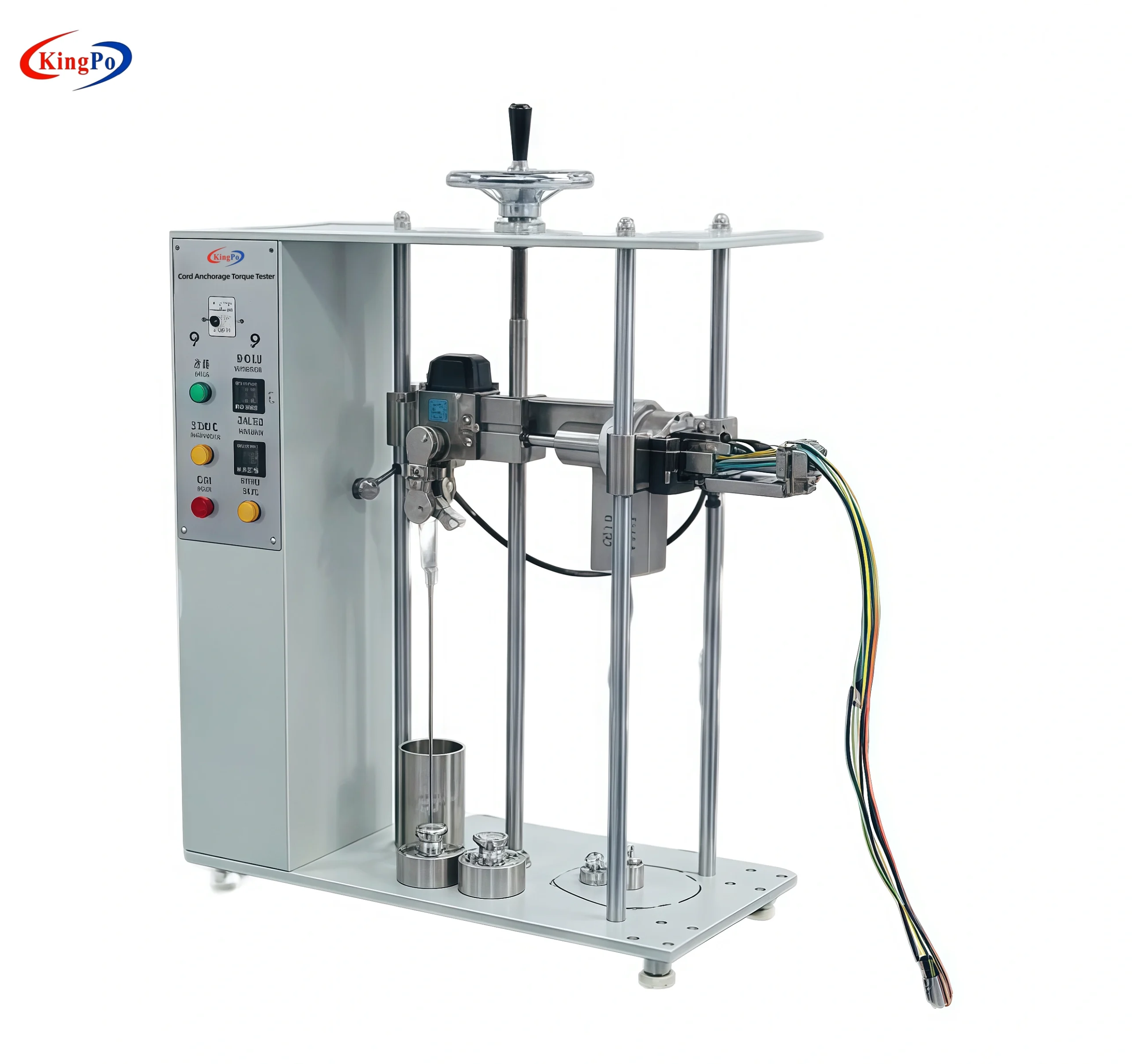
The Cord Anchorage Torque Tester is a professional test instrument manufactured by KingPo. It is specifically engineered to evaluate the mechanical performance of power cord anchorage systems in electrical appliances by applying controlled tension and torque forces, thereby confirming that the anchorage effectively relieves conductors from strain and twisting at the terminals while protecting the insulation from abrasion.
Designed in full accordance with IEC 60335-1 Clause 25.15 and IEC 60950-1, the instrument enables laboratories to verify that the cord cannot be pushed into the appliance in a way that could damage internal wiring or connections, ensuring long-term electrical safety and mechanical reliability under normal use conditions.
Tension and Torque Specifications
| Parameter | Specification | Remark / Notes |
|---|---|---|
| Standard | IEC 60335-1 Clause 25.15 / IEC 60950-1 | Power cord anchorage tension and torque test |
| Pull Weights | 20 N × 2 and 30 N × 2 | Total pull force selectable up to 60 N |
| Torque Weights | 2 N (0.1 Nm), 5 N (0.25 Nm), 7 N (0.35 Nm) | Three discrete torque values for different appliance classes |
| Test Cycles | 0–9999 (default 25 cycles) | Programmable according to standard requirements |
| Test Speed | 1 cycle/s | Controlled tension frequency with 1 s pull + release |
| Torque Duration | 0.01 s – 99 h 59 min 59 s | Programmable torque application time |
| Power Supply | AC 220 V, 50 Hz | Standard laboratory single-phase supply |
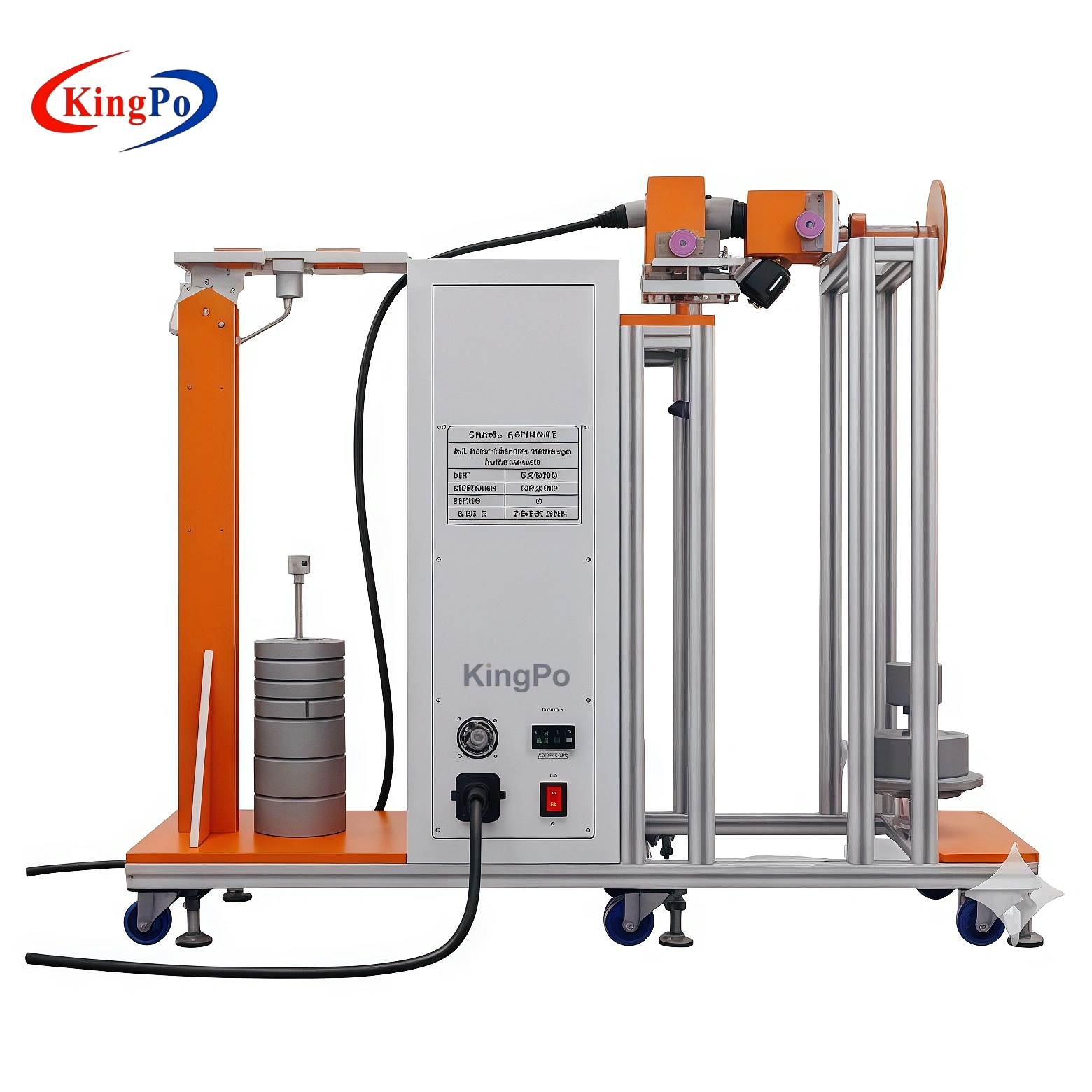
The Cord Anchorage Torque Tester is built around a rigid, high-stability test frame with precision-machined cord clamping fixtures and low-friction bearing-guided torque arm to eliminate parasitic forces during testing. The tension system employs calibrated weights suspended through high-precision pulleys with minimal friction, while the torque system uses independent calibrated weights applied via a torque arm with exact lever geometry.
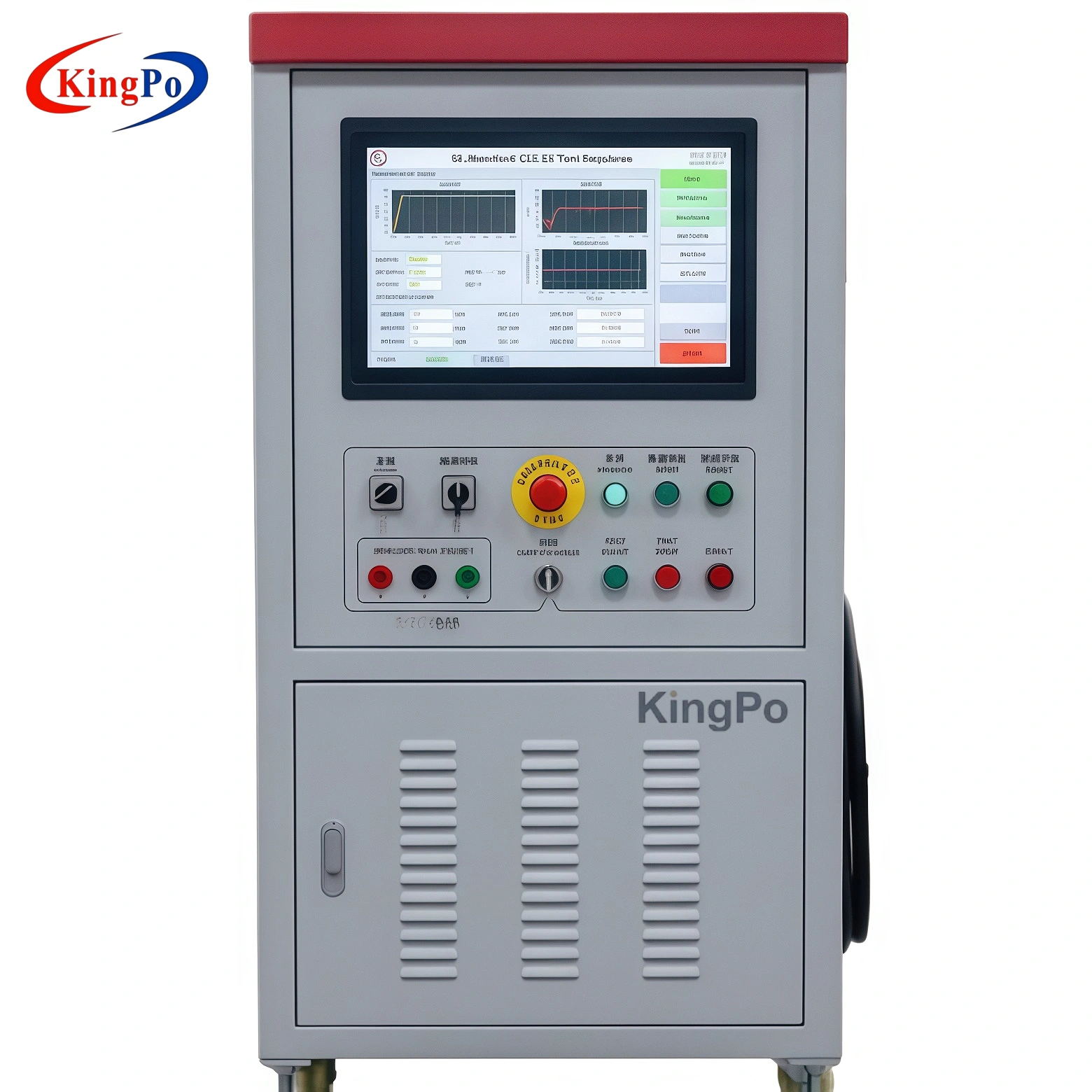
A high-accuracy digital timer and counter control the entire test sequence, ensuring repeatable timing and cycle count. All critical components are manufactured to tight tolerances, providing excellent long-term mechanical stability and measurement repeatability required for daily laboratory use in safety certification testing.
Preparation before the test
Preparation Before Testing
- Place the Cord Anchorage Torque Tester on a stable, level surface. Ensure there is no visible tilt and lock all caster brakes to prevent movement during testing.
- Select the appropriate tension and torque weights according to the appliance mass (refer to the standard table in IEC 60335-1). For example, for a 2.5 kg appliance such as a toaster, use 60 N tension (two 30 N weights) and 12.5 N torque (one 5 N weight).
- Install the test sample:
- Adjust the up/down hand wheel to align the power cord outlet and clamping end in a horizontal position.
- Position the specimen firmly against the outer side of the fixture and securely clamp the power cord.
- Release the jig, hang the torque weight, and tighten the torsion strap while ensuring the cord clamping end remains horizontal.
- Press [Start] until the pull weight tray reaches the lowest point, then insert a height pad. Place the tension weights on the pad, straighten the tension lanyard, and hang the weight hanger. Adjust the tension wheel until the lanyard is fully stretched.
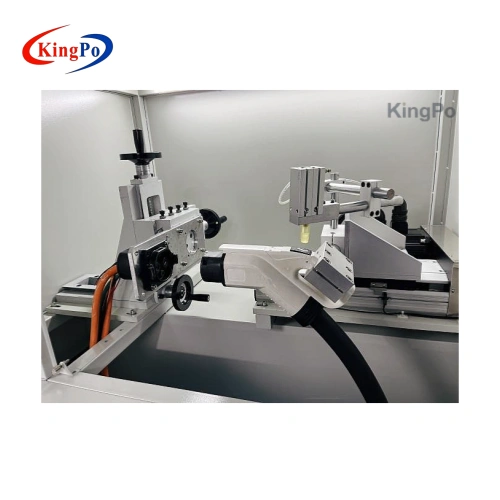
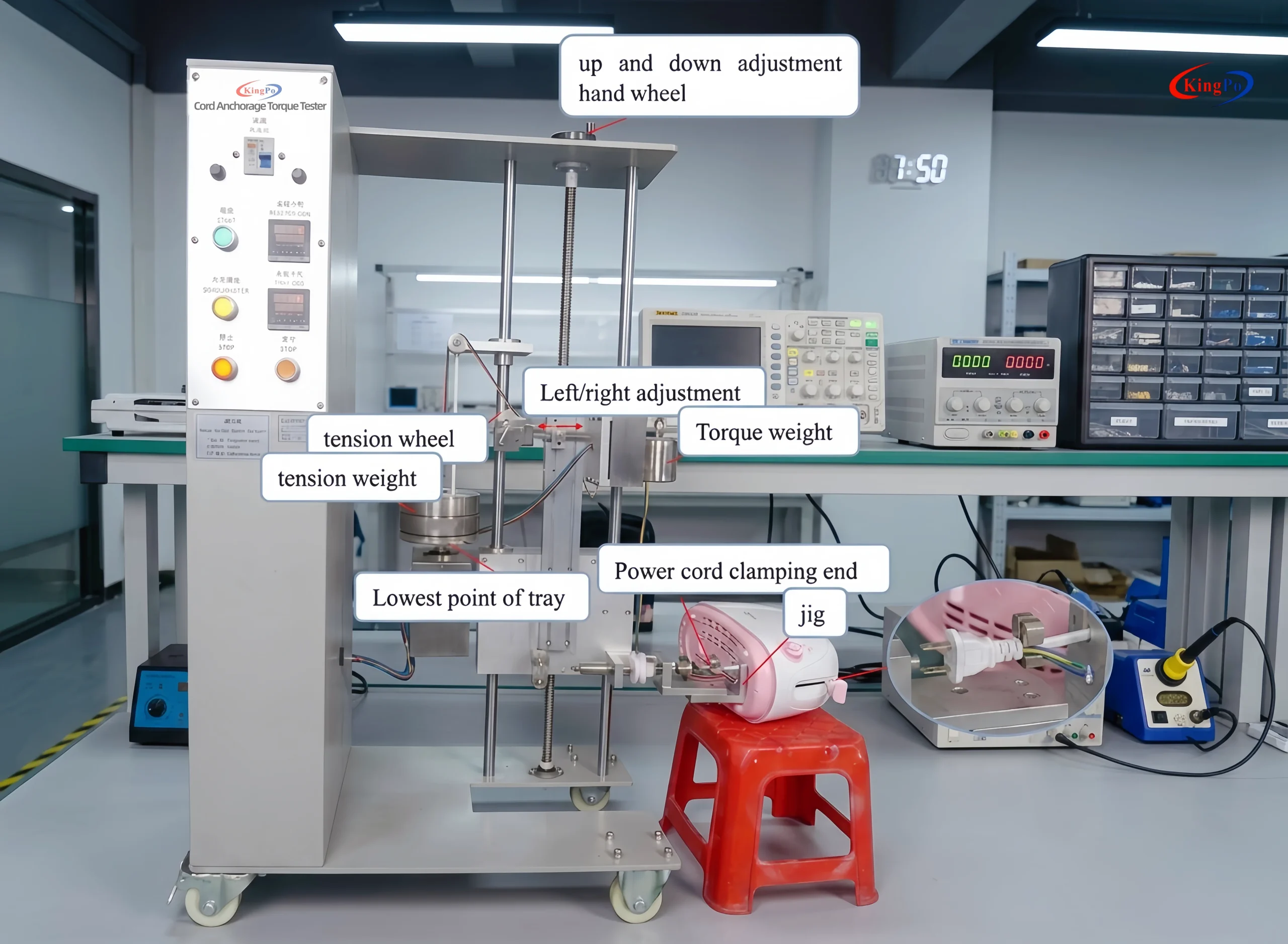 Cord Anchorage Torque Tester – KingPo Application in Appliance Testing Lab
- Mark the cord exactly 20 mm from the cord anchorage (outlet).
- Preset the required number of test cycles and torque duration according to the standard.
- Press [Reset] to clear the current test count.
Normal Test Procedure
- Remove the height pad and press [Start]. The tester will automatically perform the tension test for the preset number of cycles. Upon completion, it will release the torque weight and begin the torque test.
- When the preset torque duration is reached, manually lift the torsion weight to complete the test.
- Use a caliper to measure the distance from the mark to the cord outlet. Subtract the original 20 mm to determine the longitudinal displacement (elongation).
- For the next test, press [Reset] before starting a new sequence.
Parameter Setting (Counter / Timer)
To configure test parameters, press and hold the [SET] button for 5 seconds to enter setting mode. Use the ▲ / ▼ keys to navigate and [SET] to confirm each parameter. After all settings are complete, return to measurement mode.
Parameter Setting Table
| Parameter | Code / Display | Description | Default / Range |
|---|---|---|---|
| Panel Lock | LCK | Enable / disable panel lock | NO / YES |
| Timing Control Mode | MOD | Select timing control mode | PAU (Pause) |
| Power Outage Memory | — | Enable memory after power failure | YES |
| Output Mode | OUTF | Output mode selection | — |
| Timing Mode | MOD TIM | Timing mode (Up / Down) | U-D (Up-Down) |
| Delay Unit | UNT | Time unit selection | 999999 |
| Time Range | RAN | Maximum time range | 99.59.99 |
| Delay Time | TIM | Preset delay / test time | 000000 |
| Item | Procedure | Frequency |
|---|---|---|
| Fasteners & Locking Mechanisms | Inspect all fasteners and locking mechanisms before operation. Tighten any loose parts immediately. | Before each use |
| Power Supply | Turn off the power supply when the instrument is not in use. | After each use |
| Mechanical Components | Periodically check the condition of pulleys, clamps, weights, cords and bearings to ensure smooth operation and measurement accuracy. | Monthly or as needed |
Testing Principle
The tester applies a specified pull force to the power cord for 25 cycles (1 second each) in the most unfavourable direction, followed by a controlled torque applied as close as possible to the appliance for 1 minute. This standardized procedure verifies that the cord anchorage effectively relieves strain on the conductors and terminals, prevents the cord from being pushed into the appliance, and protects the insulation from abrasion.
Common Error Mitigation
To achieve maximum repeatability, always mark the cord exactly 20 mm from the anchorage before testing and apply tension smoothly without jerking. Select the correct tension and torque weight combination according to the appliance mass table in the standard. Keep the cord horizontal during torque application and use both the lightest and heaviest permissible cords when required by the standard. Regular inspection and cleaning of clamps, pulleys and weights, together with periodic verification of weight accuracy, are essential to prevent friction or wear that could compromise test results.
Primary Use Cases & Business Value
The Cord Anchorage Torque Tester is the dedicated instrument used by electrical appliance manufacturers and independent certification laboratories to verify that power cord anchorage provides adequate strain relief and insulation protection. It delivers reliable, repeatable test data that demonstrates compliance with safety standards, reduces the risk of field failures caused by loose or damaged cords, and supports efficient product certification and market approval.
Industrial Applications & Lab Scenarios
- Electrical Appliance Manufacturers — Tension and torque testing of power cord anchorage in household appliances, IT equipment and luminaires
- Third-Party Certification Laboratories — Compliance verification according to IEC 60335-1 Clause 25.15 and IEC 60950-1
- R&D Departments — Development and optimization of cord anchorage designs for improved strain relief and durability
- Quality Control Teams — Batch verification of cord anchorage strength during production
- Regulatory Compliance Teams — Generation of test reports for product certification and market approval
Strategic Procurement Advantages & Global Support
- High-Efficiency Testing: Adjustable tension and torque weights enable fast and versatile testing per IEC 60335-1 and IEC 60950-1.
- Certified Manufacturing: ISO 9001/14001/45001 and CE certified production with traceable calibration ensures laboratory-grade reliability.
- Reliability & Support: Each unit undergoes rigorous factory calibration in our Dongguan facility and is backed by a full one-year warranty, on-site installation guidance, and lifetime technical engineering support.