Product Overview
Unlike general-purpose ESD testing based primarily on the commonly used 150 pF / 330 Ω network, automotive ESD testing may require different combinations of storage capacitance and discharge resistance.
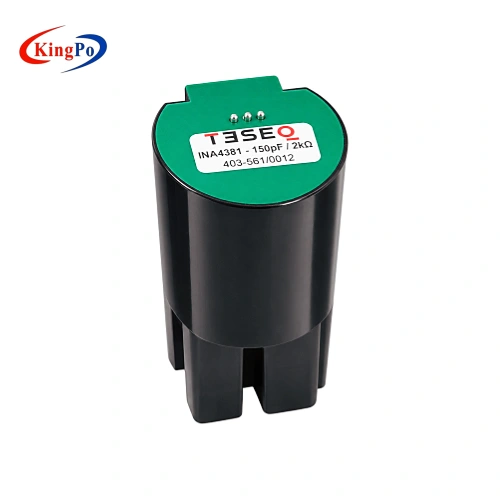
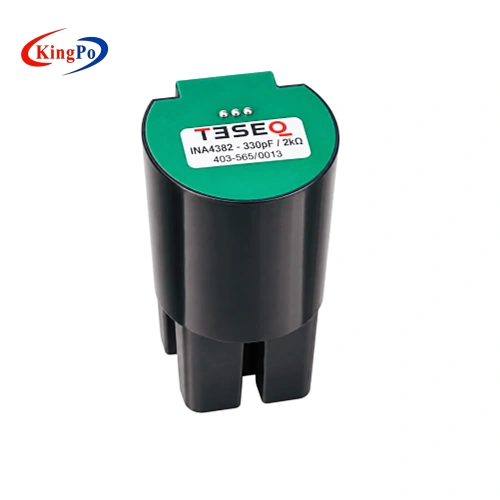
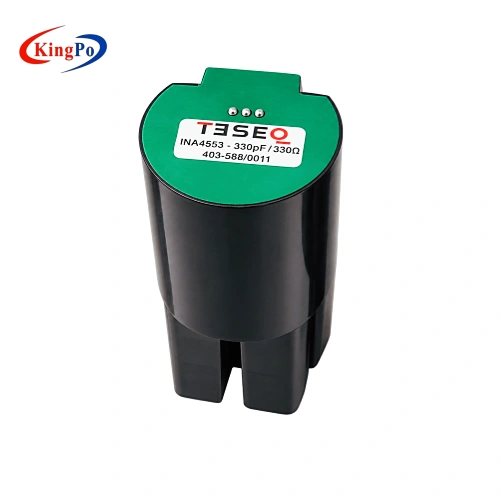
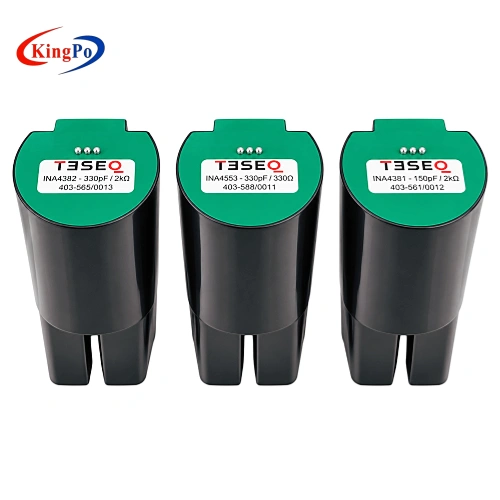
KINGPO automotive ESD discharge networks provide interchangeable RC configurations for testing vehicle electrical and electronic modules according to ISO 10605 and project-specific automotive EMC requirements.
ISO 10605 addresses electrostatic discharge events associated with vehicle assembly, servicing, handling and interaction with occupants. Different RC networks are used to reproduce the discharge conditions required for automotive electronic modules and vehicle-level testing.
These networks are particularly useful for laboratories that already operate a compatible ESD generator and need additional RC configurations to extend the system from general IEC ESD testing to automotive ESD applications.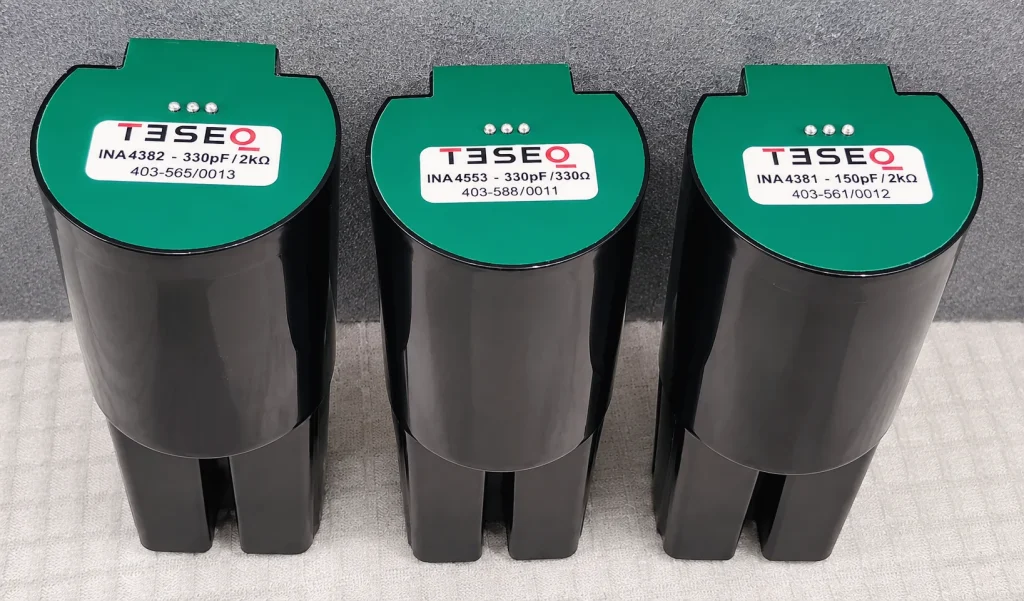
Available Configurations & Technical Specifications
| Parameter | 150 pF / 2000 Ω | 330 pF / 2000 Ω | 330 pF / 330 Ω |
|---|---|---|---|
| Storage Capacitance | 150 pF | 330 pF | 330 pF |
| Discharge Resistance | 2000 Ω | 2000 Ω | 330 Ω |
| Product Type | Replaceable RC discharge network | Replaceable RC discharge network | Replaceable RC discharge network |
| Primary Application | Automotive ESD testing | Automotive ESD testing | Automotive ESD testing |
| Primary Standard | ISO 10605 | ISO 10605 | ISO 10605 |
Selection Note: A 150 pF / 330 Ω network is also commonly used in automotive ESD testing and is the conventional RC configuration associated with IEC 61000-4-2. The required RC network should be selected according to the applicable test procedure and ESD generator compatibility.
Installation & Use Notes
- 1. Select the Correct RC Network:Confirm the required capacitance and discharge resistance according to the applicable ISO 10605 test procedure or customer test specification.
- 2. Power Down Before Replacement:Stop the test and disable the high-voltage output before removing or installing the discharge network. Follow the ESD generator manufacturer’s specified discharge and safety procedure.
- 3. Check Installation & Interface:Ensure the RC module is correctly seated and that the mechanical interface, high-voltage contacts and network connection are suitable for the ESD generator.
- 4. Confirm Before Testing:Verify that the installed RC configuration matches the test plan. Where required, check the generator output using an appropriate ESD current target and measurement system before starting the formal test.
Why Does Automotive ESD Testing Require Different RC Networks?
An ESD simulator does more than generate high voltage. The storage capacitance (C) and discharge resistance (R) influence how electrical energy is stored and how the resulting current pulse is delivered to the DUT.
Changing from a 150 pF / 330 Ω network to a 330 pF / 2000 Ω network therefore changes the actual electrical discharge condition rather than simply changing an accessory specification.
ISO 10605 vs. IEC 61000-4-2 Discharge Networks
Both standards address electrostatic discharge immunity, but their discharge network requirements are not identical.
IEC 61000-4-2
A typical IEC 61000-4-2 ESD simulator uses:
This configuration is also one of the RC conditions used in automotive ESD testing.
ISO 10605
Automotive testing can use multiple RC conditions:
- 150 pF / 330 Ω
- 330 pF / 330 Ω
- 150 pF / 2000 Ω
- 330 pF / 2000 Ω
Discharge Network Selection Guide
Select the RC network according to the applicable test procedure and test plan, not simply by DUT type or discharge voltage.
150 pF / 2000 Ω
Select this configuration when the automotive ESD procedure specifies a 150 pF storage capacitance with a 2 kΩ discharge resistance.
330 pF / 2000 Ω
Used where the test procedure requires a 330 pF storage capacitance together with a 2 kΩ discharge resistance.
330 pF / 330 Ω
Select this version where the specified test condition requires 330 pF capacitance and 330 Ω discharge resistance.
Typical Applications
Automotive EMC Laboratories
Extend an existing compatible ESD simulator to additional ISO 10605 RC conditions without requiring a separate generator for each network configuration.
Third-Party Test Laboratories
Support automotive customer projects requiring different discharge-network values and ESD test configurations.
Automotive Component Manufacturers
Support development, qualification and EMC validation of automotive electrical and electronic modules.
ECU & Electronic Module Development
Evaluate the ESD immunity of control modules, electronic interfaces, sensors and related vehicle electronics under specified automotive discharge conditions.
EV & Electrified Vehicle Electronics
Support ISO 10605 ESD testing of electrical and electronic modules used in electric and electrified road vehicles.