| A vibration test system should be selected by first calculating the required dynamic force, then checking whether the shaker can meet the test profile’s displacement, velocity, acceleration, frequency range, payload size, and axis requirements. Air-cooled systems are suitable for lower-force and general laboratory testing, while water-cooled systems are usually selected for high-force, heavy-payload, automotive, aerospace, and battery vibration testing. The final configuration should also match relevant standards such as IEC 60068, ISO 16750, MIL-STD-810, UN 38.3, ISTA, or customer-specific reliability test procedures. |
What Is a Vibration Test System?
Engineered and validated under the technical supervision of Jimmy Liu, 12-year Laboratory Automation veteran (ex-Technical Lead at Foxconn & Huawei Certification Testing Center
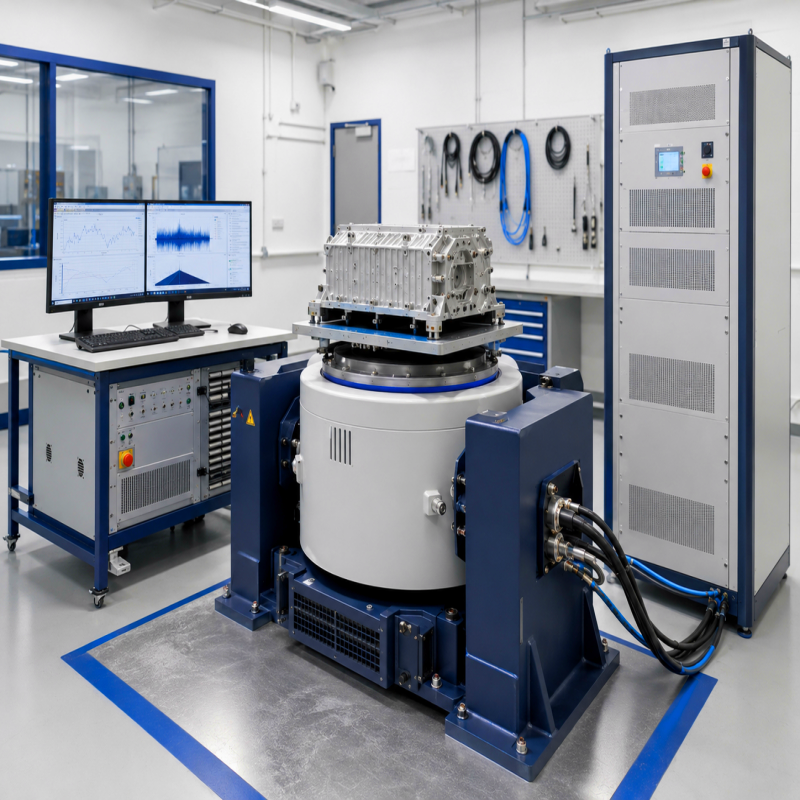
A vibration test system is a laboratory testing platform used to simulate mechanical vibration, transportation stress, resonance, fatigue, and shock conditions. A complete electrodynamic vibration test system normally includes a shaker body, power amplifier, vibration controller, cooling system, accelerometers, fixtures, and optional accessories such as a head expander, horizontal slip table, or environmental test chamber.
The system is widely used for reliability testing of batteries, automotive parts, aerospace components, consumer electronics, medical devices, packaging, and industrial equipment. Depending on the test requirement, the system may perform sine vibration, random vibration, resonance search and dwell, classical shock, sine-on-random, random-on-random, or combined temperature-humidity-vibration testing.
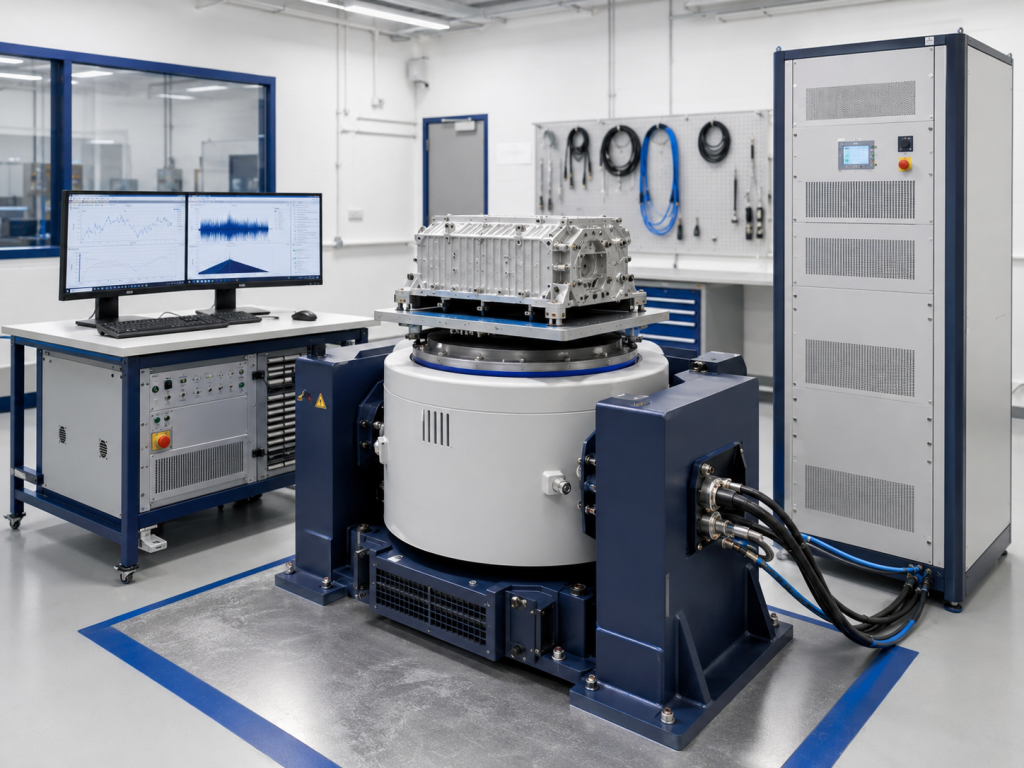
Figure 1. Complete vibration test system laboratory setup, including shaker, controller workstation, amplifier cabinet, cables and mounted test fixture.
Quick Selection Checklist
Before choosing a vibration test system, confirm the following parameters:
- Test standard: IEC 60068, ISO 16750, MIL-STD-810, UN 38.3, ISTA, ASTM, or customer-specific profile
- Payload mass: weight of the product under test
- Fixture mass: weight of the mounting fixture, head expander, or slip table interface
- Armature mass: moving mass of the shaker
- Required acceleration: peak or RMS acceleration in g
- Frequency range: minimum and maximum test frequency
- Displacement requirement: especially important for low-frequency vibration
- Velocity requirement: important for high-energy shock and low-frequency tests
- Test direction: vertical only, horizontal only, or three-axis testing
- Cooling method: air-cooled or water-cooled
- Control mode: sine, random, shock, resonance search, dwell, SoR, RoR, or kurtosis control
- Laboratory conditions: power supply, floor loading, noise, cooling water, and space
How to Calculate Required Shaker Force
The most important step is to calculate the total dynamic force required by the test profile.
| F = (Mp + Mf + Ma) × A × S |
Where:
- F = required dynamic force
- Mp = mass of the payload
- Mf = mass of the fixture, head expander, or slip table moving part
- Ma = mass of the shaker armature
- A = required acceleration
- S = safety factor, normally 1.25 or higher
Many purchasing mistakes happen because only the product weight is considered. In real vibration testing, the fixture, head expander, slip table, and armature mass also consume shaker force. A system that looks sufficient on paper may become undersized when the complete moving mass is included.
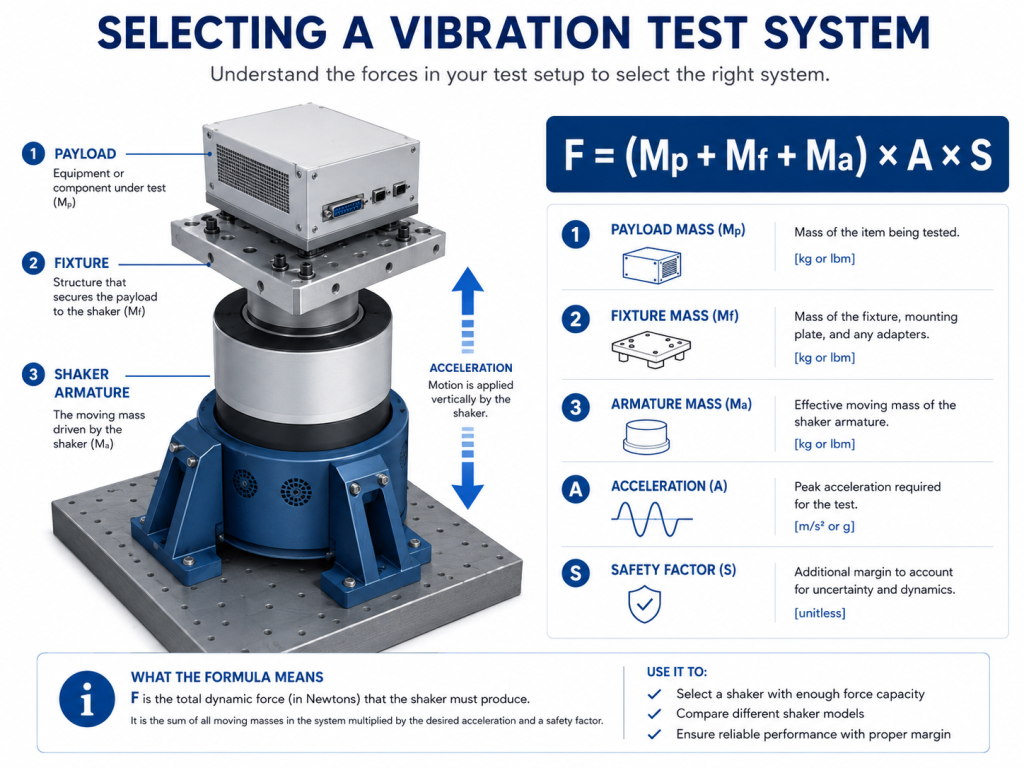
Figure 2. Force calculation diagram for vibration test system selection: payload mass, fixture mass, armature mass, acceleration and safety factor.
Air-Cooled vs Water-Cooled Vibration Test System
Air-cooled vibration systems are usually suitable for small to medium-force testing, general electronics, packaging, and laboratory reliability tests. They are easier to install and maintain, but blower noise and heat discharge should be considered.
Water-cooled vibration systems are usually selected for high-force, heavy-payload, battery, automotive, aerospace, and long-duration tests. They offer better thermal control and lower noise near the shaker, but require water circulation, heat exchange, and more installation planning.
| Selection Factor | Air-Cooled System | Water-Cooled System |
| Typical application | Electronics, small components, packaging | EV battery, automotive, aerospace, heavy payload |
| Force range | Low to medium | Medium to high |
| Installation | Simpler | Requires cooling water system |
| Noise | Higher due to blower | Lower near test area |
| Maintenance | Easier | Requires water quality and heat exchanger maintenance |
| Best for | Standard lab reliability testing | High-force and long-duration testing |
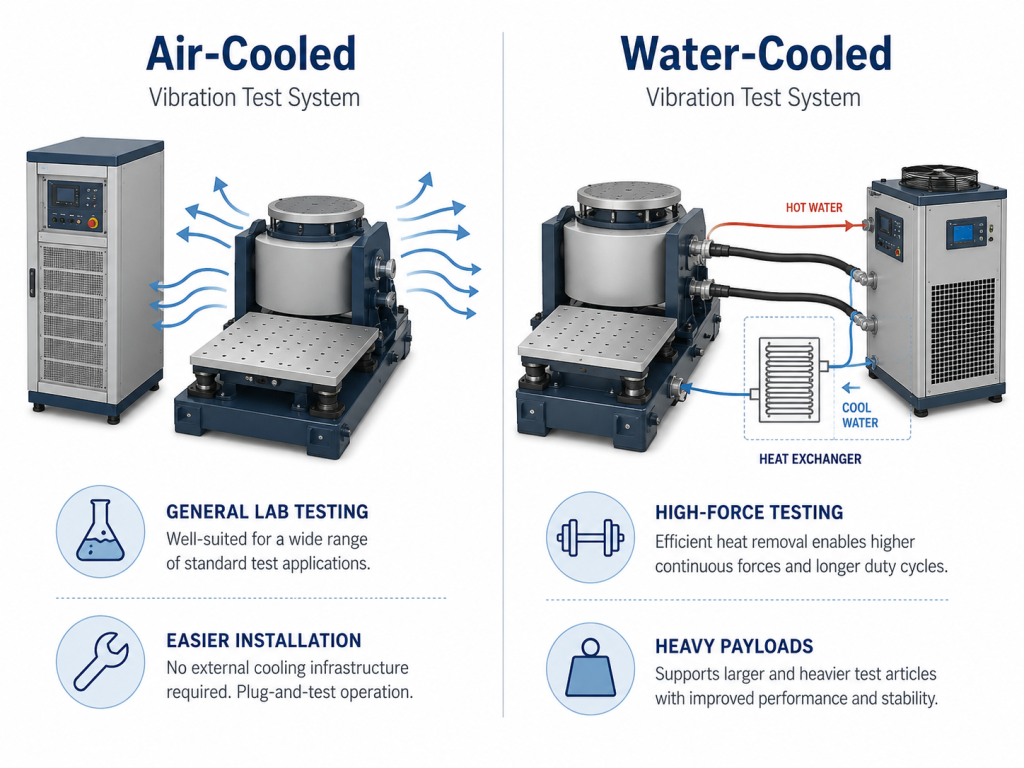
Figure 3. Air-cooled vs water-cooled vibration test system comparison for general laboratory testing, high-force testing and heavy payload applications.
When Do You Need a Horizontal Slip Table?
A horizontal slip table is required when the product must be tested in the X or Y axis without turning the product on its side. This is common for large products, battery packs, automotive modules, fluid-containing products, and equipment that must remain in a normal operating orientation during testing.
For three-axis testing, the common configuration is:
- Vertical vibration: shaker armature or head expander
- Horizontal X-axis vibration: slip table
- Horizontal Y-axis vibration: rotate the product or use another slip table setup
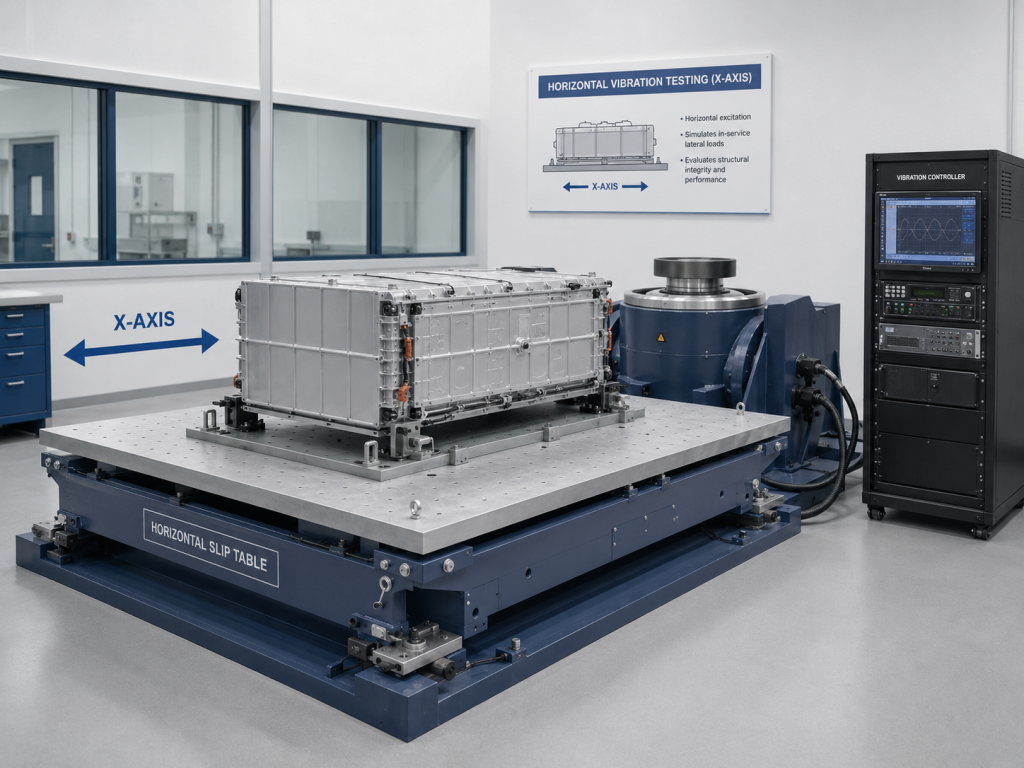
Figure 4. Horizontal slip table vibration test system for X-axis testing with a battery module, shaker and vibration controller.
Selection Matrix by Industry
| Industry | Common Standards | Key Selection Focus | Recommended Configuration |
| EV battery | UN 38.3, ISO 12405, IEC 62660, ECE R100 | Heavy payload, safety, long-duration vibration | High-force shaker + water cooling + horizontal slip table |
| Automotive parts | ISO 16750, GMW 3172, VW, Ford, Toyota standards | Multi-axis vibration, combined environment | Shaker + slip table + temperature chamber |
| Aerospace | MIL-STD-810, RTCA DO-160 | High acceleration, shock, random vibration | High-force shaker + advanced controller |
| Consumer electronics | IEC 60068, ISTA | High frequency, small payload, throughput | Air-cooled shaker + head expander |
| Packaging | ISTA, ASTM D999 | Transportation simulation | Medium-force shaker + fixture system |
| Medical devices | IEC 60068, transport validation procedures | Product safety and reliability | Precision controller + customized fixture |
Common Mistakes When Choosing a Vibration Test System
- Calculating only the product weight and ignoring fixture mass.
- Choosing force rating without checking displacement, velocity, and acceleration limits.
- Ignoring low-frequency displacement requirements.
- Selecting vertical vibration only when horizontal testing is required.
- Buying a shaker without confirming controller software functions.
- Underestimating laboratory power supply, floor loading, and cooling requirements.
- Using a generic fixture that causes resonance or cross-axis motion.
- Selecting an air-cooled system for a long-duration high-force test.
- Ignoring future expansion, such as environmental chamber integration.
- Comparing only price instead of total test capability and reliability.
Why Work with KINGPO?
KINGPO provides customized vibration test system configuration support for laboratories, manufacturers, and testing institutions. Based on the customer’s product weight, test standard, vibration profile, axis direction, fixture requirements, and laboratory conditions, KINGPO engineers can help select a suitable shaker, amplifier, controller, cooling system, slip table, fixture, and combined environmental test solution.
For projects involving batteries, automotive components, aerospace parts, electronics, packaging, or medical equipment, KINGPO can provide technical consultation, system configuration, installation support, and test solution recommendations.
Need An Offline Copy?
Download the full high-res PDF to get all pre-calculated engineering formulas ($F = (m_1 + m_2 + m_3) \cdot a$) and combined chamber wiring schematics.
- Complete 24 Pages
- MIL-STD-810 / UN 38.3 Matrix
- High-Res Diagrams Included