The “Invisible Killer” in Flammability Testing: Why Back Pressure Height Matters So Much
Table of Contents
——IEC 60695-11-3 / IEC 60950 / UL94 500W Flame Test Practice and Cable Flammability Standard Comparison
In the flammability safety certification of electric wires and cables, plastic enclosures, household appliances, and new energy vehicle battery packs, the 500W flame test is one of the most critical and technically challenging items. Standards such as IEC 60695-11-3 / IEC 60695-11-4 (equivalent to China’s GB5169.15), IEC 60950-1, UL94 5VA/5VB, and the cable-specific IEC 60332 series all impose strict requirements.
However, in actual testing, many companies and laboratories focus only on flame height, gas flow rate, and gas pressure, while frequently overlooking the critical parameter of Back Pressure Height. This article, based on KingPo’s real-world debugging cases, analyzes the importance of back pressure from the perspective of aerodynamics and turbulence modeling, and compares mainstream cable flammability testing standards.
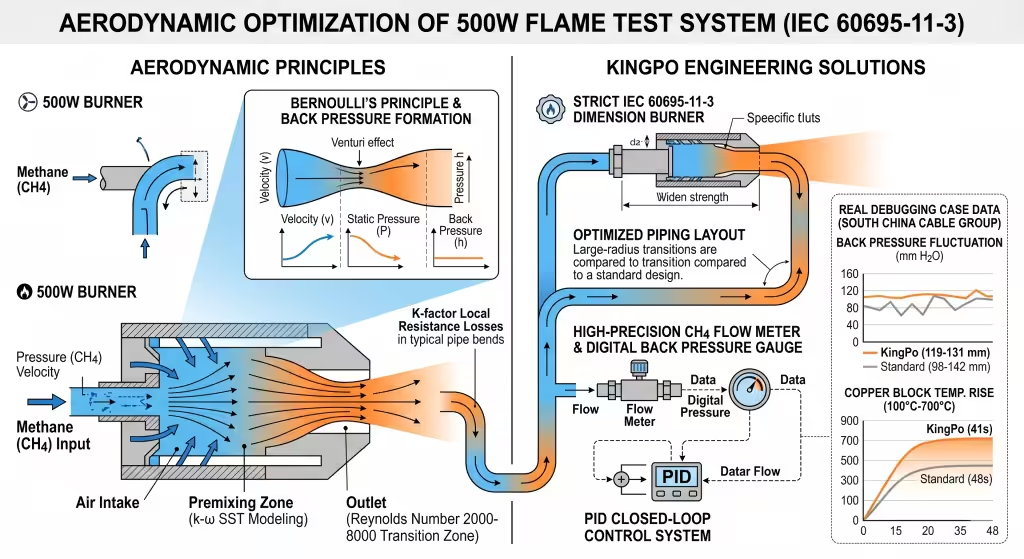
Aerodynamic optimization diagram of Kingpo 500W flame test system according to IEC 60695-11-3, showing Bernoulli principle, turbulence modeling, and engineering solutions Caption: Comprehensive aerodynamic optimization of the 500W flame test system (IEC 60695-11-3)
1. Multi-Parameter Requirements of the 500W Flame Test (IEC Standards Perspective)
According to IEC 60695-11-3 / IEC 60695-11-4, the 500W premixed flame must simultaneously meet the following key parameters:
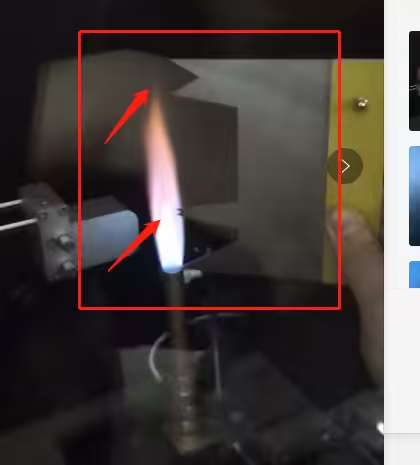
Flame Height: 125 ± 10 mm (blue inner flame)
Gas Flow Rate: 500 ± 10 mL/min (methane)
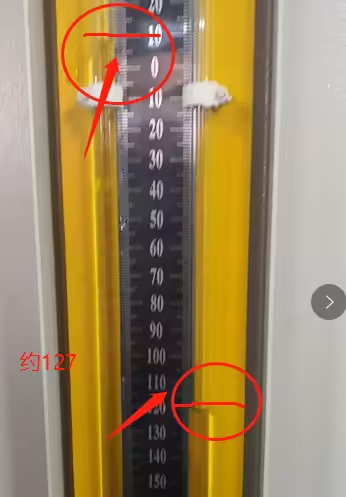
Back Pressure Height: 125 ± 10 mm water column (core stability indicator)
Copper Block Temperature Rise Time: Time from 100°C to 700°C within the specified range
Flame Temperature: Inner flame approximately 1000–1200°C
Only when multiple parameters are simultaneously stable and compliant is the test scientifically valid and repeatable.
2. Back Pressure — The “Invisible Killer” in Flammability Testing
During KingPo’s equipment debugging, we repeatedly observed:
“Before delivery, the equipment mainly considered UL1581 and other standards, while ignoring the complete requirements of IEC 60695-11-3. After rectification, flame height, gas pressure, and flow rate could all be achieved, but the back pressure height consistently showed large errors (fluctuation range 98–142 mm water column).”
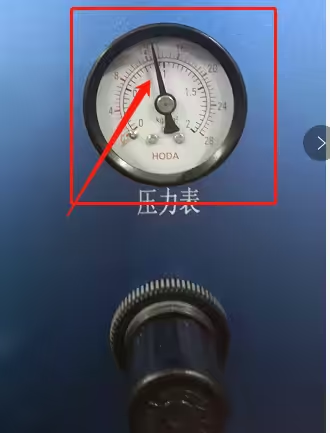
Real back pressure gauge reading showing approximately 127 mm water column during testing Caption: Precise back pressure measurement at ~127 mm water column — the critical yet often overlooked parameter.High-precision gas pressure gauge on Kingpo 500W flame test equipment
Real Customer Cases (detailed in Section 6) show that back pressure instability is one of the most common reasons for test failure or inconsistent results.
3. Aerodynamic Principles and Their Application in Flammability Testing
Back pressure formation is fundamentally governed by aerodynamic principles. Understanding these principles is essential for designing reliable 500W flame test equipment.
Core Aerodynamic Principles Applied in Combustion Testing
Bernoulli’s Principle When fluid velocity increases, static pressure decreases. At the burner nozzle, high-speed gas flow creates a low-pressure zone. Back pressure is essentially the dynamic pressure balance at the outlet. Any change in velocity directly affects back pressure.
Continuity Equation (Mass Conservation) Q = v × A (Flow rate = Velocity × Cross-sectional Area). Sudden changes in pipe diameter or burner geometry cause sharp velocity variations, directly influencing flame stability and back pressure.
Pressure Loss due to Friction and Fittings
Friction Loss (Darcy-Weisbach equation): Longer pipes or rough inner walls increase pressure drop.
Minor Losses (K-factor): Each 90° elbow has a K value ≈ 0.9, which can reduce back pressure by 8–15 mm water column.
Turbulence Effects The Reynolds number at the 500W burner outlet typically ranges from 2000 to 8000 (laminar-to-turbulent transition). Turbulence enhances air-fuel mixing and convective heat transfer but can also cause flame flickering if not properly controlled.
Real 500W flame during testing with clear inner blue cone and outer flame, highlighted with red arrowsBurner details
KingPo Turbulence Model Comparison (Real Debugging Data):
Model
Back Pressure Error
Copper Block Rise Time Deviation
Best Use Case
Standard k-ε
±18 mm
±12%
Preliminary analysis
RNG k-ε
±12 mm
±9%
Swirling flows & bends
k-ω SST
±6 mm
±8%
Flame jet simulation (Recommended)
LES
±3 mm
±4%
High-precision research
4. Comparison of Mainstream Cable Flammability Testing Standards
Standard
Flame Power
Back Pressure Requirement
Main Evaluation Criteria
Typical Applications
IEC 60695-11-3/4
500W
125 ± 10 mm water column
Flame height, back pressure, heat transfer
Appliance enclosures, plastics
IEC 60332-1-2
1kW
Strict back pressure control
Single cable vertical burning
Single cable testing
IEC 60332-3
20.5kW
Extremely strict
Bunched cable vertical burning
Building wiring, critical projects
UL94 5VA/5VB
500W
Indirect requirement
Material flammability + dripping
North American certification
5. KingPo’s Engineering Optimization Practice
KingPo’s solution includes:
Strictly customized dedicated burners according to IEC 60695-11-3 standard dimensions
High-precision CH4 flow meters + digital back pressure gauges
PID closed-loop control for automatic flow-pressure-back pressure stability
6. Real Customer Cases
Case 1: South China Cable Group (Oct 2025) Back pressure fluctuation ±28 mm → After KingPo optimization: stabilized at 119–131 mm. Test pass rate increased from 58% to 97%.
Case 2: East China Home Appliance Manufacturer (Jan 2026) Copper block temperature rise time fluctuated by 14s → Optimized to 41 ± 2s. Passed UL certification in one attempt.
Case 3: European Certification Laboratory (Mar 2026) Original back pressure pass rate 42% → KingPo equipment achieved 98%. Laboratory comment: “One of the most stable 500W systems we have seen.”
Conclusion
The 500W flame test is not simply “lighting a fire” — it is a complex system involving aerodynamics, turbulence control, and multi-parameter coordination. Back pressure, as the core indicator of flame stability, is often the “invisible killer” that determines test success or failure.
KingPo always adheres to international standards, using CFD simulation, k-ω SST turbulence modeling, and strictly IEC 60695-11-3 dimension-customized burners to deliver high-precision, high-stability, and repeatable flammability testing equipment to customers worldwide.
If you encounter back pressure instability, flame flickering, or multi-parameter issues in IEC 60695, UL94, IEC 60332, or GB5169.15 testing, feel free to contact the KingPo technical team. We are happy to share more debugging data and optimization solutions.
FAQ: IEC 60695-11-3 500W Flame Test – Common Questions Answered
Q1: What is IEC 60695-11-3? A: IEC 60695-11-3 is an international standard that specifies the apparatus and confirmatory test methods for producing a 500 W nominal pre-mixed test flame. It is widely used for evaluating the flammability of materials in household appliances, IT equipment, and plastics.
Q2: What is the required flame height in IEC 60695-11-3? A: The overall flame height should be 125 ± 10 mm, with a clear blue inner cone.
Q3: Why is back pressure so important in the 500W flame test? A: Back pressure (125 ± 10 mm water column) ensures consistent gas flow dynamics and flame energy. Unstable back pressure leads to inconsistent heat transfer and poor test repeatability.
Q4: What gas is used in IEC 60695-11-3 500W test? A: High-purity methane (CH₄ ≥ 98%) is the primary gas. Method C also allows propane as an alternative.
Q5: What is the gas flow rate requirement? A: 500 ± 10 mL/min at 23°C and 0.1 MPa.
Q6: What is the copper block temperature rise test used for? A: It verifies the flame’s heat output and thermal transfer capability. The time from 100°C to 700°C must fall within the standard’s specified range.
Q7: Can propane be used instead of methane? A: Yes, under Method C of IEC 60695-11-3, but the flame must still meet the same height, back pressure, and performance criteria.
Q8: How does Kingpo ensure back pressure stability? A: By using strictly IEC 60695-11-3 dimension-customized burners, optimized piping, high-precision flow meters, and PID closed-loop control systems.
Q9: What is the difference between IEC 60695-11-3 and UL94? A: IEC 60695-11-3 focuses on standardized flame production apparatus, while UL94 evaluates material burning behavior (e.g., 5VA/5VB ratings). Many labs use both.
Q10: Why do test results vary between laboratories? A: The most common cause is inconsistent back pressure, flame geometry, or gas purity. Using calibrated equipment like Kingpo KP-8850 greatly improves repeatability.
Q11: Is back pressure measurement mandatory? A: Yes. It is a critical confirmatory parameter in IEC 60695-11-3 to ensure the flame’s energy output is consistent.
Q12: How can I improve my 500W flame test results? A: Focus on back pressure stability, use standard-dimension burners, minimize pipe bends, and regularly calibrate all instruments. Professional equipment like Kingpo KP-8850 is designed specifically for this purpose.
Discussion: What is the most common back pressure or turbulence challenge you face in flammability testing? Feel free to share in the comments.
Bruce Zhang is the Founder and Senior Engineer of KingPo Technology Development Limited, with over 16 years of experience in environmental and safety testing technologies. As a member of SAC TC118, TC338, and TC526, he participates in national standard reviews and provides technical guidance on IEC and ISO compliance for global laboratories.
ENGINEERING INSIGHT Cable fire safety is an important compliance consideration for building wiring, fire alarm circuits, emergency power systems, transportation
Medical Electrical Safety · Technical Delivery Case KP-DFT201 Defibrillation Effect and Energy Tester Delivered to DEKRA Guangzhou Laboratory KingPo delivered
Defibrillator Test Equipment Selection Guide A request for a “defibrillator tester” can describe several completely different laboratory tasks. The core