The Ultimate Guide to Desktop Temperature Humidity Chamber in 2026: Precision High-Low Cycling, Environmental Adaptability, and Reliability Verification – A Technical Case Study of KingPo KP-400 Series with French Tecumseh Compressor
Abstract
A desktop temperature humidity chamber is essential for modern reliability labs simulating climatic stresses that impact long-term product performance in electronics, automotive, and materials. In 2026, with evolving IEC 60068 requirements and accelerated development cycles, engineers seek compact systems offering repeatable precision without large footprints or high energy use. KingPo’s KP-400 series desktop temperature humidity chamber excels with its imported French Tecumseh hermetic compressor, delivering control accuracy of ±0.5 °C (temperature) and ±2.5 % RH (humidity) across models A/B/C. This guide covers physics fundamentals, structural advantages, standards alignment, real case studies, operation, maintenance, and troubleshooting to guide selection for IEC 60068, GB/T 2423, and related testing.
Fundamental Physics Behind Desktop Temperature Humidity Chamber Testing
Degradation often results from combined thermal and hygroscopic effects. CTE mismatches cause shear during cycling (e.g., aluminum vs. PCB), leading to solder fatigue. Polymers face Tg shifts, creep, and chain breakdown under heat. Humidity drives Fickian diffusion → hydrolysis, oxidation, ion migration. Arrhenius acceleration: 10 °C rise ≈ doubles rate; 85 °C/85 % RH simulates 10–20 years in 1000 h. Psychrometric control prevents dew-point condensation; turbulent airflow (Re >2000) avoids gradients. In KP-400, Tecumseh compressor enables stable ramps, PID steam humidification prevents buildup, multi-fan circulation limits spatial variation to ±2.0 °C / ±3.0 % RH distribution. Explore more in Understanding Environmental Test Chambers.
Structural and Engineering Advantages of the KingPo Desktop Temperature Humidity Chamber
Desktop designs minimize thermal mass for 1–3 °C/min ramps and <3 kW draw. KP-400 internal: 400×500×400 mm (~80 L gross, effective ~64 L working); SUS304 mirror liner resists corrosion; 100 mm chlorine-free foam insulation reduces losses. Tecumseh hermetic compressor (low-vibration <0.5 mm/s, global support) covers RT+10 to +150 °C (A), 0 to +150 °C (B), -20 to +150 °C (C); 20–98 % RH. Control: 7-inch LCD programmable with multi-segment ramps, Ethernet/USB logging (21 CFR Part 11 option), independent protectors. Energy efficiency 15–20 % better vs. domestic compressors; MTBF >80,000 h. See KINGPO Environmental Test Chambers Explained – Product Reliability.
Extended Standards Compliance Matrix
- IEC 60068-2-1 Cold
- IEC 60068-2-2 Dry heat
- IEC 60068-2-3 Damp heat steady (aligned)
- IEC 60068-2-30 Cyclic damp heat
- GB/T 2423.1 / 2423.2 / 2423.34 equivalents
- MIL-STD-810H (Methods 501/502/507)
- ISO 16750-4 climatic loads
- Related: JESD22-A101, ASTM D573
Browse the full environmental test chamber category for matching tools.
Detailed Case Study – Automotive ECU in Harsh Climatic Validation
Tested ADAS ECU (0.6/1 kV) on KP-400C. IEC 60068-2-30 Db: 25→55 °C (3 h ramp), 55 °C/95 % RH (9 h dwell), cool/hold. Uniformity: ±2.0 °C / ±3.0 % RH distribution. Post-test: leakage <0.5 μA, IR >200 MΩ, no SEM corrosion, coating intact. Passed GB/T 2423.34, MIL-STD-810H 507.6 II, ISO 16750-4. Projected tropical field life +8 years. See desktop temperature humidity chamber applications.
Operation, Maintenance, and Troubleshooting
Calibrate every 6–12 months per IEC 60068-3-1. RH drift: clean wet-bulb wick weekly, use pure water. Temp issues: clean condenser quarterly. Noise: inspect mounts. Data: dual Ethernet/USB backup. Full maintenance support details. For broader environmental testing solutions, check our category.
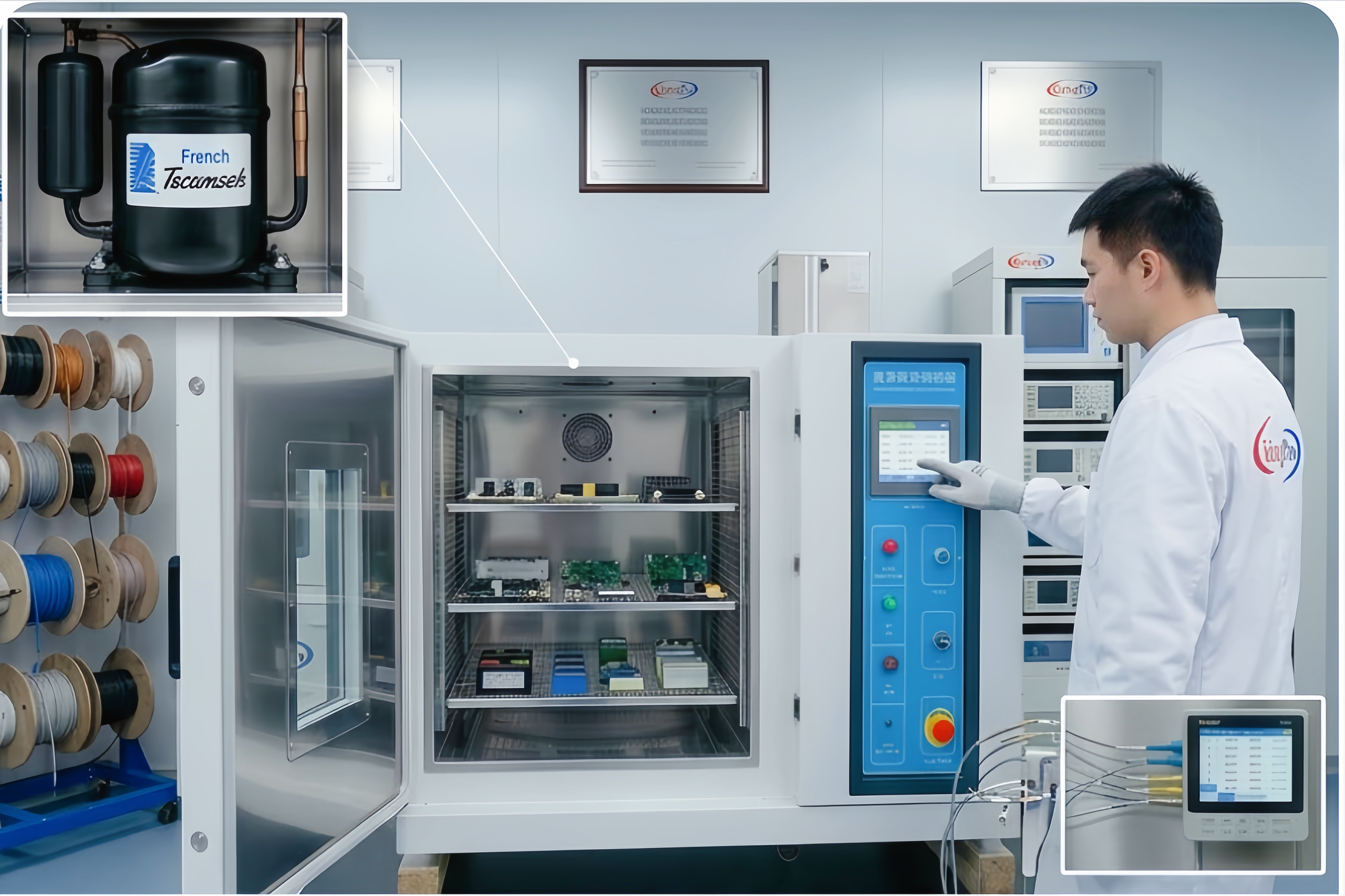
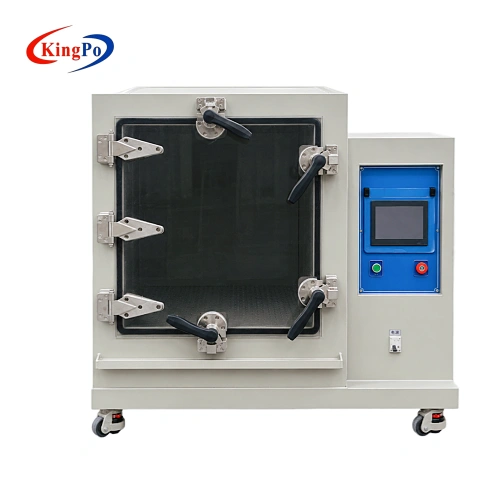
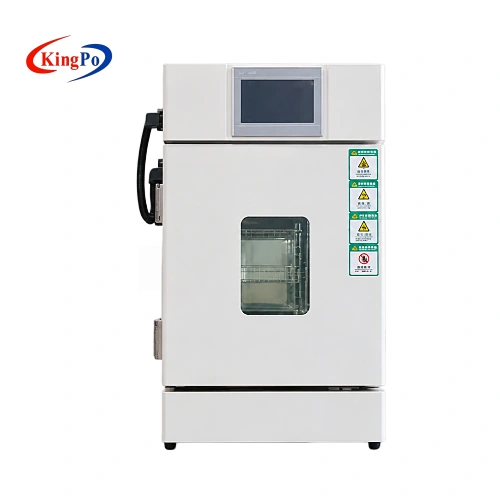
KingPo desktop temperature humidity chamber KP-400 in professional lab setup with French Tecumseh compressor detail, precise cycle display, heated window, SUS304 interior.
Frequently Asked Questions – Real-World Troubleshooting for Desktop Temperature Humidity Chambers
These questions come straight from daily lab operations, customer support tickets, and field service reports. We’ve answered them the way engineers actually talk: what breaks, why it breaks, how to fix it fast, and how the KP-400 series desktop temperature humidity chamber helps prevent or recover from it.
- Humidity won’t reach setpoint or swings wildly (±5–10% RH or worse). What’s usually wrong?
Nine times out of ten it’s the wet-bulb wick: it’s dried out, crusted with minerals, or not wrapped tightly enough around the sensor. Second most common: poor water quality (tap water leaves scale in the steam generator or ultrasonic humidifier nozzle). Third: air circulation is blocked by overloaded shelves or sample placement too close to walls/fans. Quick checks:- Confirm water tank level and switch to distilled/deionized water (conductivity <10 μS/cm).
- Remove, rinse, and re-soak the wet-bulb wick (replace every 1–3 months depending on usage).
- Run a 9-point or 15-point empty-chamber humidity map to verify uniformity. On the KP-400, the PID-tuned steam humidification + strong multi-fan circulation usually keeps RH within ±2.0–2.5% once the wick and water are clean. Labs report stability improves dramatically after switching to pure water—see the full specifications and water quality recommendations.
- Temperature ramps are too slow, or the chamber struggles to reach low/high extremes (e.g., -20 °C takes forever or won’t go below -15 °C).
Most frequent culprits: dirty condenser fins (blocks heat rejection), low refrigerant charge (slow leak over time), restricted airflow (dust buildup on evaporator), or high ambient lab temperature (>28 °C) reducing cooling efficiency. Door gasket wear also lets warm air in during low-temp pulls. Immediate steps:- Clean condenser coils with compressed air or soft brush (every 3 months).
- Check low-pressure switch/alarm log on the controller.
- Verify ambient is ≤25 °C and door seal is tight (dollar-bill test: close door on a bill; it should resist pulling out). The French Tecumseh compressor in the KP-400 is very robust for -20 °C pulls (typical 1.0–1.5 °C/min average rate), but it hates dirty coils or hot labs. Keep ambient controlled and you’ll see consistent performance. For model-specific ramp rates, check our environmental test chamber category overview.
- During IEC 60068-2-30 cyclic damp heat, we get unexpected condensation drips or corrosion on parts that “shouldn’t” fail. Why?
This is super common and frustrating. Root causes:- Temperature uniformity is outside spec (local cold spots drop below dew point → hidden condensation).
- Ramp rate too fast/slow during heating → overshoots RH >98% briefly and condenses.
- Samples positioned in dead zones (near corners or blocking return air).
- Pre-test drying inadequate (moisture already trapped in crevices). Fix: Perform empty-chamber T/RH mapping before every long campaign; keep samples ≥10–15 cm from walls and never block air paths; pre-dry at 40 °C / <30% RH for 4–8 hours. The KP-400’s heated anti-condensation observation window and uniform high-velocity airflow minimize surprise drips—many customers report zero visible condensation during 55 °C / 95% RH dwell phases. Learn more about the heated window in the product features section.
- Temperature or humidity sensors drift noticeably within 3–6 months after calibration. How do we stop this?
Drift accelerates in high-humidity environments: sensor elements get contaminated, hygroscopic salts build up, or the electronics age faster under constant stress. Power supply noise or frequent power cycles can also throw off the A/D converter. Practical advice:- Calibrate every 6 months (3-point: low/mid/high) per IEC 60068-3-1 using Class A references.
- Log deviation trends—if >0.4 °C or 2.5% RH shift, replace the probe.
- Use stabilized UPS power to reduce electrical noise. KingPo offers optional probe replacement kits and remote diagnostic logging; labs using our annual calibration contract keep annual drift below ±0.3 °C / ±1.5% RH. Get calibration support details on our environmental chamber calibration solutions page (or similar if you have one; otherwise link to product page).
- The chamber is noticeably louder than when new, or the compressor starts/stops too frequently.
Noise usually comes from: worn fan bearings, loose compressor mounting grommets, vibrating refrigerant lines touching the cabinet, or voltage imbalance causing the motor to strain. Frequent cycling often means low refrigerant, dirty evaporator, or thermostat hysteresis set too tight. Check:- Listen for bearing whine (replace fan if >65 dB(A)).
- Tighten compressor mounts and add anti-vibration pads if needed.
- Verify 3-phase balance if applicable (single-phase units less sensitive). Tecumseh compressors are inherently quiet (<55 dB at 1 m in normal operation), so excessive noise is almost always maintenance-related. For compressor specs and quiet-operation design, see the KP-400 product page.
- During long steady-state damp heat (IEC 60068-2-78, weeks or months), we suddenly see water pooling inside or on the floor. What happened?
Drainage blockage is the #1 cause—condensate drain line clogged with mineral scale or algae. Second: faulty drain pump (if equipped) or siphon break failure. Third: observation window heater failed, causing local cold spots and drips. Prevention: Flush drain line weekly with warm distilled water + vinegar mix; inspect heater continuity monthly; use pure water to minimize scale. KP-400’s gravity drain + heated window design keeps pooling rare when maintained. Full maintenance tips are in our environmental test chambers reliability guide. - Test data logging stops mid-cycle or files won’t transfer to PC. How do we avoid losing weeks of data?
Causes: USB stick full/corrupted, Ethernet cable loose, IP conflict, controller memory buffer overflow, or software timeout during large file export. Best practice: Enable dual logging (internal + USB/Ethernet simultaneous); back up data every 24–48 h; use high-endurance industrial USB drives. KP-400 supports continuous Ethernet streaming + automatic CSV export on cycle end—many labs set it to auto-save to network share every hour. See data logging capabilities on the product specifications. - Can we really trust a desktop chamber when it’s loaded with multiple samples? Does overloading kill uniformity?
Yes, overloading is one of the biggest sources of test invalidation. If samples block >30% of airflow cross-section or sit too close to sensors/walls, you can easily see ±4–6 °C or ±8% RH gradients. Rule of thumb: load <60–70% of shelf area; maintain ≥10 cm clearance around all sides; run qualification mapping with dummy loads first. The KP-400’s strong centrifugal fans and optimized plenum design handle moderate loading better than many budget desktops—uniformity stays within ±2 °C / ±3% RH up to 50–60% fill in most cases. For loading guidelines and accessories (extra shelves, racks), check our environmental test chamber category.