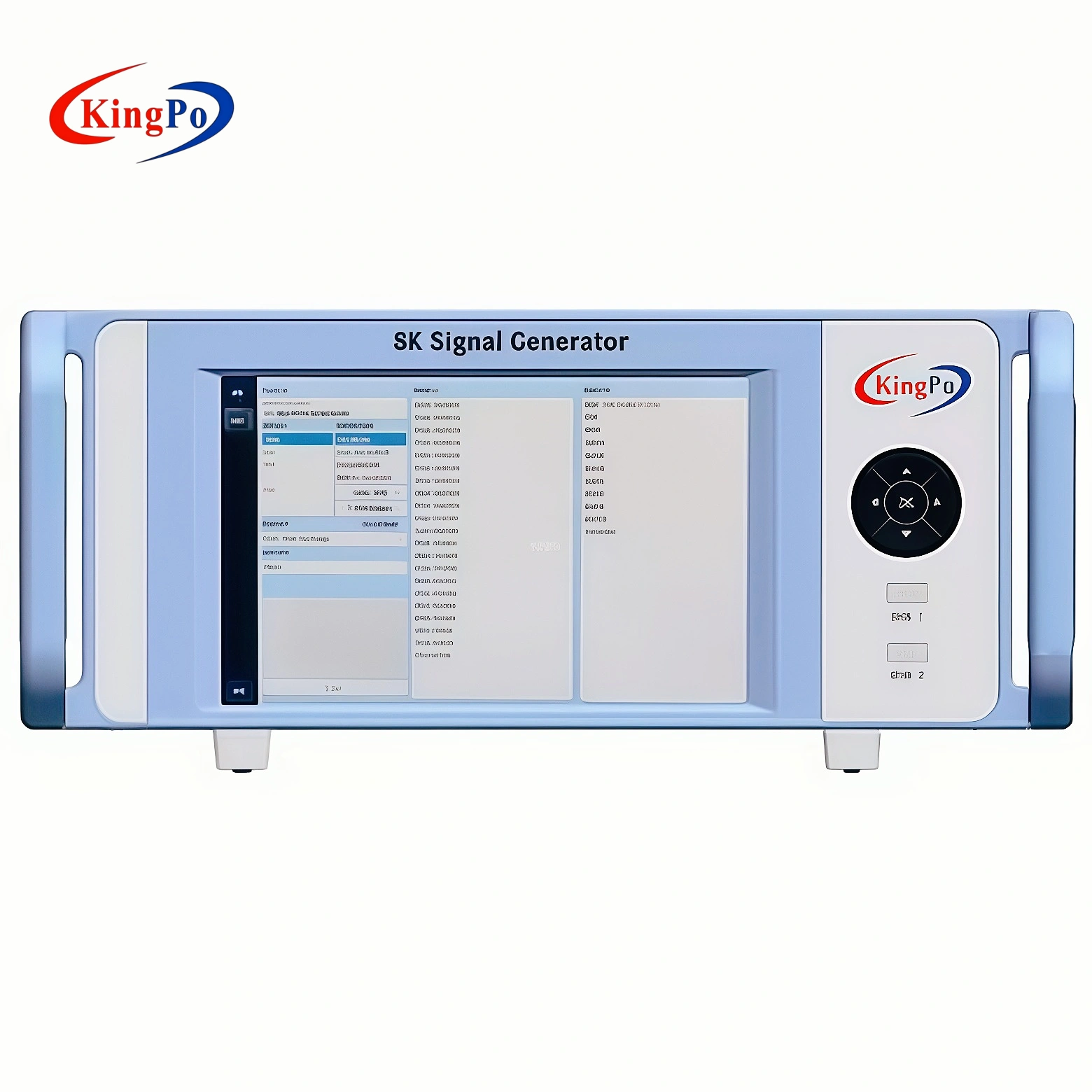
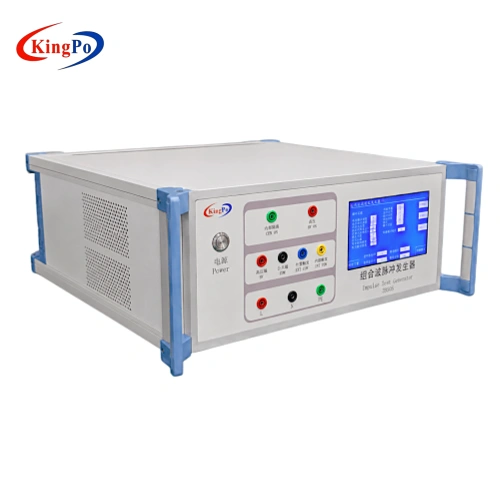
KP-3950S IEC 61000-4-5 surge generator in EMC laboratory
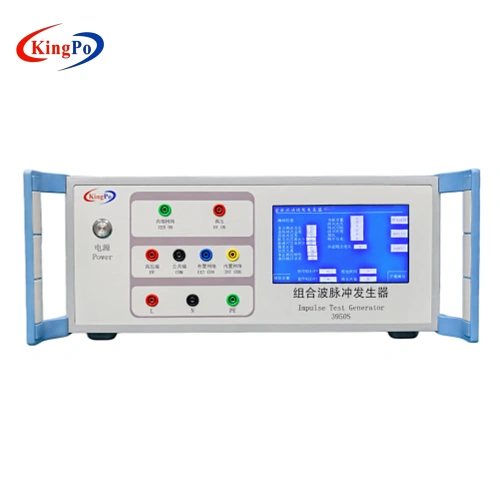
KINGPO KP-3950S IEC 61000-4-5 Combination Wave Surge Generator
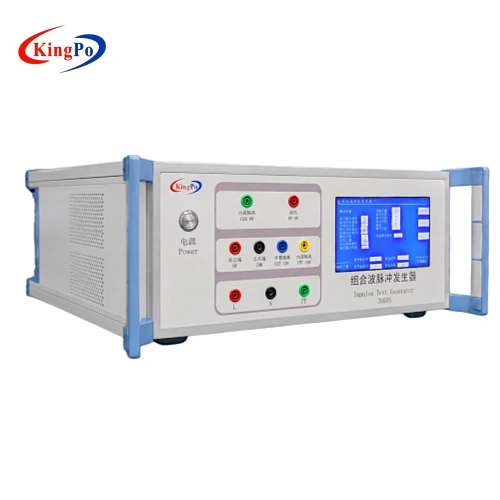
KINGPO KP-3950S combination wave generator left-angle laboratory view
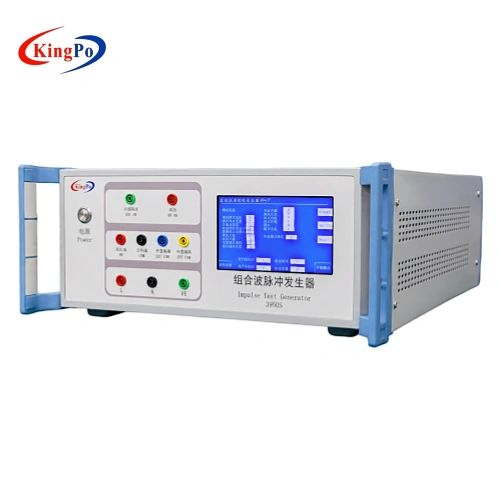
KP-3950S IEC 61000-4-5 surge generator right-angle laboratory view
KP-3950S IEC 61000-4-5 surge generator in EMC laboratory
KINGPO KP-3950S IEC 61000-4-5 Combination Wave Surge Generator
KINGPO KP-3950S combination wave generator left-angle laboratory view
KP-3950S IEC 61000-4-5 surge generator right-angle laboratory view

IEC 61000-4-5 Surge Generator for 1.2/50 μs & 8/20 μs Combination Wave Testing

The KINGPO KP-3950S Combination Wave Surge Generator is designed for surge immunity testing in accordance with IEC 61000-4-5 and GB/T 17626.5. It generates a 1.2/50 μs open-circuit voltage waveform and an 8/20 μs short-circuit current waveform for evaluating electrical and electronic equipment against surge transients caused by switching and lightning-related effects.

Provides an adjustable output of 0.5–6 kV, positive and negative polarity, phase-synchronized triggering, programmable surge sequences, and a built-in single-phase AC/DC coupling network. Source impedance and coupling configuration are selected according to the EUT port and applicable test requirement.

  • Model: KP-3950S
  • Test Object: Electrical and electronic equipment subject to surge immunity requirements
  • Main Test Item: Combination-wave surge immunity
  • Applicable Standard: IEC 61000-4-5:2014+A1:2017 / GB/T 17626.5-2019
  • Combination Wave: 1.2/50 μs open-circuit voltage / 8/20 μs short-circuit current
  • Surge Voltage Range: 0.5–6 kV
  • Built-in Coupling Network: Single-phase AC/DC, up to 300 V / 10 A
  • Typical Users: EMC laboratories, certification laboratories, electrical and electronic manufacturers, R&D and compliance teams

IEC 61000-4-5 Surge Generator | Combination Wave Generator

Product Overview

Surge immunity testing evaluates how electrical and electronic equipment responds when a defined high-energy transient is coupled into an applicable power or interconnection port.

The KP-3950S generates the combination wave required for this type of laboratory test. The generator is characterized by a
1.2/50 μs voltage waveform under open-circuit conditions and an 8/20 μs current waveform under short-circuit conditions.

For power-port testing, the surge is coupled into the equipment under test through an appropriate coupling/decoupling network. The built-in single-phase network supports EUT supplies within its specified 300 V / 10 A capacity.

The required test level, coupling path, number of surges and EUT performance criteria are determined by the applicable product standard or laboratory test plan. The KP-3950S provides the surge source and coupling functions; it does not by itself determine whether an EUT passes or fails.
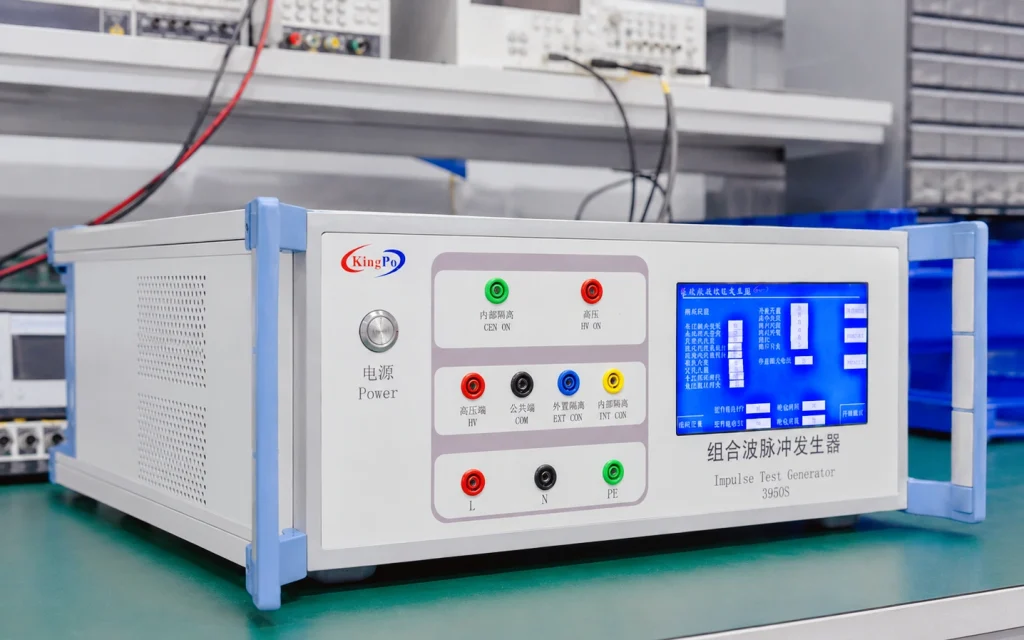
KINGPO KP-3950S IEC 61000-4-5 Combination Wave Surge Generator in laboratory, left-front view

Technical Specifications

Item Specification
Model KP-3950S
Open-Circuit Voltage Waveform 1.2/50 μs
Voltage Front Time 1.2 μs ±30%
Voltage Time to Half Value 50 μs ±20%
Surge Voltage Range 0.5–6 kV
Voltage Setting Resolution 0.01 kV
Voltage Indication Accuracy ±10%
Short-Circuit Current Waveform 8/20 μs
Maximum Short-Circuit Current 500 A ±10% (12 Ω configuration)
Output Impedance 12 Ω ±10%
2 Ω Configuration Available according to test requirement; corresponding current capability to be confirmed
Output Polarity Positive / negative
Synchronous Trigger Phase 0–360°
Phase Setting Resolution
Surge Count 1–9,999
Surge Interval 20–60 s
Built-in AC Network Capacity Single-phase 300 V, 10 A, 50/60 Hz
Built-in DC Network Capacity 300 V, 10 A
Coupling Paths L-N, L-E, N-E, L+N-E
Power Supply AC 220 V ±10%, 50/60 Hz
Dimensions 580 × 460 × 200 mm
Weight Approx. 20 kg
Configuration Note:
The 500 A rating applies to the stated 12 Ω configuration. For a 2 Ω test configuration, please confirm the required surge-current capability before quotation.

What This Equipment Tests

The KP-3950S is intended to evaluate the surge immunity of an equipment under test (EUT) when a controlled transient is applied to an applicable electrical port.

AC- and DC-powered electrical equipment
Power supplies and power conversion equipment
Industrial control and automation equipment
Measurement and laboratory instruments
Household and commercial electrical products
Electronic equipment incorporating transient-protection circuits
Products whose applicable EMC standard references IEC 61000-4-5

During the test, the EUT is normally operated under the conditions defined by the applicable procedure while the specified surges are applied. Its functional response is evaluated according to the performance criteria established by the relevant product standard or approved test plan.

This test evaluates equipment immunity to controlled surge disturbances. It should not be confused with direct lightning-current testing or component-specific qualification of individual surge protective devices.

How the Combination Wave Test Works

A combination wave generator is characterized under two reference conditions: open-circuit voltage and short-circuit current.

Open-Circuit Voltage
1.2/50 μs

With the generator output open, the surge is characterized by its voltage front time and time to half value.

Short-Circuit Current
8/20 μs

With the generator output shorted, the surge is characterized by the corresponding current waveform.

These are not two separate test outputs. They describe the voltage and current characteristics of the same combination-wave generator under different load conditions.

When an actual EUT is connected, its impedance becomes part of the surge circuit. The resulting voltage and current therefore depend on the EUT impedance, generator source impedance and selected coupling arrangement.

Source Impedance and Configuration

Selecting a surge generator only by its maximum voltage can result in the wrong test configuration. For IEC 61000-4-5 combination-wave testing, the required source impedance depends on the applicable coupling arrangement and EUT port.

The KP-3950S is specified with a 12 Ω ±10% configuration, while a 2 Ω configuration can be provided for applications that require it. Because source impedance affects the available short-circuit surge current, the required impedance and current capability should be confirmed together.

Before configuration, confirm:

• EUT port type
• Line-to-line or line-to-ground test
• Required surge voltage
• Required source impedance
• EUT supply voltage and current
• Single-phase or three-phase supply

Built-in Coupling/Decoupling Network

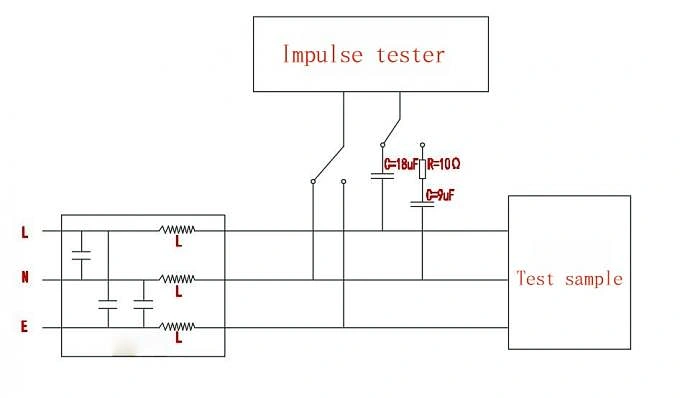
IEC 61000-4-5 surge test setup showing impulse generator, coupling network and EUT connection
IEC 61000-4-5 Surge Test Coupling Network and EUT Setup

For power-port surge testing, the generator is used with a coupling/decoupling network (CDN). The CDN couples the surge into the required EUT conductors while helping prevent the disturbance from propagating back toward the auxiliary power source.

The KP-3950S includes a built-in network for single-phase power-port applications within the following ratings:

AC EUT Supply

Single-phase, up to 300 V / 10 A, 50/60 Hz
DC EUT Supply

Up to 300 V / 10 A

Available Coupling Paths

L-N
L-E
N-E
L+N-E

When an External CDN Is Required

The built-in network should not automatically be assumed suitable for every EUT. An external or customized CDN should be considered for:

• Three-phase equipment
• EUT current above 10 A
• EUT supply voltage above 300 V
• Special source-impedance requirements
• Communication or signal ports
• Other coupling arrangements required by the applicable product standard

For these applications, the surge generator and CDN should be selected as a complete test system based on the EUT supply rating, port type and applicable test method.

Typical Laboratory Test Setup

A typical power-port surge immunity test setup includes:

• KP-3950S Combination Wave Surge Generator
• Equipment under test (EUT)
• Suitable coupling/decoupling network
• EUT power supply
• Required monitoring or measurement equipment
• Protective grounding and laboratory safety provisions

Before the test, the operator selects the required coupling path, surge voltage, polarity, phase angle, number of surges and pulse interval. The programmed surge sequence is then applied while the EUT operates under the conditions specified by the applicable test procedure.

The EUT response is monitored during and after surge application. The exact sequence and acceptance criteria should follow the applicable standard edition and product-specific test requirement.

Typical Applications

EMC and Certification Testing

EMC, third-party and certification laboratories can use the KP-3950S for surge immunity projects where IEC 61000-4-5 or an equivalent national standard is referenced. The generator and CDN configuration should be matched to the EUT port and required test level.

Product Development and Pre-Compliance

Manufacturers can evaluate EUT behavior under controlled surge conditions during product development and identify immunity weaknesses before formal external compliance testing.

Surge Protection Design Verification

R&D engineers can evaluate equipment containing MOVs, TVS devices, filters and other transient-protection circuits under defined combination-wave conditions and compare different protection designs.

QA and Engineering Verification

The system can support design-change verification, comparative testing and internal quality-control programs requiring repeatable surge conditions.

Engineering evaluation of surge-protection circuits does not replace the applicable component standard where individual surge protective devices require separate qualification.
Compliance & Regulatory Assurance

The KP-3950S is designed for surge immunity testing according to IEC 61000-4-5 and GB/T 17626.5 with the appropriate source impedance and coupling configuration.

For laboratory use, calibration and verification documentation can be specified according to project requirements. The equipment should be described as designed for testing according to the standard, not as independently IEC certified.

PDF
KP-3950S Combination Wave Surge Generator Datasheet
IEC 61000-4-5 technical specifications and configuration information


Download Datasheet

Technical Inquiry & Expert Support

To confirm the appropriate KP-3950S Combination Wave Surge Generator configuration, please provide:

• Applicable standard and edition
• Required surge voltage / source impedance
• EUT supply voltage and current
• EUT port and coupling requirement
• Calibration or documentation requirement

For EUTs above the built-in 300 V / 10 A network capacity, please also provide the required power configuration so that the appropriate external CDN can be reviewed.

IEC 61010-1 Applications

  • The KP-3950S is designed for surge immunity testing according to IEC 61000-4-5 and GB/T 17626.5 with the appropriate source impedance and coupling configuration.
  • For laboratory use, calibration and verification documentation can be specified according to project requirements. The equipment should be described as designed for testing according to the standard, rather than as independently IEC certified.

IEC 61000-4-5 Combination Wave Surge Generator

IEC 61000-4-5 Combination Wave Surge Generator FAQs

What is the KP-3950S Combination Wave Surge Generator used for?
The KP-3950S is used for surge immunity testing of electrical and electronic equipment according to IEC 61000-4-5 and GB/T 17626.5. It generates a 1.2/50 μs open-circuit voltage waveform and an 8/20 μs short-circuit current waveform for controlled surge testing. IEC defines this test as an evaluation of EUT response to surge voltages associated with switching and lightning effects.
What is the surge voltage range of the KP-3950S?
The adjustable surge voltage range is 0.5 kV to 6 kV, with a setting resolution of 0.01 kV. The required test voltage should be selected according to the applicable product standard and EUT test level rather than simply using the generator’s maximum output.
Does the KP-3950S support both 2 Ω and 12 Ω surge configurations?
The published KP-3950S specification lists a 12 Ω ±10% configuration and a configurable 2 Ω version. IEC 61000-4-5 uses a 2 Ω basic combination-wave generator, while additional resistance may be introduced for particular coupling arrangements. The required impedance should therefore be confirmed before quotation.
What type of EUT can be connected to the built-in CDN?
The built-in coupling network supports single-phase AC equipment up to 300 V / 10 A and DC equipment up to 300 V / 10 A. Higher-current, higher-voltage or three-phase EUTs require an appropriately rated external or customized coupling/decoupling network.
Can the KP-3950S be used for three-phase surge testing?
Yes, but not with the standard built-in single-phase CDN alone. A suitable three-phase coupling/decoupling network must be selected according to the EUT voltage, current, required coupling paths and applicable IEC 61000-4-5 test configuration.
Can this surge generator perform a 10/700 μs test?
The published KP-3950S configuration is for 1.2/50 μs voltage and 8/20 μs current combination-wave testing. IEC 61000-4-5 separately specifies a 10/700 μs generator for certain outdoor telecommunication-line applications, so that test requires the corresponding generator configuration.
Can the KP-3950S be used for IEC 61010-1 impulse testing?
It may be suitable for specific IEC 61010-1 impulse applications, but the exact clause, required source impedance and test conditions must be confirmed first. A 1.2/50 μs waveform alone does not mean that the same configuration is suitable for every impulse-voltage test.
What information should be provided before ordering the KP-3950S?
Please provide the applicable standard and edition, required surge voltage, EUT supply voltage/current, port type, coupling mode, required source impedance, and single-phase or three-phase requirement. These details determine whether the standard KP-3950S and built-in CDN are suitable or whether another configuration is required.

Related Products

Related News

Defibrillator Test Equipment Selection Guide A request for a “defibrillator tester” can describe several completely different laboratory tasks. The core […]

Different IEC 62368-1 test circuits may require different impulse generator configurations, even when their voltage ranges overlap. A typical request […]

An 8K Signal Generator streamlines display calibration, ensuring precise results, broad compatibility, and compliance with UHD standards for modern displays.
Ensure ISO 14117 compliance for AIMDs by using a Defibrillation Test Pulse Generator to meet safety standards and document reliable defibrillation immunity testing.
KP-1065S Pulse Voltage Generator boosts surge testing efficiency, safety, and IEC 62368-1 compliance for advanced electronics and production lines.
Impulse test generator features for IEC 62368-1: dual waveforms, adjustable voltage, and safety controls make compliance and electrical testing simple.

The Defibrillation Immunity Testing Requirements for Active Implantable Medical Devices (AIMDs): Standards Breakdown, Visual Insights, and Recommendation for the KP-1050S […]

External defibrillators are performance‑critical devices. According to KingPo manufacturing and metrology protocols, for third‑party calibration and certification laboratories—and for manufacturers’ […]

Scroll to Top

Get A Free Quote Now !

Contact Form
If you have any questions, please do not hesitate to contact us.