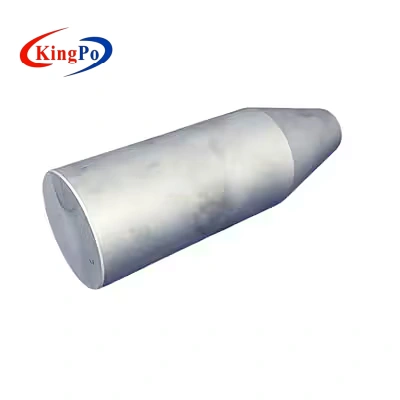
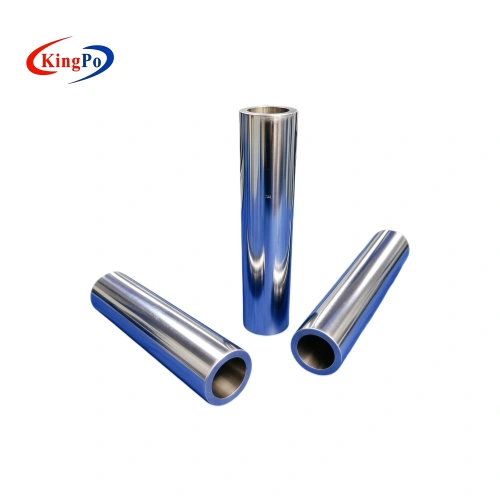
ISO 80369-2 Figure C.1 Socket Gauge | R1 Cone Connector Testing
The ISO 80369-2 Figure C.1 Socket Gauge | R1 Cone Connector Testing is a precision reference connector manufactured by KingPo. It is specifically designed as a socket gauge for verifying the performance and safety of R1 cone connectors in small-bore medical connection systems, fully compliant with ISO 80369-2 Figure C.1.
Technical Parameters
| Parameter | Specification | Remark / Notes |
|---|---|---|
| Standard | ISO 80369-2 Figure C.1 | Socket reference gauge for R1 cone connectors |
| Material | Hardened steel | High wear resistance and long-term dimensional stability |
| Hardness | HRC 58-62 | Ensures durability under repeated testing cycles |
| Gauge Type | Socket reference connector | Used to test leakage, unscrewing separation, stress cracking and non-interconnectability |
| Manufacturing Tolerance | Exact dimensions per ISO 80369-2 Figure C.1 | Guarantees repeatable and traceable test results |
| Certification | ISO 17025 traceable calibration certificate | Supports laboratory accreditation and audit requirements |
The socket gauge is precision-machined from high-hardness steel (HRC 58-62) to achieve exact dimensional tolerances as specified in ISO 80369-2 Figure C.1. The internal geometry is carefully controlled to simulate real-world connection conditions while maintaining consistent contact surfaces for reliable leakage, separation, and stress cracking tests.
All critical surfaces are ground and polished to minimize friction variability and ensure long-term dimensional stability even after thousands of test cycles. The robust construction and surface finish prevent deformation or wear that could compromise test accuracy.
Testing Principle
The gauge is mated with the R1 cone connector under controlled conditions to evaluate leakage, resistance to unscrewing separation, susceptibility to stress cracking, and prevention of misconnections with other small-bore connectors as defined in ISO 80369-2.
Common Error Mitigation
To ensure repeatable results, always align the connector axially without lateral force and verify that the gauge is clean and free of debris before each test. Regular visual inspection and periodic recalibration help maintain measurement integrity and prevent false pass/fail outcomes.
Primary Use Cases & Business Value
The ISO 80369-2 Figure C.1 Socket Gauge is used by medical device manufacturers and certification laboratories to verify the safety and performance of R1 cone connectors in small-bore medical systems. It helps ensure patient safety by preventing misconnections, leakage, and mechanical failures in critical fluid and gas delivery applications.
Industrial Applications & Lab Scenarios
- Medical device manufacturers – performance and safety validation of R1 cone connectors per ISO 80369-2
- Third-party certification laboratories – traceable compliance testing of small-bore medical connectors
- R&D departments – development and optimization of new connector designs to eliminate misconnections
- Quality control teams – batch verification of connectors used in enteral, respiratory and infusion systems
- Regulatory compliance teams – demonstration of non-interconnectability and mechanical integrity requirements
Strategic Procurement Advantages & Global Support
- High-Efficiency Testing: Precision socket gauge enables fast, repeatable ISO 80369-2 Figure C.1 testing with minimal setup time.
- Certified Manufacturing: ISO 9001/14001/45001 and CE certified production with ISO 17025 traceability ensures laboratory-grade reliability.
- Reliability & Support: Each unit undergoes rigorous factory calibration in our Dongguan facility and is backed by a full one-year warranty, on-site installation guidance, and lifetime technical engineering support.