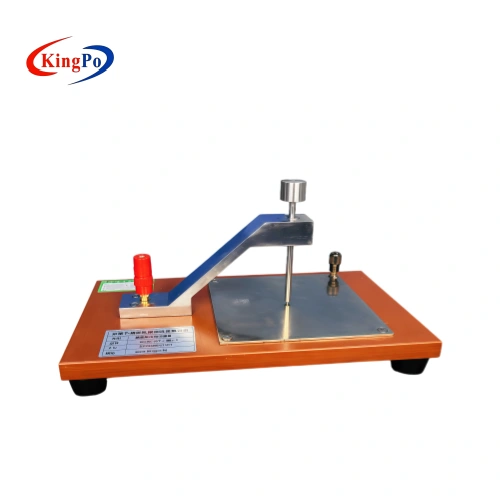
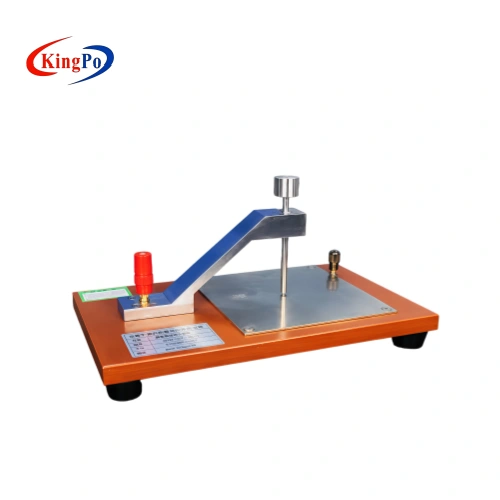

IEC 61347-1 Annex H Insulating Barrier Test Equipment Overview
The IEC 61347-1 Annex H Insulating Barrier Test Equipment is designed to test insulating materials used to meet double or enhanced insulation requirements in lamp controlgear. It’s particularly useful in situations where solid insulating materials are in direct contact with sharp edges of live electrical components or are located beneath printed circuit boards. This helps to simulate the stresses that may be exerted on these insulating materials by soldered components.
The equipment utilizes the electrode arrangement shown in Figure H.1 to establish a defined mechanical contact condition prior to conducting the electrical strength test.
This equipment enables reliable verification of insulating barriers during product development, quality control, and compliance assessments.
Technical Parameters
Standard and Test Condition Information
| Parameter | Specification | Remark or Notes |
|---|---|---|
| Product Name: | IEC 61347-1 Annex H Insulating Barrier Test Equipment | Purpose: For insulating barrier testing |
| Applicable standard: | IEC 61347-1:2024, Annex H, Figure H.1 – Test electrode | |
| Test object: | Solid insulation material. | Used for double or reinforced insulation purposes. |
| Typical applications: | Insulation safety testing for lamp controlgear. | Particularly useful for testing insulation near live parts of PCBs. |
| Test Purpose: | Verification of insulating barriers. | Simulates the stress exerted by soldered components in PCBs. |
| Electrode arrangement: | Two opposing electrodes. | Insulation material is placed between the electrodes. |
| Flat electrode material: | Brass or stainless steel. | In contact with the insulation surface. |
| Rod electrode material: | Brass or stainless steel. | The rods are cylindrical in shape, as shown in Figure H.1. |
| Applied force: | 0.5 N ± 0.1 N. | The force is applied between the electrodes. |
| Test potential: | 1.25 times the value for double or reinforced insulation. | In accordance with the requirements of Table 10. |
| Voltage holding time: | 1 minute. | Maximum test voltage is maintained throughout this time. |
| Acceptance criteria: | No flashover or breakdown. | Tests must comply with the requirements of Annex H. |
Ordering and Documentation Information
| Parameter | Specification | Remark or Notes |
|---|---|---|
| Brand | KingPo | Original product supplier |
| Model reference | IEC 61347-1:2024 Annex H | Listed as model reference on the original document |
| Place of origin: | China. | Information from the product’s official page. |
| Certification Support | ISO 17025 | Please confirm the certificate scope before ordering. |
| Minimum order quantity: | 1 set. | Please confirm before obtaining a quote. |
| Delivery period: | 35 working days. | Confirmation will be based on the order schedule. |
| Supply capacity: | 200 sets per month. | To be confirmed based on the production schedule. |
| Typical users: | Lighting laboratories, lamp controlgear manufacturers, certification labs, and quality control departments. | Purpose: Electrical safety testing and compliance preparation. |
Testing Principle and Result Evaluation
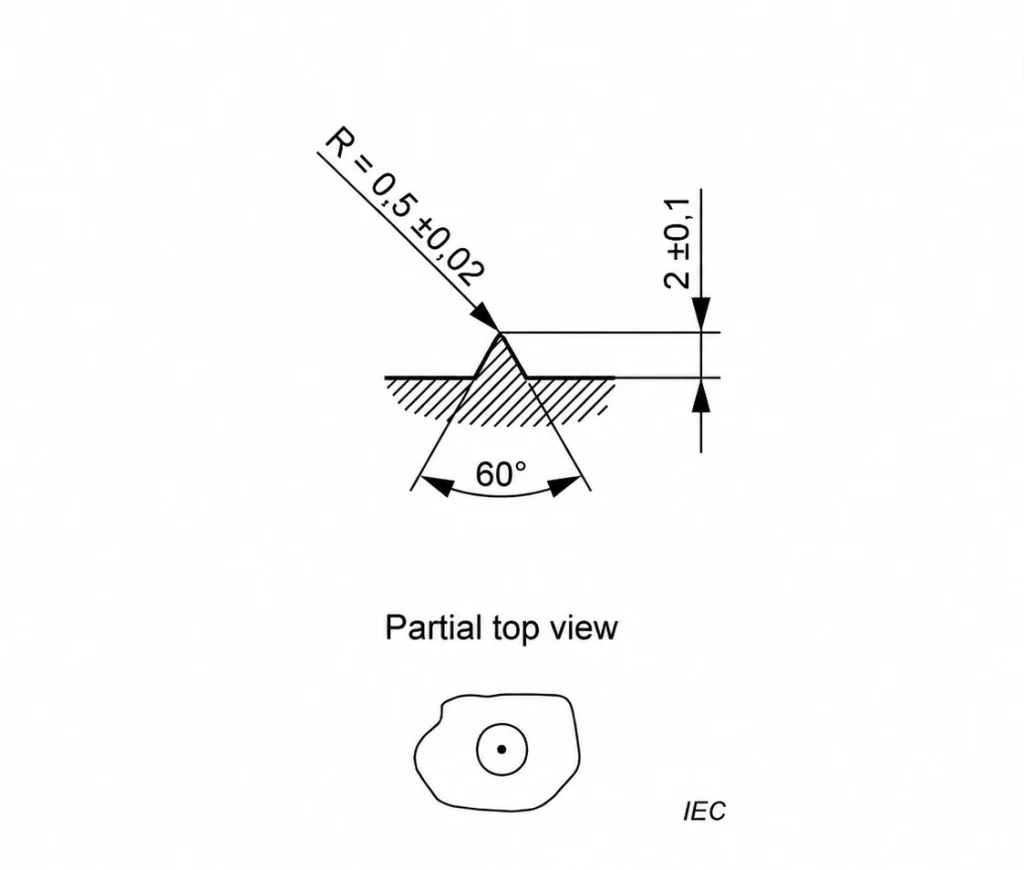
The IEC 61347-1 Annex H Insulating Barrier Test Equipment applies specified electrode forces and electrical strength conditions to verify the reliability of solid insulation used in double or reinforced insulation systems.
During testing, the insulating material is placed between two opposing electrodes. The flat brass or stainless-steel electrode contacts one side of the insulator, while the cylindrical rod electrode contacts the opposite side. The electrodes are pressed against the insulator with a force of 0.5 N ± 0.1 N.
After the specimen is positioned and the electrode force is applied, the test potential is increased to the required value. The maximum test potential is maintained for 1 minute. The test value is 1.25 times the value specified for double or reinforced insulation according to the applicable requirements.
The result is acceptable if no flashover or breakdown occurs during the test. If flashover, breakdown, insulation puncture, or any other abnormal electrical failure occurs, the result must be evaluated in accordance with IEC 61347-1:2024 Annex H and the laboratory’s acceptance criteria.
Common Error Mitigation
Reliable insulation barrier testing depends on proper specimen placement, accurate electrode alignment, and correct voltage application. Laboratories should avoid the following:
| ● Testing the incorrect insulation position or material | ● Using electrodes that do not meet the requirements of Figure H.1 |
| ● Applying incorrect electrode force | ● Poor contact between the electrode and the insulation surface |
| ● Increasing the test potential too quickly without following the proper procedure. | ● Failing to maintain the maximum test potential for the required duration |
| ● Ignoring flashover, breakdown, or insulation puncture during testing | ● Recording only pass/fail results, without information regarding test voltage or specimen details. |
| ● Treating the equipment itself as a certification result, rather than merely a standard testing tool. | |
Specimen Preparation and Test Notes
Before testing, the insulation material must be prepared in accordance with the applicable test procedures and the actual product structure. The test primarily relates to solid insulation materials that are used to meet the requirements for double or reinforced insulation in lamp controlgear.
Before starting the test, the operator must confirm the insulation material, test location, electrode contact surfaces, applied force, test voltage, and voltage holding time. The electrode contact areas must be clean, and the insulation specimen must be securely placed between the two electrodes.
The test must be conducted carefully, as the applied voltage is related to the verification of electrical strength. Test records should include the applied voltage, voltage holding time, electrode force, specimen conditions, and whether flashover or breakdown occurred during the test.
Maintenance and Documentation Support
|
The flat electrode, cylindrical rod electrode, fixture structure, and force application mechanism should be inspected regularly. The electrode surfaces must remain clean, smooth, and free from corrosion, burrs, or deformation. |
For formal laboratory use, the recommended documentation includes:
● Equipment specifications
● Calibration certificate or inspection record ● Verification of electrode material and structure ● Force verification record ● Test voltage record ● Voltage holding time record ● Specimen material and position records ● Flashover/Breakdown Observation Record ● Final test report prepared in accordance with laboratory procedures |