Abstract & Technical Summary
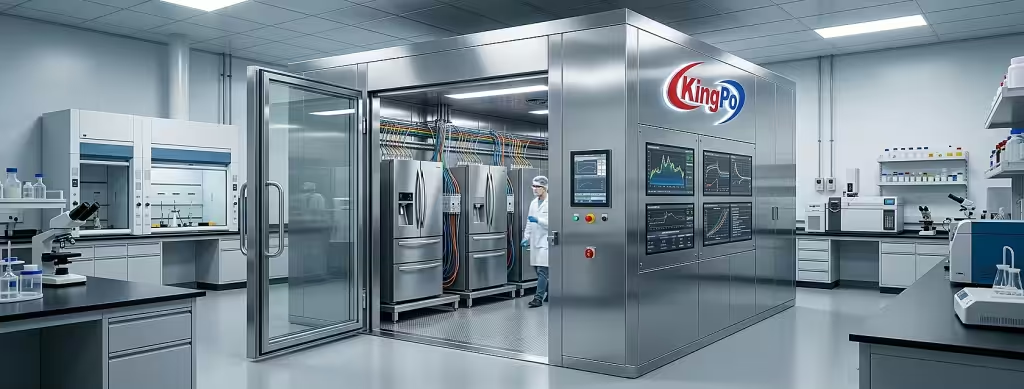
The IEC 62552 Refrigerator Test Chamber is an ultra-precise metrological environmental facility specifically engineered for the exhaustive evaluation of vapor-compression refrigerating appliances, integrating advanced Psychrometric measurement systems, PID-modulated ambient temperature stability (±0.1K), and high-frequency automated energy consumption data acquisition (DAQ) to ensure total compliance with global energy labeling and thermodynamic performance standards under the most rigorous laboratory conditions
Introduction: The Global Benchmark for Cooling Excellence
In the contemporary landscape of the global HVAC&R (Heating, Ventilation, Air Conditioning, and Refrigeration) industry, the IEC 62552:2015 (including its 2020 amendments) is not merely a document; it is the fundamental architecture for international trade and quality assurance. As regulatory bodies—such as the European Union’s Ecodesign, the United States Energy Star, and China’s GB standards—tighten their energy efficiency thresholds, the precision of the Refrigerator Test Chamber has become the primary differentiator between market-ready innovation and regulatory failure.
The KingPo test chamber is designed to transcend simple cooling. It creates a “closed-loop” thermodynamic environment that eliminates external variables, allowing engineers to isolate the performance of the compressor, the efficiency of the insulation, and the logic of the control board with surgical precision.
Key LSI (Latent Semantic Indexing) Concepts & Semantic Network:
To achieve the highest level of technical validation, our chambers address the following latent technical factors:
-
Thermal Insulation Analysis: Quantifying the R-value and heat leakage of the cabinet structure using precise heat flux sensors.
-
Relative Humidity Mapping: Ensuring that moisture levels do not interfere with evaporator frost patterns or latent heat transfer calculations.
-
Compressor Duty Cycle: Real-time tracking of “on” vs “off” time ratios during steady-state operation to determine mechanical efficiency.
-
Defrost and Recovery Period: Capturing the exact energy spike and thermal “bounce” during automatic defrost cycles to calculate incremental energy consumption.
-
Pull-down Test Performance: Measuring the transient cooling speed at which the appliance reaches target setpoints from an ambient state.
-
Internal Load Simulation: Utilizing M-packages (test loads) to simulate the thermal mass of real-world food storage.
Structural Engineering & The Physics of the Chamber
The construction of an IEC 62552 compliant room is a feat of civil and mechanical engineering. Unlike standard environmental rooms, a refrigerator test chamber must minimize air movement while maximizing temperature uniformity.
The Double-Wall Air Plenum System
A critical requirement of IEC 62552 is that the air velocity around the test unit must remain below 0.25 m/s. Traditional air conditioning systems create “drafts” that artificially cool the refrigerator’s condenser, leading to falsely optimistic energy readings.
KingPo utilizes a Double-Wall Air Plenum design. Cold or warm air is distributed through a perforated wall system, allowing the air to “bleed” into the room at ultra-low velocities. This creates a “still air” environment where heat exchange is dominated by natural convection, exactly as the standard requires.
Thermal Envelope Integrity
The walls of the chamber are constructed from high-density Polyurethane (PU) foam panels, typically between 100mm and 150mm thick. The internal skin is made of SUS304 stainless steel to prevent moisture absorption and ensure a long lifecycle under high-humidity conditions.
Technical Specifications & Comparative Analysis
The following tables outline the rigorous hardware requirements necessary to meet the IEC 62552 mandates.
Table 1: Technical Infrastructure & Performance Parameters
| Feature | IEC 62552 Requirement | KingPo Compliance Level | Engineering Logic |
| Standard Compliance | IEC 62552-1, -2, -3 | Fully Certified / ISO 17025 Ready | Multi-standard compatibility for global markets. |
| Temperature Range | 10°C to 45°C (Standard) | 5°C to 60°C (Extended) | Covers tropical and sub-tropical testing conditions. |
| Temp. Stability | ± 0.3K per standard | ± 0.1K (PID Controlled) | Higher stability reduces the “noise” in energy data. |
| Air Velocity | < 0.25 m/s | < 0.15 m/s | Minimizes forced convection on the condenser. |
| Humidity Control | 30% to 90% RH | ± 3% RH Accuracy | Prevents artificial frosting of the evaporator. |
| Data Acquisition | Minimum 1-minute intervals | 1-second sampling (1Hz) | Crucial for capturing fast defrost energy spikes. |
| Power Measurement | 1% Accuracy | 0.2% Accuracy (Class 0.2) | High-resolution measurement for low-power standby modes. |
Testing Protocols: A Deep Dive into IEC 62552 Parts 1-3
The IEC 62552 standard is divided into three comprehensive parts. Our chambers are programmed to automate these workflows.
Part 1: General Requirements
This section defines the laboratory environment, the measuring instruments, and the test room setup. KingPo chambers ensure that the “test package” placement and the “test room climate” are perfectly synchronized.
Part 2: Performance Requirements
Performance testing focuses on the “Workhorse” capabilities of the refrigerator.
| Test Type | Objective | Measurement Metric |
| Storage Test | Verify internal compartment temperatures. | T_max and T_min limits across all shelves. |
| Freezing Capacity | Speed of heat extraction from a specific load. | Time to reach -18 degrees C at the core of the M-package. |
| Cooling Capacity | Evaluate rapid cooling of fresh food. | Temperature drop rate in the fresh food compartment. |
| Ice-making Test | Quantify 24-hour ice production. | Weight of ice harvested per 24 hours. |
Part 3: Energy Consumption and Volume
This is the most commercially sensitive part of the standard. Energy consumption (E_24h) is calculated by interpolating data from two different ambient temperatures (usually 16 degrees C and 32 degrees C).
The KingPo software utilizes complex algorithms to identify Steady-state conditions. If the internal temperature of the refrigerator fluctuates by more than 0.5 K over a 24-hour period, the test is invalidated. Our system provides real-time “validity alerts” to save laboratory time.
Advanced Automation & Data Analytics
In a modern lab, manual data entry is a relic of the past. The KingPo Refrigerator Test Chamber is powered by a proprietary Lab-View based Control Suite.
Real-Time Thermodynamic Visualization
The software provides a 3D heat map of the chamber. Engineers can see exactly where the heat is being rejected by the refrigerator’s condenser and how the room’s HVAC system is compensating. This is vital for Thermal Insulation Analysis.
Automated “Defrost and Recovery” Detection
One of the most difficult tasks in IEC 62552-3 is determining when a defrost cycle begins and ends. Our system uses a derivative-based algorithm to detect the sudden rise in power and temperature, automatically calculating the Incremental Energy (delta E_df) without human intervention.
Operational Excellence: Calibration and Maintenance
-
Sensor Calibration: Every PT100 sensor is calibrated against a Fluke primary standard.
-
Air Velocity Mapping: Conducted every 6 months to ensure no blockages in the plenum are causing turbulence.
-
Power Meter Verification: Using a calibrated resistive load to verify the accuracy of the Watt-hour measurements.
FAQ: Expert Insights & Technical Solutions
Q1: How to calibrate the temperature sensors for IEC 62552 compliance?
A: Sensors must be calibrated using a dry-well or oil-bath calibrator against a traceable primary standard every 12 months. Focus on the 0°C to 40°C range with an uncertainty of less than 0.05K.
Reference: https://www.dgkingpo.com/product/iec-62552-refrigerator-test-chamber/
Q2: Why do energy consumption results often fail to match the manufacturer’s rating?
A: Failures are often due to “Thermal Short-circuits” or unstable air velocity within the chamber. Even a 0.1m/s drift can alter the condenser’s heat rejection efficiency by up to 5%.
Reference: https://www.dgkingpo.com/contact-us/
Q3: What are the key Standard Updates in IEC 62552:2015 compared to older versions?
A: The newer version moved away from a single-point energy test to a dual-ambient interpolation method (16 degrees C and 32 degrees C), providing a more realistic “Yearly Consumption” figure. Reference: https://www.dgkingpo.com/about-us/
Reference: https://www.dgkingpo.com/about-us/
Q4: How to handle the “Defrost and Recovery” period in data analysis?
A: The standard requires that energy consumed during defrost be added to the steady-state energy. Our software automates the integration of power (P) over the time interval (t) of the defrost cycle.
Reference:iec 62552refrigerator test chamber
Q5: What is the required accuracy for the Power Meter in the chamber?
A: The power measurement system must be “Class 0.2” or better. It must be capable of measuring the low “Standby” power of modern smart refrigerators, which can be as low as 0.5W.
Reference: contact us
Q6: Why is humidity control critical for refrigerator testing?
A: Humidity determines the latent heat load. High humidity causes moisture to condense on the evaporator coils, forming ice and forcing the unit to run more frequent defrost cycles.
Reference: about us
Q7: How to calibrate the air velocity inside the test room?
A: We use a multi-point grid of hot-wire anemometers. The measurements are taken at 10cm from the walls and at various heights to ensure no “dead zones” or “high-speed jets” exist.
Q8: Can this chamber test R600a or R290 (Flammable) units?
A: Yes. All KingPo chambers can be upgraded with “A3 Refrigerant Safety Packages,” including floor-level hydrocarbon sensors and anti-static ventilation.
Q9: What is the benefit of a “Psychrometric” approach in refrigerator testing?
A: It allows for the measurement of the total heat removed from the air, including sensible and latent heat, which is essential for testing “Frost-Free” or “No-Frost” appliances.
Q10: How long does a full IEC 62552 energy test typically take?
A: A comprehensive test—including stabilization, the 16 degrees C test, and the 32 degrees C test—usually requires 72 to 96 hours of continuous, uninterrupted operation.
Conclusion: Partnering with KingPo for Global Market Access
The IEC 62552 Refrigerator Test Chamber is more than just a room; it is a critical instrument in the pursuit of environmental sustainability. By providing manufacturers with the most accurate data possible, KingPo helps drive the innovation of energy-efficient appliances that reduce global carbon footprints.