You need to know global power supply specifications to use devices safely everywhere. These rules include voltage, frequency, and plug types. There are two main standards: North American and European. Each region has its own rules for global power supply specifications. You can see global power supply specifications in the table below:
|
Country |
Single Phase Plug Type |
Single Phase Voltage |
Three Phases Wiring Number |
Three Phases Voltage |
Frequency |
|---|---|---|---|---|---|
|
USA |
A, B |
120 V |
4 |
240 V |
60 Hz |
|
Canada |
A, B |
120 V |
3, 4 |
120/208 V |
60 Hz |
|
UK |
G |
230 V |
3 |
400 V |
50 Hz |
|
Australia |
I |
230 V |
3 |
400 V |
50 Hz |
|
Europe |
C, E, F |
230 V |
3 |
400 V |
50 Hz |
|
Japan |
A, B |
100 V |
3 |
200 V |
50/60 Hz |
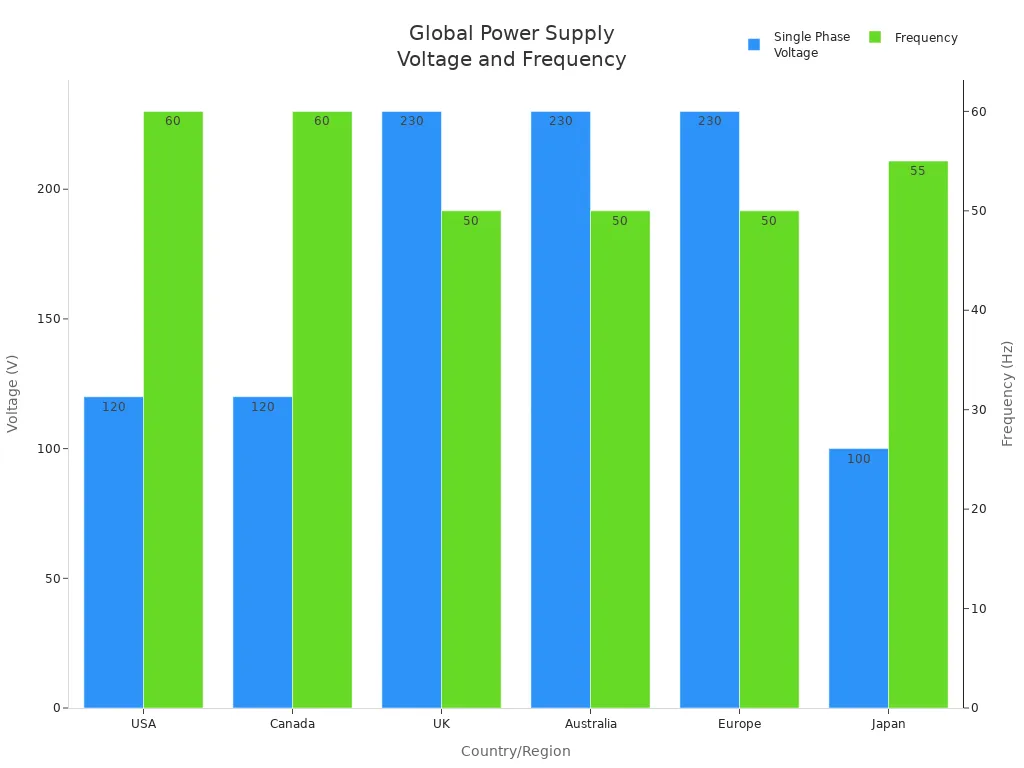
You must follow the right standards for global power supply specifications. If you do not follow the standards, your devices can break. You could also have safety problems.
Key Takeaways
-
You should check the voltage and frequency first. Do this before you use your device in a new country. This helps stop damage and keeps you safe.
-
Make sure you use the right plug type for your device. Countries have different plug shapes. You might need an adapter for your device.
-
Check if your device has a dual voltage label. If it says ‘Input: 100-240V’, you can use it in most countries. This means it is safe to use almost anywhere.
Global power supply specifications: voltage, frequency, and plug types
North American and European standards
There are two main global standards for power supply. North America uses 110 to 120 volts. The frequency there is 60 hertz. Europe uses 220 to 240 volts. The frequency in Europe is 50 hertz. Plug types are different in each region. North America uses Type A and Type B plugs. Europe uses plug Types C through M.
Here is a table with the usual values for each region:
|
Region |
Voltage (V) |
Frequency (Hz) |
Plug Types |
|---|---|---|---|
|
North America |
110-120 |
60 |
Type A, Type B |
|
Europe |
220-240 |
50 |
Type C to Type M |
Most countries in Europe use the European standard. The North American standard is used in the United States, Canada, and Mexico. Because voltage and frequency are different, you must check your device before using it in another country.
Country-specific voltage and frequency
Each country has its own power supply rules. Some countries have special voltage or frequency values. The United Kingdom uses 230 volts and 50 hertz. The United States uses 120 volts and 60 hertz. China uses 220 volts and 50 hertz. Australia uses 230 volts and 50 hertz.
Here is a table with voltage and frequency for major countries:
|
Country |
Voltage (V) |
Frequency (Hz) |
|---|---|---|
|
United Kingdom |
230 V, 415 V |
50 Hz |
|
United States |
120 V, 120/208 V, 277/480 V, 120/240 V, 240 V, 480 V |
60 Hz |
|
China |
220 V |
50 Hz |
|
Australia |
230 V |
50 Hz |
|
Japan |
100 V |
50/60 Hz |
Some countries use more than one voltage. Brazil uses 127 volts or 220 volts, depending on the area. Japan uses 100 volts, which is lower than most other places. Fiji uses Type I plugs but may have US-style plugs in resorts.
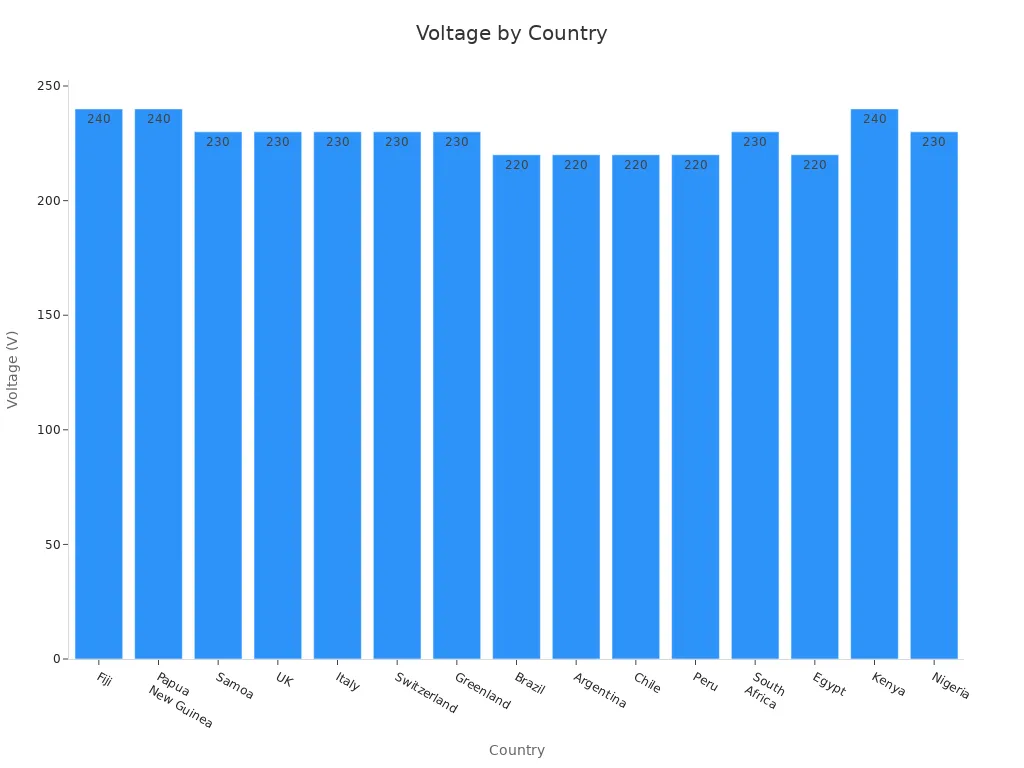
Note: Always check voltage and frequency before using your device in a new country. Using the wrong voltage can break your device or cause safety problems.
Plug types around the world
Plug types are very different in each country. There are 14 main plug types. Each type has its own shape and pin style. North America and Japan use flat-blade Type A and B plugs. Europe mostly uses round-pin Types C, E, and F. The United Kingdom uses Type G with three rectangular pins. Australia and New Zealand use Type I. South America and Asia use many plug types.
Here is a table showing common plug types and voltages in different places:
|
Country / Region |
Plug Type(s) |
Voltage |
|---|---|---|
|
United States, Canada |
A, B |
120 V |
|
United Kingdom |
G |
230 V |
|
Germany, France, Spain |
C, E, F |
230 V |
|
Australia, New Zealand |
I |
230 V |
|
China |
A, C, I |
220 V |
|
Japan |
A, B |
100 V |
|
India |
C, D, M |
230 V |
|
Brazil |
N |
127 V / 220 V |
You can see how often each plug type is used in the chart below:
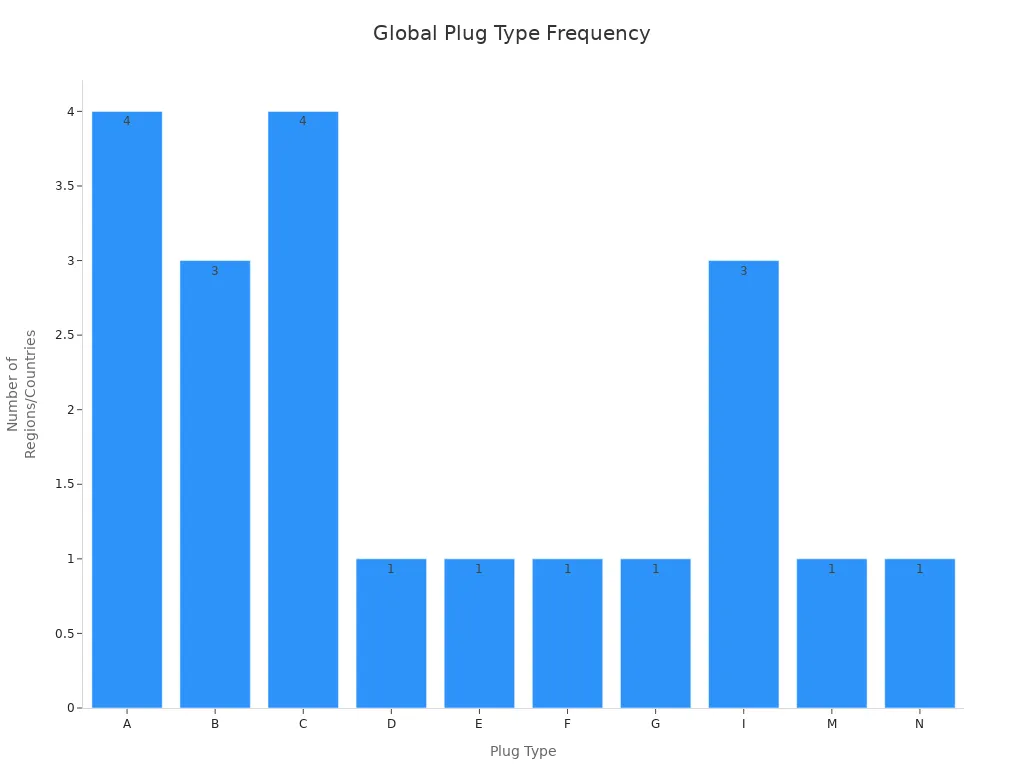
Here is a quick list of the most common plug types:
-
Type A: Two flat pins side by side (100 – 127V)
-
Type B: Two flat pins and a U-shaped ground (100 – 127V)
-
Type C: Two round pins (220 – 240V)
-
Type D: Three round pins in a triangle (220 – 240V)
-
Type E: Two round pins and a hole for ground (220 – 240V)
-
Type F: Two round pins and side clips (220 – 240V)
-
Type G: Three rectangular pins in a triangle (220 – 240V)
-
Type I: Two flat angled pins and ground (220 – 240V)
You need to use the right plug and check the voltage before you connect your device. If your device does not match the local power supply, you may need an adapter or converter.
Tip: Many new devices, like laptops and phones, work with dual voltage. Look for a label that says “Input: 110-240V” to see if your device works with different voltages and frequencies.
Transitional arrangements, dual voltages, and standardization
Some countries are changing to unified power supply systems. You may see dual voltage outlets in hotels or airports. Devices with dual voltage can work safely on both 100-127V and 220-240V systems. This helps travelers avoid damage and makes travel easier.
Groups like ISO, IEC, and CENELEC make global standards for plugs and power supply. These groups want to make using devices safer and easier everywhere.
|
Organization |
Role in Standardization |
|---|---|
|
ISO |
Makes international standards for electrical plugs |
|
IEC |
Helps create unified standards for electrical devices |
|
CENELEC |
Sets regional plug standards in Europe |
|
ANSI |
Sets local standards in the United States |
Always check the power supply rules before using your device in a new country. This will help you keep your device safe and avoid problems.
Household vs. industrial power supply differences
Voltage and phase distinctions
Household and industrial power systems are not the same. Homes use single-phase voltage. This works for lights and small appliances. Single-phase power has two wires. It sends electricity in one wave. This is simple and safe for daily use.
Industries need more power than homes. They use three-phase voltage systems. Three-phase voltage sends electricity in three waves. These systems use three or four wires. They can run big machines and heavy loads. Three-phase voltage is more efficient. It keeps the power steady. Factories and hospitals use three-phase voltage for motors and pumps.
Here is a table to compare the main differences:
|
Voltage Level |
Application |
Usage |
Configuration |
|---|---|---|---|
|
120 Volts |
Household power supply in North America |
Powers most residential lighting, receptacles, and small appliances |
Single-phase, split-phase system |
|
208 Volts |
Light industrial and commercial |
Powers three-phase equipment like motors and HVAC systems |
Three-phase Wye (star) configuration |
|
240 Volts |
Both residential and industrial |
Powers heavy-duty appliances and industrial motors |
Split-phase in homes, three-phase Delta in industry |
Three-phase voltage is used where machines need lots of energy. Single-phase voltage is enough for homes and small offices.
-
Factories use three-phase voltage for big machines.
If you travel or move equipment, check the voltage information. Each country or building may have different setups.
Application and safety standards
It is important to know how safety rules are different. Single-phase power is best for homes and small devices. Three-phase power is best for factories and big machines. Three-phase power gives a steady flow of electricity. This helps stop power interruptions.
Here is a table that shows the main differences:
|
Feature |
Single-Phase Power |
Three-Phase Power |
|---|---|---|
|
Power Delivery |
One wave, not constant |
Three waves, constant |
|
Typical Applications |
Homes, lighting, heating |
Industry, commercial, large equipment |
|
Load Capacity |
Lower loads (up to 24,000V) |
Higher loads (up to 480V) |
|
Efficiency |
Less efficient, larger wires needed |
More efficient, smaller wires |
|
Cost |
Higher operational costs |
Lower operational costs |
International standards help keep people safe. The IEC 60335-1 standard covers home appliances up to 250 volts. It also covers up to 480 volts for other uses. The IEC 60601-1 standard is for medical equipment. These rules help devices work safely and lower risks.
Industrial power systems use higher voltages, like 480V or 13.8 kV. These systems need extra safety steps. They may have backup power and strict rules. Homes focus on keeping people safe. Factories must follow more rules for high-voltage systems.
Tip: Always look at your device label for voltage and frequency. Make sure it matches the local power before plugging it in.
Practical advice for checking specifications
You can stay safe by following these steps before using devices in a new country:
-
Check for safety marks like UL, cUL, or CE on your adapter.
-
Look for energy efficiency labels, such as Level VI in the U.S.
-
Read the input and output labels. Make sure the AC input range matches the local supply. Check that the DC output fits your device.
People often make mistakes by using the wrong plug. Some do not check the voltage or skip safety checks. Always read the voltage information. Use the right adapter or converter.
Note: Using the same power equipment saves money and time. It also makes it easier to use devices in different countries.
If you follow these steps, you can use your devices safely anywhere.
You need to check the local voltage, frequency, and plug types before you plug in your device. If you do not do this, you could:
-
Break your device
-
Not follow safety rules in that country
Good places to find power supply information are:
|
Organization |
|
|---|---|
|
UL (Underwriters Laboratories) |
Makes sure devices are safe and work well by testing and certifying them. |
|
IEC (International Electrotechnical Commission) |
Creates worldwide rules for electrical equipment to keep things safe and the same everywhere. |
Pick the right adapter or converter when you travel. Universal travel adapters can be used in lots of countries. Single plug adapters are small and simple to pack. Use a travel converter if your device cannot use more than one voltage.
FAQ
What happens if you use the wrong voltage for your device?
You can damage your device or cause a fire. Always check the voltage label before you plug in your device.
Do you need a converter or just an adapter when traveling?
You need an adapter for plug shape. You need a converter if your device does not support the local voltage.
How can you tell if your device is dual voltage?
-
Look for a label that says “Input: 100-240V”.
-
If you see this, you can use your device in most countries.