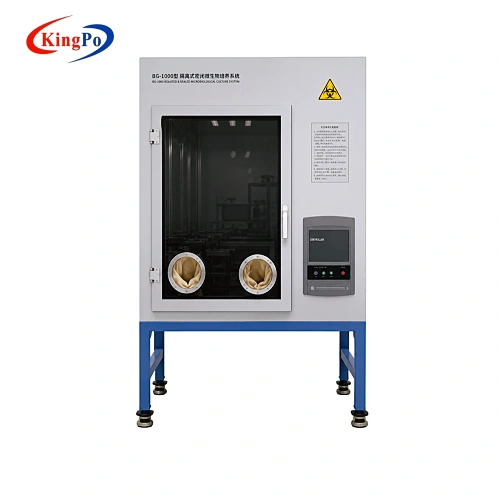
Front view of the KP-1000 Mask Bacterial Filtration Efficiency Tester for medical face mask BFE testing
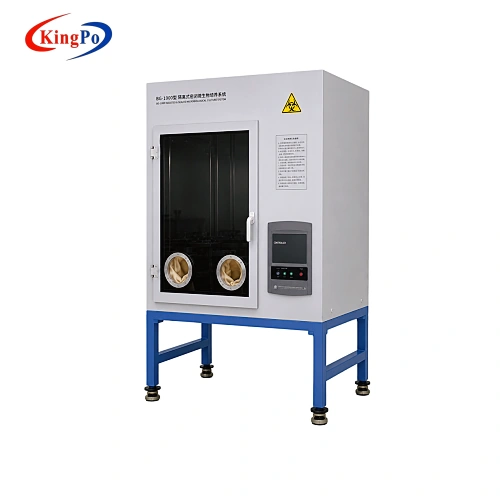
Left oblique view of the Mask Bacterial Filtration Efficiency Tester in a medical testing laboratory
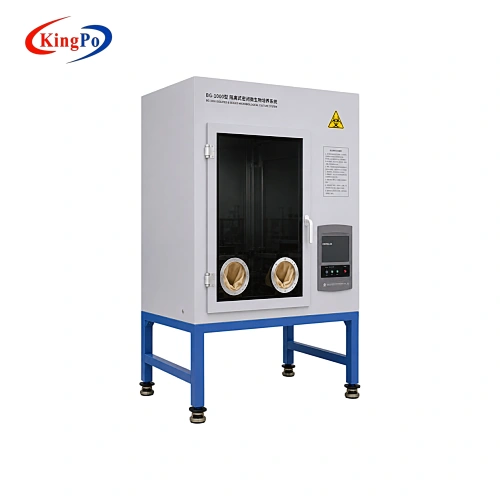
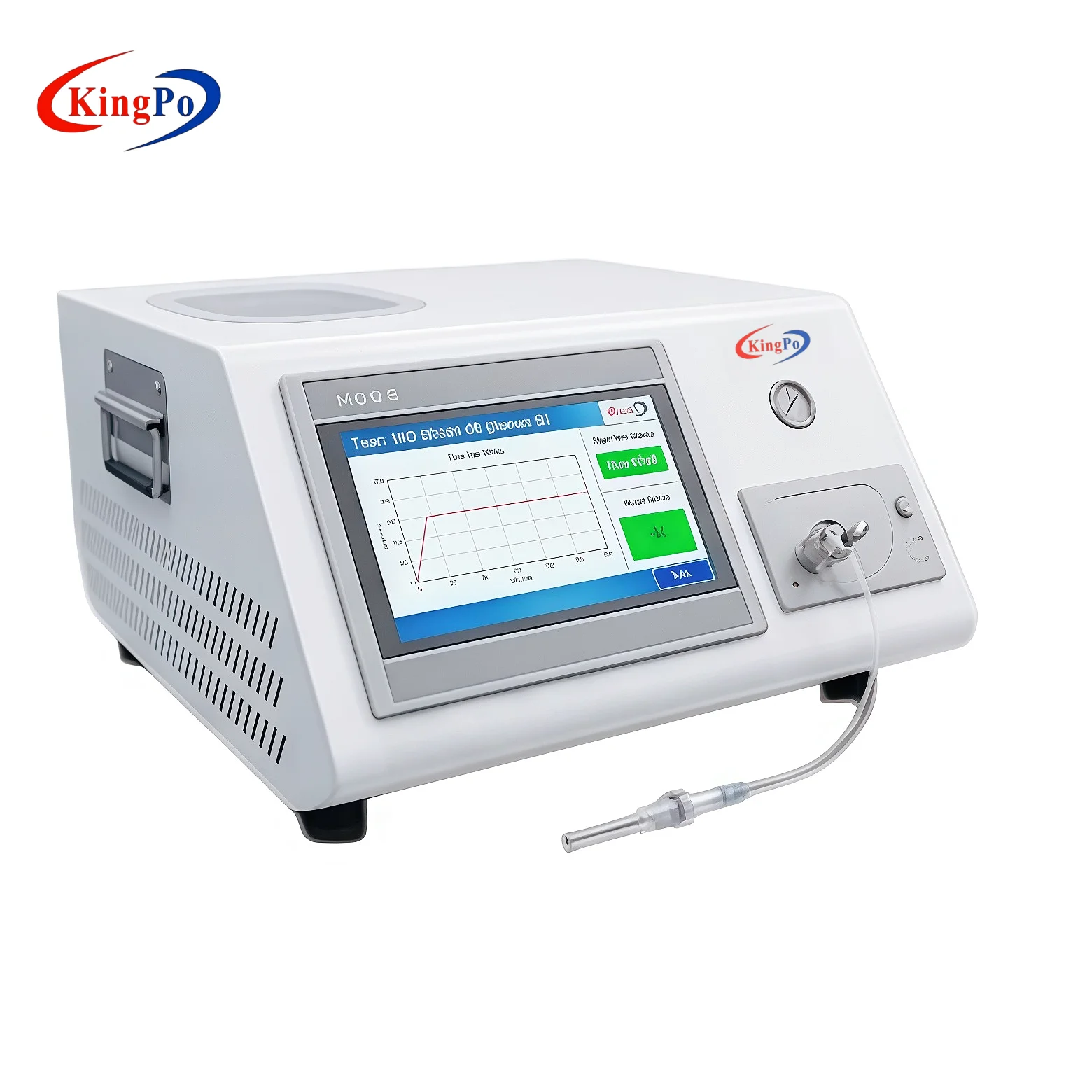
Right oblique view of the KP-1000 Medical Face Mask BFE Tester with touchscreen control
Front view of the KP-1000 Mask Bacterial Filtration Efficiency Tester for medical face mask BFE testing
Left oblique view of the Mask Bacterial Filtration Efficiency Tester in a medical testing laboratory
Right oblique view of the KP-1000 Medical Face Mask BFE Tester with touchscreen control

Mask Bacterial Filtration Efficiency Tester for Medical Face Masks

The KINGPO KP-1000 Mask Bacterial Filtration Efficiency Tester is designed for laboratory evaluation of bacterial filtration efficiency in medical face mask materials. It integrates biological aerosol generation, dual-route sampling, six-stage Andersen collection, and negative-pressure operation.

  • Product Type: Mask Bacterial Filtration Efficiency Tester
  • Main Test Object: Medical face masks and applicable porous medical materials
  • Main Test Purpose: Evaluation of bacterial filtration efficiency under controlled aerosol challenge conditions
  • Referenced Standards: ASTM F2101, ASTM F2100, EN 14683, and YY 0469, subject to the required edition
  • Equipment Execution Standard: Q/0212 ZRB003-2015
  • Typical Users: Medical mask manufacturers, third-party laboratories, inspection organizations, research institutes, and quality-control laboratories
  • Main System: Scope Aerosol generation, specimen exposure, dual-route sampling, six-stage collection, negative-pressure control, and test-data storage
  • Configuration Scope: Supporting microbiology equipment and documentation requirements should be confirmed according to the laboratory project

Mask Bacterial Filtration Efficiency Tester Product Overview

The KP-1000 Mask Bacterial Filtration Efficiency Tester is designed around the complete BFE testing process. It enables laboratories to establish a controlled biological aerosol challenge, expose the test specimen, perform comparative sampling, and retain the main operating data for subsequent evaluation.

The Mask Bacterial Filtration Efficiency Tester uses two six-stage Andersen cascade impactors to collect viable aerosol particles according to aerodynamic size. Its dual-route structure supports comparison between the control aerosol and the residual aerosol collected after passing through the medical face mask material.
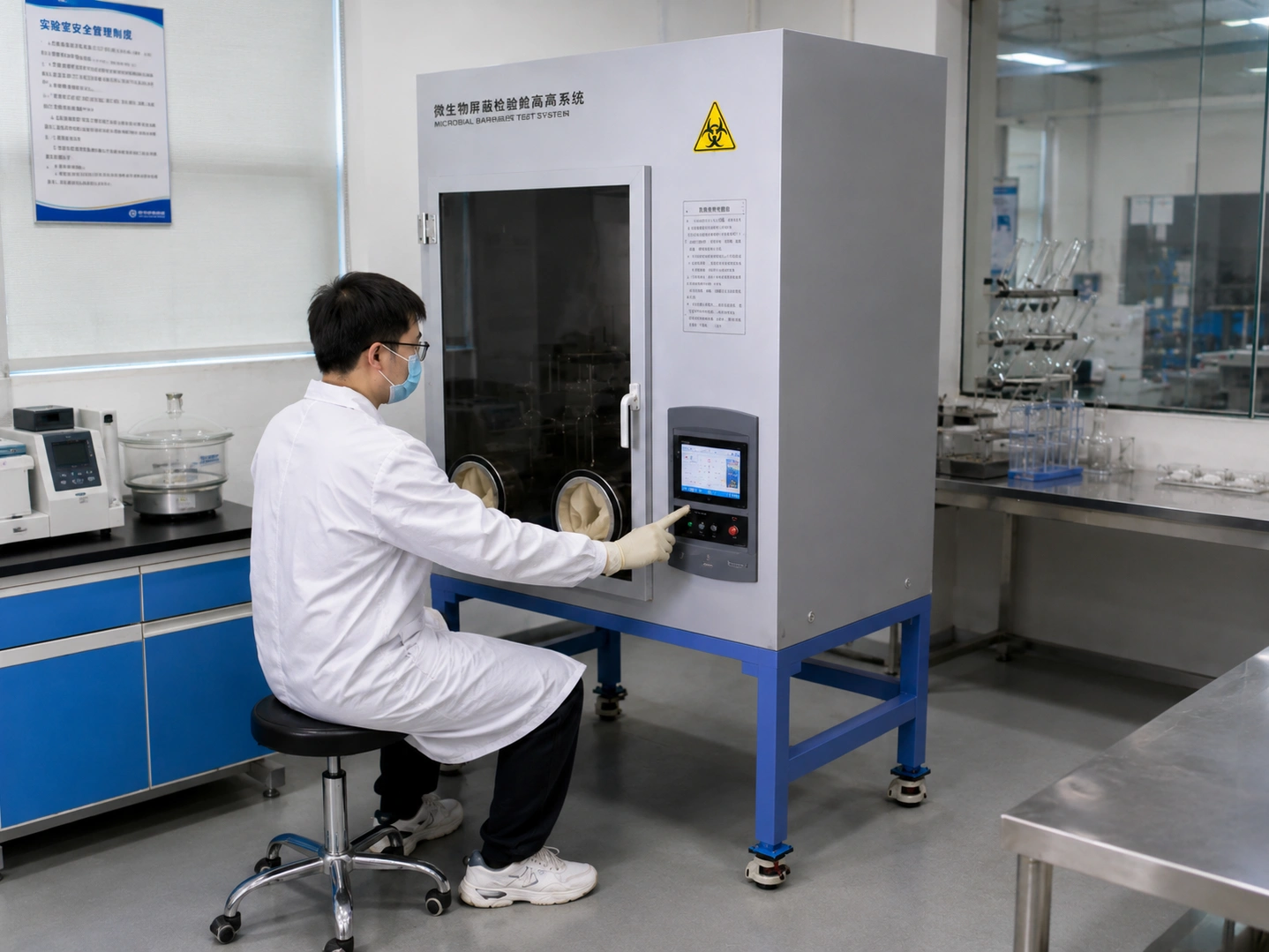
Chinese laboratory technician operating the Mask Bacterial Filtration Efficiency Tester for ASTM F2101 testing

Controlled Challenge

Integrated Aerosol Generation

Adjustable spray flow and peristaltic-pump flow support controlled preparation of the biological aerosol challenge.

Comparative Sampling

Dual Sampling Routes

Two coordinated sampling routes operate at a nominal flow of 28.3 L/min for control and downstream collection.

Laboratory Control

Negative-Pressure Operation

Negative-pressure ventilation, HEPA filtration, pressure monitoring, touchscreen control, and data storage are integrated into the system.

Technical Specifications

Aerosol Generation and Sampling

Parameter Specification Resolution Maximum Permissible Error
Route A sampling flow 28.3 L/min 0.1 L/min ±2.5%
Route B sampling flow 28.3 L/min 0.1 L/min ±2.5%
Spray flow 8–10 L/min 0.1 L/min ±5.0%
Peristaltic-pump flow 0.006–3.0 mL/min 0.001 mL/min ±2.5%
Pressure before flowmeter A −20 to 0 kPa 0.01 kPa ±2.5%
Pressure before flowmeter B −20 to 0 kPa 0.01 kPa ±2.5%
Pressure before spray flowmeter 0–300 kPa 0.1 kPa ±2.5%
Negative test-chamber pressure −90 to −120 Pa 0.1 Pa ±2.0%

Six-Stage Andersen Sampler Ranges

Stage Captured Particle Size Stage Captured Particle Size
Stage I >7 μm Stage IV 2.1–3.3 μm
Stage II 4.7–7 μm Stage V 1.1–2.1 μm
Stage III 3.3–4.7 μm Stage VI 0.6–1.1 μm

System and Installation Data

Parameter Specification Parameter Specification
Working temperature 0–50°C Cabinet negative pressure −50 to −200 Pa
Cabinet ventilation ≥5 m³/min HEPA filtration ≥99.99% for particles above 0.3 μm
Aerosol chamber 600 × Ø85 × 3 mm Cabinet door opening 1000 × 730 mm
Main unit dimensions 1180 × 650 × 1300 mm Support frame dimensions 1180 × 650 × 600 mm
Support frame adjustment Height adjustable within 100 mm Data storage More than 100,000 data groups
Noise <65 dB(A) Approximate weight 250 kg
Power consumption <1500 W Working power AC 220 V ±10%, 50 Hz
The specifications of the Mask Bacterial Filtration Efficiency Tester are based on the original KP-1000 technical information. Final values should be confirmed in the technical agreement before production or shipment.

Applicable Standards and Test Method Alignment

Test Method

ASTM F2101

ASTM F2101 describes a quantitative method for evaluating bacterial filtration efficiency by comparing the bacterial challenge concentration with the residual concentration collected after the aerosol passes through the specimen.

The KP-1000 Mask Bacterial Filtration Efficiency Tester is configured around this comparative aerosol-sampling principle and a nominal 28.3 L/min sampling flow.

Performance Specification

ASTM F2100

ASTM F2100 is a performance specification for medical face masks. BFE is one of several performance characteristics. Differential pressure, particulate filtration, synthetic blood penetration, and flammability require separate equipment or procedures.

Medical Face Masks

EN 14683

The Mask Bacterial Filtration Efficiency Tester can be considered for the BFE portion of the applicable EN 14683 procedure. The required edition, sampling arrangement, workflow, and acceptance documentation should be reviewed for each project.

Referenced Documents

YY 0469 and Q/0212 ZRB003-2015

The original technical information references YY 0469-2011 Appendix B for BFE testing and Q/0212 ZRB003-2015 as the equipment execution standard.

KINGPO model KP-1000 is the product model. ZR100 identifies an equipment type in the technical materials and is not a second product model.

Final suitability of the Mask Bacterial Filtration Efficiency Tester depends on the applicable standard edition, test clause, specimen type, supporting laboratory equipment, and complete operating procedure.

Testing Principle and Workflow

The Mask Bacterial Filtration Efficiency Tester uses a controlled biological aerosol challenge and comparative viable-particle collection process.

01

System Preparation

Check the aerosol chamber, specimen holder, tubing, Andersen samplers, sampling routes, airflow, pressure conditions, and collection plates.

02

Aerosol Generation

The aerosol generator and peristaltic pump introduce the bacterial suspension under controlled spray-flow and liquid-feed conditions.

03

Specimen Exposure

Install the mask or material specimen so that the aerosol passes through the required material face or direction.

04

Dual-Route Sampling

The Mask Bacterial Filtration Efficiency Tester uses two 28.3 L/min routes to coordinate control and downstream aerosol collection.

05

Six-Stage Collection

Two six-stage Andersen cascade impactors collect viable particles across defined aerodynamic particle-size ranges.

06

Incubation and Evaluation

Collection plates are incubated, colonies are counted, and BFE is calculated according to the selected laboratory method.

The Mask Bacterial Filtration Efficiency Tester controls and records equipment-side operating conditions. Culture preparation, incubation, colony counting, calculation, and final reporting remain part of the laboratory procedure.

Laboratory-Oriented Features

Dual 28.3 L/min Sampling Routes

Route A and Route B each provide a nominal 28.3 L/min flow for comparative BFE collection in one system.

Two Six-Stage Andersen Impactors

Each impactor separates viable aerosol particles according to aerodynamic size across six collection stages.

Adjustable Aerosol Generation

The Mask Bacterial Filtration Efficiency Tester provides adjustable spray and peristaltic-pump flow for establishing the biological aerosol challenge.

Negative-Pressure Environment

Negative-pressure ventilation and HEPA filtration support controlled aerosol handling within the equipment enclosure.

Industrial Touchscreen Control

A 10.4-inch color touchscreen, embedded controller, USB interface, and internal storage support equipment control and data retention.

Practical Cabinet Construction

The Medical Face Mask BFE Tester uses a stainless-steel interior, coated steel exterior, observation door, lighting, adjustable support frame, and movable casters.

Standard Supply

One KP-1000 BFE test-system host
Two six-stage Andersen cascade impactors
One aerosol sprayer
One adjustable support frame
Four carrying handles
One 3 m AC power cord
Silicone tubing in the specified sizes
Two product manuals
One product certificate
One sprayer test report
The standard supply of the Mask Bacterial Filtration Efficiency Tester does not identify bacterial strains, culture media, collection plates, incubators, sterilization equipment, colony counters, or laboratory biosafety facilities as included items.

Typical Applications

Manufacturing

Product and Material Control

Medical face mask development, filtration-material inspection, production quality control, process verification, and supplier comparison.

Independent Testing

Laboratory and Inspection Use

The Mask Bacterial Filtration Efficiency Tester provides controlled flow, pressure, aerosol, and sampling conditions for validated BFE procedures.

Research

Comparative Filtration Studies

Suitable for universities, research institutes, and comparative evaluation of applicable porous medical filtration materials.

For medical mask manufacturers, the Medical Face Mask BFE Tester supports product development, incoming inspection, process validation, and routine quality control.

This Bacterial Filtration Efficiency Test Equipment may also be considered for certain porous medical materials when the test method, specimen holder, airflow path, and operating conditions are confirmed.

Test Scope and Limitations

BFE Test Scope

The Mask Bacterial Filtration Efficiency Tester evaluates bacterial filtration through the test material under controlled laboratory conditions.

It supports comparative viable-aerosol testing and does not replace the complete microbiological procedure or laboratory quality system.

Separate Test Requirements

  • Respirator approval or respiratory protection
  • Face fit, facial sealing, or total inward leakage
  • Differential pressure or breathing resistance
  • Particle or viral filtration efficiency
  • Synthetic blood penetration resistance
  • Flammability or microbial cleanliness
A high BFE result does not by itself demonstrate respirator-level protection because the test primarily evaluates material filtration rather than the fit and sealing performance of the finished product. A complete medical mask laboratory may require additional Bacterial Filtration Efficiency Test Equipment, particle filtration equipment, differential-pressure equipment, synthetic-blood penetration equipment, and other dedicated systems.

Compliance & Regulatory Assurance

The KP-1000 Mask Bacterial Filtration Efficiency Tester is designed to support bacterial filtration efficiency testing associated with ASTM F2101, EN 14683, YY 0469 and the equipment execution standard Q/0212 ZRB003-2015. Its controlled biological aerosol generation, dual 28.3 L/min sampling routes, six-stage Andersen cascade impactors, pressure monitoring and negative-pressure enclosure support comparative evaluation of bacterial filtration performance in medical face mask materials. ASTM F2100 should be considered separately as a medical face mask performance specification that includes BFE together with other test requirements.

Final compliance depends on the complete laboratory procedure, including the applicable standard edition, challenge microorganism, bacterial suspension preparation, aerosol particle-size distribution, positive-control count, sampling flow, specimen orientation, incubation conditions, colony-counting method and result calculation. Supporting microbiology equipment, biosafety controls and laboratory validation procedures must also be reviewed according to the intended application.

Flow, pressure and aerosol-generation verification records, factory inspection documents, operation manuals, equipment certificates and available calibration documentation can be confirmed according to project requirements.

PDF
ASTM F2101 Mask Bacterial Filtration Efficiency Tester Catalogue
Technical specifications, BFE testing principle, ASTM F2101 and EN 14683 references, laboratory applications and system configuration guidance.

Download PDF

Technical Inquiry & Expert Support

To confirm whether the KP-1000 Mask Bacterial Filtration Efficiency Tester matches your project, please provide the information below when sending an inquiry. This helps KINGPO review the applicable standard, mask specimen, BFE test procedure, laboratory facilities and required documentation before quotation.

Information Needed Description
Applicable Standard ASTM F2101, EN 14683, YY 0469 or the relevant customer test procedure, including the required standard edition and applicable test clause.
Specimen Information Finished medical face mask or material specimen, mask type, layer structure, material composition, specimen dimensions, test direction, quantity and expected daily test volume.
BFE Test Requirements Required sampling method, positive-control range, aerosol particle-size conditions, sampling flow, test sequence, data-storage needs and whether BFE calculation or report functions are required.
Laboratory Facilities Power supply, available microbiology laboratory facilities, incubation equipment, sterilization equipment, colony-counting method, biosafety controls, ventilation and biological waste-treatment arrangements.
Documentation Needs Product datasheet, operation manual, factory inspection report, flow and pressure verification records, calibration-related documents, equipment certificate, training documents or traceability information if required.
Note:
Final suitability should be reviewed together with the applicable standard edition, complete microbiological procedure, specimen arrangement, challenge aerosol conditions, supporting laboratory equipment and local biosafety requirements.

Mask Bacterial Filtration Efficiency Tester Detail Display

Mask Bacterial Filtration Efficiency Tester FAQ

What does the Mask Bacterial Filtration Efficiency Tester measure?
The Mask Bacterial Filtration Efficiency Tester evaluates how effectively a medical face mask material reduces the passage of a controlled bacterial aerosol. It compares the viable bacterial concentration under the control condition with the concentration collected after the aerosol passes through the specimen, allowing the laboratory to calculate bacterial filtration efficiency.
Which standards can be referenced for BFE testing?
The system is intended for bacterial filtration efficiency testing associated with ASTM F2101, EN 14683 and YY 0469. ASTM F2100 may also be referenced as a medical face mask performance specification. The exact edition, applicable clause, sampling procedure and reporting requirements should be confirmed before selecting the final equipment configuration.
Can the Medical Face Mask BFE Tester evaluate finished masks and material samples?
The Medical Face Mask BFE Tester can be used for finished medical face masks or suitable flat material specimens when the specimen holder, exposure area, airflow direction and test procedure match the selected standard. Customers should provide the mask type, layer structure, specimen dimensions and required test direction before quotation.
What is the purpose of the two six-stage Andersen cascade impactors?
The two six-stage Andersen cascade impactors collect viable aerosol particles across different aerodynamic particle-size ranges. Their dual-route arrangement supports comparative collection of the control aerosol and the aerosol remaining after passage through the specimen. This configuration is central to professional bacterial filtration efficiency testing and subsequent colony-count evaluation.
Does the Mask Bacterial Filtration Efficiency Tester automatically calculate BFE?
The confirmed configuration includes touchscreen control, operating-data storage and USB data transfer. However, automatic BFE calculation and complete report-generation functions should be confirmed for the selected software version. Incubation, colony counting and result verification normally remain part of the laboratory’s microbiological procedure and quality-management system.
What supporting laboratory equipment is normally required?
In addition to the Bacterial Filtration Efficiency Test Equipment, the laboratory may require suitable culture media, collection plates, incubation equipment, sterilization facilities, colony-counting equipment, microbiological consumables and biological waste-treatment arrangements. The exact supporting configuration depends on the applicable standard, laboratory workflow, local biosafety requirements and existing facilities.
Can this equipment also perform PFE, VFE or differential-pressure testing?
No. The Mask Bacterial Filtration Efficiency Tester is specifically designed for BFE testing using a biological aerosol and viable-particle collection. Particle filtration efficiency, viral filtration efficiency, differential pressure, synthetic blood penetration, flammability and mask-fit testing use different test principles and normally require separate dedicated equipment.
How should standard-edition compatibility be confirmed?
Standard compatibility should be reviewed against the exact edition and applicable test clause requested by the customer. The review should cover sampling flow, challenge aerosol conditions, positive-control range, particle-size distribution, specimen arrangement, incubation procedure and documentation. KINGPO should not describe the equipment as fully compliant until these project-specific conditions are confirmed.
What verification and documentation can be requested with the equipment?
Customers may request the product datasheet, operation manual, factory inspection records, equipment certificate, flow and pressure verification information, sprayer test documentation and available calibration-related records. The required document scope, traceability level, third-party calibration needs and acceptance format should be agreed before production and shipment.
What information should be provided before requesting a quotation?
Please provide the target standard and edition, mask or material type, specimen dimensions, expected testing volume, laboratory power supply, existing microbiology facilities, required documentation and installation location. This information helps determine whether the KP-1000 Mask Bacterial Filtration Efficiency Tester and its supporting accessories match the intended BFE testing project.

Related Products

Related News

Pink noise balances sound energy for relaxation and sleep. See how a pink noise generator works and why it’s gentler than white noise for daily use.

In the field of environmental reliability testing for electrical, electronic, and electromechanical products, the IEC 60068 series of standards provides […]

Manufacturers perform glow wire tests by heating a wire and applying it to electrical components to assess fire resistance and meet safety standards.
A dust test chamber simulates dusty environments to assess product durability, ensuring devices meet standards and perform reliably in harsh conditions.

The nozzle is the heart of the IPX9K test setup, directly influencing water flow, pressure, and spray patterns. According to […]

  KingPo completed the supply of a multi-standard laboratory testing equipment package for Eurofins E&E North America in February 2023. The […]

Scroll to Top

Get A Free Quote Now !

Contact Form
If you have any questions, please do not hesitate to contact us.