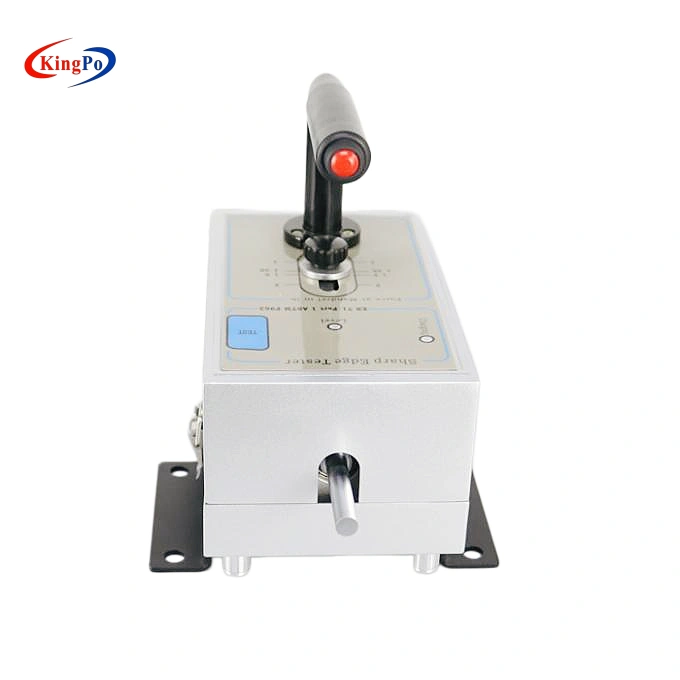
Product Overview
Sharp edges can become accessible during normal use, assembly or reasonably foreseeable abuse of a toy. A controlled sharp-edge test provides a repeatable method for determining whether an accessible edge presents an unacceptable cutting hazard under the applicable product-safety standard.
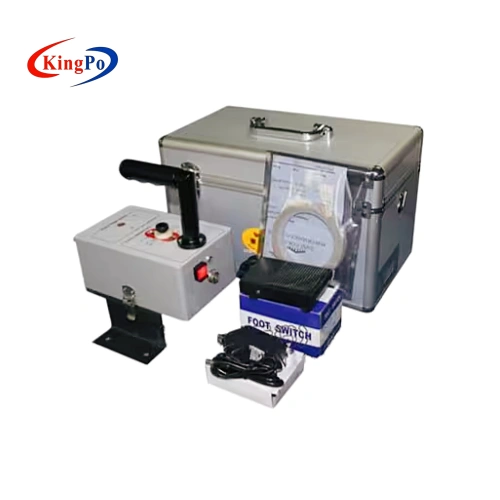
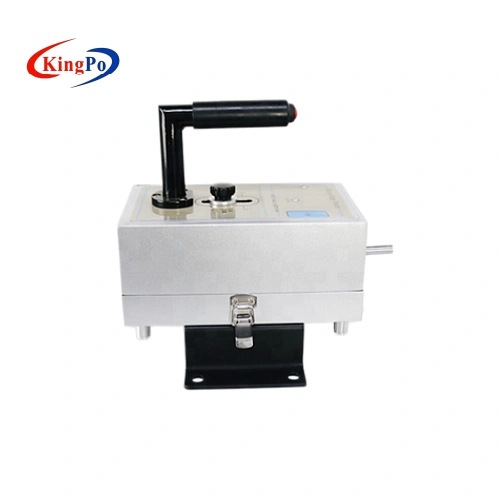
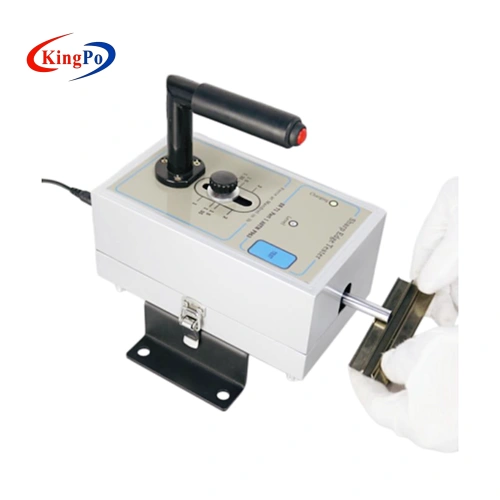
The KingPo Sharp Edge Tester applies a PTFE-tape-covered cylindrical mandrel to the edge under evaluation. The mandrel rotates through the prescribed test movement while the operator maintains the required contact condition. After testing, the PTFE tape is inspected according to the acceptance criteria of the applicable standard.
The tester incorporates force indication and external force adjustment, allowing the operator to establish the required test force before performing the test. The original KingPo product data also specify a 1.35 lb force verification device for checking and adjusting the force indication.
Although ISO 8124-1 is used as the primary product keyword and application standard on this page, the same general type of sharp-edge apparatus is referenced by several toy and consumer-product safety systems. The exact mandrel specification, tape requirement, test force and pass/fail criterion should therefore be checked against the controlled edition of the standard used for the test project.
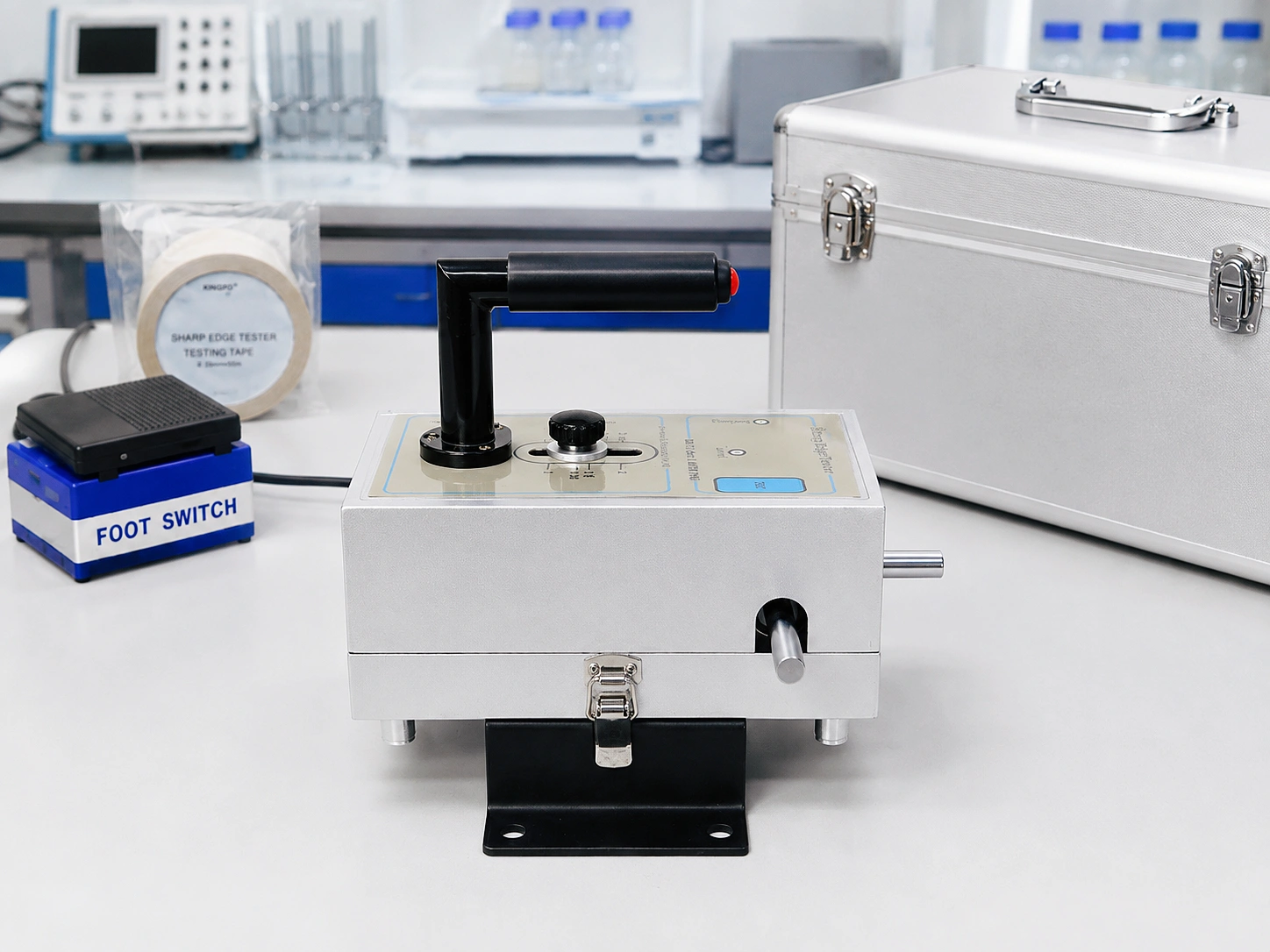
What Does the Sharp Edge Tester Evaluate?
The tester is used to assess whether an accessible edge on a toy or applicable product can cut the specified test tape under controlled test conditions.
The test is particularly relevant to edges that can be contacted during:
For the U.S. regulatory method in 16 CFR 1500.49, the test specifically applies to accessible metal or glass edges on toys and other articles intended for children under eight years of age. The regulation evaluates whether such an edge presents a potential laceration or avulsion hazard.
The tester itself does not determine whether an edge is accessible. Accessibility must first be established according to the applicable product standard or regulation.
Technical Specifications
The specifications below separate KingPo product configuration from test parameters defined by the referenced 16 CFR method. This distinction is important when the tester is used for different standards.
Product Configuration
| Item | Specification |
|---|---|
| Product Name | ISO 8124-1 Sharp Edge Tester |
| Brand | KingPo |
| Product Type | Rotating-mandrel sharp edge test equipment |
| Primary Application | Toy and consumer-product sharp-edge testing |
| Force Indication | Photoelectric indication |
| Force Adjustment | External adjustment provided |
| Force Verification | 1.35 lb verification device stated in original product configuration |
| Nominal Mandrel Diameter | 9.53 mm; required tolerance should be confirmed against the applicable standard edition |
| Operation | Handle switch / foot-switch operation |
| Dimensions | 290 × 190 × 100 mm (L × W × H) |
| Weight | Approx. 4 kg |
| Installation | Portable benchtop use |
Reference Test Parameters – 16 CFR 1500.49
| Test Parameter | Requirement |
|---|---|
| Normal Test Force | 1.35 lb / 6.00 N |
| Mandrel Material | Hardened steel |
| Mandrel Hardness | ≥40 HRC |
| Tangential Velocity | 1.00 ± 0.08 in/s during the center 75% of rotation |
| Test Medium | Pressure-sensitive PTFE tape |
| PTFE Tape Width | Not less than 6 mm |
PTFE tape thickness is intentionally not stated as a universal product parameter. The original product page lists 0.066–0.099 mm, while the referenced 16 CFR 1500.49 method specifies a PTFE backing thickness of 0.066–0.089 mm. The required tape specification should therefore be selected according to the actual standard and edition used for testing.
Sharp Edge Test Principle
The sharp-edge test converts an otherwise subjective judgement about edge sharpness into a controlled mechanical test.
A cylindrical steel mandrel is wrapped around its full circumference with the specified pressure-sensitive PTFE tape. The taped mandrel is then pressed against the edge under evaluation and rotated under the conditions specified by the applicable test method.
If the edge cuts through the PTFE tape to the extent defined by the applicable standard, the edge is evaluated accordingly.
For the reference method in 16 CFR 1500.49, the mandrel is applied with a normal force of 1.35 lb (6.00 N) and rotated through one complete revolution while linear movement along the edge is prevented. The regulation identifies an edge as sharp when the tape is completely cut through for a length of not less than 1/2 in (13 mm).
Reference Test Method – 16 CFR 1500.49
The 16 CFR method provides a particularly clear description of the operating principle of this type of sharp-edge tester.
Prepare the Mandrel
Wrap one layer of the specified PTFE tape around the full circumference of the mandrel without stretching the tape.
For the 16 CFR method, the tape ends may be butted or overlapped by no more than 0.10 in (2.5 mm).
Position the Test Edge
Secure the test sample so that the edge does not move during testing.
The mandrel axis is positioned at 90° ±5° to a straight test edge, or at the same angle to the tangent at the contact point of a curved edge.
Apply the Test Force
Apply the taped mandrel to the approximate center of the test edge using the prescribed force.
Under 16 CFR 1500.49, the normal force is 1.35 lb (6.00 N). If the full force causes the edge itself to bend, the regulation permits a reduced force.
Rotate the Mandrel
Maintain contact with the edge and rotate the mandrel through one complete revolution without allowing linear movement along the edge.
The specified tangential velocity is 1.00 ± 0.08 in/s (25.4 ± 2.0 mm/s) during the center 75% of the rotation, with smooth starting and stopping.
Inspect the PTFE Tape
Remove the tape carefully without enlarging a cut or turning a score mark into a cut.
For 16 CFR 1500.49, a complete cut through the tape measuring not less than 1/2 in (13 mm) identifies the tested edge as sharp.
use the procedure and evaluation criteria specified by that particular standard edition.
Test Mandrel and PTFE Tape
Hardened Steel Mandrel
The test mandrel is the mechanical interface between the sharp edge tester and the PTFE tape.
The KingPo product uses a hardened steel shaft. For 16 CFR testing, the mandrel test surface must be free from scratches, nicks and burrs, with a Rockwell C hardness of at least 40 HRC.
The original KingPo product data give a nominal cylindrical shaft diameter of 9.53 mm. Because mandrel dimensions can be standard- and edition-dependent, especially for UL 3300 projects, the applicable dimension and tolerance should be confirmed before quotation.
PTFE Test Tape
The test uses pressure-sensitive polytetrafluoroethylene (PTFE/TFE) tape wrapped around the rotating mandrel.
Under 16 CFR 1500.49:
- Thickness: 0.0026–0.0035 in (0.066–0.089 mm)
- Tape width: at least 1/4 in (6 mm)
- Pressure-sensitive silicone adhesive
- Tape temperature: 70–80 °F (21.1–26.6 °C)
Laboratories working to ISO 8124-1, ASTM F963, EN 71-1, GB 6675.2 or UL 3300 should verify the tape specification against the edition actually used for conformity assessment.
Applicable Standards and Test Scope
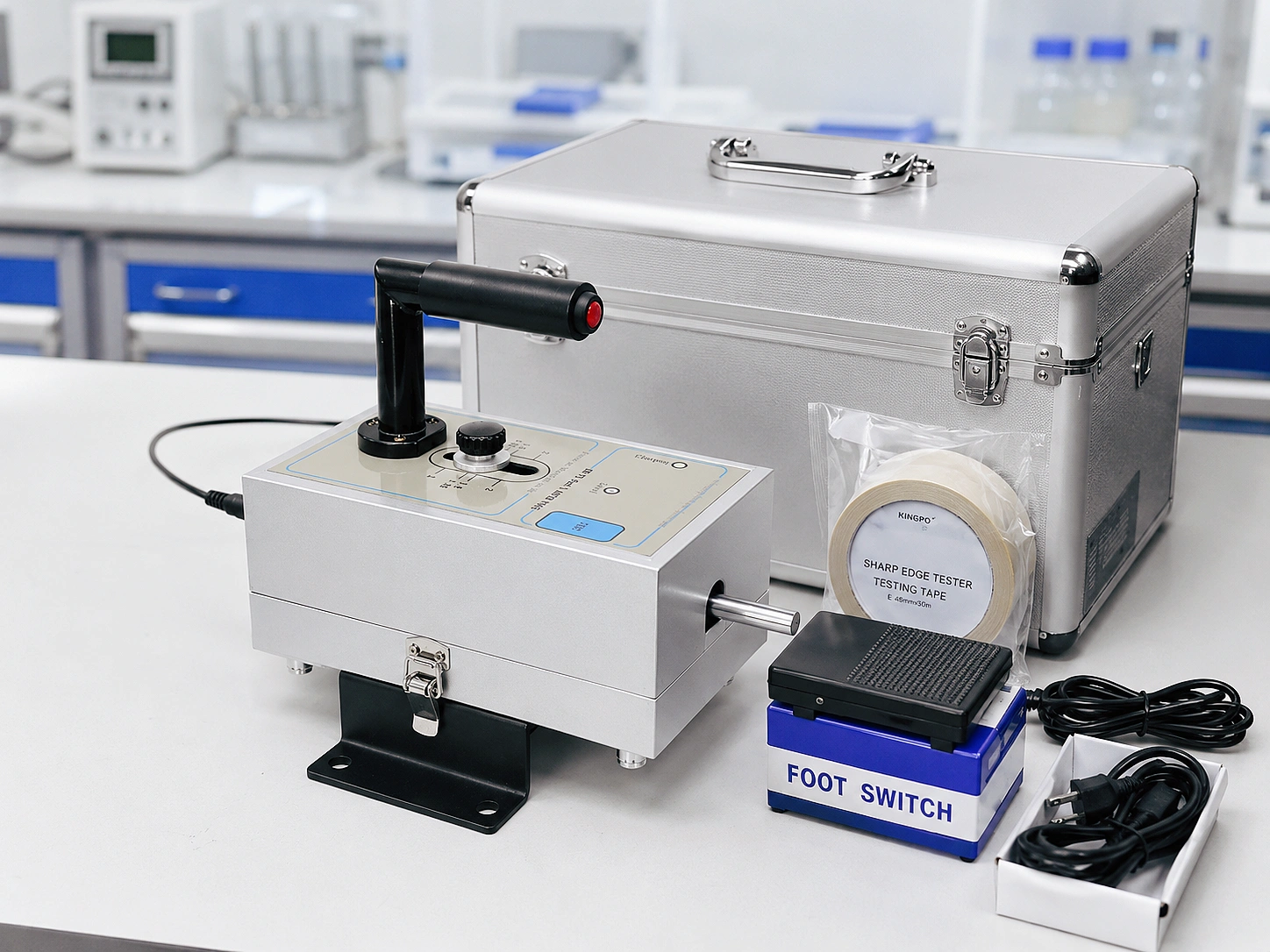
Product Features
Photoelectric Force Indication
The tester uses a photoelectric indication function to help the operator identify when the required test-force condition has been reached. This reduces dependence on reading a mechanical indicator from a particular viewing angle and helps maintain a consistent force condition during testing.
External Force Adjustment
An external adjustment mechanism allows the indicated force to be checked and adjusted against the reference load. This is useful for routine laboratory verification before performing a series of sharp-edge tests.
1.35 lb Force Verification Device
The original configuration includes a 1.35 lb verification device for checking the tester’s force setting. This device supports routine force checking but should not be confused with an accredited calibration certificate or ISO/IEC 17025 laboratory calibration.
Portable Benchtop Configuration
With published dimensions of 290 × 190 × 100 mm and a weight of approximately 4 kg, the tester is suitable for benchtop use and can be moved between test stations when required.
Handle and Foot-Switch Operation
The original operating instructions identify both handle-switch and foot-switch control, allowing the operator to control mandrel rotation while positioning the DUT at the required test edge.
Typical Test Objects
Depending on the applicable standard and product design, the Sharp Edge Tester can be used for evaluation of accessible edges on:
Typical Laboratory Users