Abstract & Technical Summary
In high-bandwidth oscilloscope measurements involving power electronics, high-speed digital signals, and PCB testing, the optimal high-precision circuit testing probes deliver ultra-low input capacitance (<1 pF), high CMRR (>60 dB), GHz-level bandwidth, and minimal probe loading to preserve signal integrity and achieve sub-microvolt noise performance in demanding applications such as GaN/SiC switching characterization and SerDes validation.
What Are High-Precision Circuit Testing Probes?
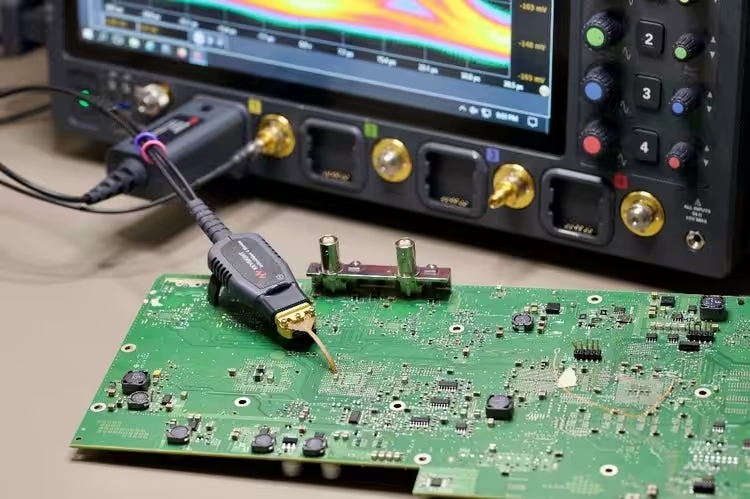
High-precision circuit testing probes serve as the critical interface between the device under test (DUT) and precision measurement instruments like oscilloscopes, spectrum analyzers, or multimeters. They capture weak, transient, or high-frequency waveforms with negligible distortion or loading effects.
Key probe categories include:
Passive Probes
- Traditional 10:1 attenuation with 10 MΩ || 10–15 pF input impedance.
- Ideal for general-purpose, mid-frequency circuit debugging due to low cost and simplicity.
- Limitation: Higher input capacitance causes bandwidth roll-off and phase distortion at elevated frequencies.
Active Probes
- Feature integrated amplifiers for extremely low input capacitance (<1 pF) and high input impedance.
- Support bandwidths from 1 GHz to several GHz, perfect for high-speed serial buses (PCIe, USB, DDR) and RF front-ends.
- Examples: Single-ended active probes and active differential probes.
Differential Probes
- Designed for floating/high-side measurements, power device testing (e.g., SiC/GaN MOSFETs), and noise-sensitive differential signals.
- Excellent CMRR (common mode rejection ratio) suppresses common-mode noise in power electronics, motor drives, and automotive systems.
- Essential for accurate high-voltage differential or low-level signal capture.
Current Probes & Specialized Variants
- AC/DC current probes enable non-intrusive switching transient analysis in power supplies.
- Power-rail probes target ultra-low ripple (μV-level) measurements with wide offset range and high bandwidth.
How to Select the Best High-Precision Circuit Testing Probes
Prioritize these parameters for precision applications:
- Bandwidth & Rise Time — Probe bandwidth should exceed oscilloscope bandwidth by 3–5× to faithfully capture fast edges.
- Input Capacitance & Loading — Choose models with low-input capacitance to avoid disturbing high-impedance nodes.
- Attenuation & Dynamic Range — Multi-range options (1X/10X/100X) accommodate varied voltage levels.
- Noise Floor & CMRR — Target <100 μV RMS noise and >80 dB CMRR for critical measurements.
- Compatibility & Accessories — Ensure BNC/oscilloscope brand compatibility (e.g., Keysight, Tektronix, Rohde & Schwarz) plus low-inductance grounds, spring tips, etc.
For most high-precision needs, combine high-bandwidth active differential probes with Kelvin sensing techniques to minimize contact resistance and maximize signal integrity.
Application Scenarios for High-Precision Probes
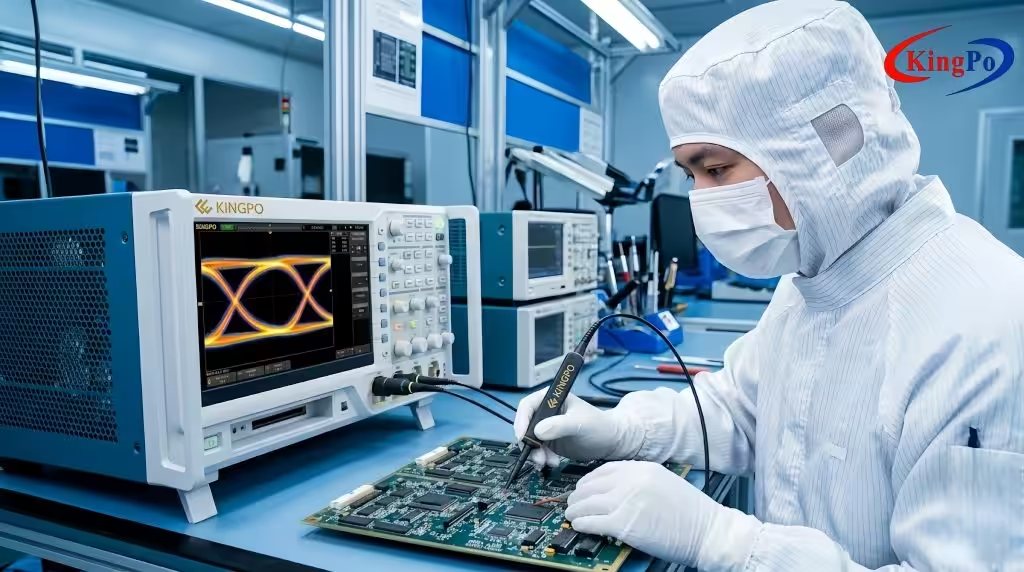
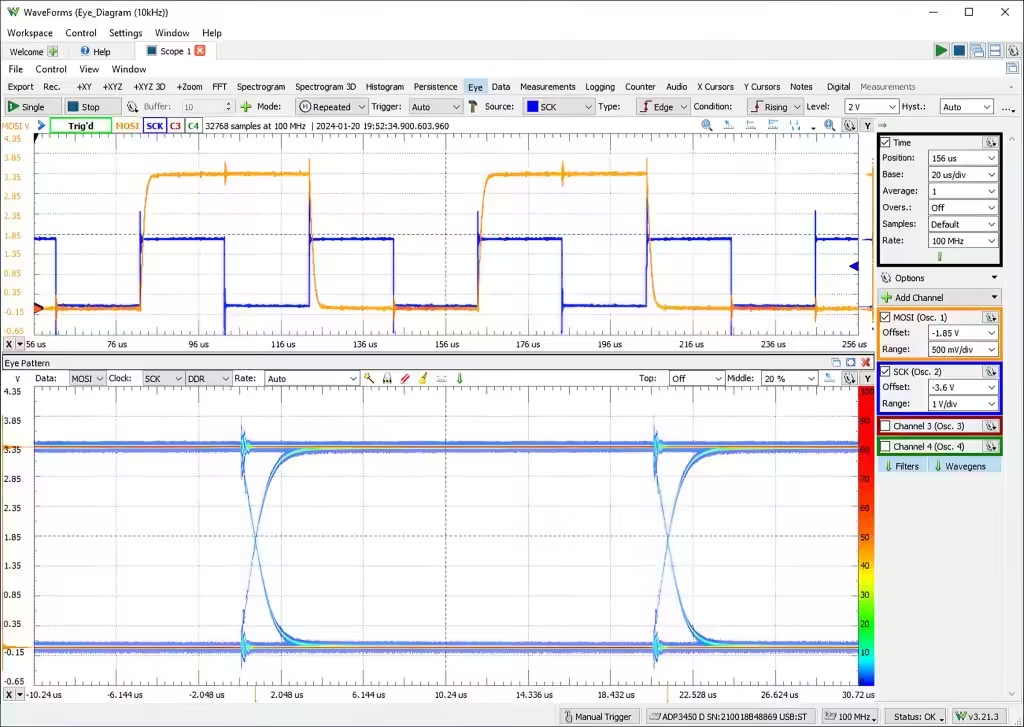
- High-Speed Digital Validation — Eye diagram analysis for DDR, PCIe Gen6, USB4 signals.
- Power Electronics — GaN/SiC gate drive timing, dead-time verification, switching losses.
- Automotive & EV — BMS high-voltage monitoring, inverter debugging.
- RF & Microwave — 5G/6G millimeter-wave LNA characterization.
Frequently Asked Questions – High-Precision Circuit Testing Probes
1. What are the best high-precision testing probes for oscilloscope circuit testing?
For demanding applications, KINGPO recommends active differential probes featuring GHz-level bandwidth and ultra-low input capacitance. These models excel at preserving signal integrity during advanced PCB testing.
2. How do you calibrate high-precision circuit testing probes?
Calibration typically uses the oscilloscope’s built-in square-wave reference signal. Adjust the compensation capacitor until the waveform shows a flat square top with no overshoot or rounding, then verify accuracy with a calibrated function generator. KINGPO provides step-by-step calibration procedures for all supported probe families.
3. Why do measurement results fail or show distortion when using testing probes?
The most frequent causes are excessive probe loading due to high input capacitance, inadequate grounding (long ground leads), bandwidth mismatch between probe and oscilloscope, or insufficient CMRR in differential measurements on floating circuits. Always match probe characteristics to the DUT impedance and signal conditions.
4. What are the latest standards updates affecting oscilloscope probes in 2026?
Key updates include tightened IEC 61010-2-030 and IEC 61010-031 requirements for galvanic isolation, CAT ratings, probe assemblies, surge protection, and measuring circuit terminals (effective phases into 2026–2027). Emerging guidelines address high-frequency probing for 5G/6G and automotive applications. KINGPO probes align with the latest editions.
5. How do I choose between passive and active probes for high-precision testing?
Passive probes suit general use below ~500 MHz. Active probes are essential for >500 MHz bandwidth, <2 pF input capacitance, or minimal loading on high-impedance nodes to maintain signal fidelity.
6. What is CMRR and why is it important in differential probes?
CMRR (Common Mode Rejection Ratio) quantifies rejection of common-mode noise while amplifying the differential signal. High CMRR (>60 dB, ideally >80 dB) is critical for accurate floating measurements in power circuits, motor drives, and high-side signals.
7. Can high-precision probes be used in flying probe PCB testing systems?
Yes — especially four-wire Kelvin sensing probes for ultra-low resistance and voltage measurements. KINGPO offers compatible high-accuracy probe heads for automated flying-probe platforms.
8. How often should high-precision testing probes be calibrated?
Annual calibration suffices for most lab/R&D use. Production or safety-critical environments warrant 6-month intervals per ISO 17025 and quality standards.
9. Which accessories significantly improve performance in high-precision circuit testing?
Short low-inductance ground springs/leads, spring-loaded sharp tips, color-coded rings, coaxial adapters, and twisted-pair inputs reduce parasitics, enhance contact reliability, and improve waveform quality.
10. Where can I receive expert help selecting the right high-precision probe?
Contact KINGPO technical support. Share your oscilloscope model, bandwidth needs, voltage range, and application (e.g., GaN switching, PCIe, BMS) for tailored recommendations.