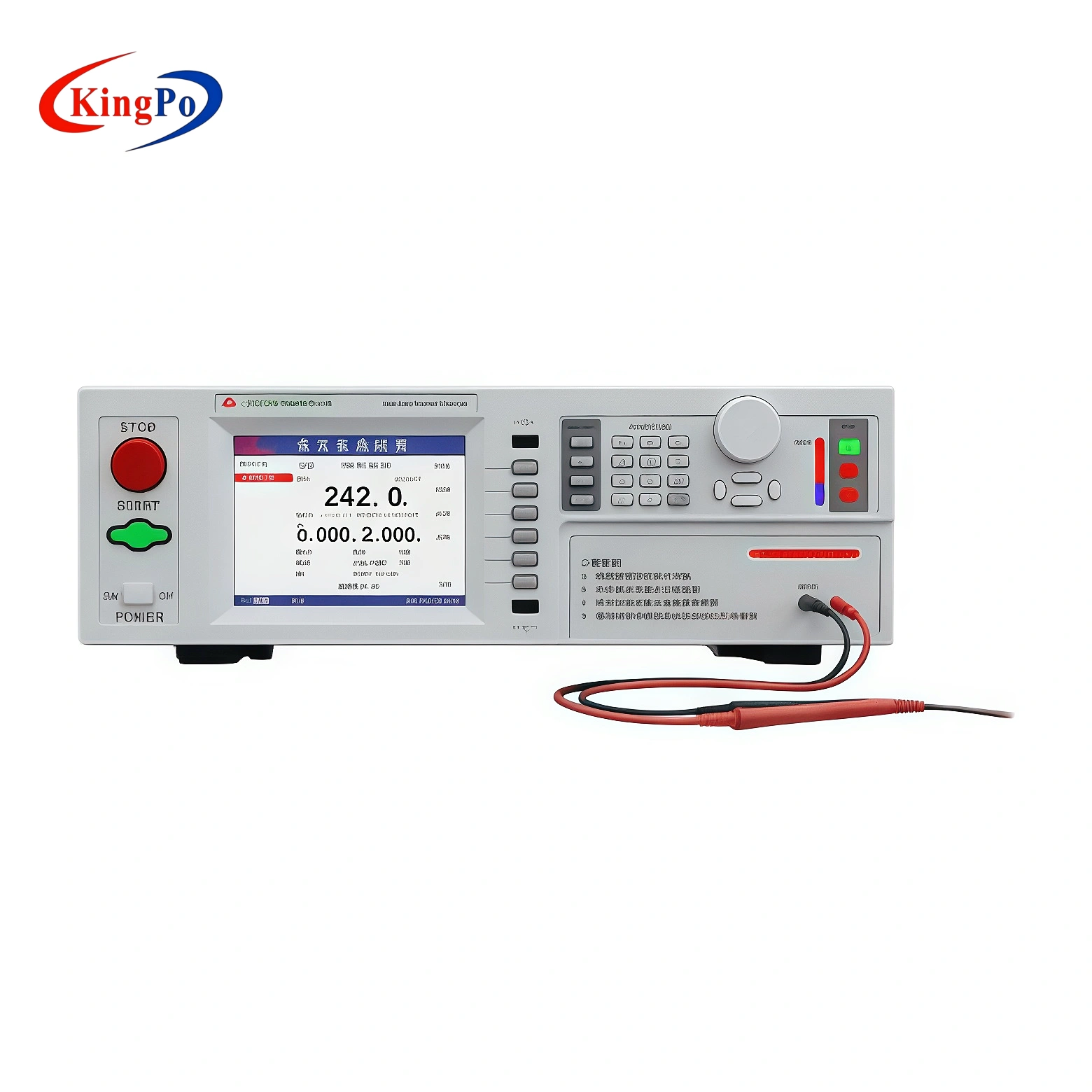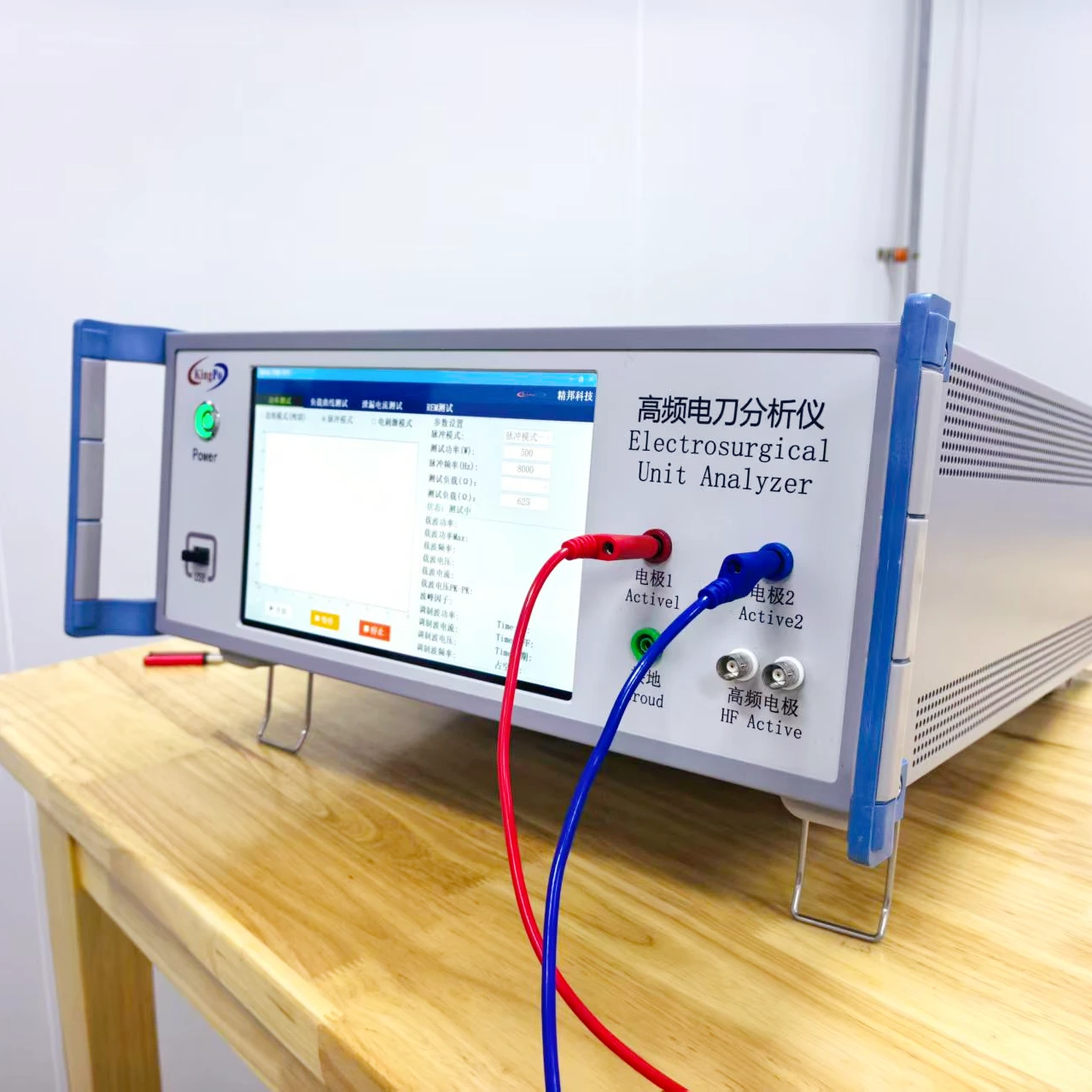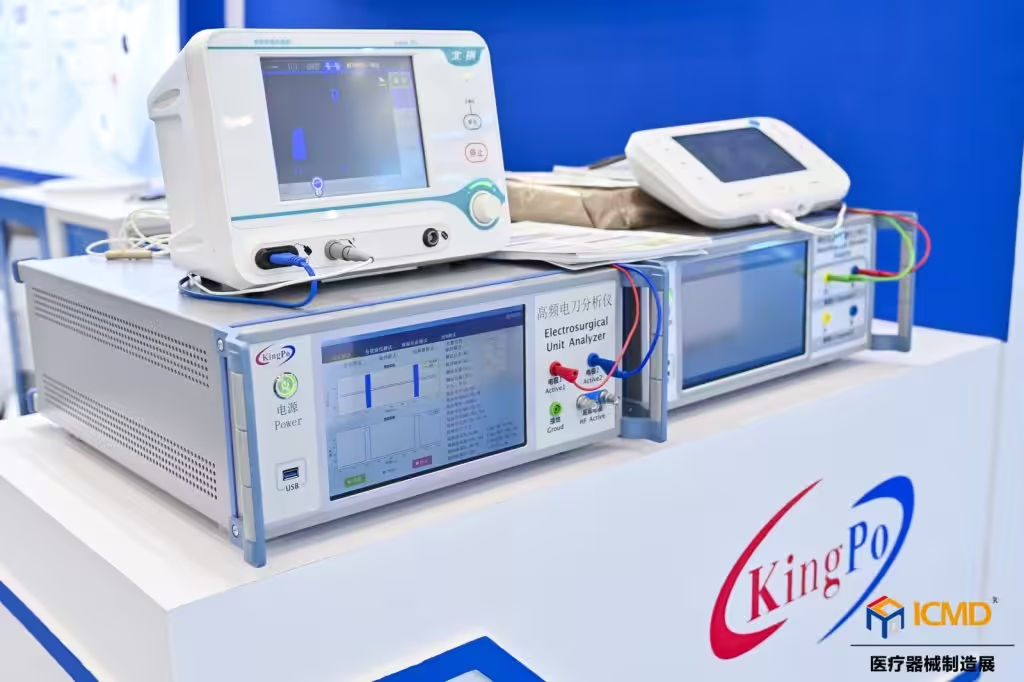
Comparing Two Leading ESU Analyzers
Explore the key differences between KP8850 and QA-ES III analyzers.
| Features | Fluke Biomedical QA-ES III | Kingpo KP-8850 High-Frequency Electrosurgical Analyzer |
|---|---|---|
| Measurement Accuracy | ±2.5% (of reading for output current) | Power: ≤50 W: ±(2.5% + 2 digits); >50 W: ±(2.5% + 2 digits) Load/REM impedance: ±1% (≥50 Ω); ±2.5% (10–50 Ω) |
| Power Range | 0–400 W (typical, supports higher ESU output) | 0–500 W |
| Voltage Range | 0–10 kV peak-to-peak | 0–10 kV (peak) |
| Current Range | 0–5,500 mA RMS | 2 mA–7,000 mA RMS |
| Bandwidth / Frequency Range | 30 Hz–3 MHz (–3 dB with load) | 30 kHz–200 MHz |
| Load Impedance | 10 Ω–5,200 Ω (variable load) | 0–2,000 Ω (1 Ω steps), expandable to 6,400 Ω |
| High-Frequency Leakage Current | Supported (grounded/isolated) | 20 mA–1,000 mA |
| REM/CQM Testing | Supported (CQM) | Supported (REM, 0–2,000 Ω expandable to 6,400 Ω) |
| Power Distribution Curves | Supported (automatic power distribution) | Supported + automatic internal impedance switching |
| Crest Factor / Peak Factor | Supported | 1.4–400 |
| Pulse Mode Testing | Supported | Supported |
| External Load Support | Supported | Supported |
| Display | High-contrast LCD | Full-color 10-inch LCD touchscreen (graphics, curves, zoom) |
| Data Export / Storage | USB, Bluetooth wireless | USB + Ethernet, 500 GB internal storage |
| Standards Compliance | IEC 60601-2-2 (international) | GB 9706.202-2021, WS/T 602-2018, JJF 1217-2025 (IEC 60601-2-2 aligned) |
| Automatic / Guided Testing | Guided sequences + Ansur software automation | Full automatic testing function |
| Dimensions | 14.5 × 35 × 47 cm | 500 × 450 × 220 mm |
| Weight | 7.5 kg | 15 kg |
| Portability | Field-service optimized (lightweight) | Bench/lab oriented (heavier) |
KP8850 delivers high-frequency precision and advanced waveform capture, making it ideal for laboratory and manufacturer settings where accuracy and compliance matter most. QA-ES III excels in hospital and field service environments, providing guided test sequences and wireless record downloads for efficient preventive maintenance. Kingpo’s ESU Analyzer offers automated power distribution curves and REM/CQM testing, while Fluke Biomedical’s solution features all-in-one hardware and software, user-friendly navigation, and robust memory storage. Users seeking maximum measurement reliability and global compliance benefit from KP8850, whereas those prioritizing workflow speed and device compatibility find QA-ES III better suited.
Key Takeaways
-
KP8850 excels in laboratory settings with high-frequency precision and advanced waveform capture.
-
QA-ES III is designed for clinical environments, offering guided test sequences for efficient preventive maintenance.
-
Both analyzers comply with international safety standards, ensuring reliable performance in various applications.
-
KP8850 features a large touchscreen for easy navigation, while QA-ES III uses a high-contrast LCD with physical buttons.
-
Automated power distribution curves in KP8850 provide deep insights into generator performance over time.
-
QA-ES III supports wireless data export, streamlining documentation and enhancing workflow in busy clinical settings.
-
Consider your operational needs: KP8850 is ideal for detailed analysis, while QA-ES III offers speed and portability.
-
Both analyzers provide robust memory storage, but QA-ES III can store up to 5,000 test records for easy data management.
ESU Analyzer Comparison Overview
Key Specifications Table
|
Specification |
KP8850 High Frequency Electrosurgical Analyzer |
Fluke Biomedical QA-ES III ESU Analyzer |
|---|---|---|
|
Measurement Accuracy |
±2.5% or better (power/current) |
High accuracy (manufacturer specified) |
|
Frequency Range |
Wide, supports complex waveforms |
Standard ESU frequency range |
|
Display |
Large touchscreen |
High-contrast LCD |
|
Test Modes |
Pure cut, blend cut, coag, vessel sealing |
Cut, coag, bipolar, advanced modes |
|
Standards Compliance |
IEC 60601-2-2:2017, global standards |
IEC 60601-2-2, international standards |
|
Data Export |
USB, automated reports |
Wireless download, USB |
|
REM/CQM Testing |
Supported |
Supported |
|
Power Distribution Curves |
Automated generation |
Not specified |
|
Guided Test Sequences |
Automated test sequences |
Step-by-step user guidance |
|
Portability |
Compact, lab-ready |
Field service optimized |
Feature Highlights
Both KP8850 and QA-ES III stand out in the ESU Analyzer market due to their advanced measurement capabilities. KP8850 uses high-frequency current sensors and high-voltage acquisition technology. This design allows it to capture complex pulsed and modulated waveforms with true RMS accuracy. QA-ES III focuses on workflow efficiency, offering guided test sequences that help technicians complete preventive maintenance quickly.
KP8850 excels in laboratory and manufacturing environments. Its automated power distribution curves and comprehensive REM/CQM testing provide deep insights into generator performance. The large touchscreen interface simplifies navigation and supports automated test sequences, making the device accessible for both experts and new users. The analyzer’s compliance with IEC 60601-2-2:2017 ensures suitability for international applications.
QA-ES III targets hospital and field service use. Its robust memory storage and wireless data export streamline documentation. The device supports a wide range of ESU models, making it a versatile choice for biomedical engineers who maintain diverse equipment fleets. The step-by-step user guidance reduces training time and minimizes errors during testing.
In terms of technology, KP8850 emphasizes high-frequency measurement and waveform fidelity. QA-ES III prioritizes usability and compatibility with multiple ESU types. Both analyzers deliver reliable results and support international safety standards. However, KP8850’s advanced waveform capture and automated analysis features set it apart for users who require detailed performance evaluation. QA-ES III’s intuitive interface and wireless workflow integration make it ideal for fast-paced clinical environments.
Note: Both analyzers measure key performance and safety parameters, ensuring compliance with global standards. Their user-friendly interfaces enhance the testing experience, but each model offers unique strengths tailored to specific user needs.
ESU Analyzer Performance
Measurement Capabilities
Power Output
KP8850 and QA-ES III both deliver robust power output measurement for electrosurgical generators. KP8850 utilizes high-frequency current sensors and advanced high-voltage acquisition technology. This approach enables the analyzer to capture true RMS values across a wide range of ESU modes, including pure cut, blend cut, coagulation, and vessel sealing. The device automatically generates power distribution curves, which provide users with a clear view of generator consistency and stability.
QA-ES III measures power, current, frequency, crest factor, and load resistance. The analyzer supports both single and continuous measurement modes, allowing technicians to assess ESU performance during preventive maintenance or troubleshooting. The all-in-one design incorporates hardware and software, streamlining the testing process for hospital and field service environments.
Tip: Automated power distribution curves in KP8850 help laboratories and manufacturers evaluate generator performance over time, while QA-ES III’s guided test sequences simplify routine checks for clinical staff.
Frequency Range
KP8850 stands out with its wide frequency range and high sampling frequency. The analyzer captures complex pulsed, modulated, and high-crest-factor waveforms with exceptional fidelity. Ultra-fast digital sampling ensures that even transient signals are recorded accurately, which is critical for laboratory and manufacturing applications where waveform integrity matters.
QA-ES III covers the standard ESU frequency range required for clinical testing. The device reliably measures frequency and crest factor, supporting compliance with international safety standards. While QA-ES III provides accurate frequency readings, KP8850’s high-speed digitization offers deeper insight into waveform behavior, making it suitable for advanced research and development.
Precision & Reliability
Repeatability
KP8850 achieves repeatable measurements through its high-frequency sensors and true RMS technology. The analyzer consistently delivers precision of ±2.5% or better for power and current measurements, even in high-power ranges. This level of repeatability ensures that results remain stable across multiple test sessions, which is essential for quality assurance in laboratory settings.
QA-ES III also demonstrates strong repeatability. The device collects precise metrics for all critical ESU functions and stores up to 5,000 test records in memory. Technicians can review historical data to verify consistency and identify trends in ESU performance. The guided test sequences reduce user error, further enhancing reliability during routine maintenance.
-
QA-ES III tests all critical ESU functions with precise metrics, including power, current, frequency, crest factor, and load resistance.
-
Measurements can be collected in both single and continuous modes.
-
Memory storage streamlines data management after testing sessions.
Standards Compliance
Both analyzers comply with international standards for electrosurgical equipment. KP8850 meets IEC 60601-2-2:2017 requirements, ensuring global compatibility and safety. The analyzer verifies compliance through precise instrumentation and automated test sequences, which align with regulatory expectations.
QA-ES III adheres to IEC 60601-2-2 and ANSI/AAMI standards. The device uses accurate testing methods specified in these standards, providing confidence in the safety and performance of ESU devices. Compliance verification occurs through guided test sequences and reliable measurement instrumentation.
-
QA-ES III complies with IEC 60601-2-2, the international standard for high-frequency surgical equipment safety and performance.
-
Compliance verification is achieved through precise instrumentation and testing methods.
Note: Both ESU Analyzer models deliver reliable performance and meet global safety standards. KP8850’s advanced waveform capture and high sampling frequency offer enhanced measurement fidelity for laboratory and manufacturing use. QA-ES III’s guided workflow and robust memory storage support efficient preventive maintenance in clinical environments.
Usability
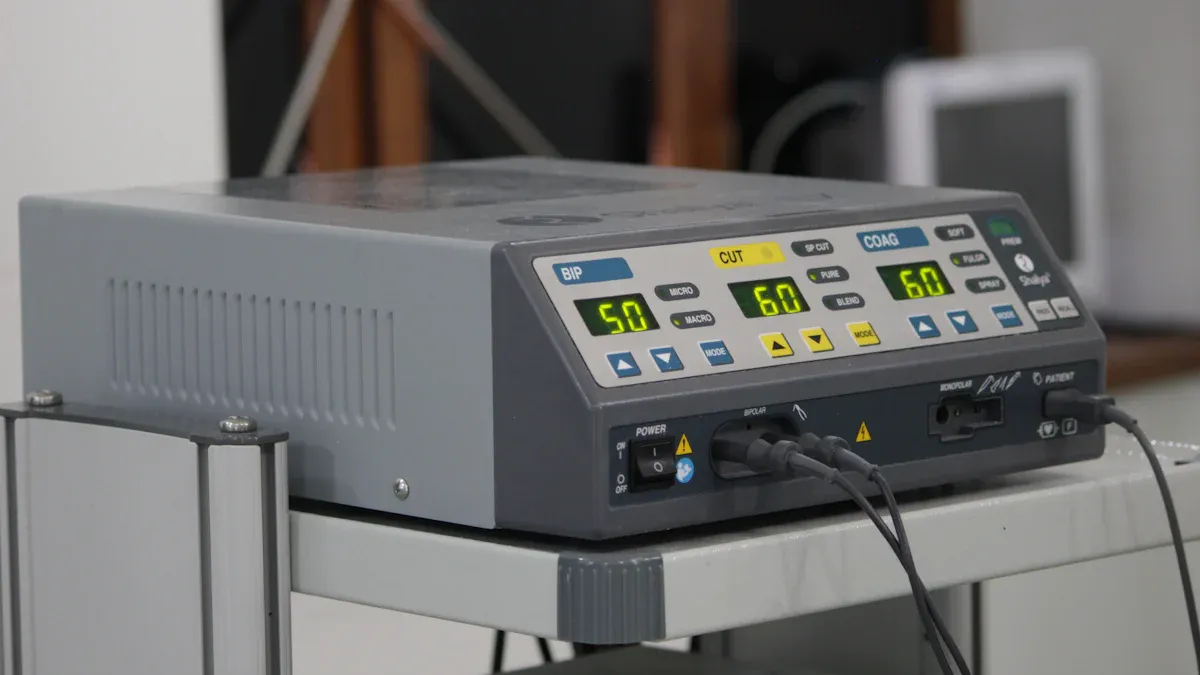
Interface & Controls
Display
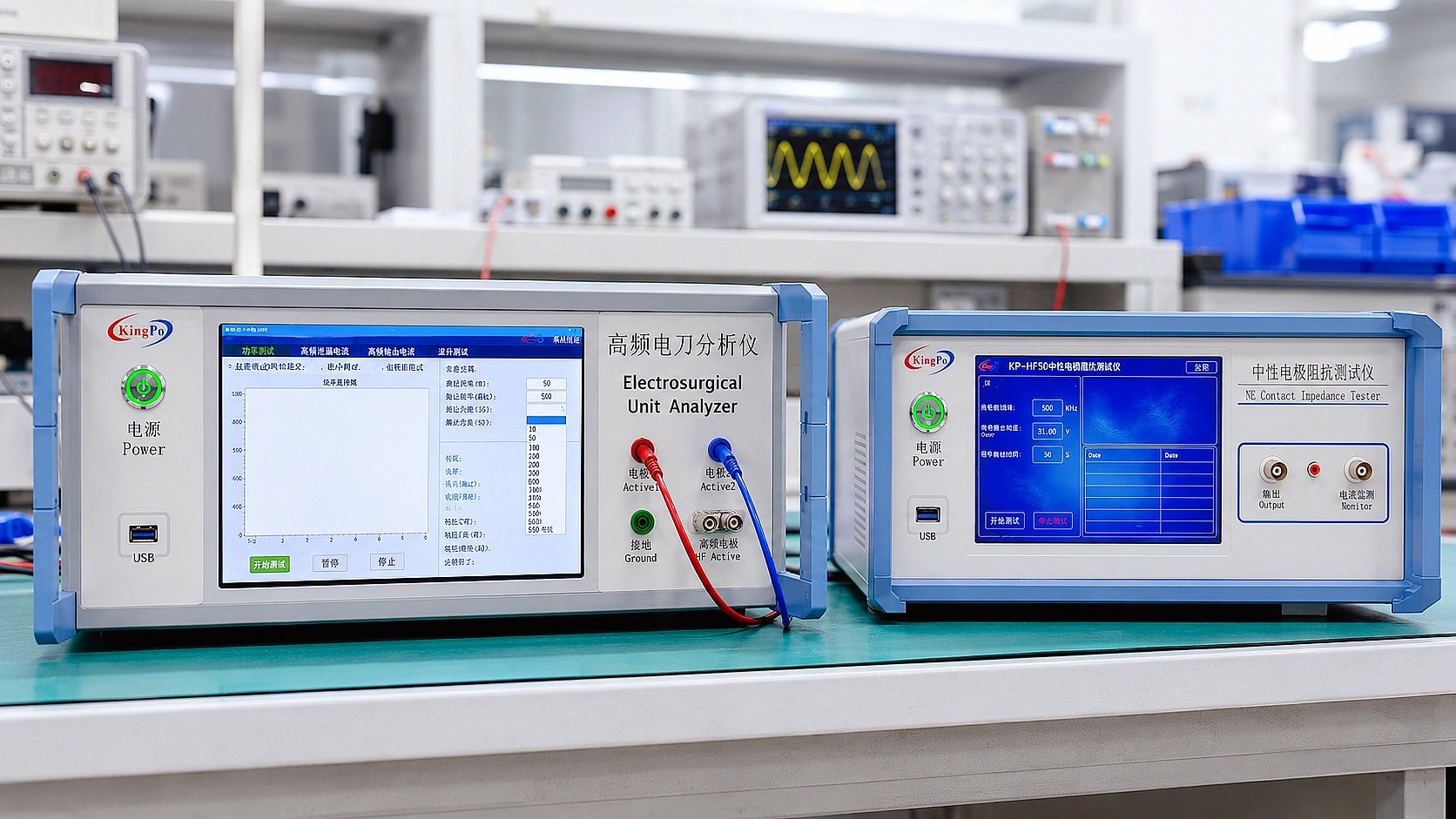
KP8850 features a large, high-resolution touchscreen. This display provides clear visuals for test results and menu navigation. Users can view waveform data and power distribution curves directly on the screen. The touchscreen supports intuitive gestures, which helps users access functions quickly.
QA-ES III uses a high-contrast LCD. The display presents essential test data in a straightforward format. The screen remains visible in various lighting conditions, which benefits technicians working in different environments. The LCD design supports durability and reliability during field use.
Navigation
KP8850 offers a modern interface with touch-based navigation. Users can move between test modes and settings with simple taps. Automated test sequences guide users through complex procedures, reducing the chance of error. The menu structure remains logical and easy to follow.
QA-ES III provides step-by-step user guidance. The interface uses physical buttons for navigation, which some technicians may prefer for tactile feedback. The device leads users through each test, ensuring that even less experienced staff can complete procedures accurately.
Setup & Portability
Physical Design
KP8850 has a compact, lab-ready form factor. The device fits easily on benchtops and workstations. Its robust construction supports frequent use in laboratory and manufacturing settings. The analyzer’s design emphasizes stability and ease of handling.
QA-ES III is optimized for portability. The lightweight chassis and integrated handle make transport simple. Field service technicians can carry the device between locations without difficulty. The rugged exterior protects the analyzer from bumps and minor impacts during travel.
Battery & Power
KP8850 operates primarily on AC power, which suits stationary environments like labs and production lines. The device ensures continuous operation during extended testing sessions. Power management features help maintain measurement accuracy.
QA-ES III includes an internal rechargeable battery. This feature allows technicians to perform tests in locations without immediate access to power outlets. The battery supports multiple test sessions on a single charge, increasing flexibility for field service work.
Workflow Integration
Data Export
KP8850 supports USB data export. Users can generate automated reports and transfer results to computers for further analysis. The process streamlines documentation and record-keeping in regulated environments.
QA-ES III enables wireless record download. Technicians can transfer test data directly to networked systems or storage devices. This wireless capability reduces paperwork and speeds up the workflow in busy clinical settings.
Software Compatibility
KP8850 integrates with standard data management software. The analyzer’s exported files are compatible with common formats, which simplifies integration into existing quality systems. Automated test reports help maintain compliance with regulatory requirements.
QA-ES III works seamlessly with Fluke’s proprietary software. The system supports efficient data review and archiving. Users can organize and retrieve historical records with minimal effort, supporting preventive maintenance programs.
Tip: When choosing an ESU Analyzer, consider how the device’s interface, portability, and data management features align with your workflow needs. Both KP8850 and QA-ES III offer user-friendly solutions, but each excels in different operational environments.
Compatibility & Features
Supported ESU Modes
Cut, Coag, Bipolar
Both KP8850 and QA-ES III support essential electrosurgical modes, including cut, coagulation, and bipolar. These modes allow technicians to test a wide variety of electrosurgical units in clinical, laboratory, and manufacturing environments. KP8850 offers broad compatibility by supporting pure cut, blend cut, coagulation, and vessel sealing. QA-ES III covers cut, coag, and bipolar modes, ensuring it meets the needs of modern surgical equipment.
-
Tests all critical ESU functions with precise power, current, frequency, crest factor, and load resistance ranges.
-
Collects measurements in single and continuous mode.
-
Complies with global standards, including ANSI/AAMI and IEC.
Advanced Modes
KP8850 and QA-ES III both handle advanced ESU modes. KP8850 excels in capturing complex waveforms, such as pulsed and modulated signals, which are common in high-performance generators. QA-ES III optimizes compatibility with high-power ESUs, supporting advanced waveform analysis and ensuring compliance with safety standards. This versatility makes each ESU Analyzer suitable for a wide range of devices.
Advanced Functions
Safety Features
Safety remains a priority for both analyzers. KP8850 provides comprehensive REM and CQM testing, verifying return electrode monitor and contact quality monitor functions. The device checks impedance ranges, alarm thresholds, and timing accuracy, ensuring patient safety and generator reliability. QA-ES III also supports REM/CQM verification, meeting international safety requirements for electrosurgical equipment.
Automation
KP8850 stands out with automatic generation of power distribution curves. This feature evaluates generator consistency and stability by producing power versus load resistance graphs. QA-ES III offers guided test sequences, automating routine checks and reducing technician workload. Both analyzers streamline testing processes, improving efficiency and accuracy.
Note: Automated features in KP8850 and guided workflows in QA-ES III help users maintain high standards of safety and performance.
|
Feature |
Description |
|---|---|
|
Power Distribution Curves |
Automatic generation of power vs. load resistance graphs for evaluating generator consistency and stability. |
|
REM / CQM Verification |
Complete testing of Return Electrode Monitor / Contact Quality Monitor functions, including impedance range, alarm thresholds, and timing accuracy. |
Connectivity
USB, Bluetooth
KP8850 supports USB data export, allowing users to transfer test results and generate automated reports. QA-ES III provides both USB and wireless download capabilities, enabling technicians to quickly move records to networked systems. Wireless connectivity speeds up documentation and enhances workflow integration in busy environments.
System Integration
Both analyzers integrate with standard data management software. KP8850 exports files compatible with common formats, simplifying quality system integration. QA-ES III works seamlessly with Fluke’s proprietary software, supporting efficient data review and archiving. These connectivity options ensure that each ESU Analyzer fits into existing hospital, laboratory, or manufacturing workflows.
Tip: When selecting an ESU Analyzer, consider the supported modes, advanced functions, and connectivity features to match your operational needs.
Value & Support
Pricing Analysis
Purchase Price
Pricing plays a significant role in the selection of an ESU Analyzer. Hospitals and laboratories often weigh the initial investment against long-term benefits. The QA-ES III Electrosurgical Analyzer and Tester from Fluke Biomedical lists at $11000 in recent market offerings. KP8850’s pricing varies based on configuration and regional distribution, typically aligning with other high-end laboratory-grade analyzers. Buyers should consider the features and measurement capabilities when evaluating cost.
-
QA-ES III: $7,104.95 (market listing)
-
KP8850: Competitive with advanced laboratory analyzers
Note: The purchase price reflects the technology, compliance, and workflow integration each analyzer provides.
Maintenance
Maintenance requirements differ between models. QA-ES III offers streamlined preventive maintenance, supported by robust memory storage and guided test sequences. Technicians can perform routine checks efficiently, reducing downtime. KP8850 emphasizes automated test sequences and stable hardware, minimizing calibration frequency and service interruptions. Both analyzers require periodic calibration to maintain measurement accuracy.
Warranty & Support
Service Coverage
Warranty coverage ensures peace of mind for buyers. Fluke Biomedical provides comprehensive warranty options for QA-ES III, including service plans and extended coverage. Users benefit from global support networks and authorized service centers. DG Kingpo offers warranty coverage for KP8850, supporting laboratory and manufacturing environments with responsive service and technical assistance.
|
Analyzer |
Warranty Coverage |
Service Network |
|---|---|---|
|
KP8850 |
Manufacturer warranty |
Regional/global support |
|
QA-ES III |
Comprehensive warranty |
Global service centers |
Technical Assistance
Technical support remains essential for both analyzers. QA-ES III users access Fluke’s technical helpline, online resources, and training modules. KP8850 users receive guidance from DG Kingpo’s engineering team, including remote troubleshooting and documentation. Both brands deliver prompt assistance, ensuring minimal disruption during critical testing.
Long-Term Value
Durability
Durability impacts the analyzer’s lifespan and reliability. QA-ES III features a rugged chassis and field-ready design, suitable for frequent transport and clinical use. KP8850 incorporates robust construction and high-quality components, supporting continuous operation in laboratory and manufacturing settings. Both analyzers withstand daily use and environmental stress.
Upgrade Options
Upgrade paths extend the value of each analyzer. QA-ES III supports firmware updates and software enhancements, allowing users to access new features and compatibility improvements. KP8850 offers modular upgrades and integration with evolving laboratory systems. These options help users adapt to changing regulatory requirements and technological advancements.
Tip: When evaluating ESU Analyzers, consider not only the purchase price but also maintenance, warranty, support, and upgrade options. Long-term value depends on durability, service coverage, and adaptability to future needs.
Pros & Cons
KP8850 Strengths
The KP8850 High Frequency Electrosurgical Analyzer demonstrates robust performance and versatility. Users benefit from advanced measurement capabilities and comprehensive compatibility with modern ESU devices. The analyzer supports a wide range of operational modes and delivers reliable results for both laboratory and manufacturing environments.
|
Feature |
Description |
|---|---|
|
Adjustable Impedance Simulation |
Simulates impedance from 5 Ω to 150 Ω, enabling full verification across ESU types. |
|
Alarm Threshold Testing |
Verifies alarm thresholds, enhancing operational safety and reliability. |
|
Activation Timing |
Measures activation timing for multiple ESU modes, supporting precise evaluation. |
|
Mode Handling |
Captures pure cut, blend cut, coagulation, and vessel sealing with deep waveform buffering. |
|
Internal Storage |
Stores test data internally and allows USB/PC export for easy access and review. |
|
Customizable Report Generation |
Generates tailored reports for traceability and compliance documentation. |
-
KP8850 offers full verification in both manual and automatic modes.
-
Data export options simplify workflow integration and support regulatory compliance.
-
Customizable reports improve usability for quality assurance teams.
-
KP8850 remains compatible with various ESU modes, including coagulation and vessel sealing.
-
The analyzer supports non-standard RF waveforms, increasing versatility for advanced testing.
-
Compliance with calibration records and documentation ensures traceability and regulatory alignment.
KP8850 stands out for its high-frequency measurement fidelity, automated power distribution curves, and REM/CQM testing. The touchscreen interface and automated test sequences streamline operation, making the device accessible for both experienced engineers and new users.
KP8850 Weaknesses
While KP8850 excels in laboratory and manufacturing settings, its design prioritizes stationary use. The analyzer relies on AC power, which may limit portability for field service technicians. Some users may prefer a device with integrated battery support for remote testing environments.
KP8850 focuses on advanced waveform capture and precision measurement, which suits environments where accuracy and compliance are critical.
QA-ES III Strengths
The QA-ES III ESU Analyzer from Fluke Biomedical delivers strong performance in clinical and field service applications. Technicians benefit from guided test sequences and efficient data management features.
|
Strengths |
Description |
|---|---|
|
Guided Test Sequences |
User-friendly interface with large buttons and LCD screen guides users through test sequences. |
|
Wireless Data |
Stores up to 5,000 test records, enabling efficient data management and wireless downloads. |
|
Multi-Model Support |
All-in-one tool includes hardware and software for various ESU functions, complying with global standards. |
-
QA-ES III simplifies preventive maintenance with step-by-step guidance.
-
Wireless data export accelerates documentation and reduces manual record-keeping.
-
Multi-model support ensures compatibility with diverse ESU devices in hospital fleets.
QA-ES III offers portability, robust memory storage, and intuitive navigation, making it ideal for technicians who require flexibility and speed in clinical environments.
QA-ES III Weaknesses
The QA-ES III ESU Analyzer from Fluke Biomedical offers strong performance in clinical and field service environments. However, several limitations may affect its suitability for certain users and applications. The following points summarize key weaknesses observed in comparison with the KP8850 High Frequency Electrosurgical Analyzer:
-
Limited Waveform Analysis
QA-ES III provides reliable measurement for standard ESU waveforms. It does not capture complex pulsed or modulated signals with the same fidelity as KP8850. Laboratories and manufacturers requiring advanced waveform analysis may find QA-ES III less suitable. -
Display and Interface Constraints
The device uses a high-contrast LCD with physical buttons. This interface supports durability but lacks the intuitive navigation and visual clarity of a touchscreen. Users accustomed to modern touch-based controls may experience slower workflow and reduced ease of use. -
Restricted Automated Reporting
QA-ES III enables wireless data export and memory storage. It does not offer customizable automated report generation or power distribution curve analysis. Quality assurance teams may need to perform additional manual steps to document and evaluate generator performance. -
Battery Life and Portability
QA-ES III includes an internal rechargeable battery. Extended field use may require frequent recharging, especially during intensive testing sessions. Technicians working in remote locations must plan for power management. -
Software Compatibility
The analyzer integrates with proprietary Fluke software. Users seeking broader compatibility with third-party data management systems may encounter limitations. Exported data formats may require conversion for integration into existing laboratory workflows. -
Advanced Mode Support
QA-ES III supports cut, coag, and bipolar modes. It does not provide the same depth of compatibility for vessel sealing or blend cut modes as KP8850. Biomedical engineers testing a wide range of ESU devices may need additional tools for comprehensive evaluation.
Note: QA-ES III delivers efficient preventive maintenance and guided workflows for clinical environments. Users in laboratory or manufacturing settings may require analyzers with deeper waveform analysis, broader mode compatibility, and enhanced reporting features.
The QA-ES III ESU Analyzer remains a reliable choice for hospitals and field service teams. Its weaknesses become more apparent when compared with analyzers designed for advanced laboratory testing and regulatory compliance. Decision-makers should assess their operational needs and workflow requirements before selecting an ESU Analyzer.
KP8850 suits laboratory and manufacturing environments where advanced waveform analysis and compliance drive decision-making. QA-ES III fits clinical and field service teams who value guided workflows and portability. The following table highlights how each ESU Analyzer supports informed choices:
|
Feature |
KP8850 |
QA-ES III |
|---|---|---|
|
Testing Capabilities |
Advanced |
|
|
Measurement Modes |
Single/Continuous |
Single/Continuous |
|
Compliance |
IEC 60601-2-2 |
IEC, ANSI/AAMI |
|
Interface |
Touchscreen |
LCD, buttons |
Select KP8850 for precision and automation. Choose QA-ES III for speed and versatility.
FAQ
What environments suit KP8850 and QA-ES III best?
KP8850 fits laboratory and manufacturing settings where precision and compliance matter. QA-ES III works well in hospitals and field service environments, supporting fast preventive maintenance and guided workflows.
How do KP8850 and QA-ES III handle data export?
KP8850 exports data via USB and generates automated reports. QA-ES III enables wireless record downloads and USB transfers, streamlining documentation for clinical teams.
Which analyzer offers more advanced waveform analysis?
KP8850 captures complex pulsed and modulated waveforms using high-frequency sensors and fast digital sampling. QA-ES III measures standard ESU waveforms, focusing on usability and compatibility.
Are both analyzers compliant with international standards?
Both KP8850 and QA-ES III comply with IEC 60601-2-2. QA-ES III also meets ANSI/AAMI standards. Each analyzer verifies compliance through precise instrumentation and automated test sequences.
What modes do KP8850 and QA-ES III support?
KP8850 supports pure cut, blend cut, coagulation, and vessel sealing. QA-ES III covers cut, coag, and bipolar modes, ensuring compatibility with most modern ESU devices.
How do the interfaces differ between KP8850 and QA-ES III?
KP8850 features a large touchscreen with intuitive navigation. QA-ES III uses a high-contrast LCD and physical buttons, offering durability and step-by-step user guidance.
What warranty and support options are available?
DG Kingpo provides manufacturer warranty and technical assistance for KP8850. Fluke Biomedical offers comprehensive warranty coverage and global service centers for QA-ES III.
Which analyzer is more portable?
QA-ES III includes an internal rechargeable battery and lightweight design, making it ideal for field service. KP8850 suits stationary lab environments with AC power operation.