For plastic insulation frames, given the high heat generated by the copper wires and iron core, if the flame retardant properties of the plastic are not up to standard, it can cause winding burnout and thus affect product quality. Therefore, understanding UL94 V-0 is essential. I hope this article I am forwarding can inspire you.
UL94 V-0 is one of the highest standards for the flammability of plastic materials. It requires that after two 10-second burning tests, the afterflame must extinguish within 10 seconds, and no burning material should drip down and ignite the cotton below. Simply put, this is the “golden line of defense” for equipment fire safety, meaning that the material has extremely strong self-extinguishing capabilities and can effectively prevent the spread of fire.
As someone who has worked in the electronic packaging industry for many years, I remember when I first started, I always felt that because LED beads are so small, the flame retardancy of the casing material didn’t seem that important. That is, until I witnessed a comparative test in the lab: a non-flame-retardant casing rapidly melted into a “rain of fire” upon heating, instantly igniting the test paper below; while the UL94 V-0 rated material next to it only emitted a wisp of black smoke before automatically extinguishing itself. At that moment, I deeply realized that V-0 is not just a parameter; it’s a lifesaver for products in extreme conditions.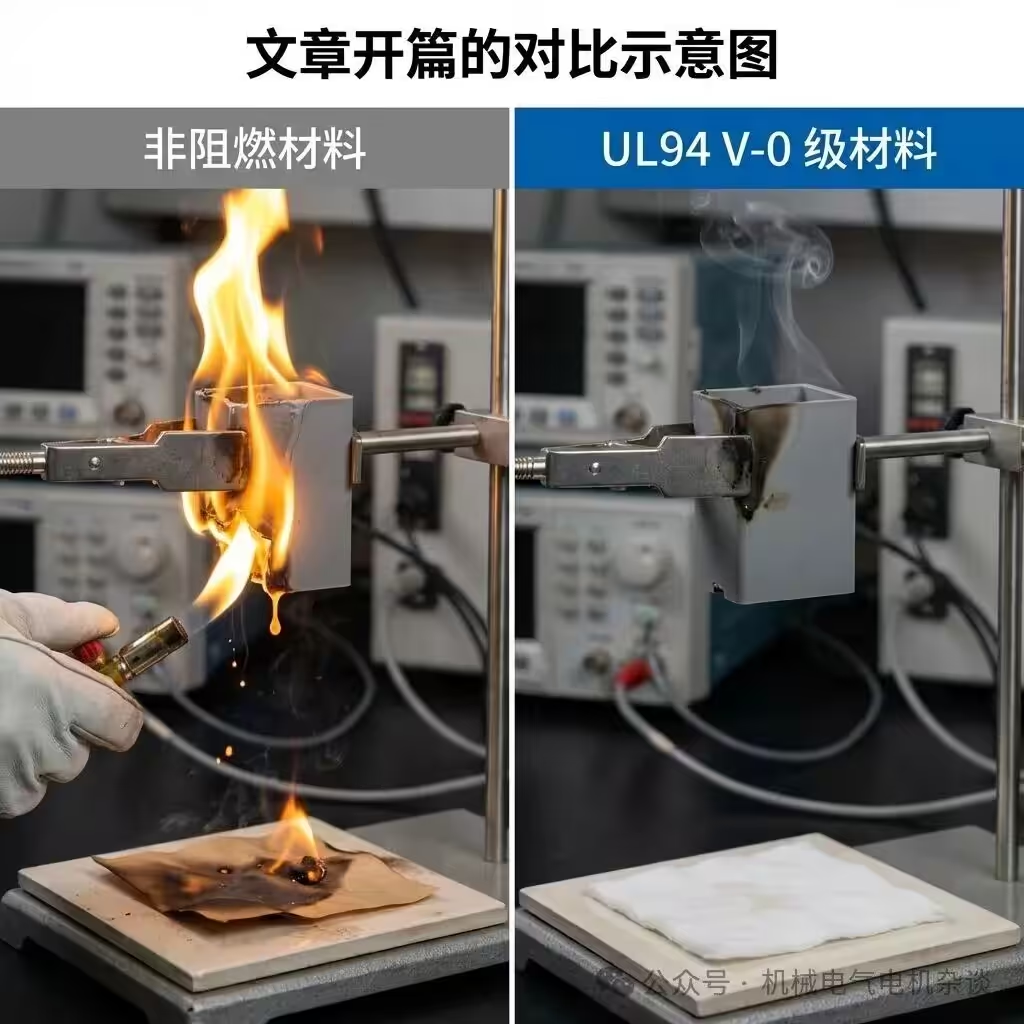
A vertical burning test comparison between UL94 V-0 flame-retardant materials and non-flame-retardant materials showed that the V-0 material self-extinguished rapidly after the flame was removed, with no burning droplets, while the non-flame-retardant material continued to burn and produced fire rain that ignited the cotton below.
- V-0 is the highest rating in vertical burning tests, meaning the flame must self-extinguish within 10 seconds .
- No burning molten droplets are allowed to fall and ignite the absorbent cotton below .
- The thickness of the material directly determines the flame retardant rating; the thinner the material, the more difficult it is to achieve V-0 .
- V-0 materials must be given priority for high-heat components such as LED packages and connectors .
- Checking the UL Yellow Card is the most direct way to verify the authenticity of materials .
- V-0 materials typically contain more flame retardants than HB or V-2 grade materials, and are therefore relatively more expensive .
- A balance must be struck between flame retardancy and physical strength; too much flame retardant may reduce the toughness of the material .
What are UL94 V-0 flame retardant materials? Key indicators and core definitions
In the world of engineering plastics, UL94 is the most basic and authoritative standard for material flammability. Many purchasing or engineering personnel, when selecting materials, may say “I want V-0 material,” but they often overlook the huge gap between different grades.
UL94 V-0 does not mean that the material is “unburnable,” but rather that it “cannot ignite on its own without a heat source.” This represents an extremely high requirement for self-extinguishing capability upon removal from a flame. For companies like Hengcai Electronics, which produce high-precision LED light sources, ensuring that the packaging material does not become a combustion promoter in the event of overheating or short circuits is the bottom line of product design.
To help you understand this more intuitively, let’s look at the “hierarchy of disdain” for several common grades in the UL94 standard:
| grade | Testing methods | Combustion time requirements | Is it permissible for dripping material to ignite cotton? | Brief Review |
| V-0 | Vertical combustion | ≤ 10 seconds | Not allowed | Safest, fastest self-extinguishing, no dripping flame. |
| V-1 | Vertical combustion | ≤ 30 seconds | Not allowed | Safety is acceptable, but it extinguishes a bit slowly. |
| V-2 | Vertical combustion | ≤ 30 seconds | allow | There is a fire hazard; the molten droplets may ignite the surrounding area. |
| HB | Horizontal combustion | Combustion rate < 40 mm/min | / | The minimum standard is actually “it can burn and burns slowly”. |
Industry data shows that electronic devices using UL94 V-0 standard materials have a 95% or higher probability of controlling the fire within the ignition point in the initial stage of a fire caused by a circuit fault.
This data clearly explains why V-0 is standard in high-end electronic products. While HB-grade materials are cheaper, they may burn out like a candle when placed vertically, which is extremely dangerous for wall-mounted or freestanding electronic devices.
In-depth analysis of UL94 V-0 testing standards and experimental procedures
Many customers ask, “You say you’ve achieved V-0, how did you measure that?” Actually, the testing process is very rigorous, and you could even say it’s a bit “brutal.”
The vertical burning test is not complicated, but it requires extremely high attention to detail. The tester will fix the long strip of sample vertically onto the fixture. Then, a piece of surgical absorbent cotton is placed underneath the sample.
Next comes the crucial “ignition step.” Using a standard Bunsen burner (flame height 20mm), apply the flame to the bottom of the sample for 10 seconds, then quickly remove it. At this point, we need to watch the stopwatch to see how long it takes for the flame to extinguish (this is called the afterflame time t1).
If it goes out, we have to burn it again! Apply the flame again for 10 seconds, remove it, and record the second extinguishing time (t2) and the red-hot time without flame (t3).
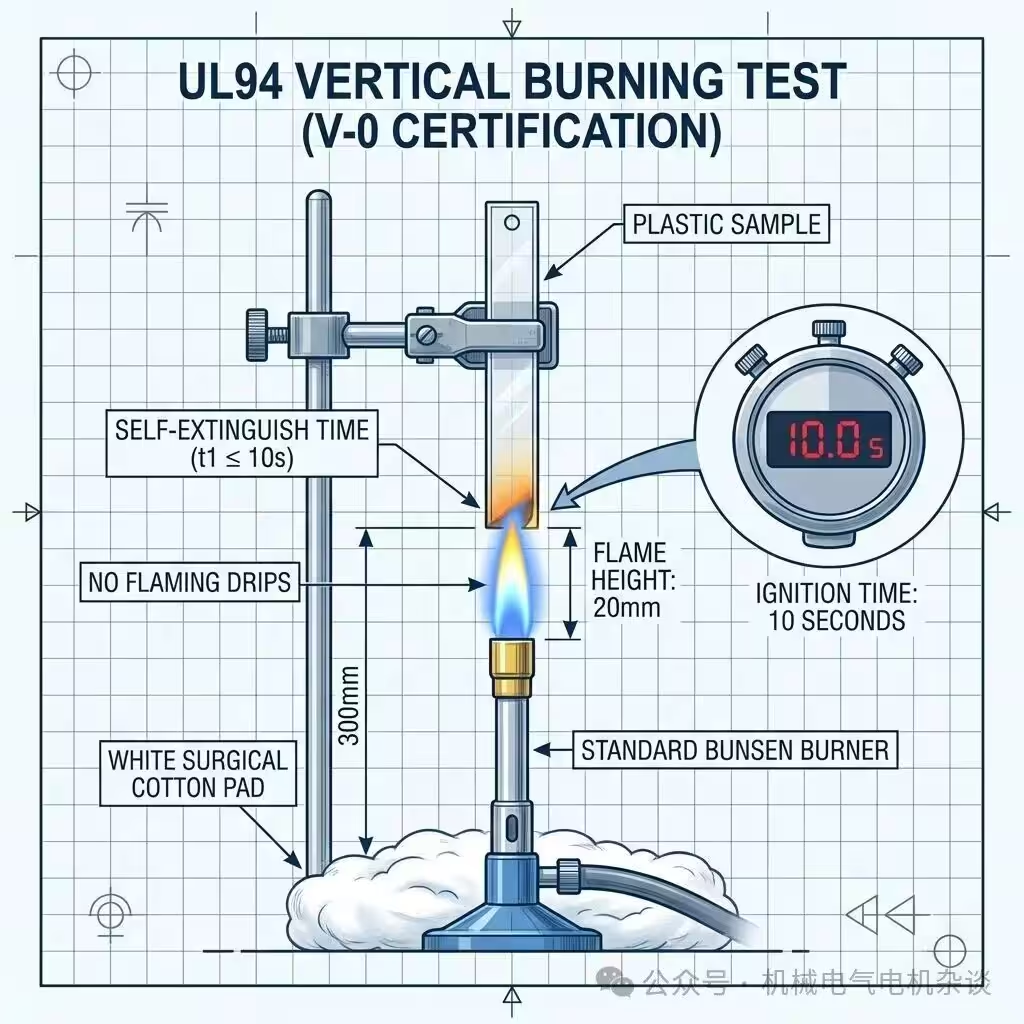
The UL94 Vertical Burning Test flowchart shows that after a standard sample is ignited by a Bunsen burner flame for 10 seconds, the afterflame must self-extinguish within 10 seconds and no dripping material should ignite the absorbent cotton.
To achieve the UL94 V-0 rating, the following stringent conditions must be met simultaneously:
- The afterflame time (t1 or t2) of each sample must not exceed 10 seconds.
- The total afterflame time (t1+t2) of the 5 samples must not exceed 50 seconds.
- Absolutely no burning liquid droplets should fall and ignite the cotton below .
Here’s a very interesting physical phenomenon: thickness. Often, a material with a thickness of 3.0mm has a V-0 value, but with a thickness of 0.8mm, it might not even reach a V-2 value.
This is because thin-walled materials are more easily penetrated by heat and can hold a smaller total amount of flame retardant. Therefore, when looking at a material property sheet, never just look at the words “UL94 V-0,” but always check the thickness that follows. If your product’s wall thickness is only 1mm, but the supplier provides a V-0 report for 3mm, then that report is basically useless to you.
Common Engineering Plastics and Material Properties that Meet UL94 V-0 Standard
Not all plastics can easily achieve a V-0 rating. Typically, we need to modify the base material and add flame retardants. Currently, the most common V-0 materials on the market include:
1. Polycarbonate (PC)
PC is a favorite in the electronics industry. It naturally possesses a certain degree of flame retardancy and, after modification, can easily achieve V-0. Its advantages lie in its high transparency and high impact resistance. Many charger casings and LED panel brackets use flame-retardant PC. However, adding too much flame retardant can affect transparency, requiring a very good balance in the formulation.
2. Polyamide (PA/Nylon)
Nylon materials (such as PA66) are very strong and durable, but pure nylon is highly flammable. To achieve V-0 flame retardancy, nitrogen- or phosphorus-based flame retardants are usually added. This material is commonly used in terminals and connectors. However, it should be noted that nylon is highly hygroscopic, and its electrical properties and dimensional stability will change after absorbing water.
3. PBT and PET
These two polyester materials are widely used in the LED industry, especially for lamp cups and frames. They possess excellent electrical insulation and heat resistance. Reinforced PBT, in particular, exhibits stability during high-temperature reflow soldering and is easily made to achieve a thin-walled V-0 rating.
Industry expert opinion : “When selecting V-0 materials, don’t just focus on the flame retardant rating. Flame retardants often reduce the material’s physical strength (such as notched impact strength). A good formulation engineer is someone who walks a tightrope between ‘unburnable’ and ‘unbreakable’.”
Special requirements for UL94 V-0 flame retardant materials in the LED and electronics industries
In the field of LED packaging, the requirements for flame-retardant materials are more stringent than those for ordinary consumer electronics. Why? Because an LED itself is a heat source.
For companies like HengCai Electronics, which focus on SMD LED chips and high-power LED light sources, we deeply understand the importance of thermal management. When an EMC3030 or 5050 LED chip is operating at full power, its core temperature rises rapidly. If the flame retardancy of the packaging bracket or lens material is inadequate, the material may carbonize after prolonged high-temperature aging, and could even ignite in the event of a circuit failure.
When LED chip packaging manufacturers we frequently encounter select bracket materials (such as PPA or EMC), V-0 is a mandatory requirement.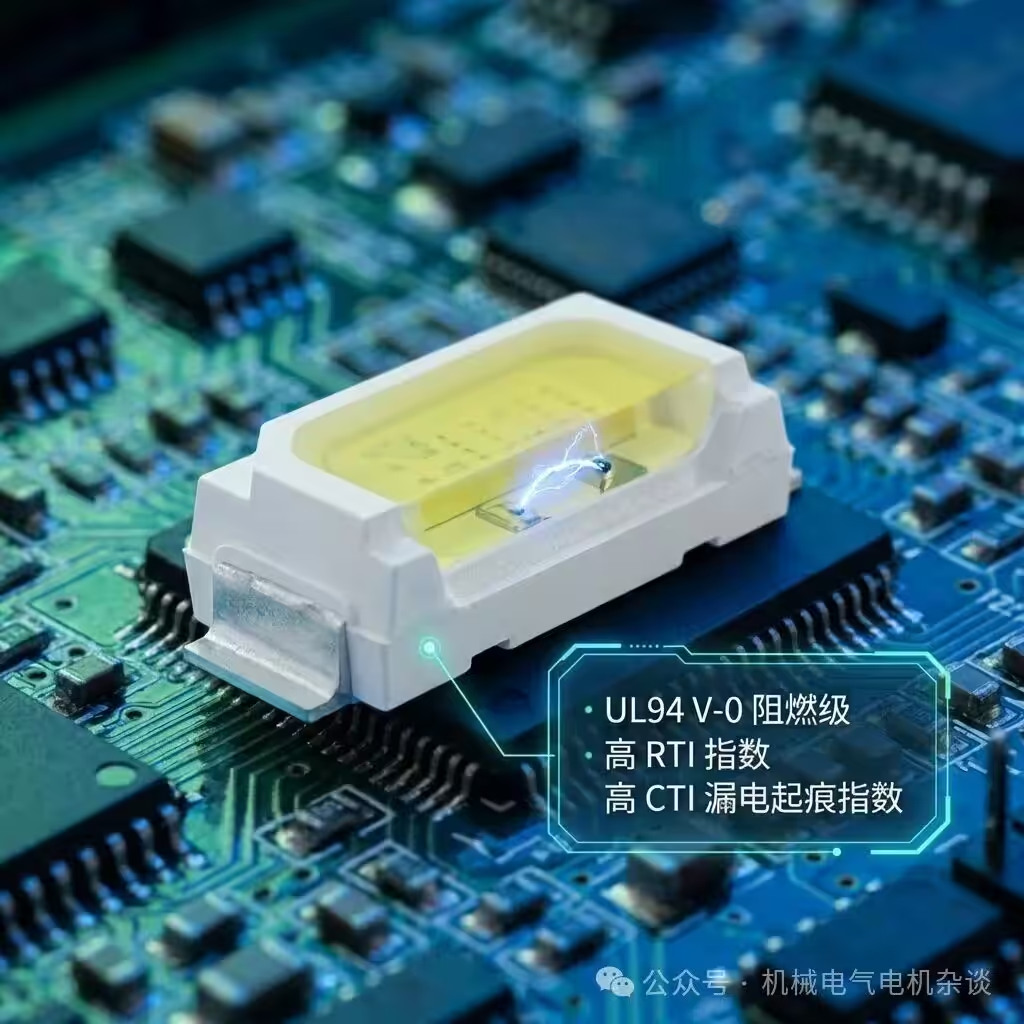
The internal structure cross-sectional view of Hengcai Electronics’ high-power SMD LED beads highlights the UL94 V-0 flame-retardant encapsulation bracket material, which effectively prevents combustion under simulated arc short circuit conditions, and is marked with high RTI and CTI indices.
Special Challenges: Preventing Arc Ignition In high-voltage LED applications, in addition to flame, arc prevention is also crucial. Materials must not only be flame-retardant but also possess a high CTI (compared to tracking index). If the material surface carbonizes due to a tiny discharge, the carbonized channels become conductive, generating enormous heat. V-0 materials must interrupt the combustion chain at this point.
Compromises in optical performance are a major pain point for all LED R&D personnel. Many highly effective flame retardants (especially halogen-based ones) yellow when exposed to heat for extended periods. Once the material yellows, the luminous efficacy and color temperature of the LED will deviate from their intended path. Therefore, the current trend is to use halogen-free flame retardant materials. Although this is technically more challenging and costly, it is a necessary step to ensure the consistency of light and color in HengCai Electronics products such as the SMD2835 and 3433 series throughout their entire lifecycle.
Technical Perspective: How to Interpret the Datasheet of UL94 V-0 Materials
As a professional purchasing or engineering professional, when you receive a material datasheet, your eyes should scan the key areas like radar.
Find the UL Yellow Card number . This is the document’s identification. If you have this number, you can check it directly on the UL website to prevent suppliers from falsifying documents (it’s impolite, but necessary).
Secondly, pay attention to the RTI (Relative Thermal Index) . RTI is divided into three types: electrical, mechanical shock, and non-mechanical shock. Even if the material has a V-0 rating, if the RTI is only 50°C, it will fail if it operates near an LED at 80°C for an extended period. You need to find materials with RTI values that match the operating temperature of your product.
Thickness traps (again, this is emphasized) are usually listed in the table:
- 0.8 mm -> V-0
- 1.6 mm -> V-0
- 3.0 mm -> V-0
If you see:
- 0.8 mm -> V-2
- 1.6 mm -> V-0
- 3.0 mm -> V-0
This means that if your product design has a 1mm thin-walled buckle, then that buckle part does not meet the V-0 requirement! This will be rejected directly during safety certification.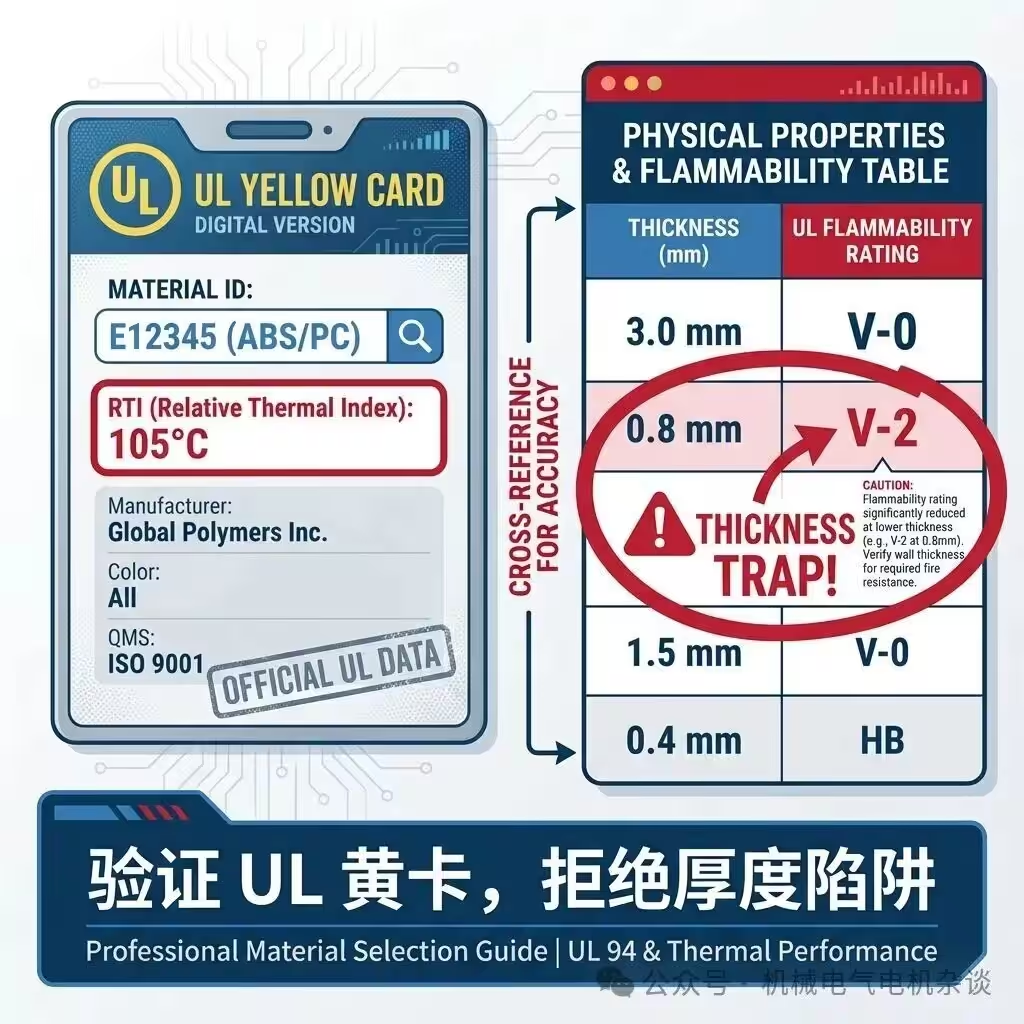
How to read UL Yellow Cards and Material Properties Tables: Show the Material ID and RTI on the UL Yellow Card, and highlight the differences in flame retardant ratings for different thicknesses in the Material Properties Table, warning against the ‘thickness trap’.
Tip : Many modification plants will provide “self-test reports”. While these are valuable for reference, if it is an export product or has passed safety certifications (such as CE, UL), you must request an official test report issued by a third-party laboratory (such as SGS, CTI, or UL official).
Comparison and compliance of UL94 V-0 with other international flame retardant standards
While UL94 is the leading standard, you’ll encounter other standards in global trade. Understanding their relationships can help you avoid pitfalls.
- UL94 V-0 vs. Chinese Standard GB/T 2408 The good news is that the vertical burning test in China’s GB/T 2408 is basically a direct copy of UL94. If a material passes GB/T 2408’s FV-0 rating (corresponding to V-0), it will most likely also pass UL94 V-0. However, when exporting to North America, customers only recognize the UL label.
- **Glow Wire Test (IEC 60695)** This is essential knowledge for exporting to the EU. The EU prefers IEC standards. The glow wire test involves using a red-hot wire to heat the material.
- GWFI (Flammability Index) : Extinguishes after being heated.
- GWIT (Ignition Temperature) : It must not ignite when heated. Materials that meet UL94 V-0 standards usually have good GWFI performance, but may not pass GWIT (because some flame retardants, while extinguishing fires, are easily ignited). If your product is intended for sale in Europe as part of home appliances, V-0 alone may not be enough; you also need to check if it ignites at 750°C or 850°C on a glow wire.
Frequently Asked Questions about UL94 V-0 Flame Retardant Materials
Is UL94 V-0 material completely non-combustible?
No. There is no absolutely unburnable plastic in the world. V-0 is defined as “flame-retardant and self-extinguishing.” If you throw it into a steel furnace, it will still turn to ash. Its function is to extinguish a fire from a limited energy source like a short circuit on a circuit board.
How can you verify if a supplier’s materials truly meet the V-0 standard?
Besides checking reports, the simplest, albeit impractical, method is to use a lighter. In a safe environment, burn the sample with a lighter for 10 seconds. If the flame continues to burn after the heat source is removed, it’s definitely not V-0. A genuine V-0 material will extinguish its flame rapidly, as if due to lack of oxygen, after the heat source is removed.
Does V-0 flame retardant affect the light transmittance of LEDs?
Yes. This is why transparent flame-retardant PC is much more expensive than opaque PC. For LED chips with lens structures, such as the 5050 or 3528, HengCai Electronics uses special flame-retardant materials with high light transmittance to ensure that luminous efficacy is not compromised.
Choosing high-standard flame-retardant materials ensures product safety.
In the electronics manufacturing industry, safety is always the “1” that comes first, while performance, price, and appearance are the “0s” that follow. Without safety, everything else is meaningless.
The UL94 V-0 standard may seem like a simple flammability test rating, but it represents a respect for life and a commitment to product quality. For companies like Hengcai Electronics, with nearly two decades of experience in packaging technology, every material selection is based on countless experimental data and stringent industry standards.
Whether you’re a buyer looking for high-reliability LED light sources or an engineer struggling with material selection late into the night, please always adhere to the V-0 standard. Because in the face of a fire, every second of self-extinguishing time can potentially prevent enormous losses.
The latest market analysis in 2024 indicates that with the popularization of new energy vehicles and smart homes, the market demand for UL94 V-0 grade high-performance flame retardant materials is expected to grow at a rate of 15% per year.
Choosing the right materials is not only for compliance, but also to give your products more confidence in gaining customer trust in the fierce market competition.