ISO 80369 Testing Equipment for Small-Bore Connector Compliance
Medical Connector Verification
ISO 80369 Testing Equipment for Small-Bore Connector Compliance
Reference connectors, Luer gauges, leakage test systems, force/torque fixtures and ISO 80369-20 test equipment for small-bore medical connector verification in enteral, respiratory, limb-cuff, neuraxial, intravascular and hypodermic applications.
ISO 80369-20:2024ISO 80369-7:2021ISO 80369-6:2025Application-specific fixtures
ISO 80369 testing equipment is used to verify small-bore medical connectors through dimensional gauges, reference connectors, leakage tests, separation force tests, torque tests, overriding resistance tests and stress cracking evaluation.
The correct equipment depends on the connector application, ISO or IEC 80369 part, edition year, Annex method, figure number and required reference interface.
A reference connector is a defined mating interface used during functional testing. It is not automatically the same as a simple go/no-go dimensional gauge, so equipment selection must separate dimensional inspection from leakage, force, torque and other performance tests.
Technical scopeISO 80369 equipment selection and connector verification
Edition basisApplication-specific parts plus ISO 80369-20:2024 methods
Published byKingPo Technology Development Limited
Reviewed7 August 2026 · Verify the purchased standard before testing
<8.5 mmSmall-bore definition
Part 20Common test methods
6% taperISO 80369-7 Luer
Application-specificReference interfaces
Series Map
Which ISO 80369 Part Applies?
Selecting ISO 80369 testing equipment starts with the intended clinical application, not with visual similarity to a Luer fitting. The series reduces the risk of accidental cross-connections between medical delivery systems. Editions and publication status change, so confirm the applicable edition in the official ISO standards catalogue and record it in the regulatory submission or design-control plan.
Current Standard Version Note: ISO 80369 standards are updated over time. Before selecting gauges, reference connectors or ISO 80369-20 test systems, confirm the exact part, edition year, Annex, figure and acceptance criteria required by your regulatory submission, laboratory method or customer specification.
Standard Part
Application
Edition / Status
Testing Focus
ISO 80369-1
General requirements for small-bore connectors in healthcare applications.
2025 edition. Confirm the purchased standard and regulatory transition requirement.
Series-level principles, application categories and non-interconnectability framework.
ISO 80369-2
Respiratory and driving-gas connections.
2024 edition. Confirm corrigendum or customer-specific requirement before quotation.
Application-specific reference interfaces, leakage performance and connection integrity.
ISO 80369-3
Enteral applications.
Application-specific part. Confirm edition and annex method for the connector under test.
Enteral feeding connectors, male/female references, leakage and connection security.
ISO 80369-4
Urethral and urinary applications.
Status must be verified before procurement. Do not assume a published Part 4 requirement without confirmation.
Project-specific review of applicable requirements and reference interface status.
IEC 80369-5
Limb-cuff inflation applications.
IEC publication. Confirm the applicable edition and clause for the project.
Blood-pressure cuff, tourniquet and pneumatic limb-cuff connector testing.
ISO 80369-6
Neural applications.
2025 edition. New projects should review the current edition instead of reusing a 2016 plan.
Neural connector reference interfaces, performance tests and non-interconnectability review.
2024 edition. Replaces the withdrawn 2015 edition.
Common performance test methods; use together with the applicable application-specific part.
Product Range
Reference Connectors, Gauges and Functional Test Systems
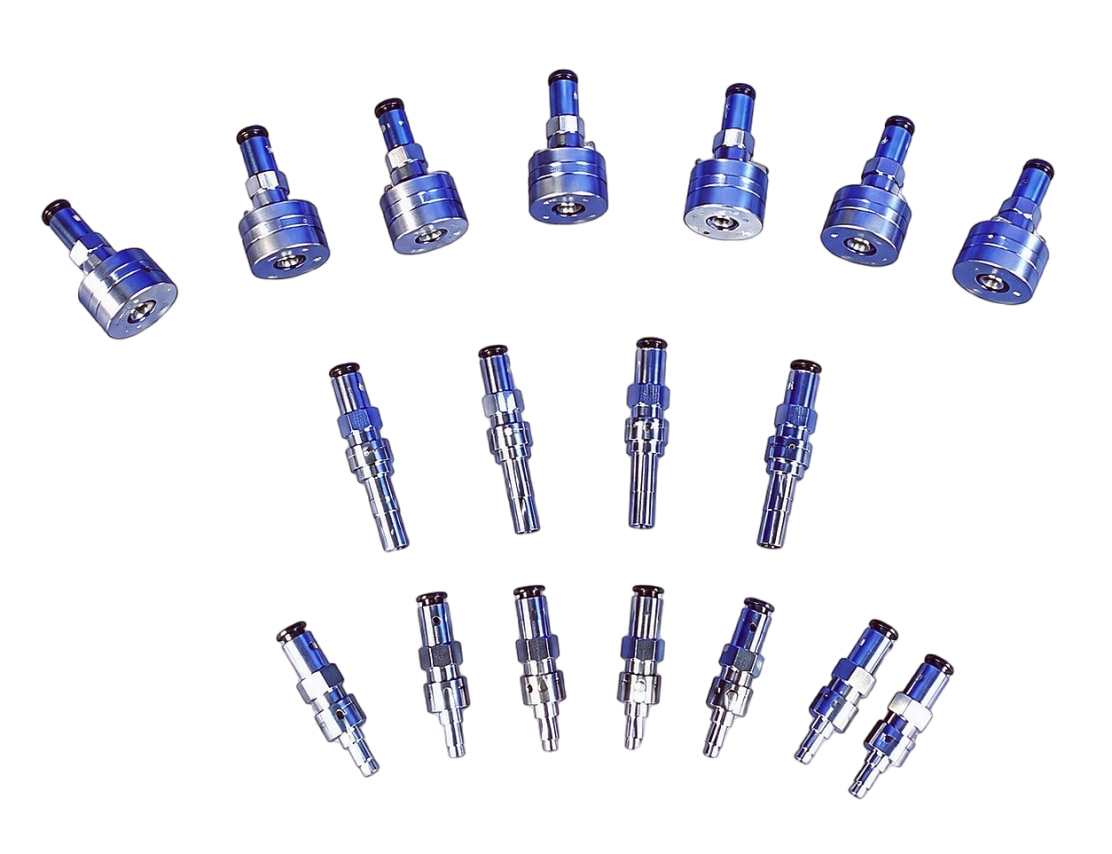
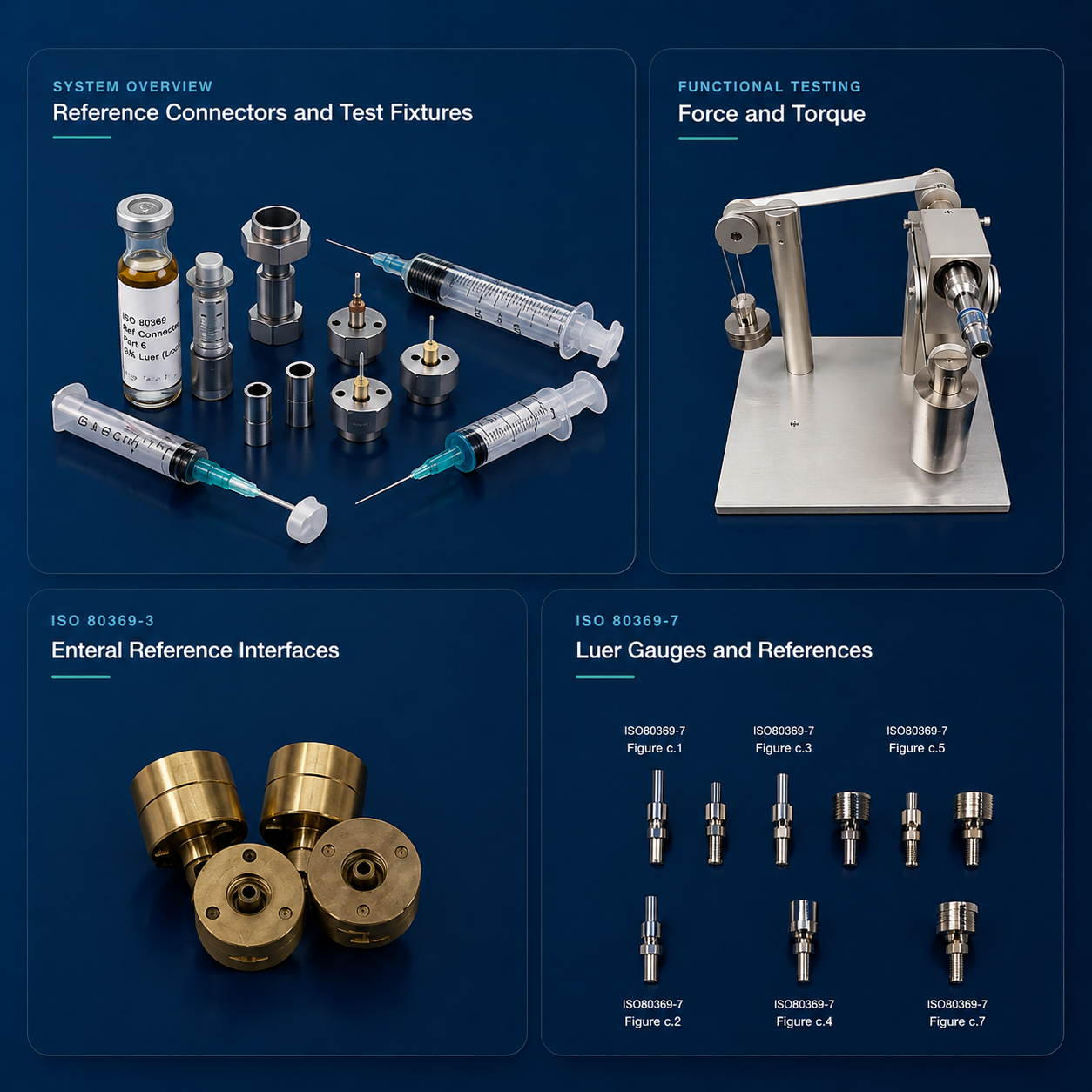
Integrated ISO 80369 Test Equipment Gallery — reference connectors, dimensional gauges and functional equipment for pressure, force, torque and connector verification.Application Scenarios
Where ISO 80369 Testing Equipment Is Used
The correct test configuration depends on the clinical application, connector design and verification stage. These are the most common scenarios for reference connectors, gauges and functional test systems.
01ISO 80369-7
Luer Connector Verification
Verification of 6% Luer taper connectors used in intravascular and hypodermic devices, including lock and slip configurations.
Syringes, needles and IV components
Leakage, separation and torque tests
Figure C.1–C.6 reference selection
02ISO 80369-3
Enteral Feeding Connections
Testing small-bore connectors used for enteral nutrition systems while controlling application-specific mating interfaces.
Feeding tubes and administration sets
Male/female reference connector tests
Leakage and connection integrity
03ISO 80369-6
Neural Device Connections
Verification of connectors for neuraxial and other neural applications using the applicable 2025 edition requirements.
Neuraxial delivery components
Application-specific references
Performance and non-interconnectability
04Parts 2 & 5
Gas and Limb-Cuff Systems
Connector evaluation for breathing-system or driving-gas applications and pneumatic limb-cuff inflation equipment.
Respiratory tubing interfaces
Blood-pressure cuff connections
Pressure, leakage and separation tests
05R&D / V&V
Medical Device Design Verification
Engineering teams use reference interfaces and functional systems to qualify connector geometry before design transfer.
Prototype comparison and tolerance review
Design verification evidence
Failure analysis and corrective action
06QA / Laboratory
Incoming, Type and Production Testing
Manufacturers and independent laboratories use controlled fixtures and calibrated instruments for repeatable acceptance testing.
Incoming connector inspection
Type-test and regulatory programs
Batch release and supplier qualification
Application Testing in the Laboratory
Syringe Luer Verification.
Dimensional and mating-interface inspection of a syringe connector using precision ISO 80369-7 gauges and reference connectors.
ISO 80369-7Enteral Feeding Connector Testing.
A purple enteral connector is evaluated with its dedicated application-specific reference interface—not a general-purpose Luer gauge.
ISO 80369-3Force, Torque and Leakage Testing.
A small-bore tubing connector is aligned in calibrated fixtures for controlled separation, torque and pressure-leak testing.
ISO 80369-20
Equipment Architecture
How to Select ISO 80369 Testing Equipment
No single instrument performs every requirement. ISO 80369 Testing Equipment must be selected according to the connector application, standard edition, mating reference and required method. A defensible system combines the correct reference connector with calibrated pressure, force, torque and environmental equipment.
01
Reference Connectors
Application-specific male or female mating interfaces defined by the relevant part and figure. Material, geometry, surface condition and traceability must be controlled.
02
Dimensional Gauges
Go/no-go or profile inspection tools where explicitly defined. A dimensional gauge alone cannot demonstrate leakage, separation or torque performance.
03
Pressure and Vacuum Circuits
Regulated pressure/vacuum sources, transducers, timers, sealed circuits and fixtures for pressure-decay, liquid leakage and subatmospheric leakage tests.
04
Force Test Equipment
Calibrated axial loading with appropriate alignment and fixtures for resistance-to-separation testing.
05
Torque Test Equipment
Controlled connection, unscrewing, overriding and disconnection torque with suitable sensors and application-specific holding fixtures.
06
Conditioning and Data
Environmental conditioning, test media, acquisition and traceable calibration records appropriate to the required method and uncertainty.
Selection Matrix
Match the Test Requirement to the Correct ISO 80369 Equipment
Use this matrix to separate dimensional gauge selection from functional ISO 80369-20 testing. It helps engineers and procurement teams confirm whether they need a single reference connector, a Luer gauge set, a fixture package or a complete leakage / force / torque test system.
Customer Need
Required Equipment
Typical KingPo Solution
Selection Notes
Dimensional verification of Luer connectors
ISO 80369-7 male plug gauge, female ring gauge or Figure C.1–C.6 reference connector set.
ISO 80369-7 Luer Gauge Set and Reference Connectors.
Choose by connector sex, lock/slip configuration and required figure.
Leakage by pressure decay or liquid leakage
Application-specific reference connector, sealed fixture, regulated pressure source, pressure transducer, timer and data system.
ISO 80369-20 leakage test fixture or integrated leakage test system.
Confirm test medium, pressure level, stabilization time and dead volume.
Combined torque / axial load setup with a rigid connector holding fixture.
Overriding torque fixture for application-specific connectors.
Do not substitute a simple handheld torque wrench for controlled verification.
Stress cracking evaluation
Conditioning environment, stressed mating fixture, reference connector and follow-up leakage test system.
Stress cracking setup plus leakage verification equipment.
Requires controlled sequence: conditioning, stress exposure, then functional check.
ISO 80369-20:2024
ISO 80369 Testing Equipment for Common Test Methods
Important distinction: ISO 80369-20 does not define every connector geometry. It provides common performance test methods, while each application-specific part defines the connector application, reference interface and acceptance context.
Test Area
What It Evaluates
Typical Equipment
Critical Control
Leakage
Positive-pressure air or liquid leakage and subatmospheric air ingress.
Seal integrity, test pressure, stabilization, media and fixture dead volume.
Axial Separation
Resistance to connector separation under an axial load.
Force tester, calibrated load cell, aligned gripping and reference connector fixture.
Axis alignment, loading profile, dwell time and connector preconditioning.
Unscrewing / Disconnection
Resistance to unintended unscrewing and controlled disconnection behavior.
Torque system, torque transducer, coaxial fixtures and reference connector.
Connection procedure, rotation rate, axial influence and peak torque capture.
Overriding
Resistance to over-torquing or thread/lock override.
Combined torque/axial test configuration and application-specific mating reference.
Applied axial force, torque direction, fixture rigidity and endpoint definition.
Stress Cracking
Material performance after defined stress and environmental exposure.
Conditioning environment, mating reference/fixture and subsequent functional leak test equipment.
Conditioning time, temperature, humidity, stress state and test sequence.
Edition warning: ISO 80369-20:2015 has been withdrawn. New projects should review ISO 80369-20:2024 and the applicable application-specific part. Do not reuse an old Annex method, load or acceptance value without an edition review.
Test Planning
Recommended ISO 80369 Verification Workflow
Classify
Identify the connector's intended healthcare application and applicable part.
Freeze Edition
Record the exact standard edition and regulatory or customer requirements.
Select References
Match connector sex, lock/slip style and required figure reference.
Build Method
Configure pressure, force, torque and conditioning equipment for each test.
Document
Record calibration, uncertainty, conditioning, samples, raw data and results.
KingPo Product Navigation
ISO 80369-7 Luer Gauges and Reference Connectors
Start with the guide if the required figure is not yet known. Select the complete set for laboratories handling multiple male/female and lock/slip configurations, or open an individual product page when the standard figure and test object have already been confirmed.
Review KingPo’s ISO 80369 product guides, connector gauge sets, test equipment categories and project support resources before selecting a complete small-bore connector test configuration.
Connector application, sex and lock/slip configuration
Drawing, tolerances and available samples
Required dimensional and functional tests
Target laboratory workflow and reporting format
Calibration or ISO/IEC 17025 certificate expectations
Evidence to Request Before Acceptance
Request a drawing-linked equipment list, material and hardness specification where applicable, dimensional inspection record, serial-number identification, calibration scope for force/torque/pressure instruments, sample method demonstration and factory acceptance criteria. A certificate for one instrument does not automatically establish traceability for every reference connector and fixture in the system.
Technical FAQ
Frequently Asked Questions
Is a reference connector the same as a go/no-go gauge?
No. A reference connector is a defined mating interface used for functional tests. A go/no-go gauge checks a specified dimensional condition. Some products may be informally called gauges, but the required function and figure must be confirmed before ordering.
Which standard contains the common performance test methods?
ISO 80369-20:2024, Edition 2, specifies common test methods used to evaluate performance requirements in the ISO and IEC 80369 series and ISO 18250 series. It replaces ISO 80369-20:2015.
Does ISO 80369-7 replace ISO 594?
ISO 80369-7 is the current framework for 6% Luer taper connectors used in intravascular or hypodermic applications. Legacy files may still reference ISO 594, so the required regulatory edition and transition strategy must be confirmed.
Can one Luer gauge test enteral and neuraxial connectors?
No. The purpose of the series is application differentiation and reduced misconnection risk. Enteral, neural and intravascular/hypodermic connectors use application-specific geometries and reference interfaces.
Do I need both male and female reference connectors?
That depends on the connector under test and required methods. Testing male DUT connectors generally requires the appropriate female reference, and vice versa. Lock and slip configurations may require different references.
What changed for ISO 80369-6?
ISO 80369-6:2016 is withdrawn and a 2025 edition is available. New projects should review ISO 80369-6:2025 rather than assuming that a 2016 test plan remains current.
Can a gauge set alone prove full ISO 80369 compliance?
No. Full verification can include design, dimensional, non-interconnectability and functional performance requirements. Leakage, separation, torque and environmental tests require additional calibrated systems and controlled procedures.
What should I send for an accurate quotation?
Send the ISO or IEC 80369 part and edition, Annex/figure numbers, connector drawing, male/female and lock/slip configuration, required test list, sample availability and certificate requirements.
Scroll to Top
Get A Free Quote Now !
If you have any questions, please do not hesitate to contact us.