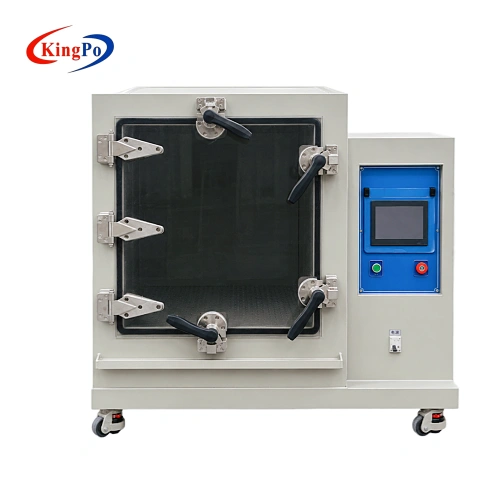
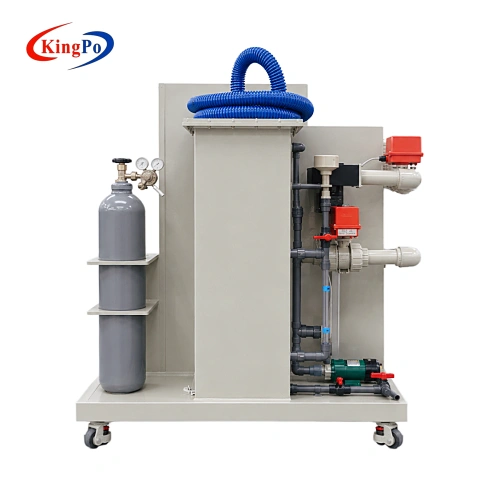
Front view of the 517 L sulfur dioxide test chamber for humid corrosion testing
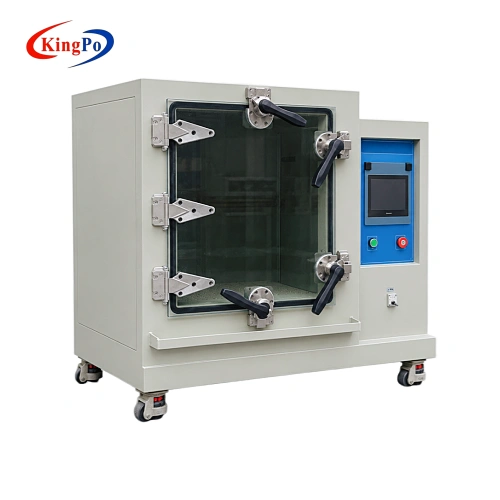
Left-angle view of the ISO 22479 sulfur dioxide test chamber in a laboratory
Right-angle view of the sulfur dioxide test chamber with touchscreen control panel
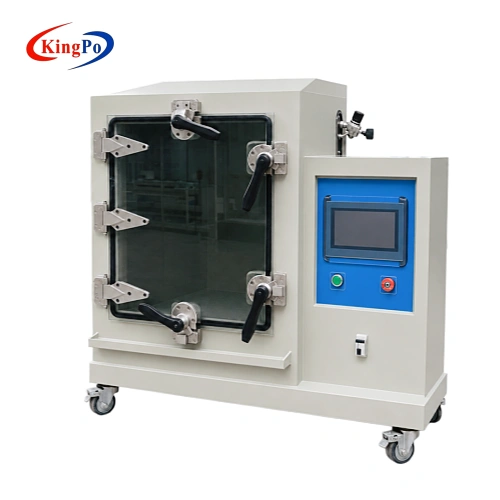
Service-side view of the sulfur dioxide test chamber gas and exhaust treatment system
Front view of the 517 L sulfur dioxide test chamber for humid corrosion testing
Left-angle view of the ISO 22479 sulfur dioxide test chamber in a laboratory
Right-angle view of the sulfur dioxide test chamber with touchscreen control panel
Service-side view of the sulfur dioxide test chamber gas and exhaust treatment system

ISO 22479 Sulfur Dioxide Test Chamber for Humid Corrosion Testing

The 517 L Sulfur Dioxide Test Chamber is designed for controlled SO₂ corrosion testing of metals, coatings, electrical contacts, and plated components.

  • Test Focus:  Comparative corrosion evaluation under humid sulfur dioxide exposure
  • Typical Samples:  Coated panels, metal parts, connectors, terminals, fasteners, and plated components
  • Typical Users:  Manufacturers, testing laboratories, quality teams, and R&D departments
  • Method Selection:  Configured according to the applicable standard and exposure conditions
  • Project Support:  Gas control, sample arrangement, exhaust, and operating functions can be reviewed for each project

Sulfur Dioxide Test Chamber Product Overview

The Sulfur Dioxide Test Chamber combines a corrosion-resistant PP test space with measured SO₂ introduction, temperature conditioning, a water system and controlled chamber ventilation.

As a Sulfur Dioxide Corrosion Chamber, it uses PP, PTFE, titanium alloy and other acid-resistant materials in areas exposed to the corrosive atmosphere. This construction helps protect the chamber, gas path, heating element, temperature sensor and sealing components during repeated tests.

The equipment supports material selection, coating evaluation, component validation, product development and routine quality control. The final Sulfur Dioxide Test Chamber configuration should be selected according to the applicable standard, SO₂ condition, moisture method, exposure cycle, sample capacity and laboratory safety requirements.

Technical Specifications

Parameter Specification
Internal Chamber Volume 517 L
Temperature Range RT+10°C to 50°C
Temperature Control Accuracy ±1°C
Temperature Uniformity ±2.0°C
Test Time 0–999 h, adjustable
Nominal SO₂ Concentration 1% by volume
Initial SO₂ Gas Volume 5.17 L
Gas Replenishment Every 24 hours under the stated configuration
Chamber Material Corrosion-resistant PP
Door 12 mm tempered glass
Heating Element Titanium alloy electric heating tube
Temperature Sensor Titanium alloy PT100
Temperature Control PID control
Controller Input / Output PT100 × 1 dry-bulb signal / 4–20 mA output
Gas Measurement Corrosion-resistant digital mass flow meter
Water System Built-in PP water tank
Power Supply AC 220 V, 2.5 kW, 50 Hz
Recommended Installation Space At least 2200 × 2000 × 2200 mm, W × H × D
Temperature accuracy and uniformity are evaluated after 30 minutes of stabilization. PLC control, touchscreen operation, programmable cycles, data recording and communication functions should be confirmed according to the selected configuration.

Test Purpose and Exposure Principle

Sulfur dioxide can accelerate corrosion when it comes into contact with moisture on metal or coated surfaces. The Sulfur Dioxide Test Chamber establishes a controlled environment in which temperature, moisture, exposure time and SO₂ introduction can be regulated.

STEP 01
Prepare and position the specimens
STEP 02
Establish temperature and moisture conditions
STEP 03
Introduce the measured SO₂ volume
STEP 04
Maintain the required exposure period
STEP 05
Replenish gas or ventilate as specified
STEP 06
Remove and evaluate the specimens

Evaluation may include rust formation, discoloration, blistering, coating deterioration, under-film corrosion, mass change, contact resistance or functional performance. Results should be assessed according to the applicable standard or customer procedure and should not be treated as a direct prediction of actual service life.
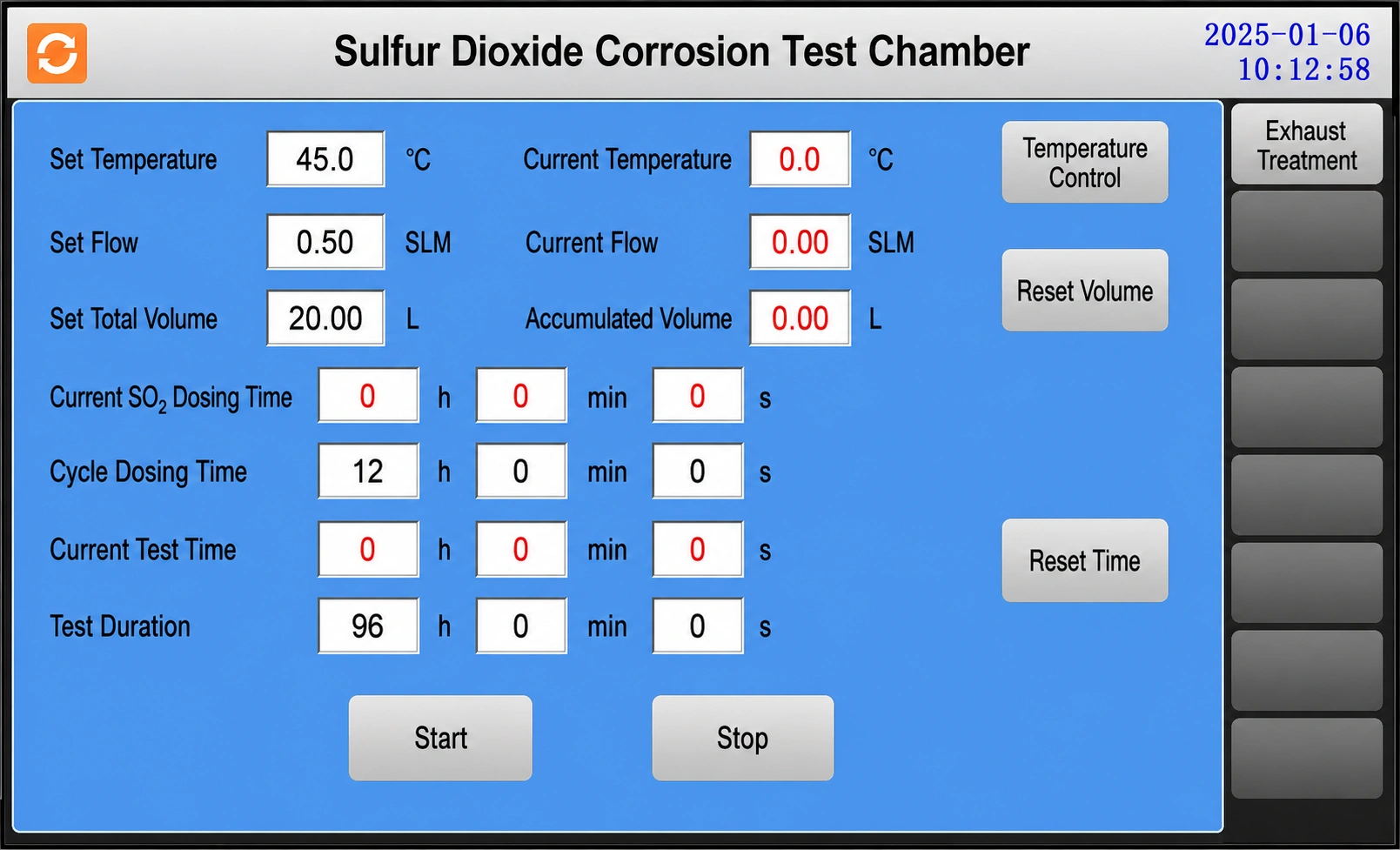
English HMI interface for controlling sulfur dioxide corrosion test conditions

Applicable Standards and Method Compatibility

ISO 22479 Humid SO₂ Corrosion Testing

ISO 22479 specifies a fixed-gas method for evaluating metals, alloys, metallic coatings, non-organic coatings and organic coatings in a humid sulfur dioxide atmosphere.

Use of this Sulfur Dioxide Test Chamber should be confirmed against the required gas quantity, moisture condition, exposure cycle and specimen arrangement.

IEC 60068-2-42 SO2 Test Chamber

IEC 60068-2-42 applies to the corrosive effects of sulfur dioxide on electrical contacts and connections.

An IEC 60068-2-42 SO2 Test Chamber may require different concentrations, severities and post-test electrical measurements from the stated configuration.

DIN 50018 and Customer Procedures

Customers following DIN 50018, legacy drawings, national requirements or internal procedures should provide the exact standard edition and test conditions before configuration.

The Sulfur Dioxide Test Chamber can be adapted to relevant ISO, IEC, DIN or customer-defined procedures. Final compliance depends on the selected gas condition, moisture method, exposure cycle and specimen arrangement.

Corrosion-Resistant System Design

517 L PP Test Space

The 517 L Sulfur Dioxide Test Chamber uses corrosion-resistant PP material with thermal insulation. Sample placement should follow the applicable method.

Controlled SO₂ Introduction

The system uses a corrosion-resistant digital mass flow meter, controlled gas introduction, automatic shutoff and acid-resistant sealing components.

Temperature Conditioning

A titanium alloy heating tube, titanium alloy PT100 sensor and PID controller maintain the selected test temperature.

Water and Observation Systems

The PP water tank supports humid exposure, while the 12 mm tempered-glass door allows observation without opening the chamber.

Stated SO₂ condition: 5.17 L of SO₂ is introduced into the 517 L chamber to establish a nominal concentration of 1% by volume. Gas is replenished every 24 hours.

Exhaust and Safety Configuration

The Sulfur Dioxide Test Chamber includes a 50 W exhaust fan, electric ball valve, exhaust pipe, filter assembly, water-shortage protection, alarm and protective electrical functions.

SO₂ absorption or neutralization unit
External exhaust connection
SO₂ gas leak detector
Emergency ventilation
Pre-opening purge cycle
Additional safety interlocks
A filter element should not be treated as a complete SO₂ neutralization system. The final arrangement should follow the laboratory facilities and local EHS requirements.

Typical Test Samples

The Sulfur Dioxide Test Chamber can be used for the following materials and components:

Metal test panels
Steel and non-ferrous parts
Metallic and organic coatings
Zinc, nickel and chromium plating
Fasteners and hardware
Electrical contacts
Connectors and terminals
Automotive components
Protective surface treatments

Different materials may influence one another during exposure. Specimen grouping should follow the applicable test method.

Typical Applications

Coating and Surface Treatment Evaluation

The Sulfur Dioxide Corrosion Chamber helps identify rust, discoloration, blistering, coating damage and under-film corrosion.

Electrical Contact and Connector Testing

Projects involving an IEC 60068-2-42 SO2 Test Chamber may require post-exposure electrical measurements.

Automotive Component Validation

Suitable for plated parts, brackets, fasteners, terminals, connectors and other surface-treated automotive components.

Laboratory and R&D Testing

The Sulfur Dioxide Test Chamber supports standard testing, material studies, product development and routine quality control.

Laboratory and Manufacturing Value

The Sulfur Dioxide Test Chamber integrates the main gas, temperature, water and ventilation functions required for controlled corrosion testing.

517 L corrosion-resistant test space
Measured SO₂ introduction
Controlled test temperature
Adjustable exposure time
Titanium heating and sensing
Automatic gas shutoff

Configuration and Selection Notes

Before selecting a Sulfur Dioxide Test Chamber, confirm the applicable standard, exposure conditions, sample information, gas supply and laboratory installation requirements.

Standard and Exposure Conditions

  • Applicable standard and edition
  • SO₂ concentration or gas volume
  • Test temperature and duration
  • Moisture or condensation method

Sample Requirements

  • Sample type and dimensions
  • Quantity and weight
  • Required orientation
  • Specimen rack requirements

Gas and Exhaust Conditions

  • SO₂ cylinder and gas purity
  • Regulator and outlet pressure
  • Laboratory exhaust system
  • Neutralization requirements

Control and Installation

  • Touchscreen and programmable cycles
  • Temperature and flow recording
  • Power supply requirements
  • Ventilation and maintenance access
The stated configuration uses 1% SO₂ by volume, corresponding to an initial gas charge of 5.17 L in the 517 L chamber, with gas replenishment every 24 hours.

Compliance & Regulatory Assurance

The 517 L Sulfur Dioxide Test Chamber is designed to support humid SO₂ corrosion testing associated with ISO 22479 and customer-defined test procedures. Its corrosion-resistant PP chamber, controlled SO₂ introduction, temperature conditioning, water system and programmable exposure time support comparative corrosion evaluation of metals, coatings, electrical contacts and plated components. IEC 60068-2-42 applications should be reviewed separately because the required gas concentration and test severity may differ from the stated 1% SO₂ configuration.

Final compliance depends on the complete laboratory arrangement, including the applicable standard edition, SO₂ concentration or gas volume, moisture or condensation method, exposure cycle, specimen placement, gas replenishment, exhaust treatment and measurement verification. Temperature, time and gas-flow verification records, factory inspection documents, safety information and traceability documentation can be confirmed according to project requirements.

Download the technical catalogue for the ISO 22479 Sulfur Dioxide Test Chamber.

PDF
ISO 22479 Sulfur Dioxide Test Chamber Catalogue
Technical specifications, SO₂ corrosion test principles, applicable standards, laboratory applications and configuration guidance.

Download PDF

Technical Inquiry & Expert Support

To confirm whether the 517 L Sulfur Dioxide Test Chamber matches your project, please provide the information below when sending an inquiry. This helps KINGPO review the applicable standard, specimen type, SO₂ exposure conditions, laboratory installation and required documentation before quotation.

Information Needed Description
Applicable Standard ISO 22479, IEC 60068-2-42, DIN 50018 or the relevant customer test procedure and applicable edition.
Specimen Information Sample material, coating type, maximum dimensions, quantity, weight, orientation and required specimen spacing.
SO₂ Exposure Conditions Required SO₂ concentration or gas volume, test temperature, exposure duration, moisture or condensation method, gas replenishment frequency and number of cycles.
Laboratory Installation Power supply, SO₂ cylinder specification, gas purity, regulator, outlet pressure, exhaust connection, neutralization system and safety requirements.
Documentation Needs Product datasheet, operation manual, calibration-related records, factory inspection report, gas-flow verification or traceability information if required.

Note:
Final suitability should be reviewed together with the applicable standard edition, complete test procedure, specimen arrangement, gas conditions, laboratory exhaust system and local EHS requirements.

Sulfur Dioxide Test Chamber Detail Display

Sulfur Dioxide Test Chamber FAQ

What is the main purpose of the Sulfur Dioxide Test Chamber?
The Sulfur Dioxide Test Chamber provides a controlled humid SO₂ environment for accelerated comparative corrosion testing. It can be used to evaluate metals, protective coatings, plated parts, electrical contacts, connectors and similar components. Typical evaluation results include rust formation, discoloration, blistering, coating deterioration and changes in electrical contact performance.
Which standards can the chamber support?
The chamber can be configured for projects referring to ISO 22479, IEC 60068-2-42, DIN 50018 or customer-defined procedures. These methods can specify different SO₂ concentrations, moisture conditions, exposure periods and specimen arrangements. The applicable standard number, edition and test severity should therefore be reviewed before the final chamber configuration is confirmed.
Does the stated configuration fully comply with ISO 22479 and IEC 60068-2-42?
Compliance cannot be determined from the chamber name alone. The stated configuration uses 1% SO₂ by volume, but ISO 22479 and IEC 60068-2-42 may require different gas quantities, severities and operating procedures. Final compliance depends on the selected configuration, standard edition, moisture method, specimen placement and complete laboratory test arrangement.
What types of specimens can be tested?
The 517 L Sulfur Dioxide Corrosion Chamber can accommodate metal panels, coated parts, plated components, fasteners, electrical contacts, terminals, connectors and automotive hardware. Before quotation, customers should provide specimen dimensions, quantity, weight and required orientation so that usable capacity, sample spacing and rack configuration can be properly reviewed.
How is sulfur dioxide introduced and maintained during testing?
The stated chamber configuration uses a corrosion-resistant digital mass flow meter and controlled SO₂ introduction. For a nominal concentration of 1% by volume, the original specification states an initial charge of 5.17 L in the 517 L chamber, with replenishment every 24 hours. Other test methods may require different gas conditions.
Does the chamber provide active humidity control?
The original configuration includes a PP water tank and supports moisture-related SO₂ exposure, but it does not specify an active relative-humidity control range. If the selected method requires precise RH control, saturated humidity or a defined condensation cycle, these requirements should be submitted for technical review before the chamber configuration is finalized.
Can it be used as an IEC 60068-2-42 SO2 Test Chamber?
It may be configured for corrosion testing of electrical contacts and connections associated with IEC 60068-2-42. However, the standard’s gas concentration, exposure severity and post-test electrical measurements must be checked separately. Customers should provide the applicable edition, test clause, specimen type and required verification method before compliance is confirmed.
What exhaust and safety equipment is required?
Requirements depend on the SO₂ concentration, laboratory ventilation and local EHS regulations. The system may need an external exhaust connection, gas absorption or neutralization unit, SO₂ leak detector, gas-cylinder regulator, emergency ventilation and safety interlocks. A standard filter element should not be considered a complete sulfur dioxide neutralization system.
What laboratory conditions should be confirmed before installation?
Customers should confirm the available power supply, installation space, SO₂ cylinder location, gas purity, regulator and outlet pressure, exhaust duct connection, drainage and maintenance clearance. Local requirements for gas storage, leak detection, emergency ventilation and waste-gas treatment should also be reviewed before the Sulfur Dioxide Test Chamber is installed.
Which documents and verification records are available?
Documentation can be confirmed according to project requirements and the selected configuration. Typical requirements may include a product datasheet, operation manual, electrical diagram, gas piping information, factory inspection report and verification records for temperature, time or gas flow. Any third-party calibration, certificate scope or traceability requirement should be agreed before order placement.

Related Products

Related News

ISO 18193 Figure C.2 Vascular Model ensures precise, compliant testing of dual lumen cannulae by simulating human vascular anatomy for reliable results.

The Ultimate Guide to Desktop Temperature Humidity Chamber in 2026: Precision High-Low Cycling, Environmental Adaptability, and Reliability Verification – A […]

KINGPO environmental test chambers simulate extreme conditions to ensure product reliability, safety, and compliance with industry standards.

Shan Chao 1 , Qiang Xiaolong 2 , Liu jiming 3 , Zhang Chao 3 . (1. Heilongjiang Institute for […]

Environmental test chamber solutions boost product reliability by simulating real-world stress, identifying weaknesses, and ensuring consistent performance.

KingPo completed the delivery of a customized HME Moisture Loss Measurement System to UL Solutions Suzhou Laboratory on March 23, […]

Scroll to Top

Get A Free Quote Now !

Contact Form
If you have any questions, please do not hesitate to contact us.