
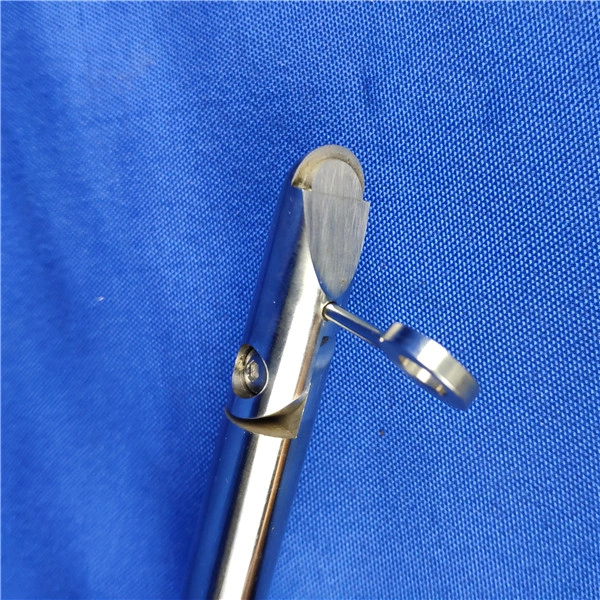
Why This Test Finger Nail Is Required
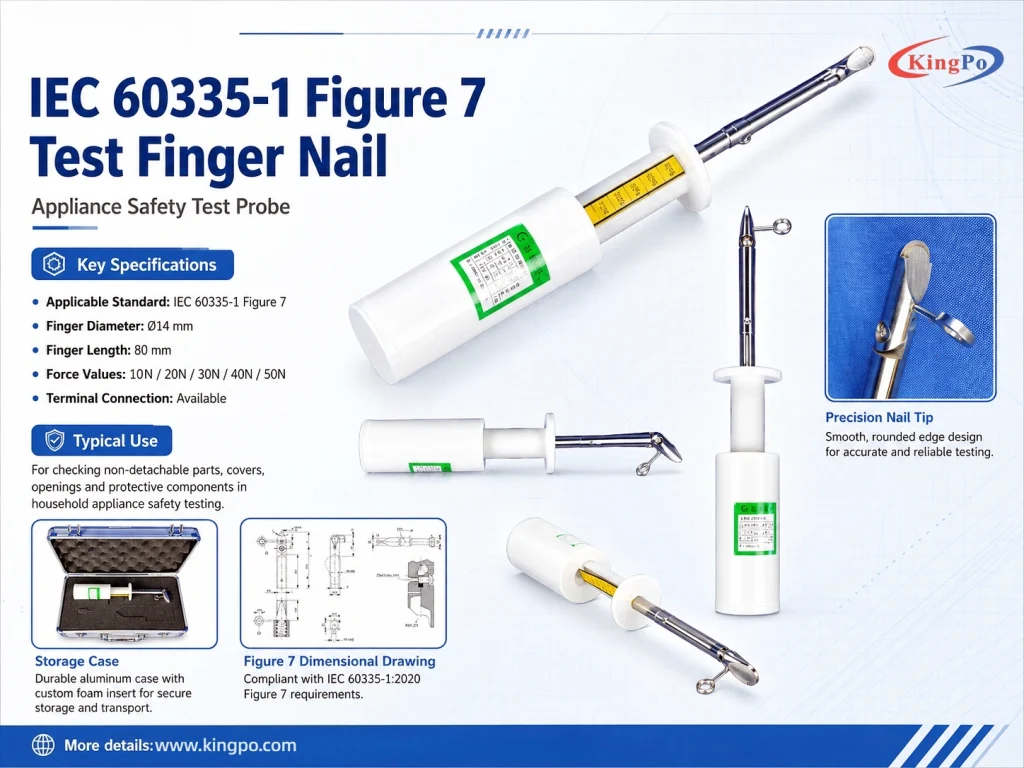
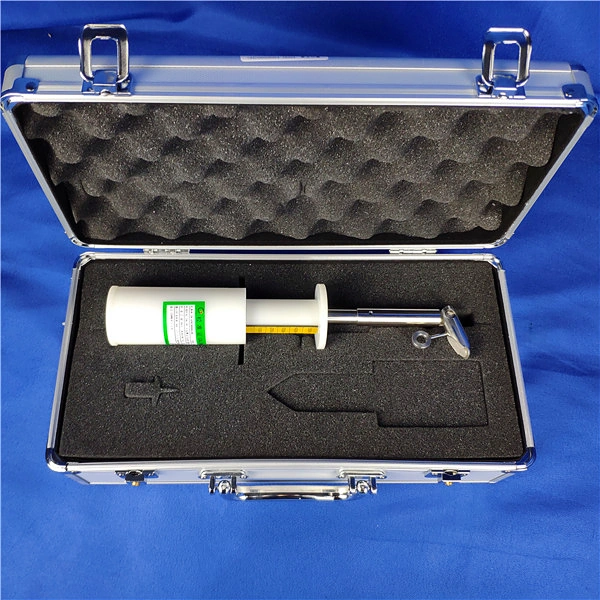
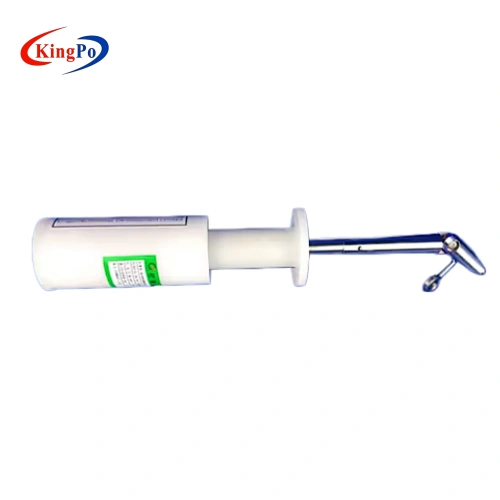
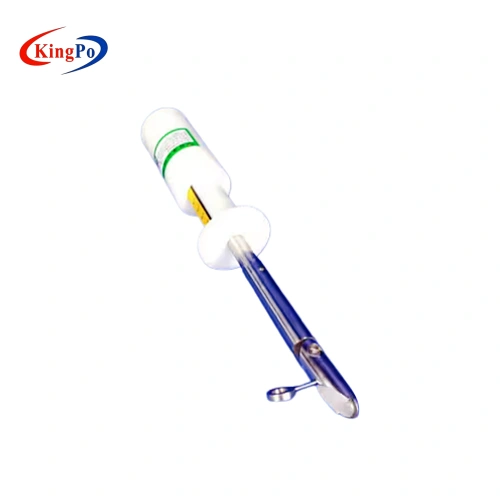
The IEC 60335-1 Figure 7 Test Finger Nail is a standard-specific appliance safety test probe used to assess the security of parts that are not intended to be removed during normal use. During testing, the fingernail-shaped probe is applied to openings, gaps, edges, joints or component interfaces to determine whether a part can be loosened, displaced or removed when mechanical stress is applied.
This test is especially important for appliance parts that protect users from access to live parts, moving parts or other hazardous areas. If a cover, guard, snap-fit part or protective component can be opened or removed too easily, the appliance may fail to provide the required level of protection during normal operation, cleaning, handling or inspection.
KINGPO supplies the IEC 60335-1 Figure 7 Test Finger Nail for appliance manufacturers, third-party laboratories, certification bodies and quality control departments that need a dedicated probe for IEC 60335-1 related safety checks.
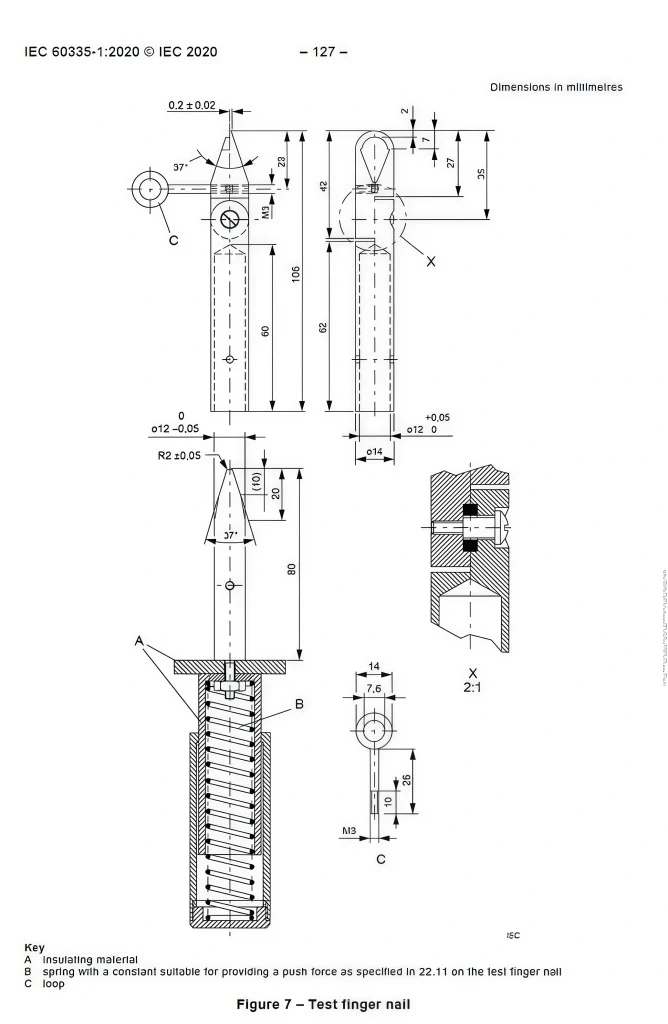
What This Test Finger Nail Is Used For
The test finger nail is mainly used to check whether non-detachable or protective parts of household and similar electrical appliances remain secure under the required test condition.
Typical test objects include:
- Appliance covers and protective panels
- Snap-fit parts and non-detachable components
- Control knobs, caps and decorative covers
- Enclosure joints, openings and small gaps
- Access panels and guards
- Parts intended to prevent access to live components
- Parts intended to prevent access to moving components
- Household appliance assemblies requiring IEC 60335-1 safety verification
This product should not be confused with general accessibility probes such as IEC 61032 test fingers. It is a dedicated test fingernail for IEC 60335-1 Figure 7 related checks.
Basic Specifications
| Item | Specification |
|---|---|
| Applicable Standard | IEC 60335-1 Figure 7 |
| Product Type | Test Finger Nail / Test Fingernail Probe |
| Typical Test Context | Non-detachable parts and snap-fit component security checks |
| Finger Diameter | Ø14 mm |
| Finger Length | 80 mm |
| Applicable Force | 10N, 20N, 30N, 40N, 50N, depending on the test requirement |
| Terminal Connection | Available, please confirm before quotation |
| Typical Test Position | Openings, joints, edges, gaps and component interfaces |
| Typical Test Object | Covers, guards, snap-fit parts, knobs, caps, access panels and protective components |
| Force Gauge | Optional / to be confirmed according to the required test method |
| Calibration Documentation | To be confirmed before quotation |
Note: The final supplied configuration should be confirmed according to the required standard edition, test clause, force value, sample type and documentation requirement.
Testing Principle
The IEC 60335-1 Figure 7 Test Finger Nail simulates the action of a fingernail applied to an appliance part, joint or opening. A specified mechanical force is applied to the probe according to the relevant test requirement. The tested part is then inspected to determine whether it remains in position, becomes loose, opens, detaches or allows access to a hazardous area.
A typical test process may include:
- Identify the appliance part, opening, gap or joint to be tested.
- Apply the test finger nail to the relevant edge, gap or accessible point.
- Apply the specified force according to the applicable test requirement.
- Observe whether the component remains secured.
- Check whether hazardous live parts or moving parts become accessible after the test.
The probe should be used according to the applicable standard clause and laboratory procedure. It should not be used as an undefined lever or destructive tool unless the test method clearly requires a specified action.
Applicable Standard and Test Purpose
This test finger nail is designed according to IEC 60335-1 Figure 7. IEC 60335-1 is the general safety standard for household and similar electrical appliances, and Figure 7 is used in checks related to the security of certain appliance parts.
In practical testing, the fingernail may be applied to openings, joints or component interfaces to check whether a part remains secured under mechanical stress. The test helps determine whether the appliance construction provides sufficient protection against access to hazardous live parts, moving parts or other protected areas.
The exact test method, force value and acceptance criteria should always be confirmed according to the applicable edition of IEC 60335-1, the product-specific standard and the customer’s internal test procedure.
Configuration and Use Notes
- Confirm the applicable IEC 60335-1 edition and the exact test clause before ordering.
- Select the required force value according to the test requirement, such as 10N, 20N, 30N, 40N or 50N.
- Confirm whether a terminal connection is required for the intended electric shock or accessibility check.
- If a force gauge or force application device is needed, it should be specified together with the probe inquiry.
- The test finger nail should be applied according to the standard procedure and should not be used as an undefined lever or destructive tool.
- For formal laboratory or certification-related testing, confirm whether dimensional verification or calibration documentation is required.
- Please provide the appliance type, tested part and sample structure so the supplied configuration can match the actual test application.
Typical Applications
The IEC 60335-1 Figure 7 Test Finger Nail is suitable for laboratories and manufacturers involved in safety evaluation of household and similar electrical appliances.
Typical application scenarios include:
- Household appliance safety compliance testing
- Factory quality control before certification submission
- Inspection of appliance covers, guards and snap-fit components
- Testing of parts that prevent access to live or moving components
- R&D verification during appliance enclosure design
- Incoming inspection or comparison testing for appliance components
- Laboratory testing according to IEC 60335-1 related requirements
Typical products that may require related checks include kitchen appliances, cleaning appliances, heating appliances, personal care appliances, small household appliances and other electrical appliances covered by IEC 60335-1 or related product standards.