Programmable AC and DC power sources are used when a device under test requires controlled, repeatable and configurable power conditions instead of direct mains power or a fixed-output power supply.
For laboratories, manufacturers and production-line QA teams, the power source is often not just an accessory. It directly affects test repeatability, product reliability evaluation, aging test stability and automated test system performance.
A product may operate normally under standard input power, but its behavior may change under low voltage, high voltage, frequency variation, startup current stress, long-duration operation or high-current DC loading. This is why programmable power sources are widely used in product development, export product verification, quality inspection and industrial test systems.
This guide explains how to choose between a Programmable AC Power Source and a Programmable DC Power Supply, what parameters should be checked before selection, and how to avoid common configuration mistakes.
Why Controlled Power Conditions Matter in Product Testing
A reliable test result starts with a reliable power condition. If the input power is unstable, not repeatable or not matched to the DUT requirement, the test result may not reflect the real product performance.
In practical testing, engineers often need to reproduce specific voltage, frequency, current or power conditions. These conditions may come from product standards, export market requirements, internal QA procedures or customer-defined test profiles.
Common Power-Related Testing Requirements
- Simulating different market voltages such as 110V, 120V, 220V, 230V or 240V.
- Checking product operation under 50Hz and 60Hz frequency conditions.
- Performing over-voltage and under-voltage operation checks.
- Providing stable AC power for long-duration aging or burn-in tests.
- Supplying high-current DC power for motors, controllers, industrial loads or electronic modules.
- Compensating voltage drop in high-current DC output cables.
- Integrating power output control into automated test software.
- Repeating the same power sequence across different DUTs or production batches.
When these requirements cannot be met by direct mains power or a simple bench power supply, a programmable power source becomes necessary.
Programmable AC Power Source: When the DUT Requires Controlled AC Input
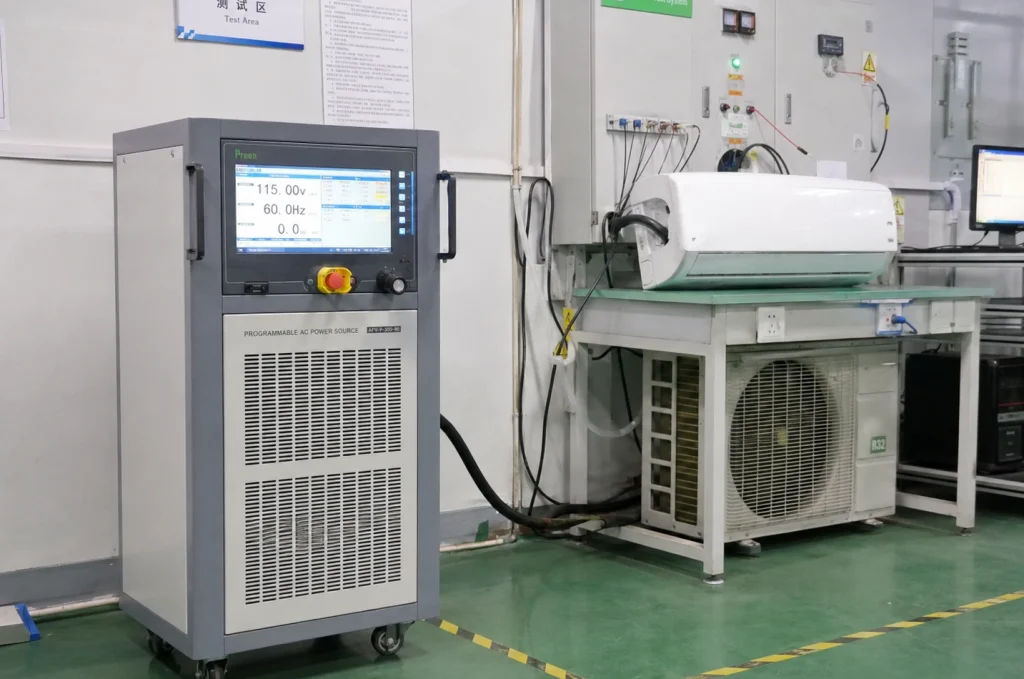
A programmable AC power source is selected when the device under test requires adjustable AC voltage, frequency or phase output.
It is commonly used for export product testing, laboratory AC power supply, production-line QA, lifetime tests, voltage variation checks and frequency simulation. Instead of depending on local mains power, engineers can define the required AC output conditions and apply them repeatedly during the test.
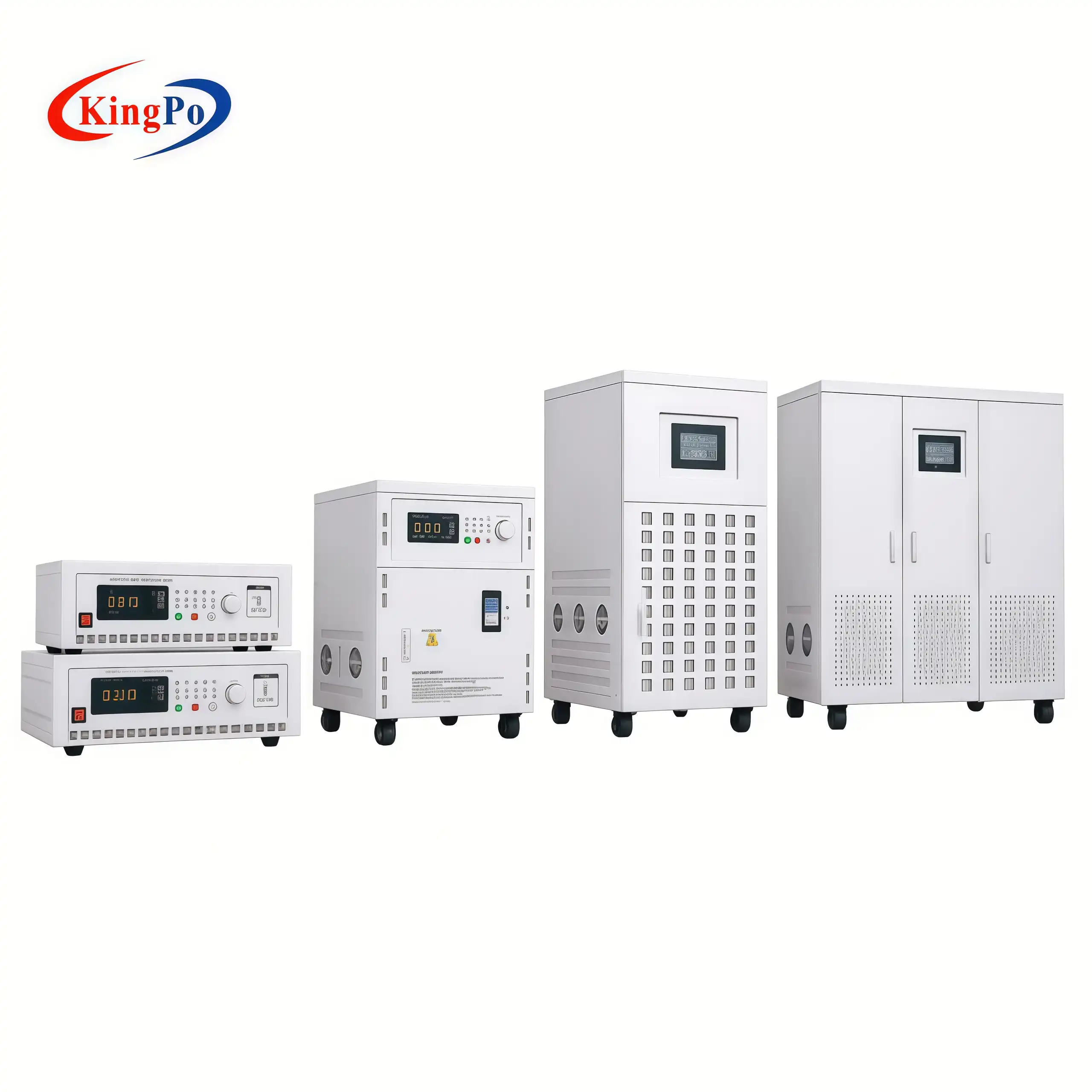
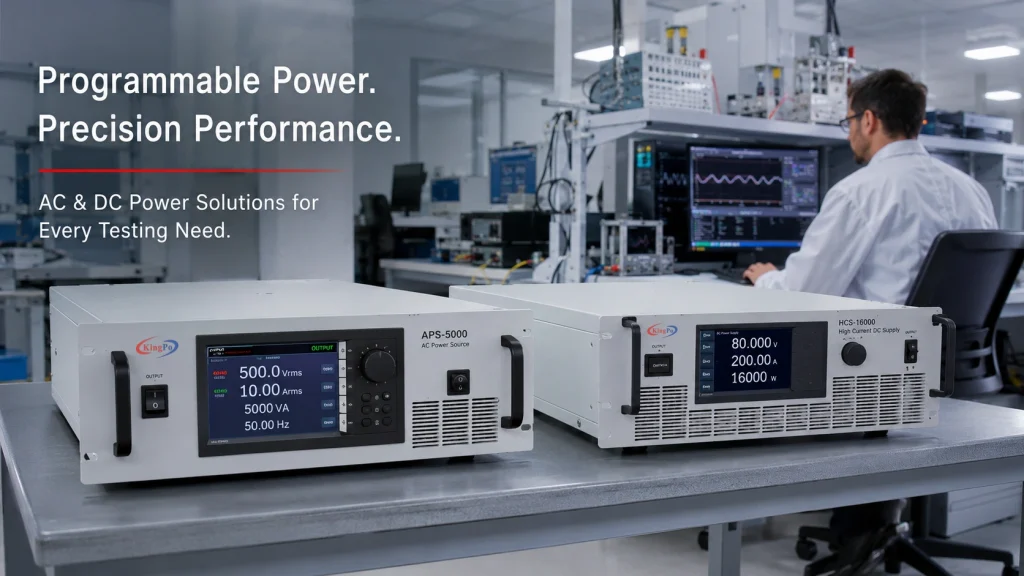
For applications requiring controlled AC voltage and frequency output, the KINGPO Programmable AC Power Source series covers models from 500VA to 200kVA, with single-phase and three-phase configurations available.
Typical Applications for Programmable AC Power Sources
- Home appliance testing
- Motor and compressor product testing
- Transformer and switching power supply testing
- UPS, charger and adapter testing
- IT equipment and office equipment testing
- Export voltage and frequency simulation
- Production-line QA, OQC and FQC stations
- Long-duration aging and reliability tests
How to Select a Programmable AC Power Source
Choosing the correct AC power source is not only about matching the rated power of the DUT. Engineers should check output phase, capacity, voltage range, frequency range, load type, startup current and test duration.
1. Confirm Single-Phase or Three-Phase Output
Small appliances, chargers, adapters, office equipment and many electronic products usually require single-phase AC output. Industrial equipment, larger motors, compressors and three-phase power products may require three-phase output.
If the DUT power input is three-phase, the output wiring method, phase voltage, line voltage and neutral requirement should be confirmed before model selection.
2. Check Rated Power and Startup Current
The selected AC power source should cover the continuous operating power of the DUT. However, rated power alone may not be enough.
Motors, compressors, transformers and switching power supplies may draw high startup or inrush current. In these cases, additional capacity margin should be considered to avoid overload protection, unstable output or incorrect test results.
3. Confirm Voltage and Frequency Range
For export product testing, the required voltage and frequency should be selected according to the target market or internal QA procedure. Common test conditions include 50Hz / 60Hz operation, rated voltage variation, over-voltage checks and under-voltage checks.
Some applications may require a wider frequency range. Before quotation, the required frequency range should be confirmed together with the applicable model or optional configuration.
4. Review Load Type and Test Duration
A resistive load is usually easier to power than an inductive load, motor load, compressor load, transformer load or switching power supply load. The same rated power may lead to different actual stress on the power source depending on the load behavior.
Short functional tests, production-line tests and long-duration aging tests may also require different capacity margins and cooling conditions.
Engineering Note: A programmable AC power source is not the same as a VFD. A VFD is mainly used for motor speed control, while a programmable AC power source is used as a controlled AC test power source for voltage and frequency simulation.
Programmable DC Power Supply: When the DUT Requires Controlled DC Voltage and Current
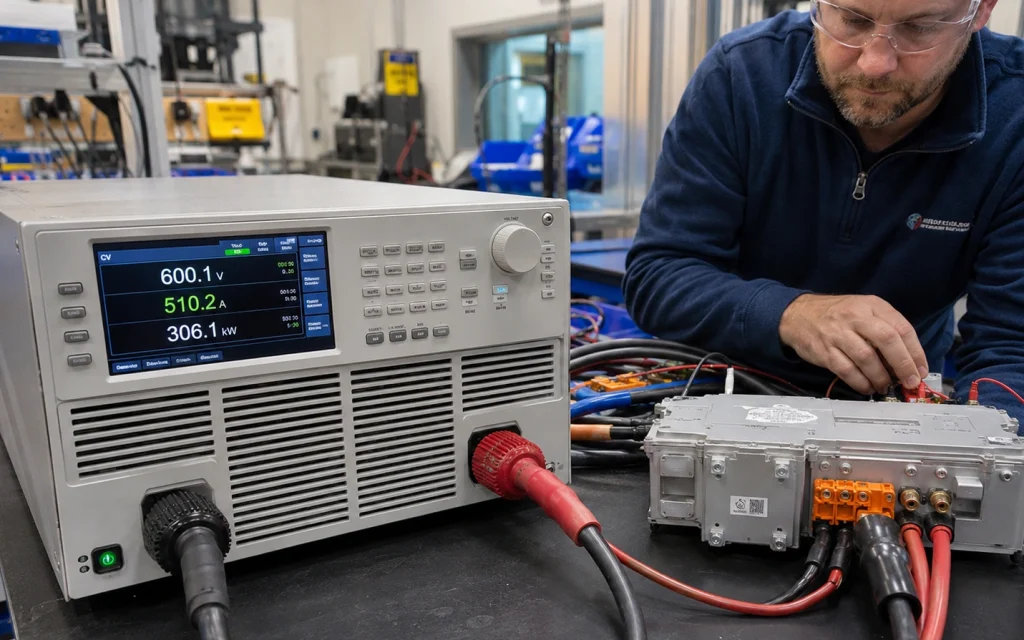
A programmable DC power supply is selected when the device under test requires adjustable DC voltage and current, especially in high-current or high-power applications.
For DC-powered products, industrial loads, motor controllers, electronic modules and battery-related DC source setups, a low-power bench supply may not provide enough current or output power. In this situation, a high-power programmable DC supply is required.
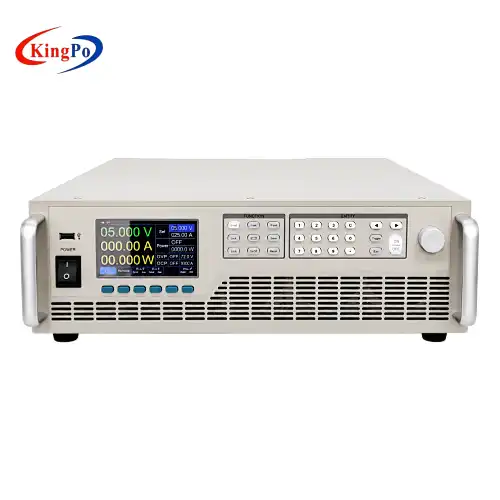
For example, the HSW68-80-900-30000 Programmable DC Power Supply provides 0–80V output voltage, 0–900A output current and 30kW output power. It is designed for laboratory DC testing, production-line testing, aging tests and automatic test system integration.
Typical Applications for Programmable DC Power Supplies
- High-current DC testing
- DC-powered product verification
- Motor controller testing
- Electronics and industrial load testing
- Production-line DC power testing
- Aging and burn-in tests
- Battery-related DC source setups
- Automatic test system integration
How to Select a Programmable DC Power Supply
For DC power selection, engineers should evaluate output voltage, output current, total power, cable voltage drop, control mode, communication interface and duty cycle.
1. Confirm Output Voltage Range
The output voltage range must cover the DUT’s rated voltage and required test conditions. A 0–80V DC power supply is suitable for applications where the required DC test voltage falls within this range.
2. Confirm Output Current Range
High-current applications require careful review of both normal operating current and possible transient current. If the DUT has startup current, pulse current or changing load current, these conditions should be provided before model confirmation.
3. Confirm Total Output Power
Voltage and current should not be evaluated separately. The total output power must also match the test requirement.
For example, an 80V / 900A / 30kW configuration means the power supply is designed for high-current, high-power DC output within its operating envelope. The actual available voltage-current combination should always be checked according to the confirmed model and power limit.
4. Consider Cable Voltage Drop
In high-current DC testing, output cable resistance can cause voltage drop between the power supply terminals and the DUT terminals. If this is not considered, the DUT may receive a lower voltage than expected.
Remote sense compensation helps reduce this influence by improving voltage control at the load side. This is especially important for high-current testing with long output cables.
5. Confirm Communication and Automation Requirements
For automatic test systems, a programmable DC supply may need to communicate with PC software, PLC systems or user-developed control platforms.
Communication interfaces such as RS232, RS485, USB, CAN and LAN can support remote setting, monitoring, sequence control and system integration depending on the selected configuration.
Engineering Note: A programmable DC power supply is not the same as a DC electronic load or a battery cycler. A DC power supply provides power to the DUT. A DC electronic load absorbs power from the DUT. A battery cycler performs controlled charge and discharge cycling.
AC vs DC Power Source: How to Choose the Correct Type
The correct selection depends on the input requirement of the DUT and the purpose of the test.
If the DUT requires controlled AC input, voltage and frequency simulation, or single-phase / three-phase supply, a programmable AC power source should be reviewed first. If the DUT requires controlled DC voltage and current, especially at high current, a programmable DC power supply is the correct direction.
| Test Requirement | Recommended Equipment | Main Purpose |
|---|---|---|
| Export voltage simulation | Programmable AC Power Source | Simulate different market voltages |
| 50Hz / 60Hz operation check | AC Variable Frequency Power Supply | Verify frequency-related performance |
| Three-phase product testing | Programmable AC power source | Supply controlled three-phase input |
| High-current DC testing | Programmable DC Power Supply | Provide stable DC voltage and current |
| Motor controller testing | Programmable DC power supply | Provide controlled DC input to controller or system |
| Aging and burn-in tests | AC or DC depending on DUT | Maintain repeatable power conditions over time |
| Automated test system integration | AC or DC depending on test process | Support remote control, sequence output and monitoring |
Typical Test Scenarios and Configuration Guidance
Export Product Voltage and Frequency Simulation
Manufacturers often need to verify whether a product can operate safely and consistently under different market power conditions. For example, the same product family may need to support 110V / 60Hz, 120V / 60Hz, 220V / 50Hz or 230V / 50Hz operation.
In this case, a programmable AC source allows the test team to set voltage and frequency directly, instead of relying on local mains power or multiple transformers.
Recommended Review Points
- Target market voltage and frequency
- Rated power of the DUT
- Single-phase or three-phase input
- Over-voltage and under-voltage test points
- Test duration and repetition frequency
Production-Line Functional Testing
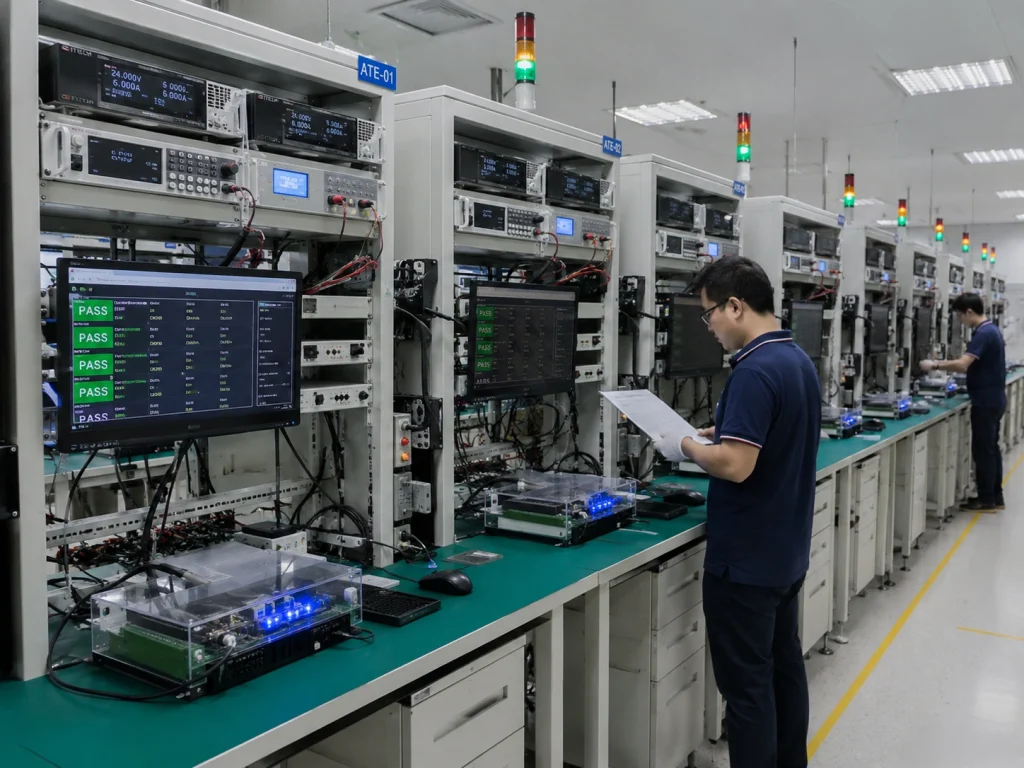
In production-line QA, repeatability is more important than manual flexibility. Each DUT should be tested under the same input condition to reduce variation caused by operator adjustment or unstable site power.
A programmable power source can support fixed output settings, remote control and repeatable test conditions, helping manufacturers improve production-line consistency.
Recommended Review Points
- Number of DUTs tested per day
- Required test time per unit
- Manual operation or automated control
- Communication interface requirement
- Production-line safety and protection requirements
Aging and Burn-In Testing
Aging tests require stable power output over a longer period. The power source should have sufficient capacity margin, proper cooling and suitable protection settings for continuous operation.
For AC-powered products, a programmable AC source can provide stable voltage and frequency during long-time operation. For DC-powered products, a programmable DC supply can maintain controlled DC voltage and current during the aging process.
Recommended Review Points
- Total number of DUTs tested at the same time
- Single DUT rated power
- Total continuous output power
- Test duration
- Cooling and ventilation conditions
- Protection behavior during abnormal load conditions
High-Current DC Testing
High-current DC testing requires more attention to the complete power path. Current capacity alone is not enough. Engineers should also review cable size, voltage drop, heat generation, protection threshold, duty cycle and installation layout.
A high-current DC test power source is typically used when the DUT requires stable DC power beyond the capability of a standard bench power supply.
Recommended Review Points
- Maximum output voltage
- Maximum output current
- Total output power
- Cable length and cable size
- Remote sense requirement
- Cooling and installation environment
- Emergency stop or system interlock requirement
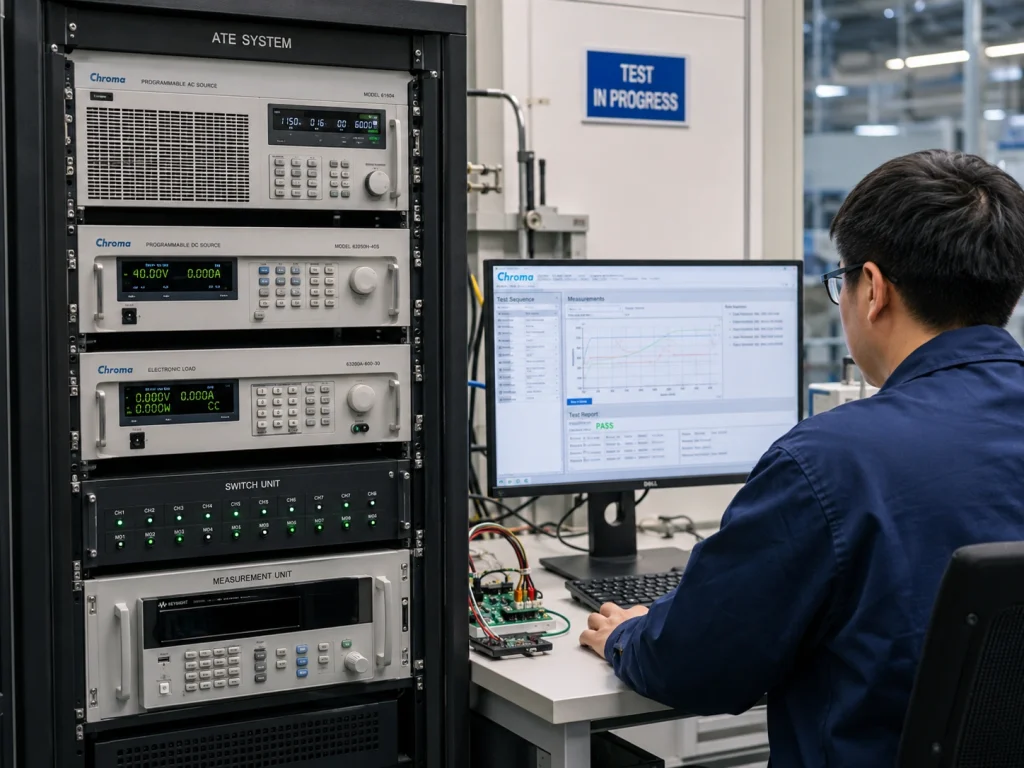
Configuration Checklist Before Requesting a Quotation
Providing complete test information before quotation helps avoid incorrect model selection and reduces technical back-and-forth.
The following checklist can be used by engineers, procurement teams and project managers before selecting a programmable AC or DC power source.
Checklist for Programmable AC Power Source Selection
- DUT name and product type
- Rated input voltage
- Rated current or rated power
- Single-phase or three-phase input
- Required voltage range
- Required frequency range
- Load type: resistive, inductive, motor, compressor, transformer or switching power supply
- Startup current or inrush current, if available
- Test duration: functional test, production-line test or aging test
- Remote communication requirement
- Installation space and cooling conditions
- Target market, product standard or internal QA procedure
Checklist for Programmable DC Power Supply Selection
- DUT name and application
- Required output voltage range
- Required output current range
- Total output power
- Normal operating current and peak current
- Test duration and duty cycle
- Constant voltage or constant current operation requirement
- Remote sense requirement
- Sequence output, RAMP or timer requirement
- Communication interface: RS232, RS485, USB, CAN or LAN
- Cabinet integration or bench installation requirement
- Cooling, ventilation and site power condition
- Required documentation and acceptance criteria
Common Selection Mistakes to Avoid
Selecting Only by Rated Power
The DUT rated power is important, but it is not the only selection factor. Startup current, inrush current, load variation and test duration may require additional capacity margin.
Ignoring Load Type
A motor, compressor, transformer, switching power supply and resistive heater can behave very differently even if their rated power looks similar. Load type should be confirmed early.
Using a VFD Instead of an AC Test Power Source
A VFD may be suitable for motor speed control, but it is not the same as a programmable AC test power source. For voltage and frequency simulation during product testing, a programmable AC source is usually the more appropriate equipment.
Using a DC Power Supply as a Battery Cycler Without Confirmation
A programmable DC power supply can provide adjustable DC output for battery-related test setups, but charge / discharge cycling, regenerative operation and battery cycle-life testing should not be assumed unless the complete system configuration supports those functions.
Ignoring Cable Voltage Drop in High-Current DC Tests
For high-current DC output, cable voltage drop may affect the actual voltage at the DUT terminals. Remote sense compensation and proper cable sizing should be considered before installation.
Forgetting Communication Requirements
If the power source will be integrated into an automatic test system, the required communication interface and command protocol should be confirmed before ordering.
FAQ: Programmable AC and DC Power Sources
What is the difference between a programmable AC power source and a programmable DC power supply?
A programmable AC power source provides adjustable AC voltage and frequency output. It is used for AC input simulation, export voltage testing, production-line QA and aging tests. A programmable DC power supply provides adjustable DC voltage and current output. It is used for DC-powered products, high-current DC testing and automatic DC test systems.
When should I use a programmable AC power source?
You should use a programmable AC power source when the DUT requires controlled AC input, voltage variation, 50Hz / 60Hz simulation, single-phase or three-phase output, or long-duration AC aging tests.
When should I use a programmable DC power supply?
You should use a programmable DC power supply when the DUT requires controlled DC voltage and current. It is especially useful for high-current DC applications, motor controllers, industrial electronics, battery-related DC source setups and automatic DC test systems.
Is a programmable AC power source the same as a VFD?
No. A VFD is mainly used for motor speed control. A programmable AC power source is used as a controlled AC test power source for voltage and frequency simulation, product verification and laboratory testing.
Is a programmable DC power supply the same as a battery cycler?
No. A programmable DC power supply supplies adjustable DC power. A battery cycler is designed for charge and discharge cycling. For battery-related test projects, the required function should be confirmed before selecting the equipment.
What information is needed before selecting a programmable power source?
The most important information includes DUT type, rated voltage, rated current, load type, startup current, required voltage range, required frequency or current range, test duration, communication interface and installation conditions.
Related Technical Product Pages
Programmable AC Power Source / AC Variable Frequency Power Supply
For voltage and frequency simulation, export product testing, production-line QA, laboratory AC power supply and aging tests, review the Programmable AC Power Source series.
Programmable DC Power Supply 80V 900A 30kW
For high-current DC testing, laboratory verification, production-line testing, aging tests and automatic test system integration, review the Programmable DC Power Supply 80V 900A 30kW.
Technical Configuration Support
Selecting a programmable power source should be based on the DUT, test purpose and actual operating conditions. Before quotation, engineers are encouraged to prepare voltage, current, power, phase, frequency, load type, startup current, test duration, communication interface and installation requirements.
A proper configuration review helps ensure that the selected AC or DC power source can support the required test conditions, reduce the risk of undersizing and improve long-term test reliability.