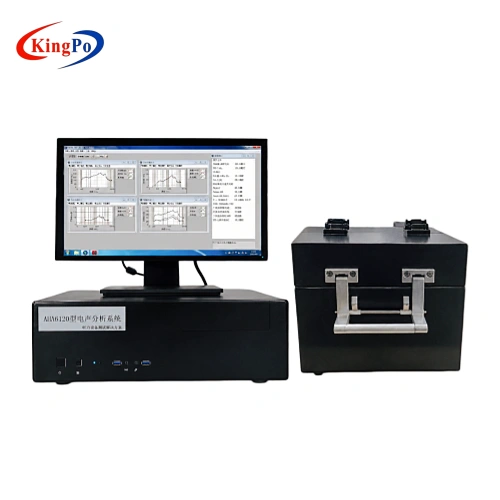
KP6128 Hearing Aid Test System with anechoic box and 2CC artificial ear for electroacoustic measurement – KingPo
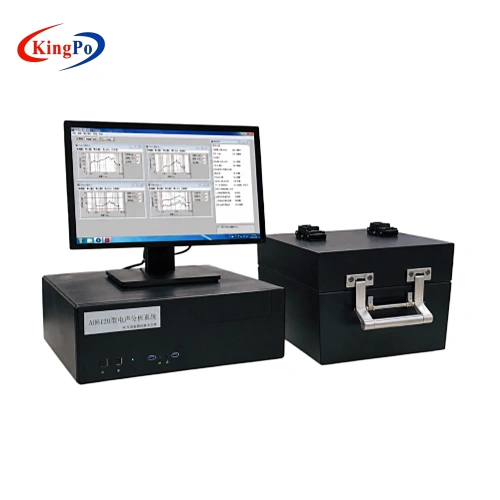
KP6128 Hearing Aid Tester main unit with high-resolution display and control interface – KingPo
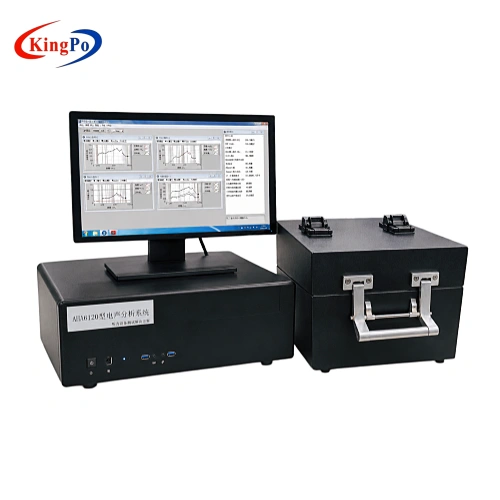
KP6161F 2CC Artificial Ear and coupler assembly used with the KP6128 Hearing Aid Test System – KingPo
KP6128 Hearing Aid Test System with anechoic box and 2CC artificial ear for electroacoustic measurement – KingPo
KP6128 Hearing Aid Tester main unit with high-resolution display and control interface – KingPo
KP6161F 2CC Artificial Ear and coupler assembly used with the KP6128 Hearing Aid Test System – KingPo

KP6128 Hearing Aid Test System

The KP6128 Hearing Aid Test System is designed for electroacoustic performance testing of hearing aids in production and quality control environments. It measures key parameters under controlled acoustic conditions, supporting incoming inspection, production sampling, outgoing verification and test documentation.

  • Standards Support: Designed to support selected IEC 60118, ANSI S3.22, ANSI/CTA-2051, GB/T 25102 and JJF 1201 related hearing aid electroacoustic test requirements
  • Test Environment: Integrated with KP8583 anechoic box for controlled acoustic measurement
  • 2CC Artificial Ear: KP6161F 2CC artificial ear / coupler assembly with HA-1, HA-2 and CIC couplers
  • Measurement Functions: OSPL90, FOG50, reference test gain, frequency response, THD, equivalent input noise, attack / release time, battery current, telecoil output and delay time
  • Frequency Range: 200 Hz – 8000 Hz
  • SPL Range: Input 30–130 dBSPL; output 50–130 dBSPL
  • Measurement Resolution: 0.1 dB
  • Software Control: Dedicated hearing aid test software for curve display, test sequence control and automatic result calculation

Hearing Aid Test System Description

KP6128 Hearing Aid Test Systemwith KP8583 Anechoic Box and 2CC Artificial Ear

The KP6128 Hearing Aid Test System provides a complete solution for measuring the electroacoustic performance of hearing aids. The system combines a precision main unit, an anechoic test box (KP8583), and a 2CC artificial ear / coupler assembly to create a stable and repeatable measurement environment.

During testing, the sound source inside the anechoic box is calibrated to deliver specified sound pressure levels. The hearing aid microphone picks up the sound, amplifies it, and drives the receiver. The microphone inside the artificial ear captures the acoustic output, allowing the software to calculate key parameters such as OSPL90, FOG50, frequency response, distortion, and noise levels.

This system is suitable for production line sampling, incoming inspection, outgoing quality verification, and test reporting and electroacoustic documentation before delivery.

Technical Parameters

Acoustic Input – Test Microphone

Item Specification Remark or Notes
Frequency Range 200 Hz – 8000 Hz
Measurement Range 30 dBSPL – 130 dBSPL (Z-weighted) Microphone reference sensitivity -26 dBV/Pa
Resolution 0.1 dB
Amplitude Error ≤ ±1.0 dB (200 Hz–3 kHz); ≤ ±2.0 dB (3 kHz–8 kHz) Relative to 1 kHz

Acoustic Output – Test Sound Source

Item Specification Remark or Notes
Frequency Range 200 Hz – 8000 Hz (100 Hz interval)
Frequency Error Better than 0.5%
Output SPL 50 dBSPL – 130 dBSPL
Amplitude Error ≤ ±1.5 dB (200 Hz–3 kHz); ≤ ±2.5 dB (3 kHz–8 kHz) By comparison method
Total Harmonic Distortion ≤ 1.0% at 70 dBSPL; ≤ 2.0% above 70 dBSPL and ≤90 dBSPL From 200 Hz to 8 kHz

Dynamic, Telecoil and Battery Measurement

Item Specification Remark or Notes
Attack / Release Time 50 ms – 5 s; accuracy ±10% or ±2 ms Whichever is greater
Telecoil Output MASL: 10 mA/m; ETLS: 31.6 mA/m Magnetic field strength
Battery Current 0.00 – 10.00 mA; accuracy ±5% of reading Available current > 10 mA
Battery Voltage 0 – 10 V; voltage error ±0.2 V (open circuit)

Physical & Environmental

Item Specification Remark or Notes
Main Unit Dimensions 440 × 325 × 151 mm (W × D × H) Approx. 8 kg
Anechoic Box (KP8583) 345 × 300 × 260 mm (W × D × H) Approx. 20 kg
Operating Temperature 0 °C – 40 °C
Operating Humidity 20% – 90% RH, non-condensing
Transport / Storage Temperature -20 °C to 60 °C
Transport / Storage Humidity 5% – 95% RH, non-condensing

Professional Construction & Technical Precision

The KP6128 system integrates a high-precision test microphone, calibrated sound source, and 2CC artificial ear / coupler assembly within a controlled anechoic environment (KP8583). The main unit provides stable signal generation and high-resolution measurement (0.1 dB) with defined amplitude error limits. The software automatically calculates key electroacoustic parameters according to the selected test sequence.

The system supports production quality control, incoming inspection, outgoing verification and electroacoustic documentation workflows, helping manufacturers maintain consistent hearing aid performance before delivery.

Measurement Principle

Inside the anechoic box, the test microphone calibrates the sound source to generate specified sound pressure levels at selected frequencies. The hearing aid microphone receives the acoustic signal, amplifies it, and drives the receiver. The microphone inside the 2CC artificial ear / coupler assembly measures the acoustic output. The software then processes the data to calculate parameters such as OSPL90, FOG50, frequency response, total harmonic distortion, equivalent input noise, attack/release time, and telecoil performance.
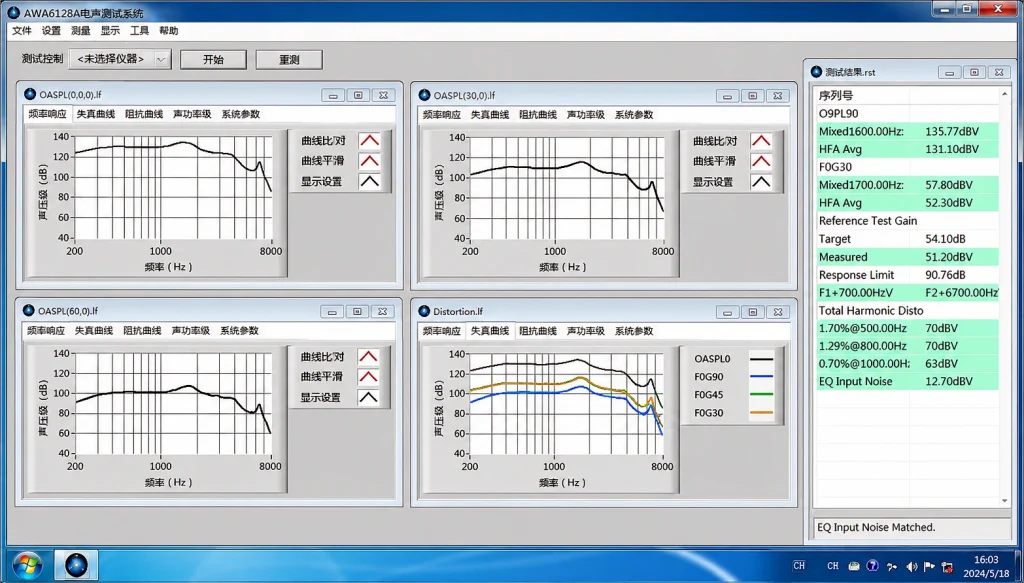
KP6128 Hearing Aid Test System Software interface for curve display and result calculation
Software interface for curve display and result calculation

Applications & Use Cases

This system is used by hearing aid manufacturers, quality assurance teams, and testing laboratories for production line quality control, incoming inspection, outgoing product verification, and electroacoustic performance evaluation.

Typical Applications:

  • Production sampling and process control
  • Supply chain and delivery quality assurance
  • Electroacoustic performance verification
  • Test reporting and electroacoustic documentation

Key Advantages

  • Integrated anechoic box and 2CC artificial ear / coupler assembly for stable, repeatable measurements
  • Supports selected international and national hearing aid electroacoustic test standards
  • Comprehensive test functions including acoustic, telecoil, and battery parameters
  • Defined amplitude error limits and 0.1 dB measurement resolution
  • User-friendly software with automatic curve display and result calculation
  • Suitable for production quality control and delivery verification workflows
Compliance & Regulatory Assurance

This system is designed to support electroacoustic performance testing of hearing aids in accordance with selected IEC 60118, ANSI S3.22, ANSI/CTA-2051 and GB/T 25102 related standards.

Metrological Integrity & Validation

  • Regular verification of the test microphone, sound source and 2CC artificial ear / coupler assembly using a suitable acoustic calibrator is recommended.
  • Periodic inspection and maintenance of the acoustic measurement chain helps ensure stable and repeatable test results.
  • Proper care of the measurement system supports reliable performance evaluation and consistent documentation.

Download Product Documentation

Technical Inquiry & Expert Support

KingPo offers the KP6128 Hearing Aid Test System for electroacoustic performance evaluation. Our engineering team can provide guidance on system setup, standard selection, and measurement procedures. For technical specifications or quotations, please contact us.

The Core Value We Deliver

  • Professional electroacoustic testing platform for hearing aid production and quality assurance
  • Supports selected international and national hearing aid test standards
  • Integrated anechoic environment with high-resolution measurement capability
  • Comprehensive functions covering acoustic, telecoil, and battery parameters
  • Reliable and repeatable results for manufacturing and documentation needs

KP6128 Hearing Aid Test System Detail Display

KP6128 Hearing Aid Test System FAQs

What is the KP6128 Hearing Aid Test System mainly used for?
The KP6128 is designed for electroacoustic performance testing of hearing aids during production, incoming inspection, and outgoing quality verification. It helps manufacturers ensure product consistency and meet delivery quality requirements.
What is the difference between the KP6128 and a clinical audiometer?
A clinical audiometer is primarily used for patient hearing assessment and hearing aid fitting. The KP6128 is an electroacoustic analyzer used to measure the output performance of the hearing aid itself (such as OSPL90, FOG50, distortion, and noise), rather than testing the patient’s hearing.
Which test parameters can the KP6128 measure?
The system can measure key parameters including OSPL90, FOG50, reference test gain, frequency response, total harmonic distortion (THD), equivalent input noise (EIN), attack and release time, battery current, telecoil output, and signal delay.
Why is the anechoic box (KP8583) important for testing?
The anechoic box provides a controlled acoustic environment that minimizes external noise and sound reflections. This ensures accurate and repeatable measurements of frequency response, gain, and noise performance.
What is the function of the 2CC artificial ear in this system?
The 2CC artificial ear (coupler) simulates the acoustic load of the human ear. It allows accurate measurement of the sound pressure level delivered by the hearing aid receiver, following standard measurement practices defined in IEC and ANSI standards.
Does the KP6128 support telecoil testing?
Yes. The system can measure telecoil performance by generating a magnetic field and evaluating the hearing aid’s inductive output (MASL and ETLS) according to relevant test standards.
Why is battery current measurement important in hearing aid testing?
Battery current testing helps evaluate power consumption under different operating conditions. It is useful for quality control, battery life estimation, and ensuring consistency between production batches.
Is the KP6128 suitable for full type testing and certification?
The system is primarily intended for production quality control, incoming inspection, and delivery verification. For formal type testing or regulatory certification, manufacturers should confirm requirements with accredited laboratories according to the specific standard.
How accurate is the KP6128 measurement system?
The system offers 0.1 dB resolution with defined amplitude error limits across the 200 Hz–8000 Hz range. Actual measurement repeatability also depends on proper sample mounting, environmental control, and adherence to standard test procedures.
What are common considerations when using the KP6128 system?
Key considerations include ensuring the anechoic box is properly sealed, correctly coupling the hearing aid to the artificial ear, using a calibrated sound source, maintaining stable test conditions, and following the selected standard’s test sequence. Regular verification with an acoustic calibrator is also recommended to maintain measurement reliability.

Related Products

Related News

Three Vertical Bar Signal Generator streamlines IEC 62368-1 compliance by ensuring accurate display testing and reliable safety certification.
IEC 62368-1 Annex D.3 impulse test generator ensures lab reliability, precise compliance, and efficient surge testing with advanced safety and automation.
Impulse test generator features for IEC 62368-1: dual waveforms, adjustable voltage, and safety controls make compliance and electrical testing simple.
IEC 62368-1 safety standard transition: key compliance steps, UL 62368-1 differences, and what manufacturers must do for global market access.
Achieve IEC 62368-1 compliance with a pink noise generator for reliable, accurate audio equipment testing and consistent performance verification.

The 83rd International Electrotechnical Commission (IEC) General Assembly, held in Shanghai, China from October 14 to 25, 2019, marked a […]

Scroll to Top

Get A Free Quote Now !

Contact Form
If you have any questions, please do not hesitate to contact us.