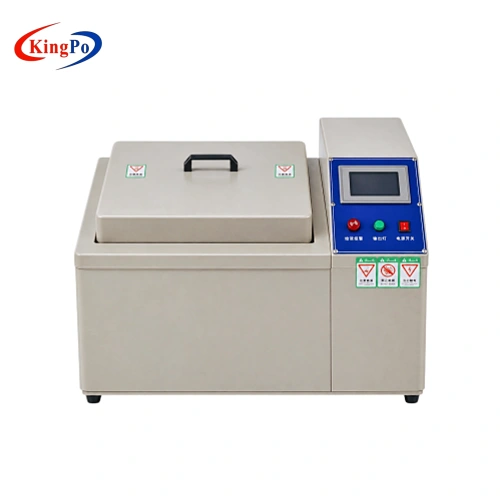
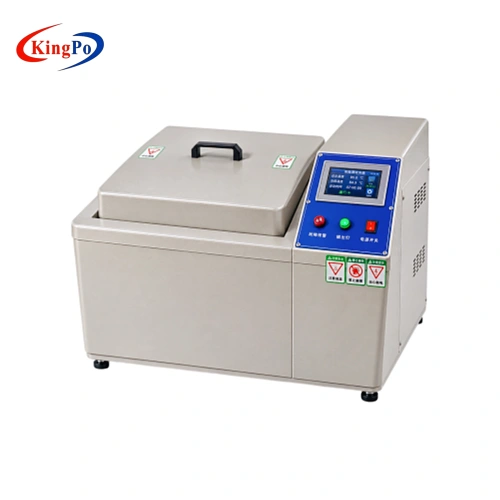
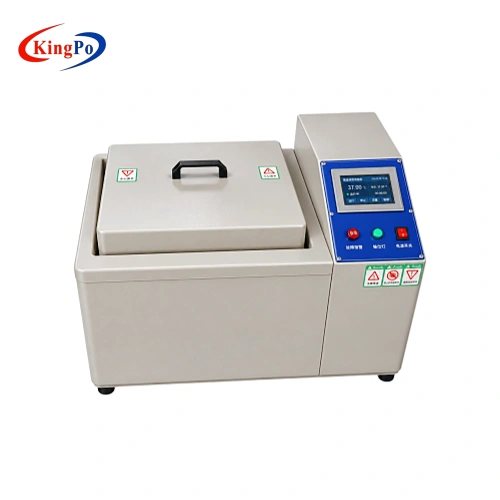
— DETAILED PRODUCT DESCRIPTION —
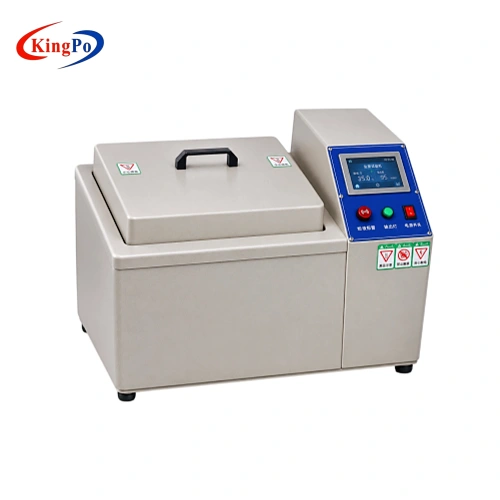
The KingPo Automotive Wire Hot Water Resistance Tester is used to test the insulation of automotive single-core wires under hot salt water conditions. During the test, wire specimens are immersed in a heated sodium chloride solution while a 48 V DC voltage is applied. This helps assess whether the insulation maintains its electrical properties after prolonged exposure.
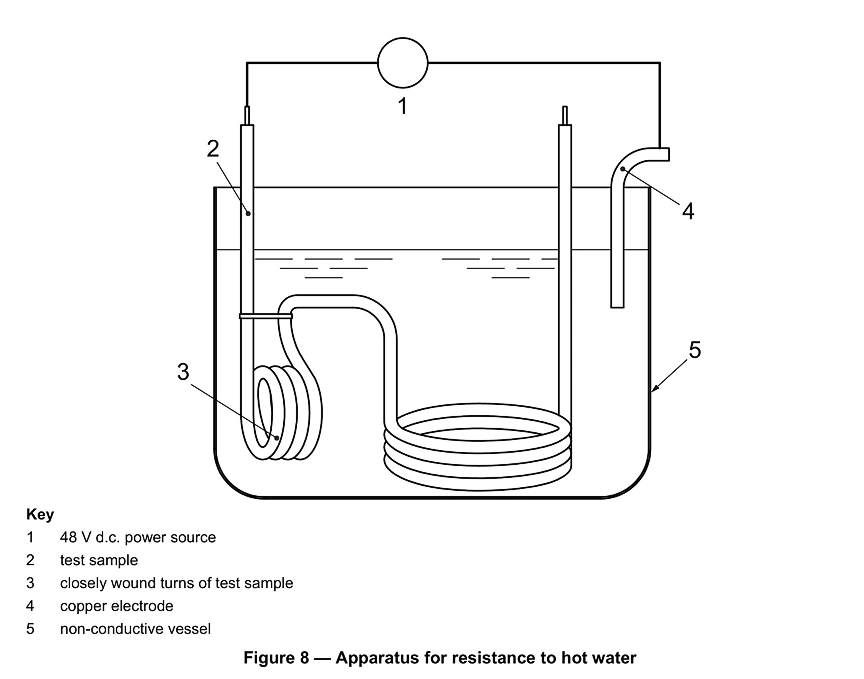
The equipment consists of a temperature-controlled water bath, a non-conductive test vessel, a copper electrode, a DC power supply and specimen fixtures. The wire is wound around a specified mandrel before being placed in the test vessel. The DC supply provides the required electrical exposure, with polarity reversed for the second specimen.
After each 7-day test period, insulation volume resistivity is measured while the specimen remains in the heated salt water. The process is repeated over five cycles in accordance with ISO 19642-2:2023 Clause 5.5.10.
1. Technical Specifications
The tester is configured for the hot water resistance test using heated sodium chloride solution and DC electrical exposure.
Test Conditions and Electrical Parameters
| Parameter | Specification |
|---|---|
| Applicable Standard | ISO 19642-2:2023, Clause 5.5.10 |
| Test Method | Resistance to hot water |
| Test Medium | Sodium chloride (NaCl) aqueous solution |
| NaCl Concentration | 10 g/L |
| Test Temperature | 85 ± 5°C |
| DC Power Supply | 48 V DC |
| Power Supply Configuration | Isolated output with reversible polarity |
| Copper Electrode Area | 10,000 ± 1,000 mm² immersed surface area |
| Heating Arrangement | External temperature bath |
Test Vessel and Specimen Parameters
| Parameter | Specification |
|---|---|
| Test Vessel | Electrically non-conductive; virgin PP in the KingPo configuration |
| Water Volume | 2–5 L; larger volume permitted for conductor CSA ≥10 mm², with actual volume recorded |
| Number of Specimens | 2, tested through separate complete procedures |
| Specimen Length | 2.5 ± 0.1 m each |
| Insulation Stripping Length | 25 mm at both ends |
| Minimum Winding Turns | 3 complete turns |
| Mandrel Diameter | According to ISO 19642-2:2023 Table 5, Column A |
| Specimen End Position | 250 mm above the liquid level |
Test Duration and Measurement
| Parameter | Specification |
|---|---|
| Duration per Cycle | 7 days |
| Number of Cycles | 5 |
| Total Exposure Duration | 35 days per specimen |
| Intermediate Measurement | Insulation volume resistivity |
| Measurement Condition | In the heated salt water bath at 85 ± 5°C |
| Measurement Reference | Clause 5.3.6; 100–500 V DC measurement voltage |
| Referee Measurement Voltage | 500 V DC |
| Final Cooling Period | 16 hours at room temperature |
| Second Specimen | Complete test repeated with reversed 48 V DC polarity |
2. Test Principle and Procedure
The test combines heated salt water immersion with DC electrical exposure to evaluate the electrical integrity of automotive wire insulation. The specimen is wound around a specified mandrel, immersed in the solution and subjected to the prescribed electrical conditions.
Test Specimen Preparation
Two specimens are prepared according to ISO 19642-2:2023 Clause 5.5.10.2. Each specimen is 2.5 ± 0.1 m long, with 25 mm of insulation removed from both ends. It is wound for at least three complete turns around a mandrel selected according to Table 5, Column A. The mandrel is removed before immersion.
Exposure and Measurement Sequence
- Prepare the bath: Fill the non-conductive vessel with 10 g/L NaCl solution and establish a temperature of 85 ± 5°C.
- Position the specimen: Immerse the wound specimen while keeping it clear of the copper electrode. Both ends extend 250 mm above the liquid level.
- Apply electrical exposure: Connect the specimen to the 48 V DC supply and maintain the specified conditions for 7 days.
- Measure resistivity: Disconnect the 48 V supply and measure insulation volume resistivity according to Clause 5.3.6 while the specimen remains in the hot salt water bath.
- Repeat the cycles: Complete five 7-day exposure and measurement cycles, totaling 35 days.
- Complete the final inspection: Remove the specimen, cool it for 16 hours at room temperature and perform the required visual examination. If no exposed conductor is visible, conduct the subsequent withstand voltage test according to Clause 5.3.4.
The insulation volume resistivity measurement uses a separate resistance-measuring instrument. The 48 V DC supply is for the long-term exposure stage, not the resistivity measurement itself. Under Clause 5.3.6, the measurement voltage is 100–500 V DC, with 500 V used as the referee setting in case of dispute.
3. System Architecture and Components
The tester integrates the thermal, electrical and specimen-handling components required for the hot water resistance procedure.
Non-Conductive Test Vessel
The KingPo configuration uses a virgin polypropylene (PP) vessel to contain the heated salt water and immersed specimen. Its electrically insulating construction separates the solution from the surrounding equipment structure.
External Temperature Bath
The external heating arrangement transfers heat to the test vessel and maintains the salt water at the required test temperature throughout the long-duration exposure.
48 V DC Power Supply
The isolated DC output supplies the test voltage during each exposure cycle. Reversible polarity supports the opposite-polarity procedure for the second specimen.
Copper Electrode Assembly
The copper electrode provides the specified electrical arrangement inside the vessel. Its immersed surface area is controlled according to the standard, and the specimen must remain physically separated from it.
Mandrel and Specimen Fixtures
The mandrel set, winding jig and insulating support fixtures assist with specimen preparation and positioning. Mandrel selection is based on the applicable cable dimensions and ISO 19642-2:2023 Table 5, Column A.
Resistivity Measurement Interface
The measurement interface allows connection to a compatible external resistance-measuring instrument for intermediate insulation volume resistivity measurements.
4. Applicable Standard and Test Scope
ISO 19642-2:2023 — Road vehicles — Automotive cables — Part 2: Test methods
| Reference | Description |
|---|---|
| Clause 5.5.10 | Resistance to hot water |
| Clause 5.5.10.2 | Test specimens |
| Clause 5.5.10.3 | Test procedure |
| Figure 13 | Test apparatus for resistance to hot water |
| Clause 5.3.6 | Insulation volume resistivity |
| Clause 5.3.4 | Withstand voltage after environmental testing |
The KingPo Automotive Wire Hot Water Resistance Tester is designed for the specific hot water resistance test in Clause 5.5.10. The referenced resistivity measurement and subsequent withstand voltage test follow their respective procedures under Clauses 5.3.6 and 5.3.4.
5. DUT Compatibility and Applications
The tester is intended for single-core automotive wires and cables. The specimen arrangement and mandrel selection depend on the conductor cross-sectional area, cable dimensions and insulation construction.
For aluminium conductor cables, specimen preparation in cases of dispute follows Clause 5.3.1. The appropriate mandrel diameter is selected according to Table 5, Column A of ISO 19642-2:2023.
Typical users include automotive wire manufacturers, cable material R&D laboratories, quality assurance departments and third-party testing laboratories.