Executive Summary
In industries ranging from aerospace to consumer electronics, a Vibration Test System is the definitive tool for ensuring product durability. Selecting the right system requires a delicate balance of physics, engineering requirements, and budgetary constraints. This guide explores the critical factors you must evaluate to ensure your laboratory meets international testing standards like MIL-STD, ISO, and IEC.
1. System Architecture: The Four Pillars
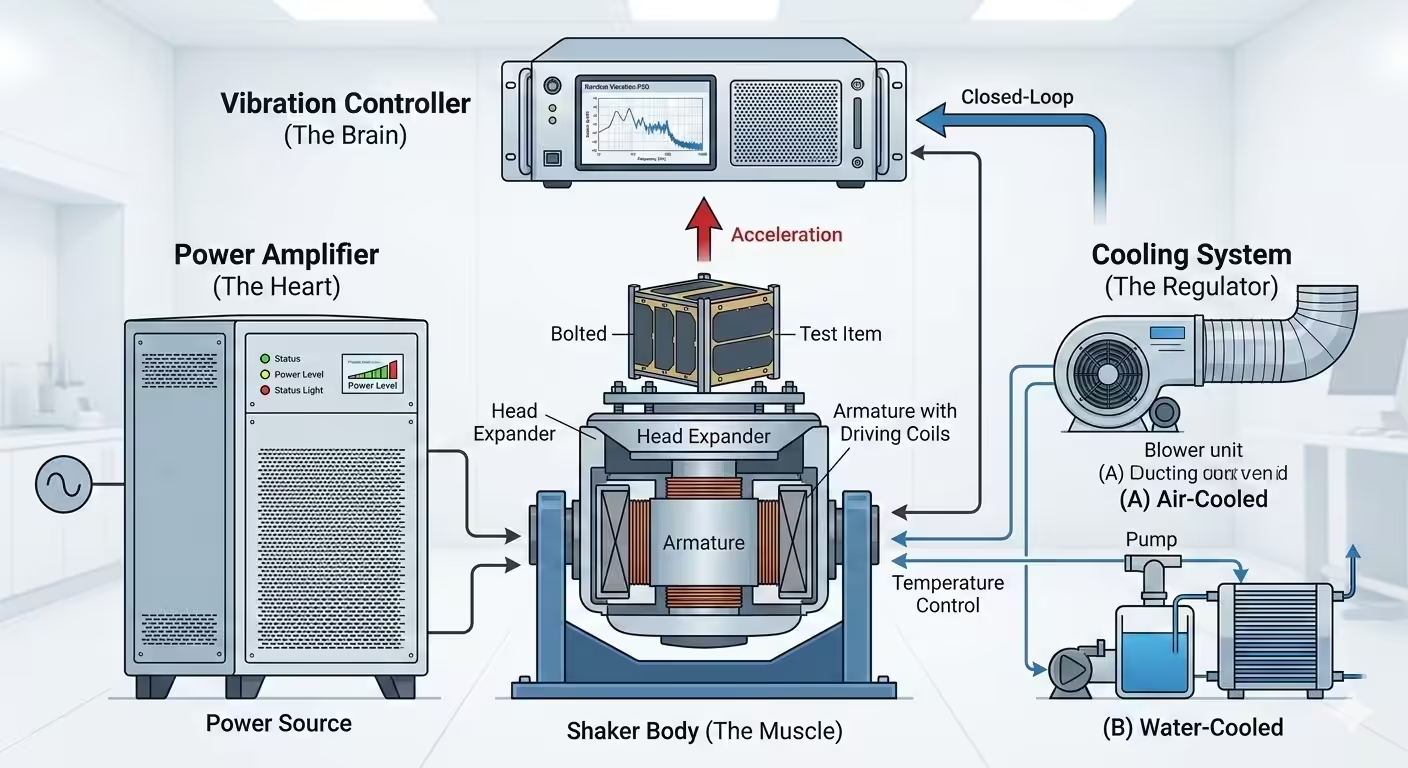
A complete electromagnetic vibration system is an ecosystem of four core components. Understanding their synergy is the first step in selection. The diagram below provides a clean visual breakdown of how these pillars—the Brain, Heart, Muscle, and Regulator—work together in a closed-loop environment.
Diagram: The Complete Vibration Test System Ecosystem
-
Vibration Controller (The Brain): Depicted as the rack-mounted unit on top, this unit receives real-time feedback from sensors and adjusts the signal to maintain the target profile, illustrated here with a closed-loop path.
-
Power Amplifier (The Heart): Shown on the left as a large cabinet, it delivers high-current, high-voltage signals to drive the mechanical movement.
-
Shaker Body (The Muscle): The cross-section diagram shows the field coils and armature (the internal structure), which convert electrical energy into kinetic energy (upward acceleration).
-
Cooling System (The Regulator): This critical component manages thermal loads. Our diagram illustrates the two main types: (A) Air-Cooled with a blower unit, and (B) Water-Cooled with a pump and heat exchanger, allowing you to compare their infrastructure requirements.
2. Core Selection Factors
A. Force Rating (The Physics of Selection)
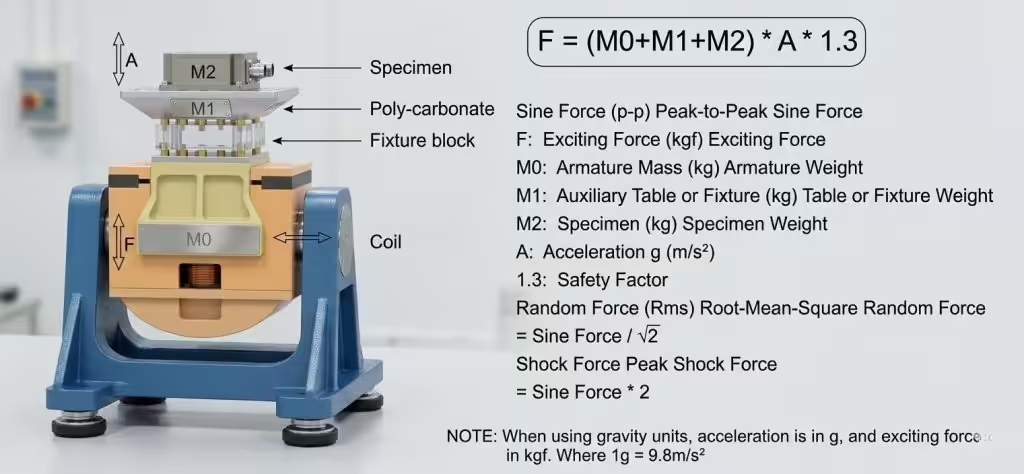
The most common mistake in procurement is underestimating the required force. You must calculate the Total Dynamic Force using the following formula:
- F: Required Force (Newtons or lbf).
- Mp: Mass of the Payload (The Test Article).
- Mf: Mass of the Fixture (The interface between shaker and payload).
- Ma: Mass of the Shaker Armature.
- A: Maximum Acceleration (g or m/s2).
- S: Safety Factor (Recommended 1.25 or 25% margin).
Pro Tip: Running a system at its 100% limit leads to premature coil failure. Always visit WWW.DGKINGO.COM for professional force-matching consultations and high-performance system configurations.
B. Displacement, Velocity, and Acceleration (DVA)
Every shaker has a performance envelope. You must ensure your test profile fits within these three physical limits:
-
Displacement: Essential for low-frequency tests. Standard shakers offer 51mm, while long-stroke models reach 76mm or 100mm.
-
Velocity: Limits the system’s ability to handle high-energy shock pulses.
-
Acceleration: Dictates the severity of high-frequency fatigue tests.
C. Frequency Range and Armature Resonance
Most electromagnetic shakers operate from 2 Hz to 3,000 Hz. However:
-
Low-frequency limits are governed by displacement.
-
High-frequency limits are governed by the Armature’s First Natural Resonance. For precision testing, the test frequency should ideally stay below 80% of the resonance frequency.
D. Cooling Strategy: Air vs. Water
| Factor | Air-Cooled Systems | Water-Cooled Systems |
| Force Range | Typically < 60 kN | Typically > 60 kN to 600 kN |
| Noise Level | High (Blower noise) | Low (Silent operation) |
| Lab Environment | Heat is exhausted into the room | Heat is transferred to external water |
| Maintenance | Simple (Filter cleaning) | Complex (Water quality & Heat Exchanger) |
3. Industry Application & Selection Matrix
Different industries have unique “stressors.” Use this table to align your needs with KINGPO solutions:
| Industry | Primary Standards | Selection Focus | Recommended Configuration |
| EV Battery | UN 38.3, ECE R100 | Large payload, Explosion-proof | Water-cooled + Slip Table |
| Consumer Tech | IEC 60068, ISTA | High frequency, throughput | Air-cooled + Head Expander |
| Aerospace | MIL-STD-810H | High G-shock, Sine-on-Random | High-force Water-cooled |
| Auto Parts | ISO 16750, GMW 3172 | Temp/Vib combined testing | Vertical/Horizontal + Chamber |
4. Advanced Considerations: Controller & Software
The hardware is only as good as the software driving it. Ensure your controller supports:
-
Random Vibration: Real-world simulation.
-
Sine Vibration: Resonance search and dwell.
-
Classical Shock: Half-sine, Sawtooth, and Trapezoidal pulses.
-
Kurtosis Control: For more realistic, non-Gaussian random simulation.
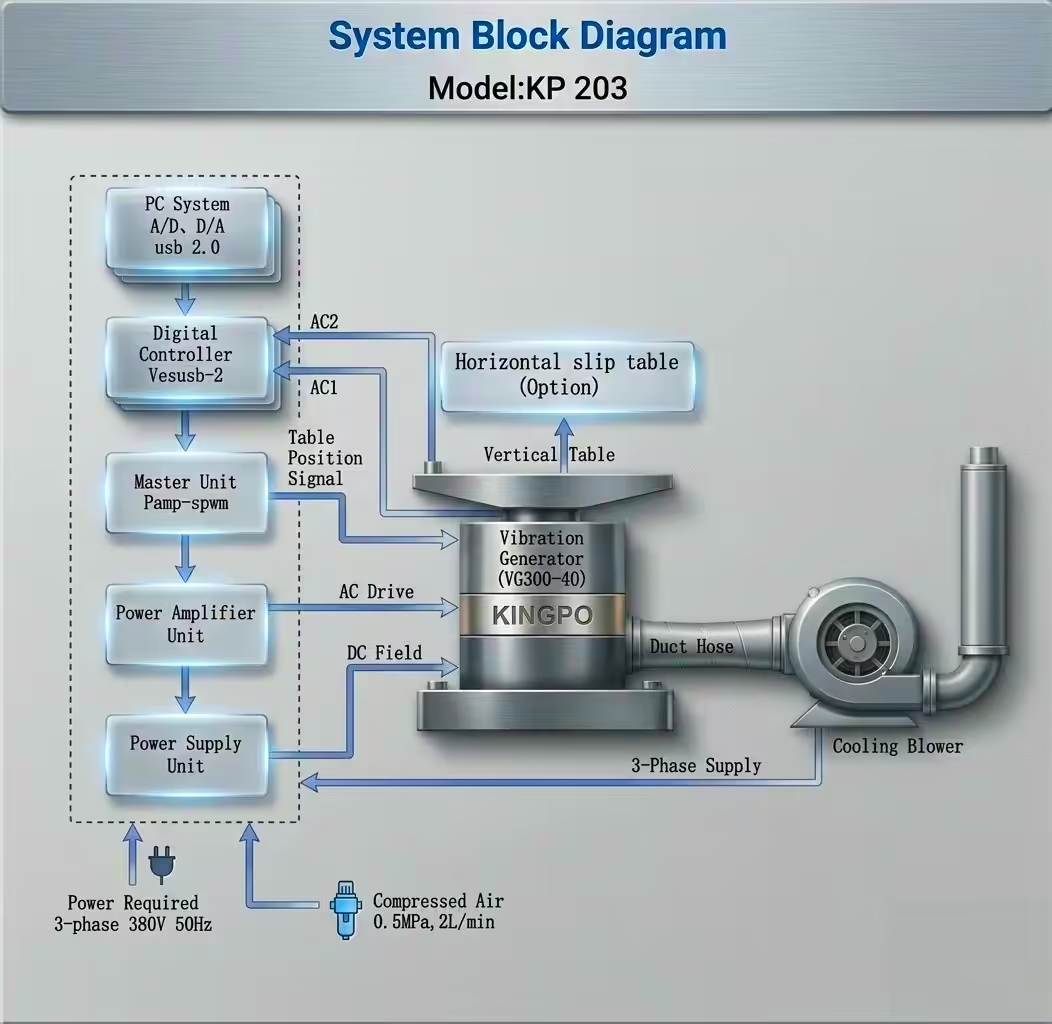
Electrodynamic Vibration Test System
5. Vibration Test System: 20+ Professional FAQs
Q1: What is the most critical factor when calculating force? A: Including the weight of the Armature ($M_a$). Many users only count the payload, leading to undersized systems.
Q2: When do I need a Slip Table? A: When you need to test in the X or Y (horizontal) axes without tilting your product, which is often required for large or fluid-containing items.
Q3: Can I use a shaker for drop testing? A: To an extent. Shakers can simulate Classical Shock pulses, but for actual gravity drops, a dedicated drop tester is better.
Q4: What is the difference between peak and RMS force? A: Sine tests use Peak Force, while Random tests use RMS (Root Mean Square) Force. Usually, Random Force is 80% to 100% of Sine Force.
Q5: How does a Head Expander affect performance? A: It allows for larger payloads but adds significant mass ($M_f$), which reduces the maximum achievable acceleration.
Q6: What is a “Closed-Loop” system? A: It means the controller continuously monitors the output via accelerometers and adjusts the drive signal in real-time to maintain accuracy.
Q7: Why is Magnesium used in armatures? A: Magnesium offers a superior stiffness-to-weight ratio, allowing for higher frequencies and lower moving mass.
Q8: How often should I calibrate the sensors? A: Accelerometers should be calibrated annually to ensure data integrity.
Q9: What causes “Clipping” in random vibration? A: Clipping occurs when the amplifier voltage is insufficient to produce the required peak peaks (3-Sigma) of a random signal.
Q10: Can I integrate a vibration table with an environmental chamber? A: Yes. This is a “Combined Reliability Test.” Visit WWW.DGKINGO.COM for specialized thermal barrier solutions.
Q11: What is Sine-on-Random (SoR)? A: It simulates environments like helicopters, where a dominant engine frequency (Sine) sits on top of broadband road/wind noise (Random).
Q12: How do I minimize noise in my lab? A: Opt for a water-cooled system or install the air-cooling blower in a separate, soundproofed room.
Q13: What is “Cross-Axis” motion? A: It is unwanted vibration in a direction perpendicular to the test axis. High-quality systems keep this < 5%.
Q14: Does humidity affect shaker performance? A: Yes. High humidity can cause corrosion or electrical arcing in the drive coils. Maintaining < 60% RH is ideal.
Q15: What is the benefit of “Kurtosis” control? A: It allows the random vibration to have higher “peaks,” making the test more realistic and capable of finding fatigue issues faster.
Q16: How do I protect my floor from vibration? A: Use a system with pneumatic isolation mounts. For massive shakers, a dedicated “isolated foundation” (concrete block) may be necessary.
Q17: What is IEPE? A: It is a type of accelerometer with built-in electronics, making it easy to plug directly into modern controllers without an external charge amp.
Q18: What is the typical lifespan of a KINGO shaker? A: With regular maintenance (cleaning and coil inspection), these systems often last 15-20 years.
Q19: Can I upgrade an old shaker with a new controller? A: Yes! Upgrading the “brain” (Controller) is the most cost-effective way to add modern features to old hardware.
Q20: Why is Center of Gravity (CoG) important? A: An off-center CoG creates “overturning moments” that can damage the shaker’s suspension and cause inaccurate test results.
Conclusion
Choosing a vibration test system is a strategic investment. By focusing on Force calculations, DVA limits, and cooling efficiency, you can ensure your lab provides reliable, repeatable data for years to come.
Ready to start your project?
Consult with our senior engineers at WWW.DGKINGO.COM for a free technical assessment and customized system configuration.