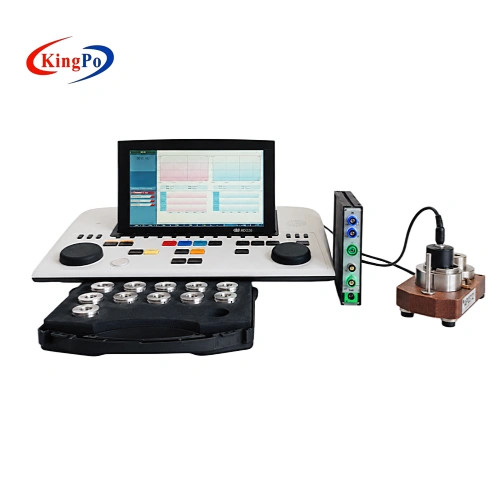
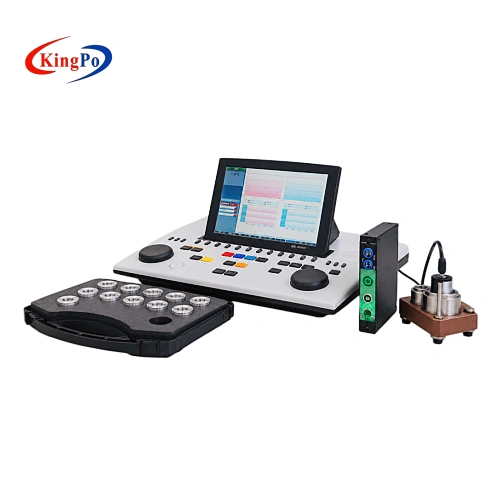
Complete Audiometer Calibration System with acoustic analyzer, standard cavities and calibration fixtures for laboratory use.
Front view of the Audiometer Calibration System for pure-tone and impedance audiometer verification.
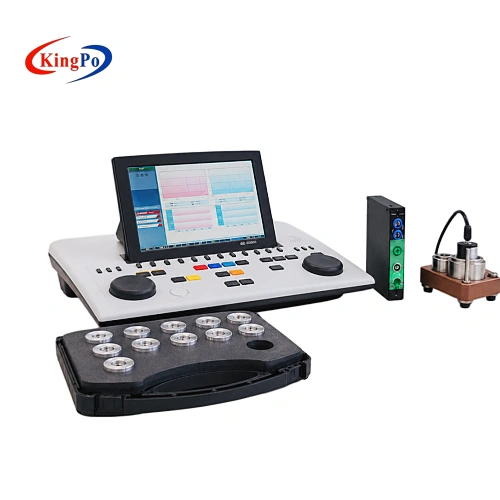
Left-side view of an Audiometer Calibration System configured for IEC 60645-1 laboratory testing.
Complete Audiometer Calibration System with acoustic analyzer, standard cavities and calibration fixtures for laboratory use.
Front view of the Audiometer Calibration System for pure-tone and impedance audiometer verification.
Left-side view of an Audiometer Calibration System configured for IEC 60645-1 laboratory testing.

Audiometer Calibration System for Pure Tone and Impedance Audiometers

This Audiometer Calibration System provides an integrated solution for the verification, calibration, development and quality control of pure-tone and impedance audiometers.

It combines acoustic analyzers, ear simulators, acoustic couplers, a mechanical coupler, pressure measurement equipment, standard volume cavities and dedicated measurement software.

  • System Type: Integrated verification/calibration solution
  • Applicable Devices: Pure-tone audiometers, impedance audiometers, tympanometers
  • Measurement: Acoustic, mechanical, pressure, cavity-volume
  • Standards: IEC 60645-1, IEC 60645-5
  • End Users: Metrology institutes, calibration labs, manufacturers
  • Configuration: Turnkey system or custom lab setup

Audiometer Calibration System Product Overview

The Audiometer Calibration System is designed for metrology institutes, calibration laboratories, third-party testing organizations and audiometer manufacturers that require a coordinated measurement solution rather than separate test instruments.

Unlike a standalone sound analyzer or acoustic coupler, the Audiometer Calibration System covers different audiometer transducers and measurement principles within one configured platform. The appropriate ear simulator, acoustic coupler or mechanical coupler is selected according to the transducer type and applicable standard.

Dedicated software guides the operator through the measurement process, applies stored correction data, calculates results, compares measured values with predefined limits and generates test records. By combining acoustic, mechanical, pressure and cavity-volume references, the Audiometer Calibration System reduces the integration work required when establishing a new audiometer calibration capability.

Integrated Workflow
One coordinated platform
Measurement hardware, reference devices and software are configured together.
Dual Coverage
Pure-tone and impedance
Supports both audiometer categories without building two separate systems.
Professional Use
Laboratory and manufacturing
Suitable for routine calibration, R&D adjustment and quality control.

Technical Specifications

The following Audiometer Calibration System specifications are based on the available technical materials. Final values are subject to the approved configuration and calibration documentation.

Item Reference Requirement
Ear Simulator Frequency Range Typically 20 Hz to 10 kHz, depending on simulator type
Supra-Aural Acoustic Coupler Range 125 Hz to 8 kHz
Occluded-Ear Simulator Range Typically 20 Hz to 10 kHz for the specified configuration
2 cm³ Acoustic Coupler Range 125 Hz to 8 kHz
Mechanical Coupler Range At least 125 Hz to 8 kHz
Mechanical Coupler Expanded Uncertainty 1.5 dB, k=3
Acoustic Measurement Expanded Uncertainty Up to 0.6 dB, k=2, for specified simulator and coupler configurations
Conditioning Amplifier Range 20 Hz to 20 kHz
Conditioning Amplifier Frequency Response Maximum permissible error ±0.3 dB
Conditioning Amplifier Level Linearity Maximum permissible error ±0.4 dB
Acoustic Analyzer Range 20 Hz to 20 kHz for the specified configuration
Acoustic Analyzer Frequency Response Maximum permissible error ±0.2 dB
Acoustic Analyzer Indication Maximum permissible error ±0.2 dB
Frequency Measurement Maximum permissible error ±0.1%
Pressure Measurement Maximum permissible error ±0.2% of full scale
Headband Force Measurement 0 to 15 N
Headband Force Maximum Permissible Error ±0.1 N
Standard Cavity Range 0.1 cm³ to 8.0 cm³
Standard Cavity Quantity At least 11 cavities
Cavity-Volume Tolerance ±2% of nominal value or 0.05 cm³, whichever is greater
Frequency-range note: The standard configuration is primarily intended for measurements up to 8 kHz. Testing above 8 kHz requires compatible analyzers, simulators, couplers and reference-level data and must be confirmed separately.

System Coverage

The Audiometer Calibration System combines two specialist workflows for air-conduction, bone-conduction and impedance/admittance audiometer measurement.

Pure Tone Audiometer Calibration System

The Pure Tone Audiometer Calibration System supports the calibration and performance evaluation of air-conduction and bone-conduction audiometers.

  • Supra-aural earphones
  • Circumaural earphones
  • Insert earphones
  • Bone vibrators
Output Level
Frequency
Linearity
Distortion

Impedance Audiometer Calibration System

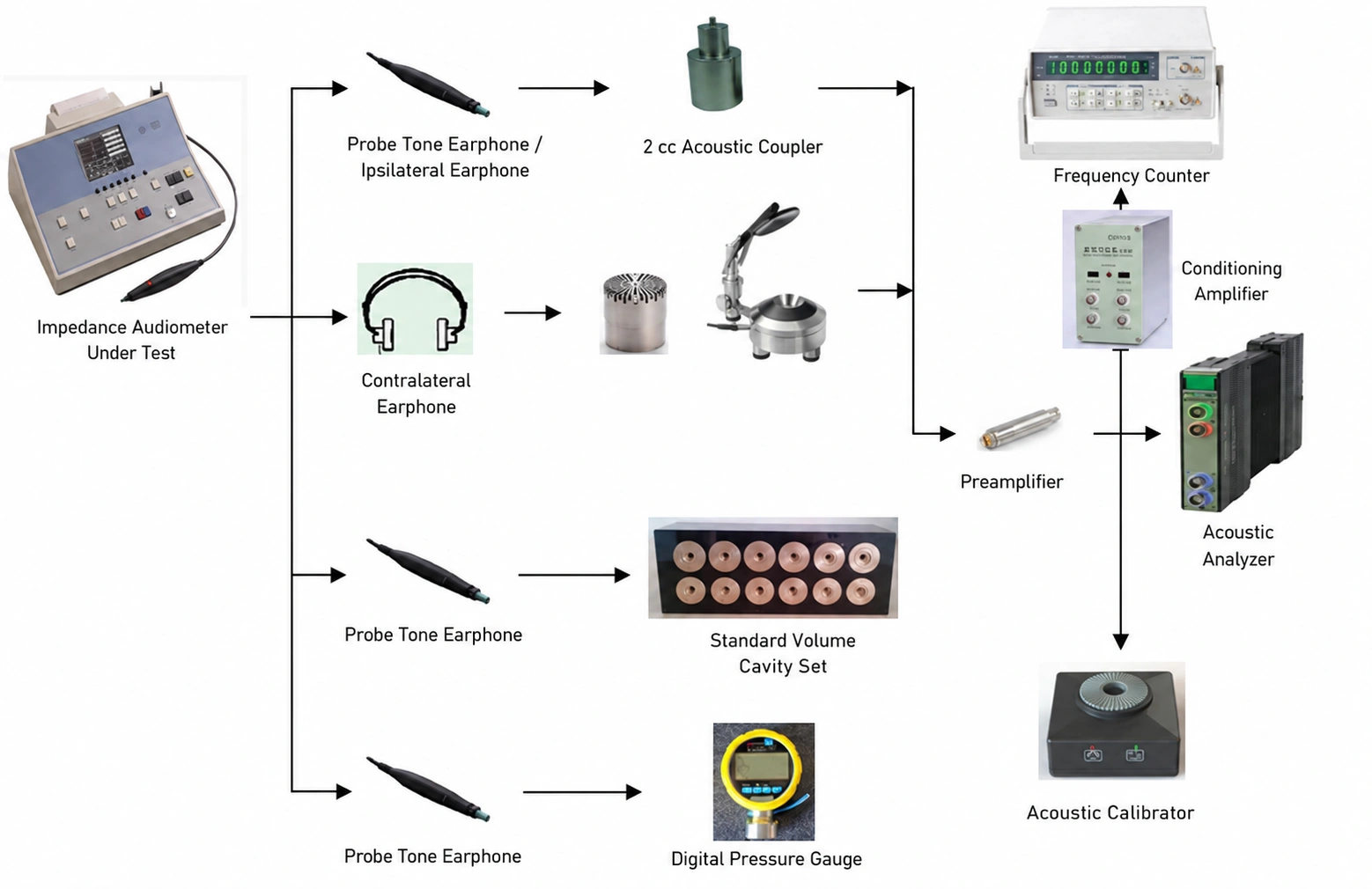
The Impedance Audiometer Calibration System is intended for impedance/admittance audiometers and tympanometers with probe-tone and acoustic reflex functions.

  • Probe-tone channels
  • Ipsilateral acoustic reflex channels
  • Contralateral acoustic reflex channels
  • Pressure and cavity-volume indication
Probe Tone
Acoustic Reflex
Pressure
Cavity Volume

Audiometer Measurement Scope

Pure-Tone Measurement

  • Output sound pressure level
  • Hearing-level reference-zero verification
  • Bone-conduction output force level
  • Test signal frequency
  • Level linearity
  • Harmonic distortion
  • Earphone headband force
  • Applicable timing characteristics

For air-conduction measurements, the earphone is connected to the appropriate ear simulator or acoustic coupler. Bone vibrators are applied to a mechanical coupler or artificial mastoid under a specified static force.

Impedance and Tympanometer Measurement

  • Probe-tone frequency
  • Probe-tone sound pressure level
  • Ipsilateral reflex signal level
  • Contralateral reflex signal level
  • Harmonic distortion
  • Pressure indication
  • Standard cavity-volume indication

The Audiometer Calibration System uses defined acoustic cavities, ear simulators and pressure references to evaluate acoustic and pressure-related performance.

How the Measurement Works

In each Audiometer Calibration System workflow, the audiometer transducer is connected to a standardized acoustic or mechanical load before the measurement data is evaluated by the software.

01
Select the Interface

Select the suitable ear simulator, coupler, mechanical coupler or standard cavity.

02
Acquire the Signal

Measure acoustic pressure, vibratory force, frequency, pressure or cavity response.

03
Apply Corrections

Use stored simulator sensitivities and reference data to calculate the result.

04
Evaluate and Record

Compare results with configured limits and generate a structured measurement record.

This workflow makes the Audiometer Calibration System suitable for laboratory calibration, production quality control and product performance comparison. Direct device control depends on the audiometer model and communication interface.

Key Features

The Audiometer Calibration System is designed around the operating requirements of professional calibration laboratories and audiometer manufacturers.

01

Integrated Measurement Chain

Combines acoustic, mechanical, pressure and cavity-volume measurement equipment.

02

Broad Transducer Coverage

Supports supra-aural, circumaural and insert earphones as well as bone vibrators.

03

Guided Software Workflow

Guides operators through measurement, correction, calculation and result evaluation.

04

Integrated Reference Data

Stores and applies reference-zero values, simulator sensitivities and correction data.

05

Automatic Evaluation

Compares measured results with configured limits for clear pass/fail interpretation.

06

Test Record Generation

Produces structured records for calibration, quality control and development work.

07

R&D Adjustment Support

Helps identify deviations and compare performance before and after adjustment.

08

Flexible Configuration

The Audiometer Calibration System can be supplied as a complete package or integrated with existing equipment.
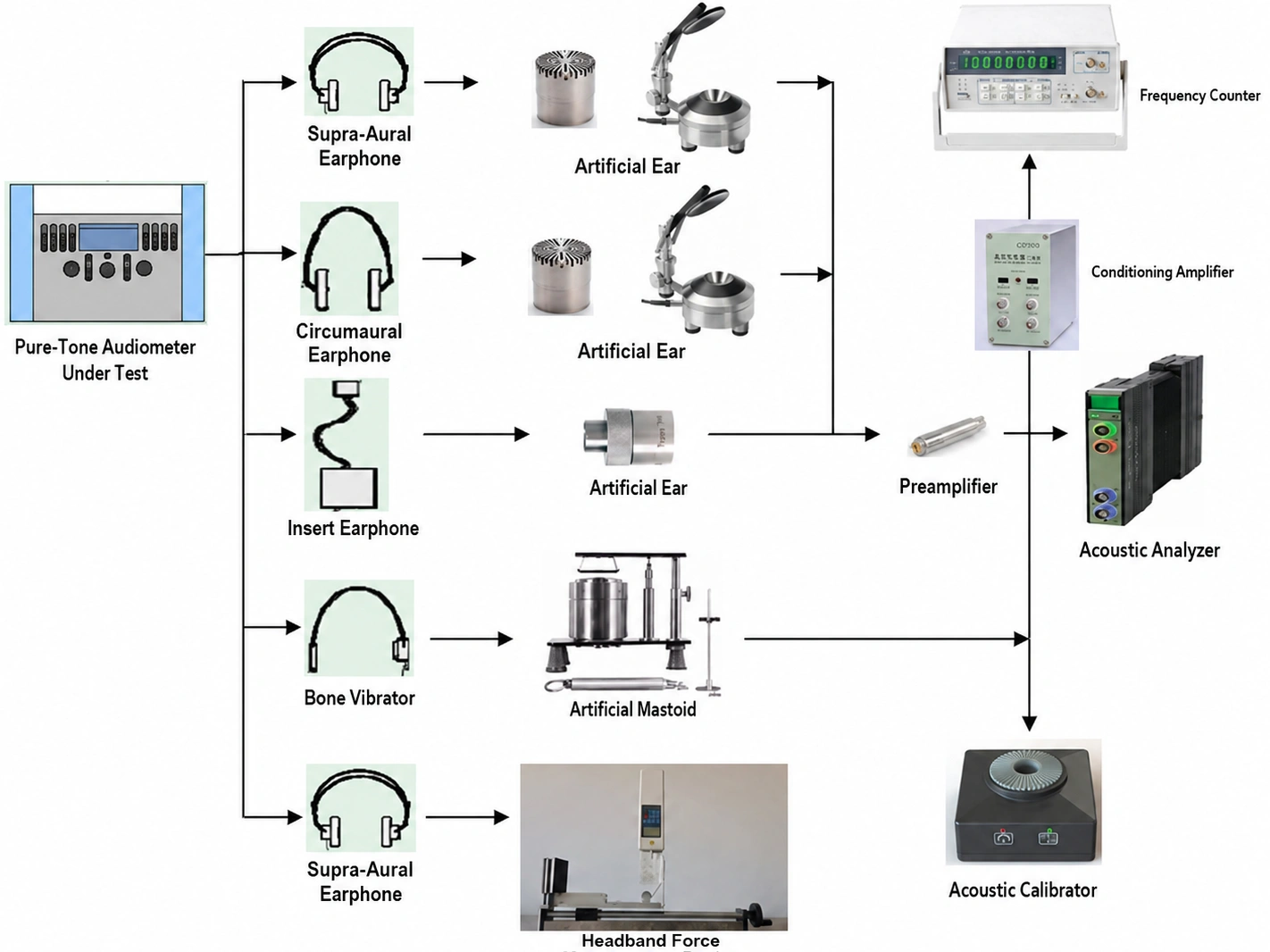
IEC 60645-1 pure-tone audiometer calibration flow for air-conduction and bone-conduction transducers.

IEC 60645-5 impedance audiometer calibration flow using a 2 cc coupler, cavity set and pressure gauge.

Applicable International Standards

The Audiometer Calibration System can be configured around the following audiometer, ear simulator and reference-zero standards.

Standard Application
IEC 60645-1:2017 Equipment for pure-tone and speech audiometry
IEC 60645-5:2004 Instruments for measuring aural acoustic impedance/admittance
IEC 60318-1:2009 Ear simulator for supra-aural and circumaural earphones
IEC 60318-3:2014 Acoustic coupler for supra-aural audiometric earphones
IEC 60318-4:2010 Occluded-ear simulator for insert earphones
IEC 60318-5:2006 2 cm³ coupler for insert earphones
IEC 60318-6:2007 Mechanical coupler for bone vibrators
ISO 389 Series Reference zero for the calibration of audiometric equipment
Standard applicability depends on the audiometer type, transducer, frequency range and laboratory scope. Final conformity should be confirmed against the applicable standard edition, calibration certificates and approved laboratory procedure.

Typical System Configuration

A typical Audiometer Calibration System may include the following reference devices, measurement instruments, adapters and software.

Component Reference Model or Description Quantity
Multifunction Acoustic Analyzer AWA6292 or approved equivalent 1
Sound Calibrator AWA6021A or approved equivalent 1
Artificial Mastoid / Mechanical Coupler Model 4930 or approved equivalent 1
Conditioning Amplifier Matched to the measurement chain 1
6 cm³ Acoustic Coupler Model 317-J or equivalent 1
IEC 60318-1 Ear Simulator Set Model 318-J or equivalent 1
Occluded-Ear Simulator and Adapters Model 711-J or equivalent 1
2 cm³ Coupler and Adapters LXY-2CC-1 or equivalent 1
Frequency Counter Laboratory-grade configuration 1
Earphone Headband Force System LXY-TGFM or equivalent 1
Standard Weight 510 g 1
Standard Volume Cavity Set 0.1 to 8.0 cm³, 11 cavities 1 set
Digital Pressure Meter LXY-SZYLJ or equivalent 1
Audiometer Measurement Software 15-PATSLM-2 or current version 1
Connection Cables and Adapters According to the approved configuration 1 set
Computer or Display Device According to project requirements 1

Typical Applications

An Audiometer Calibration System can support calibration, verification, development and quality-control work in the following professional environments.

Metrology Institutes

Establish or extend pure-tone and impedance audiometer verification capability.

ISO/IEC 17025 Laboratories

Perform repeatable measurements using traceable reference equipment and structured records.

Third-Party Testing

Evaluate audiometers used by hospitals, hearing centers and medical equipment suppliers.

Audiometer Manufacturers

Use the Pure Tone Audiometer Calibration System for R&D, output adjustment and quality control.

Tympanometer Manufacturers

Use the Impedance Audiometer Calibration System to verify probe tones, pressure and cavity volume.

Medical Engineering Departments

Support equipment comparison, performance checks and internal quality management.

Installation, Training and Documentation
Each Audiometer Calibration System can be supplied with project services according to the agreed laboratory scope.

Representative pure-tone and impedance audiometers should be available during installation and acceptance. This allows the complete Audiometer Calibration System workflow to be demonstrated using actual devices under test.

  • System installation and connection verification
  • Software installation and configuration
  • Pure-tone audiometer measurement demonstration
  • Impedance audiometer measurement demonstration
  • Operator training
  • Test-record template configuration
  • Standard equipment and certificate review
  • Laboratory capability consultation
  • Remote technical support

Compliance & Regulatory Assurance

Compliance & Regulatory Assurance

The Audiometer Calibration System supports the verification and calibration of pure-tone audiometers, impedance audiometers and tympanometers according to IEC 60645-1:2017 and IEC 60645-5:2004.

Final conformity depends on the selected configuration, reference-equipment traceability, measurement uncertainty, test procedure and applicable standard edition. Relevant calibration and test documentation can be confirmed according to project requirements.


Applicable Standards
IEC 60645-1:2017
IEC 60645-5:2004

Test Objects
Pure-tone and impedance audiometers

Key Verification
Level, frequency, distortion, pressure and volume

Documentation
Certificates, test records and traceability files
Technical Datasheet
Audiometer Calibration System – IEC 60645-1 & IEC 60645-5
Product overview, international standards, system configuration, and pure-tone and impedance audiometer calibration workflows.

Download PDF

Technical Inquiry & Expert Support

To confirm whether the Audiometer Calibration System matches your laboratory requirements, please provide the key information below when submitting an inquiry. This helps our technical team confirm the applicable standards, audiometer type, transducer configuration, measurement scope and required documentation before quotation.

Information Needed Description
Applicable Standard IEC 60645-1, IEC 60645-5, relevant IEC 60318 or ISO 389 requirements, or the applicable national adoption used by your laboratory.
Audiometer Type Confirm whether the device under test is a pure-tone audiometer, impedance audiometer or tympanometer, including its brand and model.
Transducer Configuration Specify supra-aural, circumaural, insert or bone-conduction transducers, as well as probe-tone and acoustic-reflex channels where applicable.
Measurement Scope Confirm the required frequency range and test items, such as output level, linearity, distortion, pressure indication or standard cavity volume.
Documentation Needs Specify any required datasheets, calibration certificates, test records, software reports or traceability documentation.

Note:
Final suitability should be reviewed together with the complete laboratory setup, existing reference equipment, required measurement uncertainty and applicable standard edition.

Audiometer Calibration System Detail Display

Audiometer Calibration System FAQ

What types of audiometers can the Audiometer Calibration System test?
The Audiometer Calibration System can be configured for pure-tone audiometers, impedance audiometers and tympanometers. Depending on the selected components, it can support supra-aural, circumaural and insert earphones, bone vibrators, probe-tone channels and ipsilateral or contralateral acoustic-reflex channels.
Which international standards are relevant to this system?
The primary standards are IEC 60645-1 for pure-tone and speech audiometry equipment and IEC 60645-5 for aural acoustic impedance/admittance instruments. Depending on the transducer and measurement method, relevant requirements may also include IEC 60318-1, IEC 60318-3, IEC 60318-4, IEC 60318-5, IEC 60318-6 and the ISO 389 series.
Can one system cover both pure-tone and impedance audiometer calibration?
Yes. The system can combine a Pure Tone Audiometer Calibration System and an Impedance Audiometer Calibration System within one laboratory configuration. However, the required ear simulators. However, the required ear simulators, couplers, mechanical coupler, pressure reference and standard cavities must be selected according to the audiometers and test items included in the laboratory scope.
Which coupler or ear simulator should be used for each transducer?
The correct interface depends on the transducer type and applicable standard. Supra-aural, circumaural and insert earphones require different ear simulators or acoustic couplers, while bone vibrators require a mechanical coupler. The transducer model and reference-level data should be reviewed before the Audiometer Calibration System is configured.
What parameters can be measured during pure-tone audiometer calibration?
A configured Pure Tone Audiometer Calibration System can evaluate output sound pressure level, hearing-level reference zero, signal frequency, level linearity and harmonic distortion. Bone-conduction configurations can also evaluate vibratory force output. Headband force and applicable timing characteristics may be included when required by the selected test procedure.
What can be tested on an impedance audiometer or tympanometer?
An Impedance Audiometer Calibration System can be configured to evaluate probe-tone frequency and sound pressure level, ipsilateral and contralateral acoustic-reflex signals, harmonic distortion, pressure indication and cavity-volume indication. The exact scope depends on the instrument type, probe configuration, pressure range and standard cavities selected for the project.
Is the Audiometer Calibration System fully automatic?
The software can guide the measurement process, apply stored correction data, calculate results, compare measured values with configured limits and generate test records. Direct automatic control of the audiometer is not universal and depends on the brand, model and communication interface. Device compatibility should therefore be confirmed before quotation.
Can the system support an ISO/IEC 17025 calibration laboratory?
The Audiometer Calibration System can provide suitable reference equipment, software and measurement records for use within an ISO/IEC 17025 laboratory. However, the system itself does not provide accreditation. The laboratory remains responsible for method validation, uncertainty evaluation, equipment traceability, environmental control, personnel competence and approval of its calibration scope.
Can the standard configuration measure audiometers above 8 kHz?
The standard configuration is primarily intended for measurements up to 8 kHz. Extended high-frequency audiometry requires compatible analyzers, ear simulators or couplers, adapters and reference-level data. Customers requiring measurements above 8 kHz should specify the audiometer model, transducer and maximum frequency before the system configuration is finalized.
What information should be provided when requesting a quotation?
Please provide the applicable standards, audiometer brands and models, transducer types, required frequency range and measurement items. It is also helpful to identify existing laboratory equipment, required calibration certificates, software-reporting needs and installation or training requirements. This information allows the Audiometer Calibration System to be configured without unnecessary or incompatible components.

Related Products

Related News

Pink noise balances sound energy for relaxation and sleep. See how a pink noise generator works and why it’s gentler than white noise for daily use.

Abstract & Technical Summary Under the UK’s BS 7671 IET Wiring Regulations (18th Edition), electrical safety and circuit protection rely […]

Essential equipment for residual voltage testing under IEC 60601-1, IEC 60335-1, IEC 61010-1, IEC 62368-1 and similar safety standards. 1. […]

Achieve IEC 62368-1 compliance with a pink noise generator for reliable, accurate audio equipment testing and consistent performance verification.
Glow Wire Tester checks if electronics resist fire, ensuring your devices meet safety standards and protect your home from electrical fire hazards.

KingPo completed the delivery of a customized HME Moisture Loss Measurement System to UL Solutions Suzhou Laboratory on March 23, […]

Scroll to Top

Get A Free Quote Now !

Contact Form
If you have any questions, please do not hesitate to contact us.