In ANSI/CAN/UL 3300 (latest edition as of 2024/2025 revisions), simulated dummies (also called targets, child targets, or anthropomorphic test devices) are essential for validating robot safety, particularly in human-robot interaction scenarios. The standard focuses on protecting vulnerable persons (vulnerable persons), including children, elderly, and people with disabilities, against risks such as collision, pinching (pinch points), squeezing, and inadequate obstacle avoidance.
Dummies are divided into two main categories:
Obstacle Detection / Avoidance Targets (primarily for multidirectional mobility and sensor validation):
- These are lightweight, non-instrumented child targets designed to simulate child size and shape for testing LiDAR, cameras, ultrasonic sensors, and AI-based detection. They must be recognized as obstacles, triggering speed reduction, stopping, or path deviation.
- Collision / Pinch / Force Measurement Dummies (for external manipulation and contact force assessment): These are instrumented anthropomorphic dummies with built-in force/torque sensors, accelerometers, and load cells to quantify impact forces, pinch pressures, and joint torques during foreseeable misuse or abnormal operation. Limits are often referenced from standards like ISO/TS 15066 (collaborative robots) or specific UL 3300 thresholds.
Key specifications from the standard and compliant products:
- Child Target for Obstacle Avoidance (explicitly required for vulnerable child scenarios):
- Option 1: Height 998 mm (≈39.3 inches), Weight 14.5 kg (≈32 lbs) — represents ≈5-6 year old child.
- Option 2: Height 831 mm (≈32.7 inches), Weight 9.4 kg (≈20.7 lbs) — represents ≈3-4 year old child.
- Features: Flexible postures (standing, sitting, lying, crawling); soft foam/fabric construction for sensor compatibility (visual, radar, ultrasonic); non-destructive to robot.
- Adult / Wheelchair Targets: Height ≈1500–1800 mm; used for public/commercial scenarios, including wheelchair users.
- Instrumented Dummies: Equipped with multi-axis force/torque sensors (e.g., ATI or Pilz systems); child versions prioritized for education/entertainment robots; adult versions for general service robots.
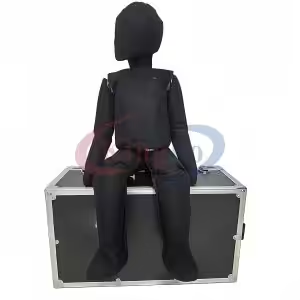
UL 3300 Standard 14.5 kg Child’s Body 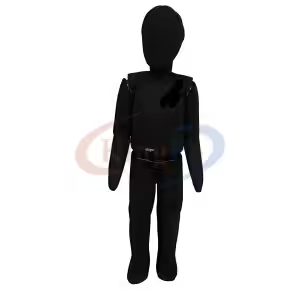
UL 3300 Standard 14.5 kg Child’s Body 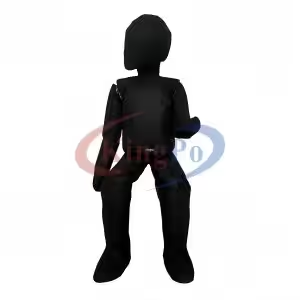
UL 3300 Standard 14.5 kg Child’s Body
These images illustrate typical child targets in crawling/lying postures (for avoidance testing) and instrumented setups with sensors for collision force evaluation.
Required Test Equipment List – Focus on Dummies and Related Systems
The following table summarizes the key dummy-related test equipment for full UL 3300 compliance testing, including suppliers/examples and purpose.
| Category | Equipment / Dummy Type | Key Specifications | Purpose in UL 3300 |
| Obstacle Avoidance Target | UL 3300 Child Target (Option 1) | Height: 998 mm, Weight: 14.5 kg; Multi-posture (stand/sit/lie/crawl) | Validate sensor detection & avoidance for child-sized vulnerable persons |
| Obstacle Avoidance Target | UL 3300 Child Target (Option 2) | Height: 831 mm, Weight: 9.4 kg; Multi-posture | Same as above, for younger child simulation |
| Obstacle Avoidance Target | Adult / Wheelchair Target | Height: 1500–1800 mm; Movable base | Public space / disabled user avoidance testing |
| Collision / Force Dummy | Instrumented Child Anthropomorphic Dummy | Child size (3–6 years); Force/torque sensors, accelerometers | Measure pinch/collision forces on vulnerable children; Ensure < safe thresholds |
| Collision / Force Dummy | Instrumented Adult Dummy | Adult size; Multi-axis sensors | General contact force validation (pinch points, squeezing) |
| Dynamic Test Platform | Movable Dummy Track / Platform | Programmable motion for targets/dummies | Simulate random human movement in avoidance & collision scenarios |
| Data Acquisition System | Force/Torque & Acceleration Logging | Sync with robot logs; High-speed sampling | Record & analyze contact data for compliance reports |
Implementation Recommendations
- Start with affordable child targets for avoidance certification (most common failure point for consumer/service robots).
- For force-intensive tests (e.g., arm/joint pinching), partner with UL Solutions labs (e.g., Uiwang, Korea) that provide validated instrumented dummies.
- Integrate with motion capture (e.g., Vicon) and dynamic platforms to recreate real-world scenarios like sudden child entry or elderly slow approach.
- Benefits: Comprehensive dummy testing accelerates UL 3300 certification, supports OSHA NRTL compliance (since Dec 2025 inclusion), and builds trust for deployment in homes, schools, hotels, and public spaces.