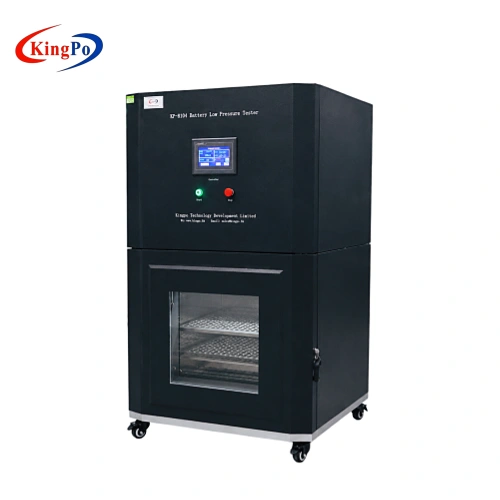
Interior of Battery Low Pressure Test Chamber showing stainless steel construction โ€“ KingPo
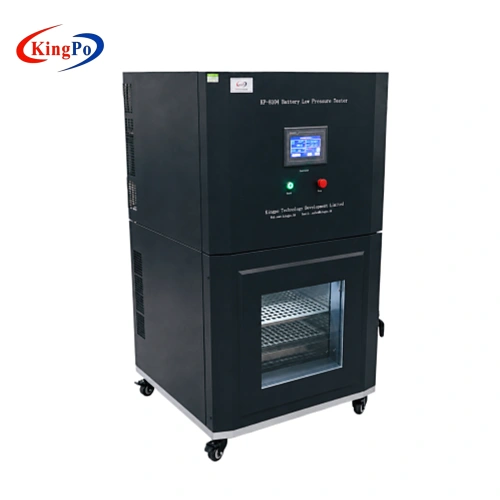
UN38.3 Battery Low Pressure Test Chamber for high-altitude simulation testing โ€“ KingPo
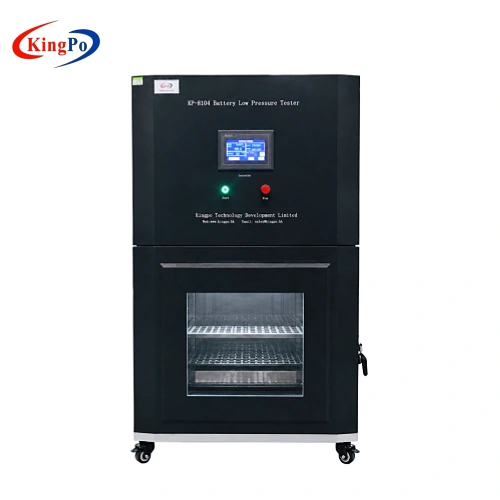
Battery sample placed inside Low Pressure Test Chamber for altitude simulation โ€“ KingPo
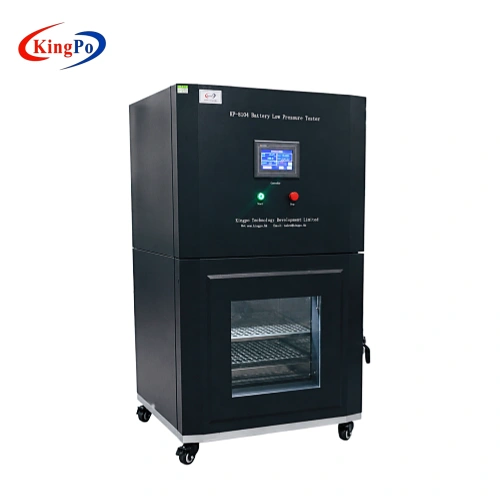
UN38.3 Battery Altitude Simulation Chamber with precise vacuum control โ€“ KingPo
Interior of Battery Low Pressure Test Chamber showing stainless steel construction โ€“ KingPo
UN38.3 Battery Low Pressure Test Chamber for high-altitude simulation testing โ€“ KingPo
Battery sample placed inside Low Pressure Test Chamber for altitude simulation โ€“ KingPo
UN38.3 Battery Altitude Simulation Chamber with precise vacuum control โ€“ KingPo

Battery Low Pressure Test Chamber | UN38.3 & IEC 62133 Altitude Simulation

The Battery Low Pressure Test Chamber simulates high-altitude low-pressure conditions for UN38.3 and IEC 62133 battery safety testing, supporting reliable evaluation for manufacturers and laboratories.

  • Standards Support: Designed to support UN38.3 altitude simulation testing, IEC 62133 Clause 7.3.7, UL 1642, and related battery low-pressure test requirements
  • Test Conditions: Supports low-pressure testing at 11.6 kPa absolute pressure for 6 hours with voltage monitoring
  • Pressure Range: 0.5 kPa โ€“ 100 kPa, suitable for high-altitude simulation
  • Chamber Construction: Stainless steel inner chamber with protective Teflon lining for corrosion resistance and easy cleaning
  • Control System: Automatic vacuum control with LED timer for precise test duration management
  • Safety Features: Pre-overpressure protection, pressure relief valve, and automatic fault alerts
  • Monitoring Capability: Real-time battery voltage monitoring during testing
  • Customization: Chamber size and configuration can be tailored to specific test requirements
  • MOQ: 1 set
  • Delivery Time: 30 working days

Battery Low Pressure Test Chamber Description

IEC62133 Clause 7.3.7 Lithium Battery Low Pressure Chamber To Simulate High Altitude Testing

Battery low-pressure testing is an important safety evaluation used to assess lithium battery performance under reduced atmospheric pressure conditions, such as those encountered during air transport or high-altitude storage. Depending on the applicable standard and battery type, the test helps verify whether the battery remains safe without fire, explosion, leakage, venting, rupture, or other abnormal behavior under low-pressure conditions.

This Low Pressure Test Chamber provides controlled force application, accurate measurement, and robust safety protection. It is suitable for battery manufacturers and testing laboratories conducting mechanical abuse evaluation during product development, quality verification, and certification processes. It helps reduce operator risk during hazardous battery testing while providing reliable data for product validation and compliance preparation.

Technical Parameters

Parameter Specification Remark / Notes
Applicable Standards UN38.3, IEC 62133 Clause 7.3.7 Low pressure (altitude simulation) test
Test Pressure 11.6 kPa absolute pressure Standard condition for 6 hours
Pressure Range 0.5 kPa โ€“ 100 kPa Covers high-altitude simulation
Test Duration 6 hours Automatically controlled
Internal Dimensions W300 ร— H300 ร— D300 mm Standard configuration
Internal Material Stainless steel inner chamber with protective Teflon lining Corrosion and fire resistant
Control System Automatic vacuum control with LED timer Precise and easy operation
Monitoring Real-time battery voltage monitoring Helps detect abnormal conditions
Safety Features Pressure relief valve, pre-overpressure protection, fault alerts Enhanced safety during testing
Power Supply AC 380V, 50Hz, 2.2kW Standard industrial power supply


Professional Construction & Technical Precision

The Battery Low Pressure Test Chamber is constructed with a stainless steel inner chamber and protective Teflon lining to provide durability, corrosion resistance, and ease of cleaning during battery testing. This material combination helps maintain chamber integrity even when testing batteries that may vent or release gases under low-pressure conditions.

The vacuum system is designed for stable and precise pressure control across a wide range, while the automatic timing and control functions ensure consistent and repeatable test execution. Multiple safety mechanisms, including pressure relief and interlock systems, are integrated to manage risks associated with battery testing under reduced atmospheric pressure.

Testing Principle

Low-pressure testing evaluates the safety performance of lithium batteries when exposed to reduced atmospheric pressure, simulating conditions encountered during air transport or high-altitude storage. The test assesses whether the battery can maintain structural and electrical integrity without experiencing leakage, venting, fire, explosion, or other abnormal behavior.

During the test, the chamber reduces internal pressure to the specified level (typically 11.6 kPa absolute pressure) and maintains this condition for the required duration while continuously monitoring battery voltage. The precise vacuum control and real-time monitoring capabilities of the chamber help detect any abnormal behavior early, supporting accurate safety evaluation in accordance with applicable standards such as UN38.3 and IEC 62133.

Common Error Mitigation

To achieve accurate and reliable low-pressure test results, the following practices are recommended:

  • Confirm the correct test pressure (11.6 kPa absolute) and duration according to the applicable standard version.
  • Properly connect battery samples for voltage monitoring before starting the test.
  • Ensure the chamber achieves and maintains stable vacuum throughout the test.
  • Monitor voltage continuously and record any significant changes.
  • Verify chamber sealing and vacuum pump condition before each test.
  • Follow all safety protocols when testing batteries that may vent or fail under low pressure.
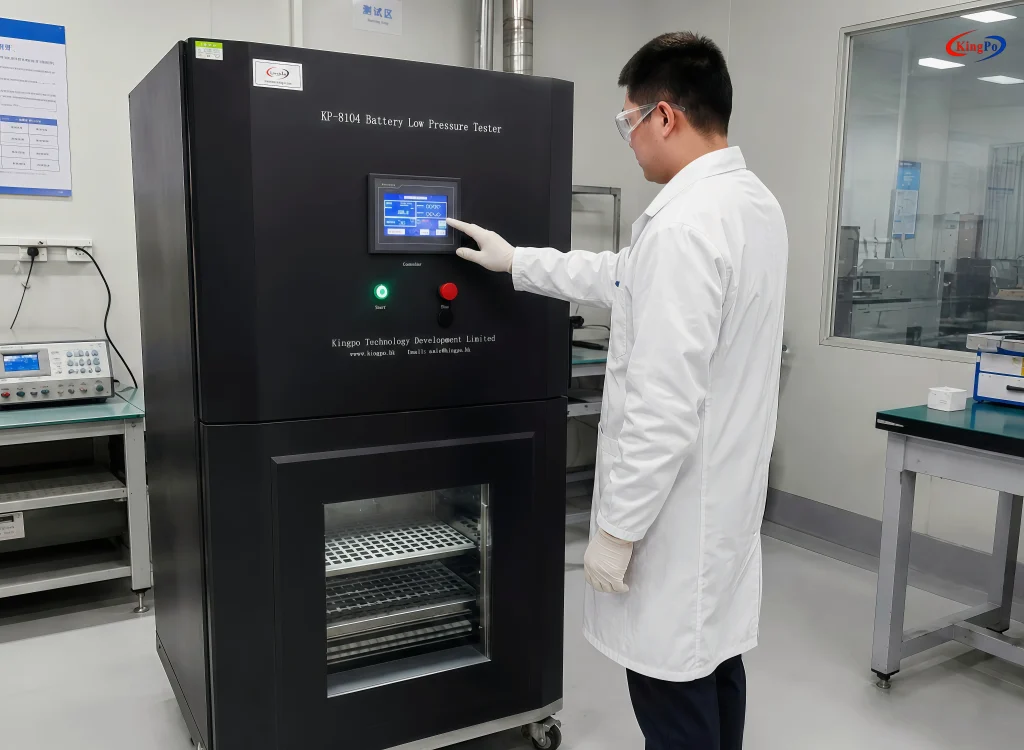
Chinese male laboratory technician operating IEC62133 Clause 7.3.7 lithium battery low pressure chamber for high altitude simulation testing
IEC62133 Clause 7.3.7 lithium battery low pressure chamber for high altitude simulation testing
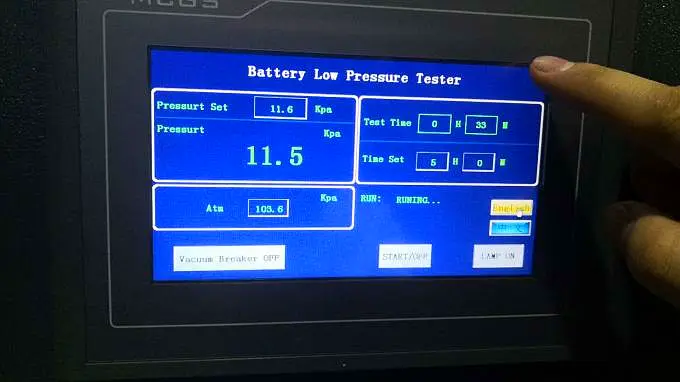
  • Control panel of UN38.3 Battery Low Pressure Test Chamber with monitoring functions โ€“ KingPo
    Control panel of UN38.3 Battery Low Pressure Test Chamber with monitoring functions

Primary Use Cases & Business Value

This Low Pressure Test Chamber enables manufacturers and testing laboratories to perform standardized altitude simulation testing for lithium batteries. It supports compliance evaluation for transportation safety requirements and helps reduce risks associated with air transport of battery products.

Industrial Applications & Lab Scenarios

  • Lithium battery manufacturers โ€” Altitude simulation testing for cells and battery packs
  • Testing laboratories โ€” IEC 62133 and UN38.3 compliance testing services
  • Transportation and logistics companies โ€” Battery safety verification for air transport
  • Certification bodies โ€” Low-pressure test execution and evaluation
  • Research institutions โ€” Battery performance studies under simulated high-altitude conditions

Strategic Procurement Advantages & Global Support

  • Designed to support UN38.3 and IEC 62133 low-pressure testing
  • Precise vacuum control and real-time voltage monitoring
  • Robust safety features suitable for battery testing
  • Compact chamber design with vacuum pump configuration available according to test requirements
  • Technical support available for test setup and standard interpretation
Compliance & Regulatory Assurance

This chamber is designed to support low-pressure testing requirements specified in UN38.3 and IEC 62133 Clause 7.3.7. It helps manufacturers and laboratories conduct standardized altitude simulation tests for lithium battery safety evaluation.

Metrological Integrity & Validation

  • Factory inspection and functional verification are provided.
  • Regular verification of vacuum gauge accuracy and chamber sealing is recommended.
  • Third-party calibration of the pressure measurement system can be arranged upon request.

Download Product Documentation


Technical Inquiry & Expert Support

KingPo offers Low Pressure Test Chambers for UN38.3, IEC 62133, and related battery safety testing. Our engineering team can provide guidance on test configuration and chamber customization. For technical specifications or quotations, please contact us.

The Core Value We Deliver

  • Precise low-pressure simulation for UN38.3 and IEC 62133 altitude testing
  • Real-time voltage monitoring during high-altitude simulation
  • Enhanced safety design for battery testing
  • Compact chamber design with flexible vacuum pump configuration
  • Professional technical support for compliance testing needs

Battery Low Pressure Test Chamber Detail Display

Battery Low Pressure Test Chamber FAQs

What is UN38.3 low pressure testing for batteries?
UN38.3 low pressure testing evaluates lithium battery safety under reduced atmospheric pressure conditions, simulating high-altitude environments. It verifies that batteries do not experience leakage, venting, fire, or explosion during air transport or high-altitude storage.
What does the Battery Low Pressure Test Chamber test?
This chamber simulates high-altitude low-pressure conditions to assess lithium battery safety performance. It is primarily used to conduct altitude simulation testing in accordance with UN38.3 and IEC 62133 Clause 7.3.7 requirements.
What pressure and duration are used in this low pressure test?
The chamber typically reduces internal pressure to 11.6 kPa absolute pressure and maintains this condition for 6 hours while monitoring battery voltage, in line with standard low-pressure test procedures.
Which types of batteries is this test chamber suitable for?
It is suitable for testing lithium-ion cells, battery packs, and other lithium batteries that require low-pressure or altitude simulation testing for transportation safety and compliance purposes.
Why is low pressure testing important for lithium batteries?
Low pressure testing helps identify potential safety risks such as leakage or thermal events that may occur when batteries are transported by air or used in high-altitude environments, ensuring product safety and regulatory compliance.
What parameters are monitored during the low pressure test?
The chamber allows real-time monitoring of battery voltage throughout the test. This helps detect any abnormal behavior caused by the low-pressure environment during the 6-hour test period.
Can this chamber be used for standards other than UN38.3?
Yes. In addition to UN38.3, the chamber can support low-pressure testing requirements referenced in IEC 62133 Clause 7.3.7 and other related battery safety standards, depending on the specific test configuration.
Who typically uses Battery Low Pressure Test Chambers?
These chambers are commonly used by lithium battery manufacturers, testing laboratories, certification bodies, and companies involved in electric vehicles and energy storage systems for compliance and safety evaluation.
What safety features does this Low Pressure Test Chamber include?
The chamber is equipped with pressure relief valves, pre-overpressure protection, and automatic fault alerts to enhance safety during battery testing under low-pressure conditions.
How can accurate low pressure test results be ensured?
Accurate results require proper sample preparation, stable vacuum control, continuous voltage monitoring, and verification that the chamber maintains 11.6 kPa absolute pressure throughout the required test duration.

Related Products

Related News

Abstract / Technical Summary Our LV 124 K-12 thermal shock test chamber is a specialized ice water splash thermal shock […]

The Ultimate Guide to Desktop Temperature Humidity Chamber in 2026: Precision High-Low Cycling, Environmental Adaptability, and Reliability Verification โ€“ A […]

I see the glow wire test as a critical step in ensuring electrical product safety. When I use the glow […]

Ensure IEC 60601 compliance in 2026 with Defib-proof and Energy Reduction Tester for safer, faster medical device approval and reliable patient protection.
Environmental test chamber solutions boost product reliability by simulating real-world stress, identifying weaknesses, and ensuring consistent performance.
Glow Wire Tester checks if electronics resist fire, ensuring your devices meet safety standards and protect your home from electrical fire hazards.
Scroll to Top

Get A Free Quote Now !

Contact Form
If you have any questions, please do not hesitate to contact us.