Summary
IPX9 / IPX9K high-pressure, high-temperature water spray testing is widely used to verify the waterproof performance of electrical enclosures, automotive components, industrial equipment, outdoor electronics, connectors, sensors, battery-related components, and products exposed to high-pressure washdown environments.
Unlike ordinary rain, splash, or immersion testing, IPX9K testing evaluates whether a product enclosure can resist hot water, high pressure, short-distance spraying, and multi-angle water impact. In practice, many unstable or unreliable IPX9K test results are not caused by the product itself, but by incorrect test equipment configuration.
The two most commonly overlooked factors are:
- Non-standard or worn IPX9K spray nozzles
- Unstable water temperature at or near the nozzle outlet
A reliable IPX9 / IPX9K test system must control nozzle geometry, nozzle surface quality, water temperature, pressure, flow rate, spray distance, spray angle, test duration, and data recording as a complete system. IEC explains that IP ratings are used to classify the resistance of enclosures of electrical and electronic devices against dust and liquid intrusion, while ISO 20653 applies IP code protection requirements to electrical equipment enclosures in road vehicles.
1. What Is the Purpose of IPX9K Waterproof Testing?
The purpose of IPX9K waterproof testing is to verify whether an enclosure, sealing structure, gasket, connector, cable entry, cover plate, housing joint, or protective shell can prevent harmful water ingress under severe high-pressure and high-temperature spray conditions.
Typical application areas include:
- Automotive electrical components
- Vehicle sensors and connectors
- Battery packs and battery-related housings
- Outdoor electrical enclosures
- Industrial control boxes
- Machinery exposed to high-pressure cleaning
- Food-processing or washdown-area equipment
- Construction machinery and agricultural equipment
IPX9K testing is not simply a stronger version of ordinary water spray testing. The combination of hot water, pressure, flow rate, spray distance, and spray angle can expose weaknesses that may not appear during lower-level waterproof tests.
High temperature may influence material expansion, gasket compression, seal hardness, plastic deformation, and adhesive performance. High pressure increases the penetration force of water. Multi-angle spraying helps reveal structural weak points around joints, covers, vents, buttons, and cable entries.
Therefore, the reliability of the test equipment directly affects the credibility of the final test result.
2. IPX9, IPX9K and IP69K: Correct Technical Wording
In product pages and international SEO content, the terms IPX9, IPX9K, and IP69K are often used together. However, for technical accuracy, they should not be treated as exactly the same term.
IPX9
IPX9 is commonly associated with IEC 60529 high-pressure, high-temperature water jet testing. Public testing-laboratory guidance describes IPX9 as a close-range high-pressure and high-temperature spray-down test, using a specific nozzle, 14–16 L/min water volume, 8–10 MPa pressure, and 80°C water temperature.
IPX9K
IPX9K is more commonly used in automotive and road-vehicle applications. ISO 20653 is the relevant standard for degrees of protection provided by enclosures of electrical equipment on road vehicles, and ISO confirms that ISO 20653:2013 has been withdrawn and revised by ISO 20653:2023.
IP69K
IP69K is a full IP rating. In this expression:
- 6 refers to dust-tight protection.
- 9K refers to protection against high-pressure, high-temperature washdown conditions.
Therefore, IP69K is not only a water test. It also includes a dust protection rating.
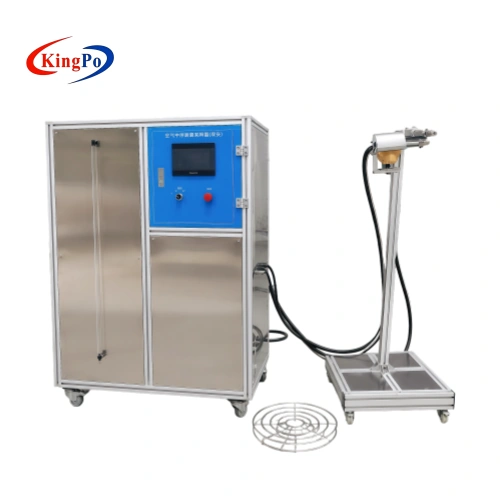
KINGPO IPX9 / IPX9K High-Pressure and High-Temperature Water Spray Test Equipment, designed for enclosure protection testing according to IEC 60529, ISO 20653, and customer-specified test requirements.
KINGPO IPX9 / IPX9K High-Pressure and High-Temperature Water Spray Test Equipment, designed for enclosure protection testing according to IEC 60529, ISO 20653, and customer-specified test requirements.
This wording covers common search keywords while keeping the standard reference more accurate.
3. Key Parameters of IPX9 / IPX9K Testing
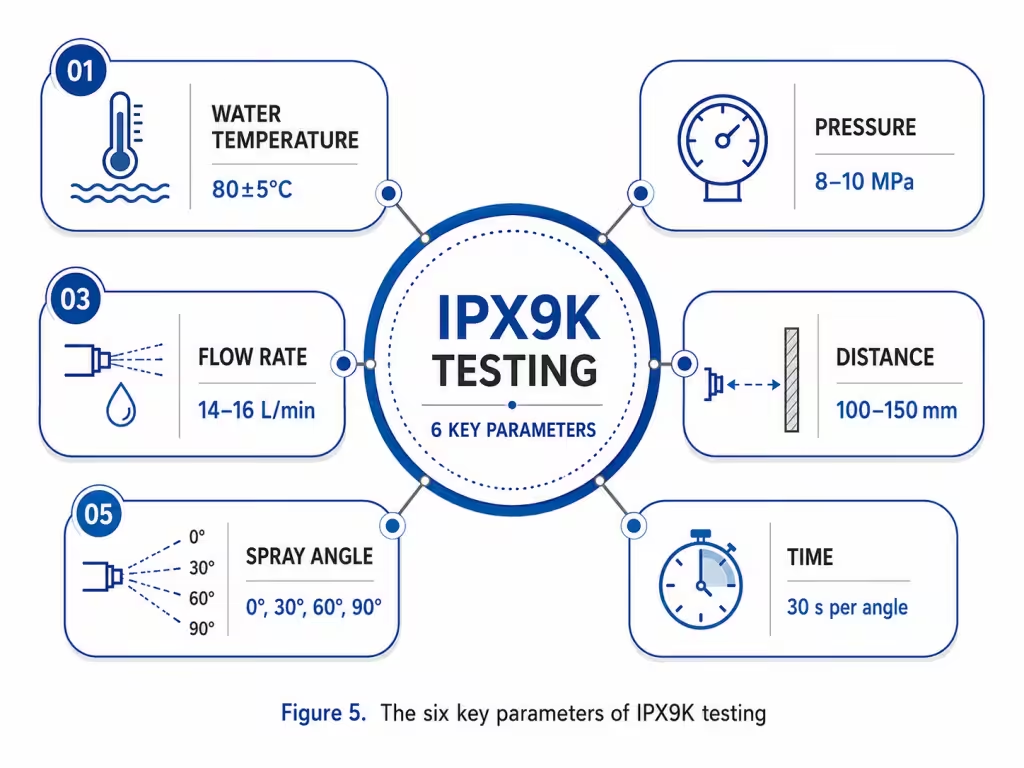
The following parameters are commonly associated with IPX9 high-pressure, high-temperature water jet testing:
| Parameter | Typical Requirement | Why It Matters |
|---|---|---|
| Water temperature | Around 80°C, commonly controlled at 80±5°C in equipment specifications | Affects thermal stress, gasket behavior, and sealing performance |
| Water pressure | 8–10 MPa / 80–100 bar | Determines spray impact and penetration potential |
| Water flow rate | 14–16 L/min | Determines the amount of water delivered to the test sample |
| Spray distance | Approximately 0.10–0.15 m | Affects actual impact force on the enclosure |
| Spray angles | 0°, 30°, 60°, 90° | Exposes sealing weaknesses from different directions |
| Test duration | Commonly 30 seconds per angle | Defines exposure time under each spray direction |
| Nozzle type | Specific fan-jet nozzle | Controls spray pattern and water distribution |
| Sample condition | Rotating turntable or fixed mounting depending on sample size | Affects spray coverage and test uniformity |
A testing laboratory reference for IEC 60529 IPX9 describes 30 seconds at each of four angles, 14–16 L/min water volume, 8–10 MPa pressure, 0.10–0.15 m distance, and 80°C water temperature.
4. Why the IPX9K Nozzle Is the Core of the Test System
Many buyers focus mainly on pump pressure, chamber size, touchscreen control, stainless steel construction, or external appearance. However, the nozzle is one of the most critical parts of the IPX9K test system.
The nozzle determines whether the water jet truly matches the required spray shape, distribution, and impact behavior.
A pressure gauge may show 8–10 MPa, and a flow meter may show 14–16 L/min, but if the nozzle geometry is incorrect, the actual spray pattern on the sample may still be invalid.
4.1 The IPX9K nozzle is not an ordinary high-pressure cleaning nozzle
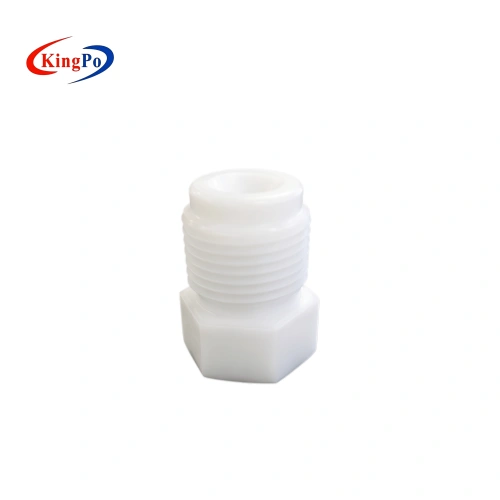
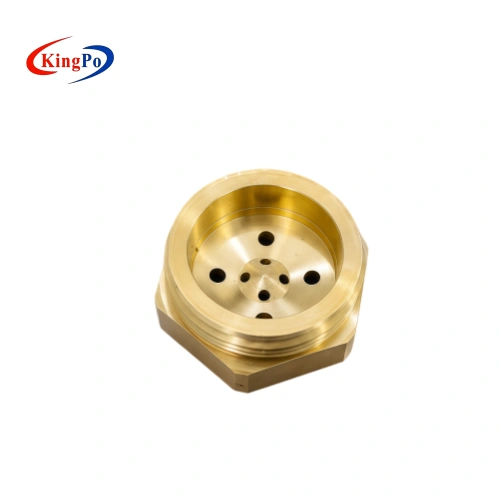
A compliant IPX9 / IPX9K nozzle is a precisely designed fan-jet nozzle. The referenced KINGPO article lists several critical nozzle dimensions, such as R0.75±0.01 mm, R1.5±0.005 mm, 8±0.01 mm, 9.69±0.01 mm, 3±0.01 mm, 2.34±0.06 mm, and 13.33±0.04 mm, and emphasizes that dimensional deviation may significantly affect waterproof test evaluation.
This means that a general-purpose industrial nozzle or pressure-washer nozzle should not be used as a substitute for a standard IPX9K test nozzle.
4.2 What can happen if the nozzle size is wrong?
Incorrect nozzle dimensions may cause:
- Incorrect fan angle
- Uneven water distribution
- Excessive local impact force
- Insufficient spray intensity
- False pass results
- False fail results
- Poor repeatability between tests
- Poor comparability between laboratories
- Difficulty explaining test data during audits or customer reviews
In other words, nozzle accuracy directly affects the repeatability, comparability, and credibility of the test.
5. Why Nozzle Surface Quality Also Matters
Correct dimensions alone are not enough. The nozzle outlet must also have good surface quality.
A nozzle may become unreliable if it has:
- Burrs
- Scratches
- Deformation
- Corrosion
- Partial blockage
- Irregular outlet edges
- Rough internal flow surfaces
- Wear caused by long-term high-pressure operation
The referenced article highlights the importance of a smooth, burr-free nozzle outlet and stainless steel construction, explaining that nozzle surface smoothness and material quality affect water spray uniformity and long-term test stability.
Possible effects of poor nozzle surface quality
A damaged or poorly machined nozzle may cause:
- Incomplete fan-shaped spray
- Irregular water distribution
- Local spray concentration
- Abnormal splashing
- Offset spray direction
- Unstable test severity
These problems are not always visible from the pressure gauge. A normal pressure reading does not prove that the spray pattern is correct.
For professional laboratories, nozzle inspection should include:
- Visual inspection
- Dimensional verification
- Spray pattern confirmation
- Cleaning and blockage inspection
- Periodic replacement when wear is observed
- Third-party calibration where required by the quality system
6. Water Temperature Control: Why Tank Temperature Is Not Enough
Water temperature is another critical factor in IPX9K testing. The test is intended to expose the product to hot water under high pressure. If the actual water temperature at the spray outlet is too low, the test condition may become weaker than intended.
A common mistake is measuring only the water tank temperature. The control panel may show that the tank has reached 80°C, but the water still needs to pass through:
- Pipes
- Pump
- Valves
- Filters
- High-pressure hose
- Nozzle connector
- Spray nozzle
During this transfer process, heat loss can occur. As a result, the actual water temperature near the nozzle outlet may be lower than the displayed tank temperature.
The original KINGPO article specifically warns that temperature loss in the pipeline and testing before water temperature stabilization can lead to unreliable results.
Recommended temperature control design
A professional IPX9K test system should include:
- Hot water tank heating
The tank must heat the water to the required test temperature. - Water circulation loop
Hot water should circulate before testing to reduce temperature loss in cold pipes. - PID temperature control
PID control helps reduce temperature overshoot and fluctuation. - Temperature monitoring near the nozzle
Measurement should be as close as practical to the actual spray outlet. - Insulated piping
Insulation reduces heat loss between the tank and nozzle. - Temperature recording during the test
The report should record actual test temperature, not only the set value.
7. Pressure and Flow Rate Must Be Controlled Together
A common question is:
“If my equipment reaches 10 MPa, does it meet IPX9K test requirements?”
The answer is: not necessarily.
Pressure alone is not enough. IPX9 / IPX9K testing requires the combined control of pressure, flow rate, nozzle geometry, spray distance, spray angle, water temperature, and test duration.
Common misconceptions
Misconception 1: Higher pressure is always better
Incorrect. IPX9K is a standardized test, not a destructive pressure challenge. Excessive pressure may make the test too severe and cause false failures.
Misconception 2: Higher flow rate is always better
Incorrect. Excessive flow can change spray behavior and test severity, making results less comparable with standard test conditions.
Misconception 3: A pressure washer can replace an IPX9K test chamber
Incorrect. A general pressure washer usually lacks a standard fan-jet nozzle, stable hot-water control, accurate flow monitoring, spray-angle control, sample turntable, and traceable test records.
Misconception 4: Tank temperature equals nozzle temperature
Incorrect. Heat loss may occur in the pipe, pump, valve, and nozzle system. The temperature near the spray outlet is more relevant to the actual test condition.
8. Spray Distance and Spray Angle Affect Test Severity
Spray distance and spray angle are not minor details. They directly affect the water impact on the enclosure.
If the nozzle is too close to the sample, the impact may be too severe. If the nozzle is too far away, the water jet may lose energy before reaching the enclosure.
The four common spray angles — 0°, 30°, 60°, and 90° — are used to expose different sealing weak points. Different angles may reveal leakage paths around covers, buttons, cable entries, ventilation structures, connectors, and housing joints.
A reliable test system should provide:
- Adjustable nozzle-to-sample distance
- Clear distance reference
- Accurate angle positioning
- Stable nozzle support
- Smooth turntable operation
- Sample fixtures that do not block critical water exposure areas
- Test configuration suitable for different product sizes
For large samples that cannot be placed on a turntable, the test method should be determined according to the applicable standard and customer test specification.
9. What Should a Professional IPX9K Test System Include?
A complete IPX9K waterproof test system should not be just a hot water tank plus a high-pressure pump. It should be designed as a controlled and traceable test platform.
9.1 Standard fan-jet nozzle system
The nozzle system should include:
- Standard-compliant fan-jet nozzle geometry
- Stainless steel or other suitable high-temperature, high-pressure material
- Smooth and burr-free outlet
- Stable spray shape
- Dimensional verification or calibration support
- Easy cleaning and replacement
9.2 High-pressure water supply system
The pressure system should include:
- 8–10 MPa working pressure capability
- Pressure stability during spraying
- High-temperature and high-pressure resistant piping
- Pressure sensor or pressure gauge
- Over-pressure protection
- Safe pressure release design
9.3 Flow control system
The flow system should include:
- 14–16 L/min test flow capability
- Real-time flow display
- Flow adjustment
- Flow calibration support
- Stable flow during continuous spraying
9.4 Hot water temperature control system
The temperature system should include:
- Water tank heating
- PID temperature control
- Water circulation loop
- Over-temperature protection
- Nozzle-side temperature confirmation
- Temperature recording during the test
9.5 Multi-angle spray mechanism
The spray mechanism should include:
- 0°, 30°, 60°, and 90° spray positions
- Stable angle positioning
- Rigid nozzle support
- Adjustable spray distance
- Repeatable alignment
9.6 Turntable and sample fixture
The sample system should include:
- Stable turntable speed
- Sufficient load capacity
- Adjustable sample mounting
- Fixture design that does not shield critical areas
- Compatibility with different sample sizes
9.7 Data recording and test report output
A reliable report should record:
- Test date
- Sample model
- Applicable standard
- Sample installation method
- Nozzle ID
- Nozzle calibration status
- Actual water temperature
- Actual pressure
- Actual flow rate
- Spray distance
- Spray angle
- Test time at each angle
- Turntable speed, if applicable
- Post-test inspection result
- Water ingress observation
- Abnormal conditions during testing
This documentation improves traceability and helps with customer audits, internal quality control, laboratory accreditation, and failure analysis.
10. KINGPO IPX9K Waterproof Test Equipment Solution
KINGPO IPX9 / IPX9K waterproof test equipment is designed to improve test repeatability and reduce uncertainty by controlling the key variables that affect high-pressure hot-water spray testing.
10.1 Standardized nozzle design
KINGPO uses fan-jet nozzle designs intended for IPX9 / IPX9K testing. The equipment focuses on nozzle dimensions, outlet shape, and spray stability to avoid the test deviation caused by general-purpose high-pressure nozzles.
10.2 Stainless steel nozzle construction
The nozzle is made from high-quality stainless steel to withstand long-term use under high-temperature and high-pressure conditions. The original KINGPO page states that the nozzle material and smooth, burr-free surface help maintain stable spray performance under high temperature and pressure.
10.3 Smooth and burr-free spray outlet
A smooth nozzle outlet helps maintain a stable fan-shaped spray pattern and reduces abnormal turbulence, splashing, or uneven water distribution.
10.4 Hot water circulation and PID control
KINGPO equipment uses water circulation and PID temperature control to help maintain water temperature stability during testing. The referenced page states that KINGPO equipment uses a circulation system and PID control to keep test water stable and reduce pipeline temperature loss.
10.5 Real-time pressure and flow control
The system supports pressure and flow monitoring, helping operators confirm whether the test process remains within the required range.
10.6 Multi-angle spray testing
The equipment supports spray testing at 0°, 30°, 60°, and 90°, allowing the sample to be exposed from multiple directions.
10.7 Calibration and technical documentation support
KINGPO can support nozzle dimensional verification, calibration documentation, operation guidance, and test solution recommendations according to customer requirements.
11. IPX9K Test Preparation Checklist
Before starting an IPX9K waterproof test, operators should confirm the following items:
| Check Item | What to Confirm |
|---|---|
| Applicable standard | Confirm IEC 60529, ISO 20653, or customer-specified requirements |
| Nozzle condition | No blockage, burrs, deformation, or visible wear |
| Nozzle dimension | Verified against the required drawing or calibration document |
| Water temperature | Actual test water temperature is within the required range |
| Temperature location | Temperature is monitored close enough to the nozzle side |
| Pressure | Spray pressure is stable within the required range |
| Flow rate | Flow rate is stable at 14–16 L/min where applicable |
| Spray distance | Nozzle-to-sample distance is correctly set |
| Spray angle | 0°, 30°, 60°, and 90° positions are correctly aligned |
| Sample mounting | Sample is firmly fixed and critical areas are not blocked |
| Turntable | Rotation is stable and suitable for the sample |
| Data recording | Temperature, pressure, flow, angle, and time can be recorded |
| Safety protection | Hot water, high pressure, anti-scald, and hose safety measures are in place |
12. Common IPX9K Testing Problems and Recommended Solutions
| Problem | Possible Cause | Risk | Recommended Solution |
|---|---|---|---|
| Test result is inconsistent | Nozzle wear or pressure fluctuation | Poor repeatability | Inspect nozzle, verify pressure and flow stability |
| Sample passes in one lab but fails in another | Different nozzle geometry or spray distance | Poor comparability | Use calibrated nozzles and standardized setup |
| Water temperature drops during spraying | Long pipe, poor insulation, no circulation | Test severity becomes too low | Use circulation loop and nozzle-side temperature check |
| Spray pattern looks uneven | Burrs, blockage, rough nozzle outlet | Local over-testing or under-testing | Clean or replace nozzle |
| Pressure is correct but test still questionable | Flow rate or nozzle geometry is wrong | Invalid test condition | Check pressure, flow, and nozzle together |
| Report lacks credibility | No actual data recording | Audit difficulty | Record measured temperature, pressure, flow, distance, angle, and time |
13. FAQ
1. Is 10 MPa pressure enough for IPX9K testing?
No. Pressure is only one parameter. A reliable IPX9 / IPX9K test also requires the correct nozzle, flow rate, water temperature, spray distance, spray angle, and test duration.
2. Can a normal pressure washer replace an IPX9K test chamber?
No. A normal pressure washer usually cannot provide standard nozzle geometry, stable 80°C hot-water control, accurate flow monitoring, angle positioning, sample rotation, or traceable test records.
3. If the water tank is 80°C, does that mean the test water is correct?
Not always. The water may lose heat through pipes, pumps, valves, and hoses. The temperature near the nozzle outlet is more representative of the actual water temperature applied to the sample.
4. Why does the nozzle need calibration?
Nozzles can wear, deform, corrode, or become partially blocked after long-term high-pressure use. Dimensional change or surface damage can affect spray shape, flow distribution, and impact force.
5. Does passing IPX9K mean the product can be immersed in water for a long time?
No. IPX9K evaluates resistance to high-pressure and high-temperature water spray. Long-term immersion should be evaluated using other waterproof test levels, such as IPX7 or IPX8, depending on the product requirement.
6. What is the difference between IPX9K and IP69K?
IPX9K refers to the water protection part only, while IP69K is a complete rating that includes dust-tight protection and high-pressure, high-temperature water protection.
14. Conclusion
The reliability of an IPX9K waterproof test depends on the whole test system, not only on the high-pressure pump. Nozzle geometry, nozzle surface finish, water temperature stability, pressure, flow rate, spray distance, spray angle, test duration, and data recording all influence the final result.
If the nozzle is not standard, or if water temperature is only controlled in the tank but not stable near the nozzle, the test may produce unreliable results. This can lead to false pass results, false fail results, inconsistent laboratory data, and weak customer confidence.
For manufacturers, testing laboratories, and quality control departments, choosing a standardized, calibrated, and traceable IPX9 / IPX9K waterproof test system is essential for accurate product validation.
KINGPO provides IPX9 / IPX9K high-pressure and high-temperature water spray test equipment with standard nozzle design, hot water circulation, PID temperature control, stable pressure and flow control, multi-angle spraying, and calibration support to help customers build a more reliable waterproof testing process.