As service robots (Service Robots) are increasingly deployed in commercial, public, and healthcare environments, human-robot interaction safety, mobility-related hazards, and application-specific risks (such as UVC disinfection) have become critical concerns for regulators and the industry. Underwriters Laboratories (UL) has established two foundational standards: ANSI/CAN/UL 3300 (Service, Communication, Information, Education and Entertainment Robots — SCIEE Robots) and UL 60335-2-2019 (Outline of Investigation for Robotic Germicidal Equipment). Together, they form the primary compliance framework for service robots.
ANSI/CAN/UL 3300 (Edition 1, published May 14, 2024; revised April 16, 2025; ANSI/SCC approved April 16, 2025) was formally added to the OSHA NRTL Program’s List of Appropriate Test Standards on December 31, 2025. UL 60335-2-2019 (Edition 2, published March 21, 2022) addresses rechargeable, automated mobile robotic germicidal equipment, primarily UVC disinfection robots.
This article provides a detailed technical breakdown of scope, key clauses, test requirements, and underlying engineering principles.
1. ANSI/CAN/UL 3300: General Safety Standard for SCIEE Robots
Scope The standard applies to service robots, communication/information robots, education/entertainment robots, companion robots, delivery robots, mobile service robots, passenger-carrying robots, household robots, physical-assistance robots, exoskeletons, security/guide robots, telepresence robots, restaurant/retail robots, and humanoid robots. It focuses on mechanical, electrical, and interaction risks in close-proximity human-robot coexistence scenarios.
Core Safety Requirements and Test Outline UL 3300 employs a risk-assessment-driven, graded protection approach organized into the following modules:
| Safety Module | Key Clauses and Test Points | Technical Rationale |
|---|---|---|
| Mobility | • Classification by mass and maximum speed (Class 1–3) • Multi-sensor fusion obstacle avoidance (LiDAR, vision, ultrasonic, tactile) • Emergency stop, post-collision force/torque limiting, kinetic-energy grading • Foreseeable misuse scenario validation | Based on kinetic energy E = ½mv². Class 1 limits speed to ≤ 0.5 m/s. Requires “fail-safe” design: sensor failure forces the robot into a safe state. |
| External Manipulation | • Contact-force limits for arms/end-effectors • Pinch/crush protection (force feedback, soft landing) • Operational-zone audible/visual warnings and path prediction | Aligns with ISO/TS 15066 collaborative-robot force limits. Prevents crushing or pinching injuries, especially to vulnerable populations (children, elderly). |
| Human-Robot Interaction | • Recognition of vulnerable persons and adaptive behavior • Path indication, audible/visual cues, proximity warnings • Indoor/outdoor environmental adaptability | Incorporates accessibility and inclusivity principles; the robot must proactively sense and adjust to users of varying abilities. |
| Fire & Electrical Hazards | • Battery systems per UL 2580 / UL 2271 / UL 62368-1 • On-the-move charging safety, vibration/drop resistance • Enclosure flammability, creepage distances, dielectric withstand | Mobile robots experience greater mechanical stress; standard mandates multi-layer overcharge/overheat/short-circuit protection and thermal-runaway propagation suppression. |
| Functional Safety & Software | • Sensor redundancy, fault diagnostics, SIL assessment • Remote software updates per UL 5500 • EMC and wireless communication safety | References IEC 61508 functional-safety framework to ensure single-fault tolerance. |
Key Innovation UL 3300 is the first standard to transform qualitative “human-robot interaction safety” into quantifiable, verifiable engineering requirements, going well beyond traditional appliance standards (e.g., UL 60335-1) and complementing ISO 13482 (personal care robots).
2. UL 60335-2-2019: Outline of Investigation for Robotic Germicidal Equipment (UVC Disinfection Robots)
Scope Covers rechargeable, automated mobile robotic germicidal equipment that uses UVC irradiation to treat air and surfaces in unoccupied areas (hospitals, hotels, airports, schools, etc.).
Core Safety Requirements and Test Points The standard uses a “whole-system + modular” evaluation model:
- Robotic Base Safety
- Mechanical/electrical safety references UL 60335-1 + UL 3300 (mobility, collision protection, battery safety).
- Even in “unoccupied” mode, full SCIEE human-interaction safeguards must be maintained to prevent accidental entry.
- UVC Radiation Safety
- Irradiance, dose, and uniformity testing.
- Multi-redundant sensors (door interlock, motion, IR, camera) enforce “confirmed unoccupied → activate lamps.”
- Fail-safe: sensor failure → immediate lamp shutdown.
- Exposure limits per ICNIRP, ANSI/IES RP-27, etc.
- Control & Ancillary Systems
- Controls per UL 60730.
- EMC per IEC 61000-4 series.
- Remote software updates per UL 5500.
- Ozone generation control (if applicable).
Engineering Rationale UVC robots face dual hazards: inherent mobility/collision risks (addressed by UL 3300) and irreversible biological damage from UVC (corneal inflammation, skin carcinogenesis). The standard mandates “sensor failure → immediate shutdown” fail-safe logic and pre-irradiation multi-sensor unoccupied confirmation, reducing accidental exposure to an engineering-acceptable level.
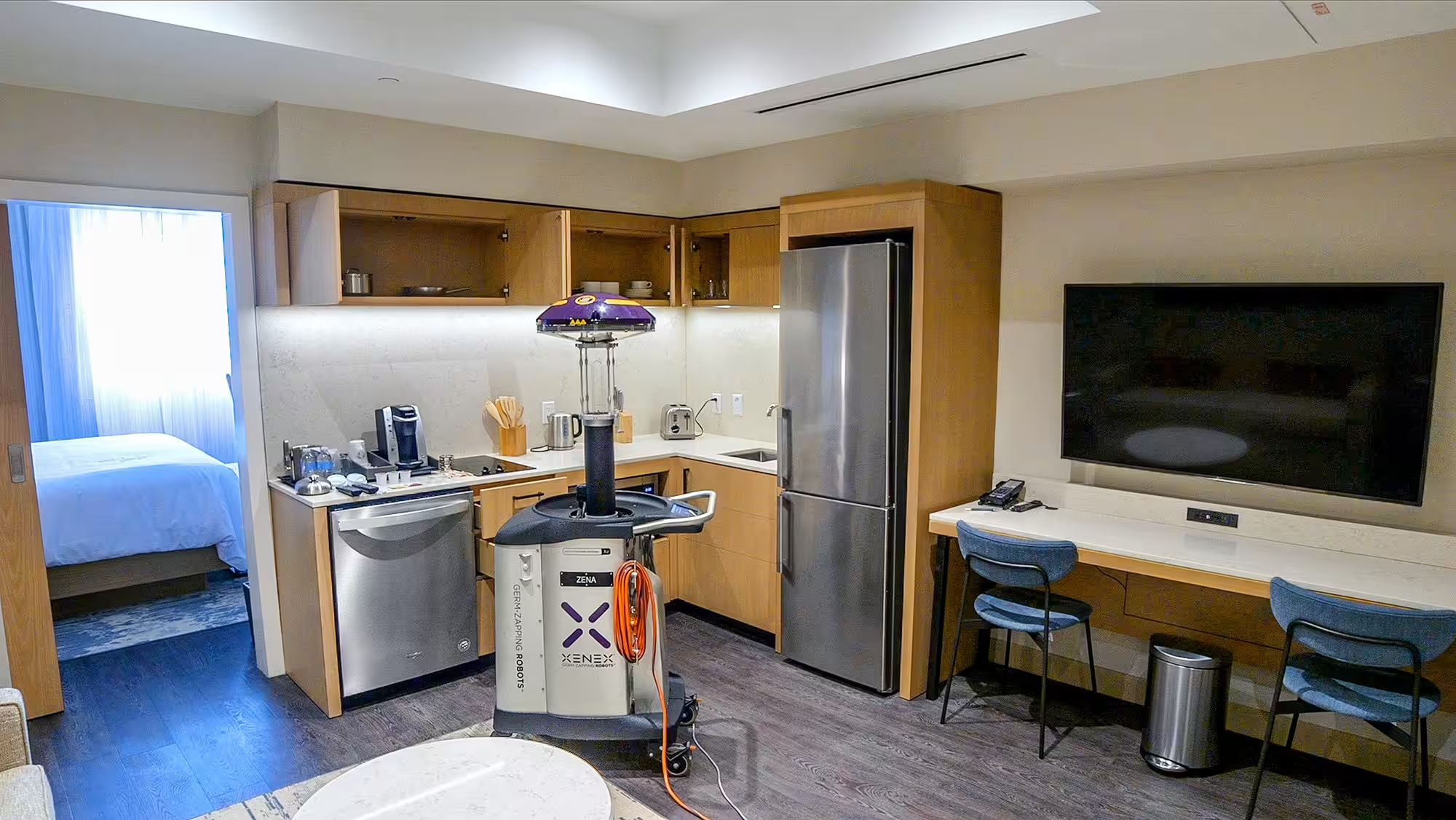
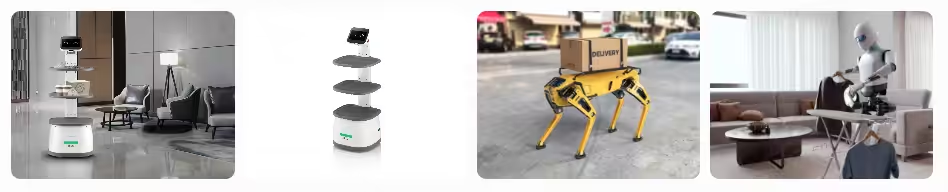
(Examples of UVC disinfection robots, including systems certified to UL 60335-2-2019.)
3. Interrelationship Between the Two Standards
- UL 60335-2-2019 explicitly references UL 3300 for the robotic base; therefore, a UVC disinfection robot certified to UL 60335-2-2019 automatically satisfies UL 3300 mobility and interaction requirements.
- General service robots (delivery, guidance, etc.) primarily follow UL 3300. Robots with UVC capability must meet both (or may be certified wholly under UL 60335-2-2019).
- Both standards support functional safety, EMC, software updates, and component-level certification, forming a closed-loop safety system.
4. Compliance Implementation Recommendations
- Perform Gap Analysis and risk assessment (ISO 12100) at the design stage.
- Conduct prototype testing: collision kinetic energy, force limits, UVC leakage, battery abuse.
- Implement factory inspection and Declaration of Conformity during production.
- Engage UL Solutions early; laboratories in China, Korea, and the United States offer one-stop pre-assessment, testing, and NRTL certification.
- Monitor future revisions of UL 3300 and OSHA NRTL guidance.
Conclusion
ANSI/CAN/UL 3300 and UL 60335-2-2019 together provide a comprehensive technical framework—from general mobility safety to specialized radiation safety—for service robots. Full compliance not only satisfies OSHA/NRTL requirements for commercial deployment but also substantially reduces incident risk, enhances product competitiveness, and builds brand trust. In the era of human-robot coexistence, safety standards are a core competitive advantage.
References
- ANSI/CAN/UL 3300:2024 (Edition 1, revised April 16, 2025), UL Standards & Engagement
- UL 60335-2-2019 (Edition 2, March 21, 2022), UL LLC Outline of Investigation
- OSHA Federal Register Notice (December 31, 2025)
- UL Solutions official pages (Consumer and Commercial Robots / UVC Disinfection Robots)