6-Axis Robotic Positioning
The collaborative robot provides ±0.02 mm repeatability. The complete system is specified for ±0.3 mm discharge positioning and ±0.5° rotational positioning.

A turnkey robotic platform for repeatable contact and air-discharge positioning, graphical test-point programming, DUT offset correction and controlled ESD test execution.
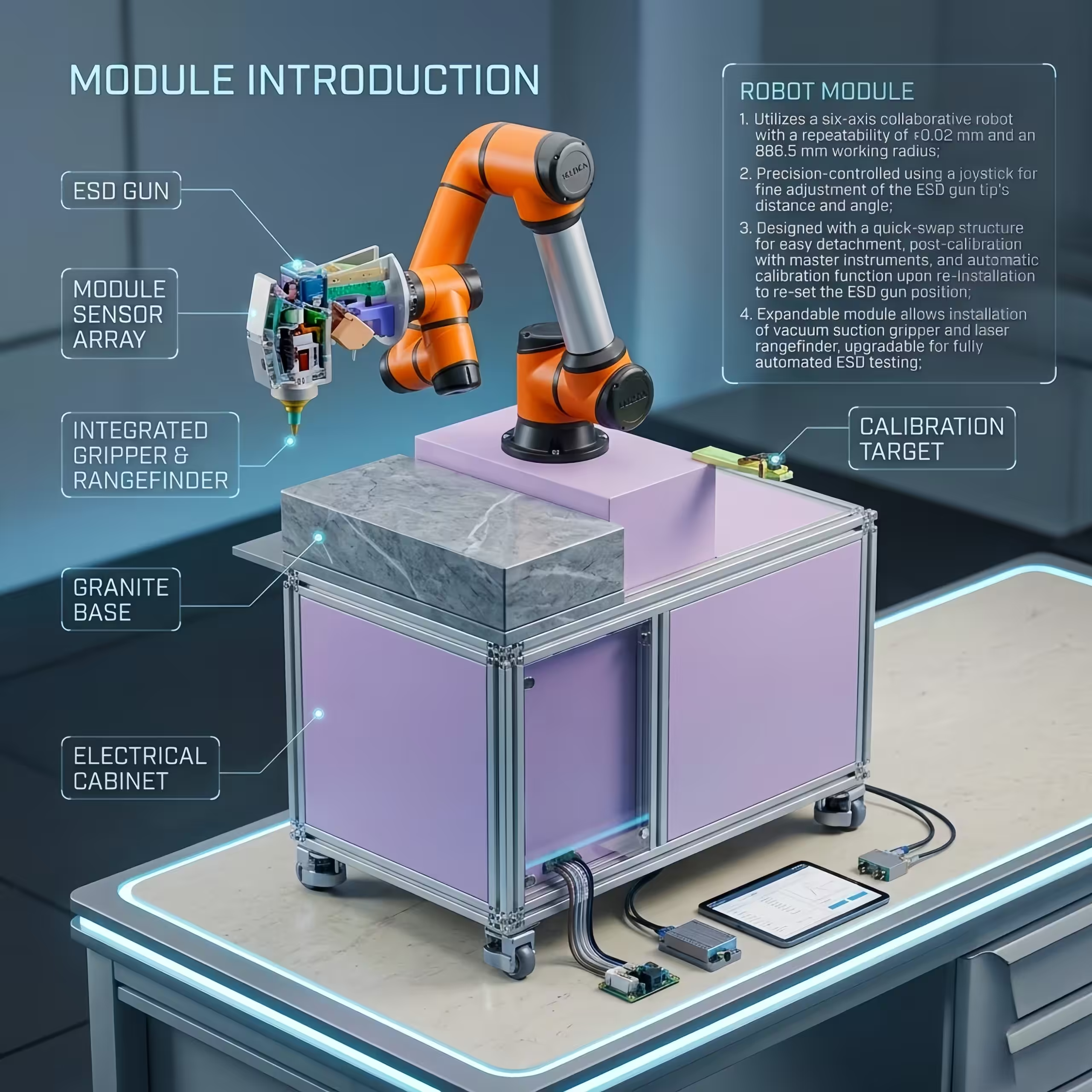
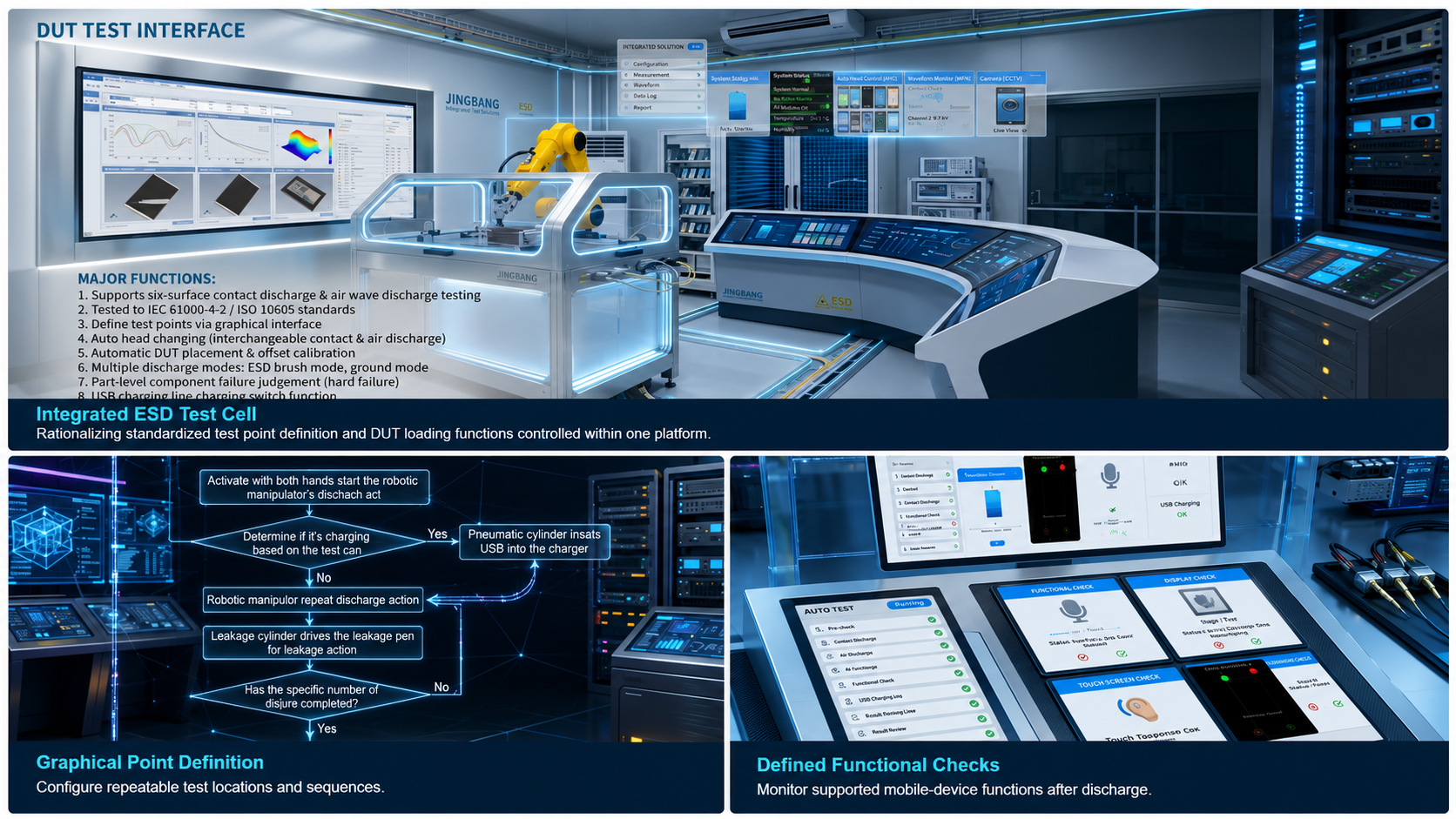
An automated ESD test system uses a programmable robot to position an ESD generator at defined points, angles and approach distances around a device under test. It improves repeatability and operator separation compared with fully manual gun positioning. This KINGPO configuration combines a 6-axis collaborative robot, ESD gun fixture, graphical test-point software, DUT offset correction, leakage and charging controls, safety monitoring and test-result handling. It is intended for controlled laboratory immunity testing—not semiconductor handling-sensitivity characterization.
Automation addresses one of the weakest parts of manual ESD testing: reproducing the same discharge location, approach direction and sequence across samples and operators. The platform standardizes motion and test execution while leaving the applicable test level, discharge count and performance criteria under the control of the relevant product standard and approved test plan.
The collaborative robot provides ±0.02 mm repeatability. The complete system is specified for ±0.3 mm discharge positioning and ±0.5° rotational positioning.
The system supports multiple DUT surfaces and precise distance control for air discharge, with automatic switching between configured contact and air-discharge tips.
Operators define discharge points through a graphical interface instead of repeatedly teaching every point through manual robot movement.
Automatic correction compensates for defined DUT placement offsets so the programmed discharge locations remain aligned with the test sample.
An automatic 470 kΩ leakage pen and controlled USB charging function support repeatable charge-removal and powered-DUT test sequences.
Dual-button initiation and through-beam light-curtain monitoring help prevent unintended robot movement when the protected test area is accessed.
A controlled automated sequence reduces operator-to-operator variation. The exact sequence must still be reviewed against the applicable standard, DUT operating mode and laboratory procedure.
Import or configure the DUT and specify discharge points, tip type, angle and sequence.
Place the DUT and apply the configured offset correction or position verification.
The robot moves the compatible ESD gun through the programmed test sequence.
Apply the configured leakage and charging actions between test stages where required.
Record results and evaluate DUT performance against the approved acceptance criteria.
| Robot configuration | 6-axis collaborative robot; maximum payload 5 kg |
|---|---|
| Robot repeatability | ±0.02 mm |
| Working radius | 886.5 mm |
| System discharge positioning | ±0.3 mm |
| Rotational positioning | ±0.5° |
| Electrical supply | AC 220 V ±10 V, 50 Hz; maximum 10 A |
| Compressed air | Greater than 0.5 MPa; 2 L/min |
| Test environment | 18–25 °C; 35–80% RH |
| Supported DUT examples | Mobile phones, tablets up to 10 inches, earphones and watches |
| Compatible ESD guns | Configured for industry ESD guns including Noiseken and Lingse models; exact model/interface must be confirmed |
| Control connection | Dedicated LAN connection between host computer and system control |
| Safety provisions | Dual-button start and through-beam light-curtain monitoring |
Basic EMC publication covering ESD immunity test levels, equipment, setup, procedure, calibration and measurement uncertainty for electrical and electronic equipment.
Official IEC publication →Road-vehicle ESD test methods. Applicability, severity and test configuration depend on the automotive component and approved test plan.
Official ISO catalogue →Chinese EMC testing and measurement standard addressing electrostatic discharge immunity test methods.
China standards platform →Compliance boundary: the system provides automation infrastructure for executing an ESD test plan. It does not by itself determine the correct severity level, number of discharges, DUT operating mode or pass/fail criterion. Those requirements come from the applicable product standard, vehicle/OEM specification or laboratory procedure.
Repeat testing around displays, buttons, ports, enclosures and conductive interfaces.
Defined post-discharge checks for supported display, touch, sensor and connectivity functions.
Programmable positioning for approved ISO 10605 or OEM-specific component test plans.
Improved repeatability, documented point sequences and safer separation from repetitive discharge work.
For a defensible procurement decision, request a configuration drawing, compatible-gun confirmation, positioning verification method, safety interlock description, sample test sequence, software scope, installation requirements and factory acceptance test plan. Calibration of the ESD generator remains a separate metrological requirement and should be confirmed for the supplied gun.
No. The robot positions and operates a compatible ESD generator. The ESD gun produces the discharge waveform and must be configured and calibrated for the applicable test standard.
Robot repeatability is specified as ±0.02 mm. Complete-system discharge positioning is specified as ±0.3 mm, with rotational positioning of ±0.5°. The system figure is the more relevant value when assessing test-point placement.
Yes. The platform supports configured contact and air-discharge operation, automatic tip switching and precise approach-distance control. Exact gun and tip compatibility must be confirmed before quotation.
No. Automated hard-failure checks are available for defined functions on supported mobile devices, such as display, touch, sensors and selected interfaces. Other DUTs may require external monitoring or operator evaluation against the approved performance criteria.
The system is designed to support IEC 61000-4-2 test execution, but compliance depends on the ESD generator, calibration, test setup, environment, test plan and correct procedure. The applicable product committee or product standard determines severity and performance criteria.
The current page data identifies mobile phones, earphones, watches and tablets up to 10 inches. Larger or unusually shaped DUTs require a workspace, payload, reach and fixture review.
The stated requirements are AC 220 V ±10 V, 50 Hz, maximum 10 A, plus compressed air greater than 0.5 MPa at 2 L/min. The recommended operating environment is 18–25 °C and 35–80% RH.
Send the DUT drawing, test standard and edition, discharge-point list, ESD gun model, required test modes, functional monitoring needs, cycle volume and site utilities. This allows KINGPO to confirm the correct robot, fixture, software and safety configuration.
